DNA Replication
By
Dr. V P Patil
BLDEA’s SSM COP & RC
VIJAYAPUR
DNA Replication: a synopsis
• Occurs in the S phase of the cell cycle
• Replication is semi conservative, with each DNA strand
serving as template for synthesis of the complementary
strand
• DNA synthesis occurs in replicons consisting of an origin of
replication and two diverging replication forks
(bidirectional)
• Each replication fork contains a complex of enzymes,
including DNA polymerase
– Other enzymes include primase, helicase,
topoisomerase
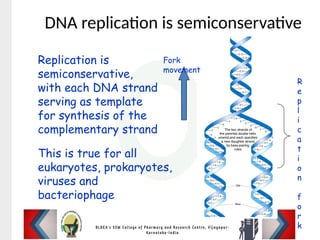
Replication is
semiconservative,
with each DNA strand
serving as template
for synthesis of the
complementary strand
Fork
movement
R
e
p
l
i
c
a
t
i
o
n
f
o
r
k
DNA replication is semiconservative
This is true for all
eukaryotes, prokaryotes,
viruses and
bacteriophage
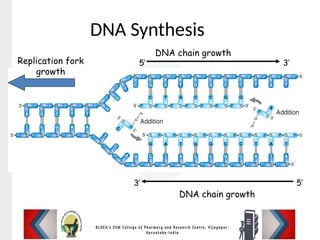
DNA Synthesis
DNA chain growth
DNA chain growth
3’
3’
5’
5’
Replication fork
growth
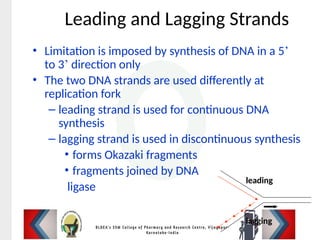
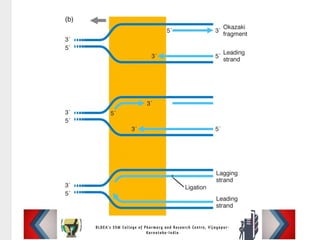
Leading and Lagging Strands
• Limitation is imposed by synthesis of DNA in a 5’
to 3’ direction only
• The two DNA strands are used differently at
replication fork
– leading strand is used for continuous DNA
synthesis
– lagging strand is used in discontinuous synthesis
• forms Okazaki fragments
• fragments joined by DNA
ligase
leading
lagging
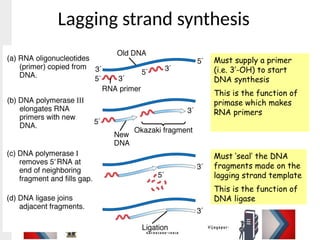
Lagging strand synthesis
Must supply a primer
(i.e. 3’-OH) to start
DNA synthesis
This is the function of
primase which makes
RNA primers
Must ‘seal’ the DNA
fragments made on the
lagging strand template
This is the function of
DNA ligase
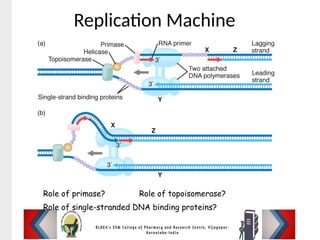
Replication Machine
Role of primase? Role of topoisomerase?
Role of single-stranded DNA binding proteins?
Origins of DNA Replication
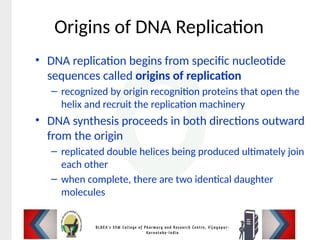
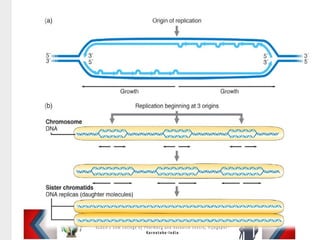
• DNA replication begins from specific nucleotide
sequences called origins of replication
– recognized by origin recognition proteins that open the
helix and recruit the replication machinery
• DNA synthesis proceeds in both directions outward
from the origin
– replicated double helices being produced ultimately join
each other
– when complete, there are two identical daughter
molecules
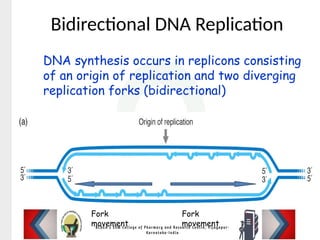
Bidirectional DNA Replication
DNA synthesis occurs in replicons consisting
of an origin of replication and two diverging
replication forks (bidirectional)
Fork
movement
Fork
movement
DNA replication: Replication/synthesis//

DNA replication: Replication/synthesis//

  • 1.
    DNA Replication By Dr. VP Patil BLDEA’s SSM COP & RC VIJAYAPUR
  • 2.
    DNA Replication: asynopsis • Occurs in the S phase of the cell cycle • Replication is semi conservative, with each DNA strand serving as template for synthesis of the complementary strand • DNA synthesis occurs in replicons consisting of an origin of replication and two diverging replication forks (bidirectional) • Each replication fork contains a complex of enzymes, including DNA polymerase – Other enzymes include primase, helicase, topoisomerase
  • 3.
    Replication is semiconservative, with eachDNA strand serving as template for synthesis of the complementary strand Fork movement R e p l i c a t i o n f o r k DNA replication is semiconservative This is true for all eukaryotes, prokaryotes, viruses and bacteriophage
  • 4.
    DNA Synthesis DNA chaingrowth DNA chain growth 3’ 3’ 5’ 5’ Replication fork growth
  • 5.
    Leading and LaggingStrands • Limitation is imposed by synthesis of DNA in a 5’ to 3’ direction only • The two DNA strands are used differently at replication fork – leading strand is used for continuous DNA synthesis – lagging strand is used in discontinuous synthesis • forms Okazaki fragments • fragments joined by DNA ligase leading lagging
  • 7.
    Lagging strand synthesis Mustsupply a primer (i.e. 3’-OH) to start DNA synthesis This is the function of primase which makes RNA primers Must ‘seal’ the DNA fragments made on the lagging strand template This is the function of DNA ligase
  • 8.
    Replication Machine Role ofprimase? Role of topoisomerase? Role of single-stranded DNA binding proteins?
  • 9.
    Origins of DNAReplication • DNA replication begins from specific nucleotide sequences called origins of replication – recognized by origin recognition proteins that open the helix and recruit the replication machinery • DNA synthesis proceeds in both directions outward from the origin – replicated double helices being produced ultimately join each other – when complete, there are two identical daughter molecules
  • 10.
    Bidirectional DNA Replication DNAsynthesis occurs in replicons consisting of an origin of replication and two diverging replication forks (bidirectional) Fork movement Fork movement