Topic :Purchasing Power Parity and
Quotation
Presented By
Iftekar Uddin Al Mahmud
ID 1415015
MBA 15
Purchasing power parity (PPP) is a component
of some economic theories and is a technique
used to determine the relative value of different
currencies.
Purchasing power indicate is the capacity of the
money for the quantity of commodity that
money can purchase .
Prof Bostel Casel
To determine the exchange rate between
currency under this theory the exchange
rate indicate the power of 1 currency
which is equal to the of other currency. In
this theory gold is replace by a parity
commodity which is produce and
consume equally between the countries
like 1 kg of rice in BD is tk 50 In India the
same quantity of price with same fitness
rp 35.
 The purchasing power parity exchange rate
serves two main functions:
 PPP exchange rates can be useful for making
compare between countries because they stay
fairly constant from day to day or week to week
and only change modestly, if at all, from year to
year.
 Second, over a period of years, exchange rates do
tend to move in the general direction of the PPP
exchange rate and there is some value to
knowing in which direction the exchange rate is
more likely to shift over the long run.
 Absolute Parity
Absolute Parity is the indicate the price of
commodity at different countries will be equal
if the measure by same currency.
 Relative Parity
Relative Parity refers to the adjustment of
transaction cost, adjusting cost and donation
cost.
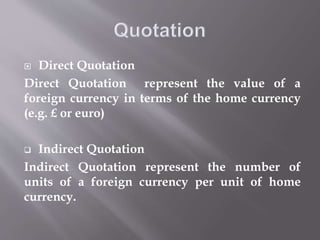
 Direct Quotation
Direct Quotation represent the value of a
foreign currency in terms of the home currency
(e.g. £ or euro)
 Indirect Quotation
Indirect Quotation represent the number of
units of a foreign currency per unit of home
currency.
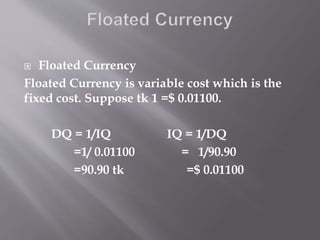
 Floated Currency
Floated Currency is variable cost which is the
fixed cost. Suppose tk 1 =$ 0.01100.
DQ = 1/IQ IQ = 1/DQ
=1/ 0.01100 = 1/90.90
=90.90 tk =$ 0.01100
Purchasing Power parity

Purchasing Power parity

  • 1.
    Topic :Purchasing PowerParity and Quotation Presented By Iftekar Uddin Al Mahmud ID 1415015 MBA 15
  • 2.
    Purchasing power parity(PPP) is a component of some economic theories and is a technique used to determine the relative value of different currencies. Purchasing power indicate is the capacity of the money for the quantity of commodity that money can purchase .
  • 3.
    Prof Bostel Casel Todetermine the exchange rate between currency under this theory the exchange rate indicate the power of 1 currency which is equal to the of other currency. In this theory gold is replace by a parity commodity which is produce and consume equally between the countries like 1 kg of rice in BD is tk 50 In India the same quantity of price with same fitness rp 35.
  • 4.
     The purchasingpower parity exchange rate serves two main functions:  PPP exchange rates can be useful for making compare between countries because they stay fairly constant from day to day or week to week and only change modestly, if at all, from year to year.  Second, over a period of years, exchange rates do tend to move in the general direction of the PPP exchange rate and there is some value to knowing in which direction the exchange rate is more likely to shift over the long run.
  • 5.
     Absolute Parity AbsoluteParity is the indicate the price of commodity at different countries will be equal if the measure by same currency.  Relative Parity Relative Parity refers to the adjustment of transaction cost, adjusting cost and donation cost.
  • 6.
     Direct Quotation DirectQuotation represent the value of a foreign currency in terms of the home currency (e.g. £ or euro)  Indirect Quotation Indirect Quotation represent the number of units of a foreign currency per unit of home currency.
  • 7.
     Floated Currency FloatedCurrency is variable cost which is the fixed cost. Suppose tk 1 =$ 0.01100. DQ = 1/IQ IQ = 1/DQ =1/ 0.01100 = 1/90.90 =90.90 tk =$ 0.01100