






Dr. Pallavi
Dr. Sanjay
Dr. Suresh
Dr. Setuvarun
Dr. Yamini
Seth G.S.M.C. & K.E.M.H.
ELETRICAL SAFETY IN
OPEARTING ROOM
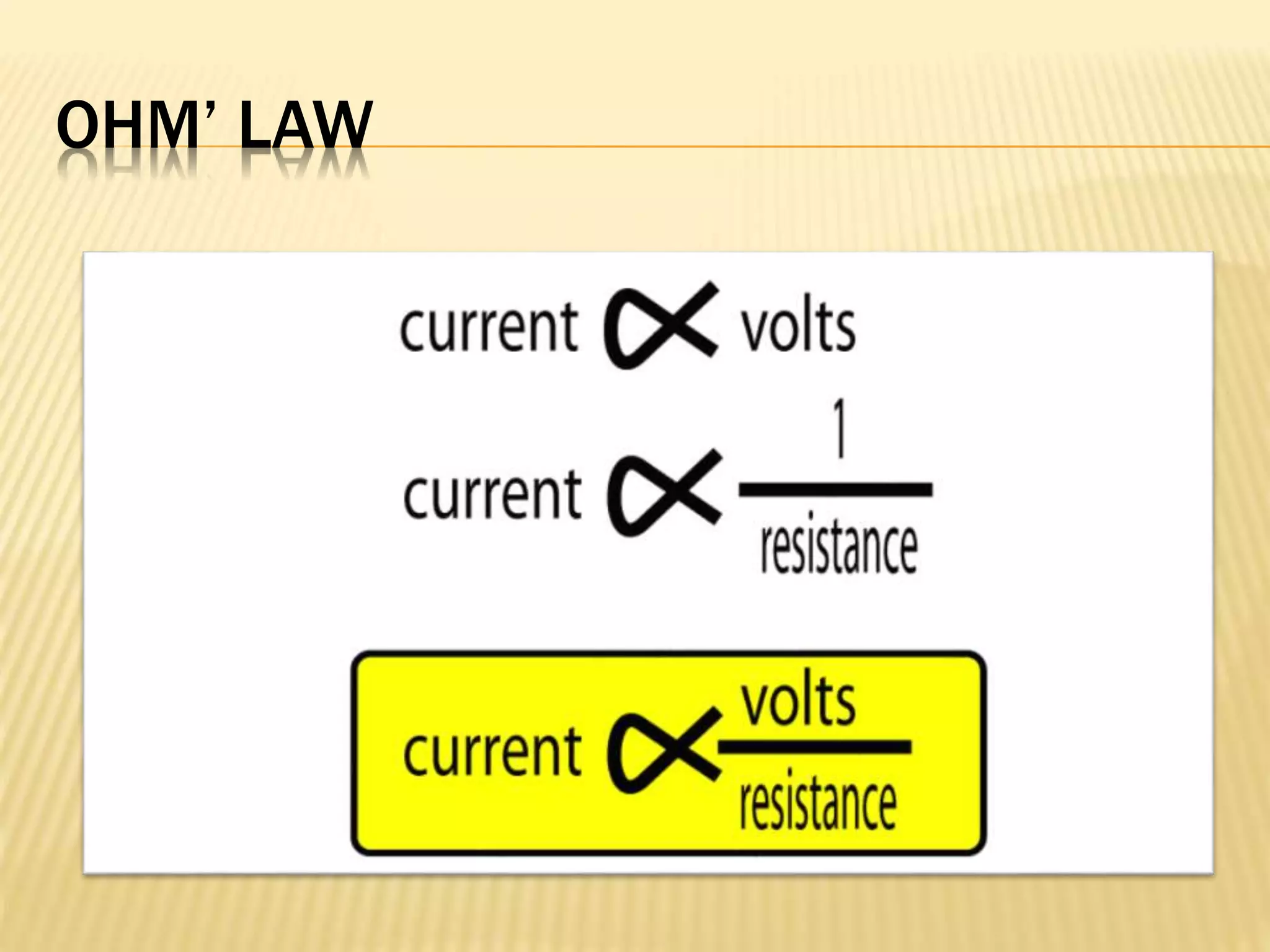
CURRENT (I) – amperes (A)
VOLTAGE DIFFERENCE (V) - volts
RESISTANCE (R)- ohms
I
George Simon Ohm
(1789-1854)
- German Physicist
OHM’ LAW
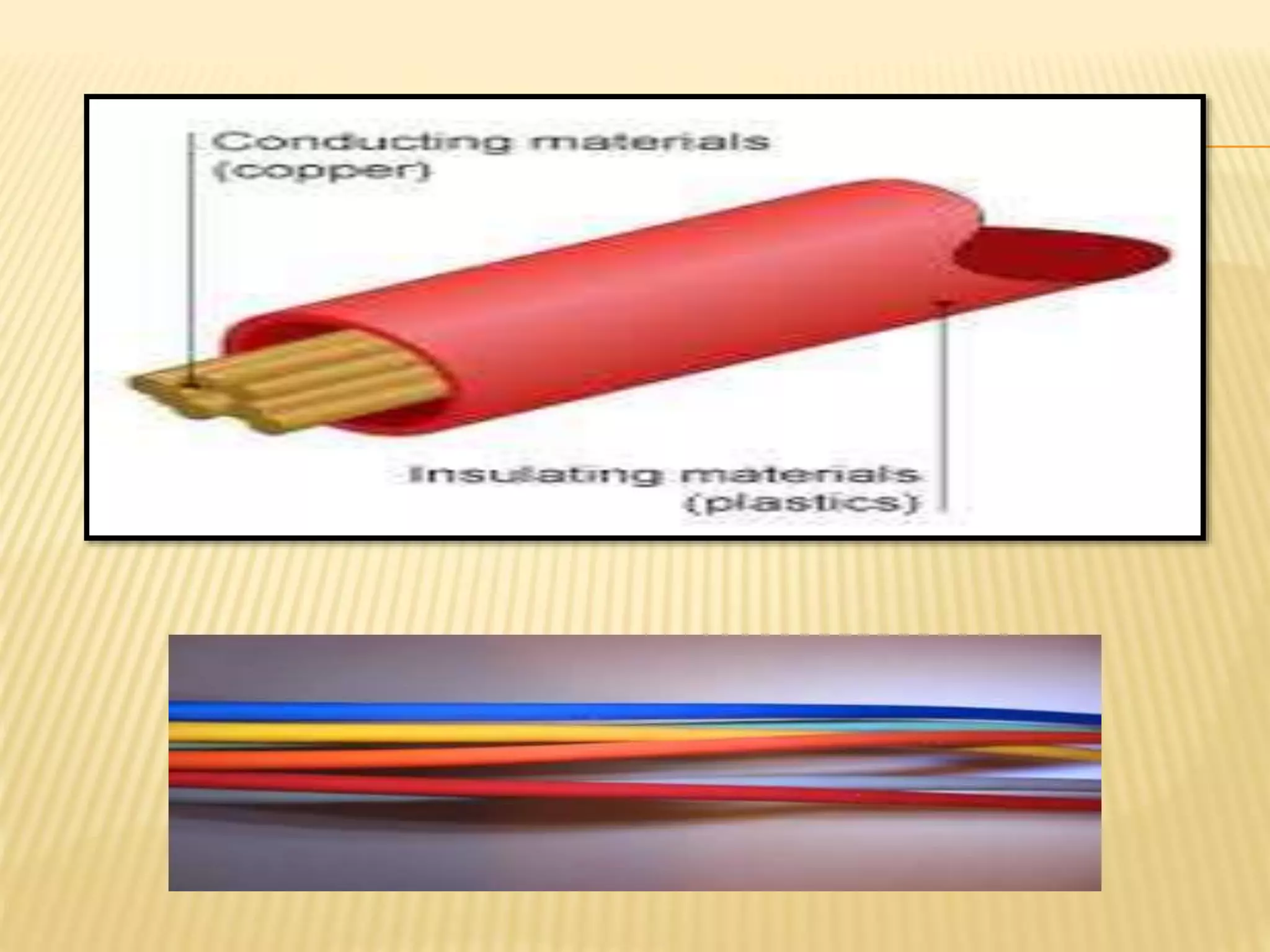
CONDUCTOR AND INSULATOR
HOW CAN ELECTRICITY FLOW THROUGH BODY?
Two ways:
 Resistive coupling
 Capacitive coupling
RESISTIVE COUPLING
When the body makes a
direct physical connection
with the electrical circuit, its
due to resistive coupling.
• Faulty equipments
• Leakage current
CAPACITIVE COUPLING
Body acts like a capacitor, which
stores the electrical charge.
In case of direct current, current
flows for a brief period until the
source and receiver are at same
potential.
In case of alternating current,
body would continuously charge
and discharge, and current will
continuously flow.
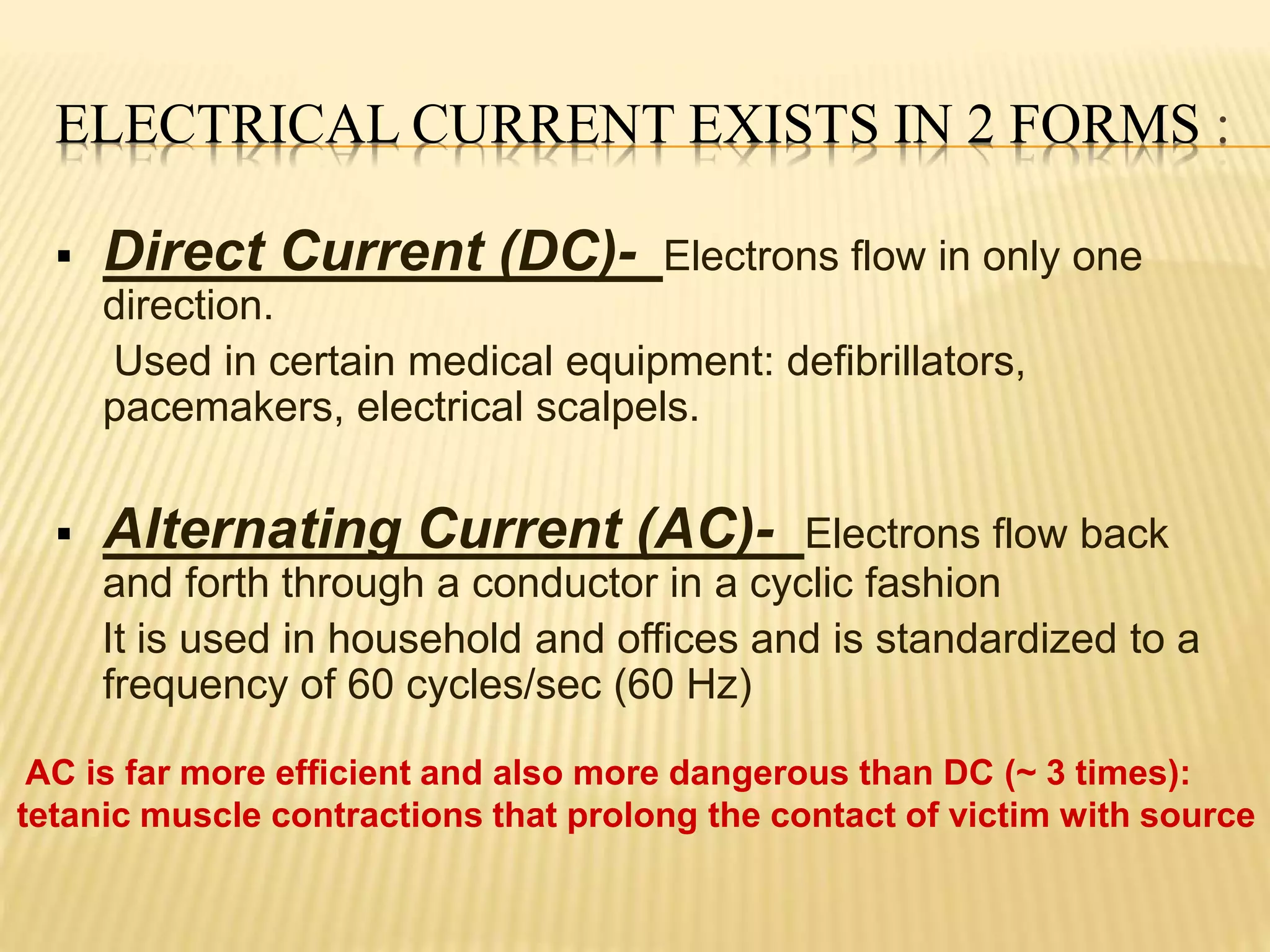
ELECTRICAL CURRENT EXISTS IN 2 FORMS :
 Direct Current (DC)- Electrons flow in only one
direction.
Used in certain medical equipment: defibrillators,
pacemakers, electrical scalpels.
 Alternating Current (AC)- Electrons flow back
and forth through a conductor in a cyclic fashion
It is used in household and offices and is standardized to a
frequency of 60 cycles/sec (60 Hz)
AC is far more efficient and also more dangerous than DC (~ 3 times):
tetanic muscle contractions that prolong the contact of victim with source
DETERMINANTS OF ELECTRICAL INJURIES
 Current density
 Current intensity
 Tissue resistance
The pathway that current takes through the body will
determine which tissues are damaged.
The effect of the size of current and current pathway can
be considered together as current density. This is the
amount of current flowing per unit area.
Macroshock current is
distributed somewhat evenly
through body parts.
Microshock current path is
through a single point,
usually the heart
Term used to describe the
very low level shocks that go
undetected
For example, a 50 Hz alternating current flowing between each hand
the current has passed through the whole of the trunk with only a
small part of it passing through the heart, i.e. the myocardial current density is
relatively low. However, if the current flows directly into the myocardium (or in
very close proximity to it), for any given current, the current density will be much
greater. In these circumstances, a substantially smaller current (50 μA at 50 Hz)
can cause ventricular fibrillation.
MICROSHOCK
 Dangerous to an “electrically sensitive” patient - with breaks in skin like
abrasions, wet dressings, pacemakers, or monitoring lines connected to a
transducer.
Examples of equipment that may allow
microshock include central venous catheters, intracardiac
pacemakers with an external lead and, to a lesser extent, a
temperature probe placed in the oesophagus immediately
behind the left atrium.
 Nerves and blood vessels are the best conductors: path of least
resistance for current after it enters the body
 The least resistance is found in nerves, blood, mucous
membranes and muscles
 The highest resistance is found in bones, fat and tendons
 Skin’s resistance ranging between 40,000 and 100,000 Ω
depending on thickness
 Moist mucus membranes: significant orofacial injury to infants
and toddlers
Exposure of different parts of the body to the same
voltage >> same current >> different degree of damage
because resistance varies.
ELECTRICAL INJURY TO SPECIFIC TISSUES
& ORGANS
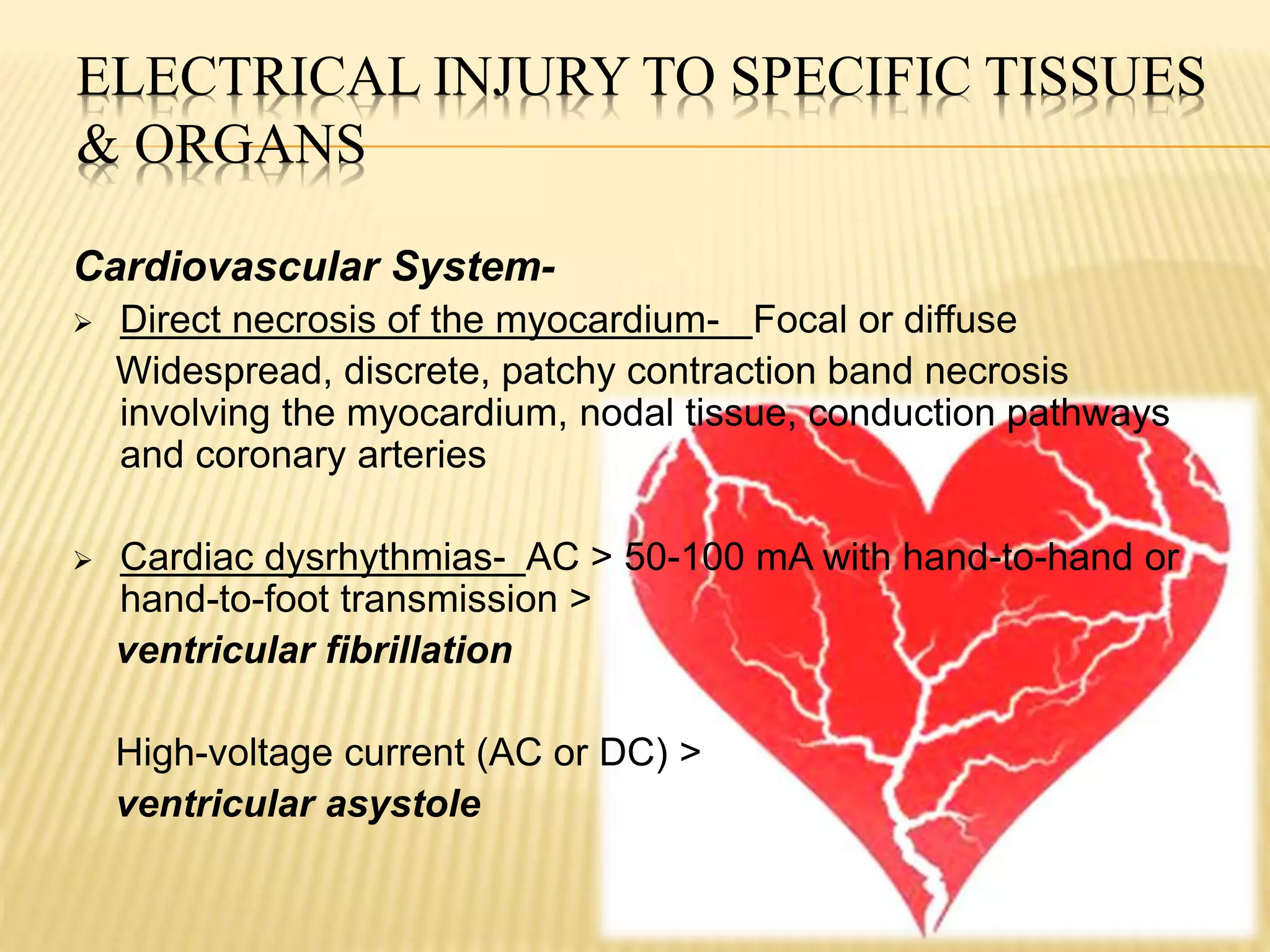
Cardiovascular System-
 Direct necrosis of the myocardium- Focal or diffuse
Widespread, discrete, patchy contraction band necrosis
involving the myocardium, nodal tissue, conduction pathways
and coronary arteries
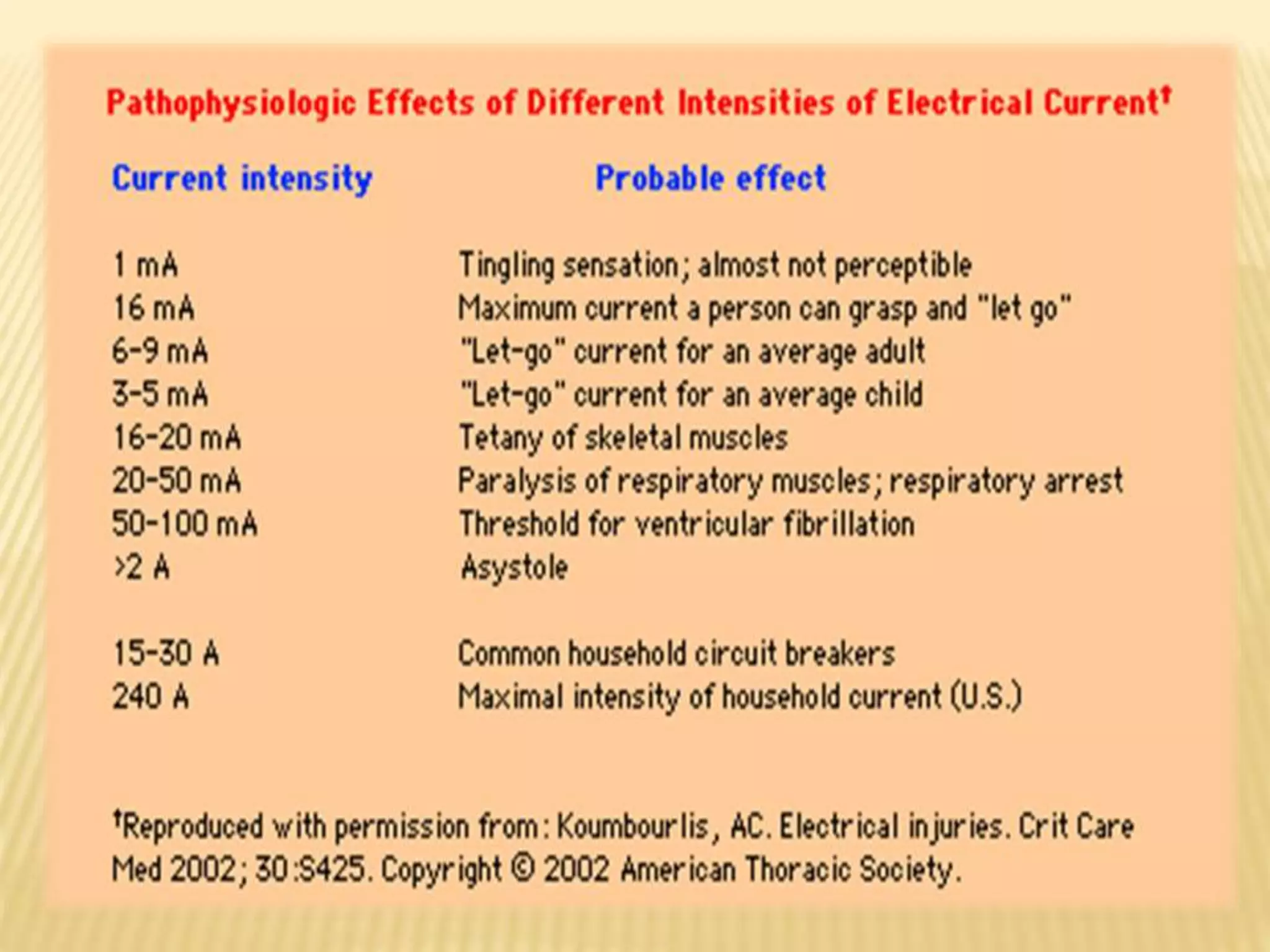
 Cardiac dysrhythmias- AC > 50-100 mA with hand-to-hand or
hand-to-foot transmission >
ventricular fibrillation
High-voltage current (AC or DC) >
ventricular asystole
Possible mechanisms:
1) Arrythmogenic foci due to myocardial
necrosis (esp. SA Node injury)
2) Alterations in the Na+ - K+ adenosine triphosphatase
concentration
3) Changes in the permeability of myocyte membranes
4) Anoxic injury (respiratory arrest precedes the injury to
the heart)
 Large arteries not acutely affected because their rapid
flow dissipate heat.
Medial necrosis: aneurysm formation and rupture
 Smaller vessels acutely affected due to coagulation necrosis
 compartment syndrome
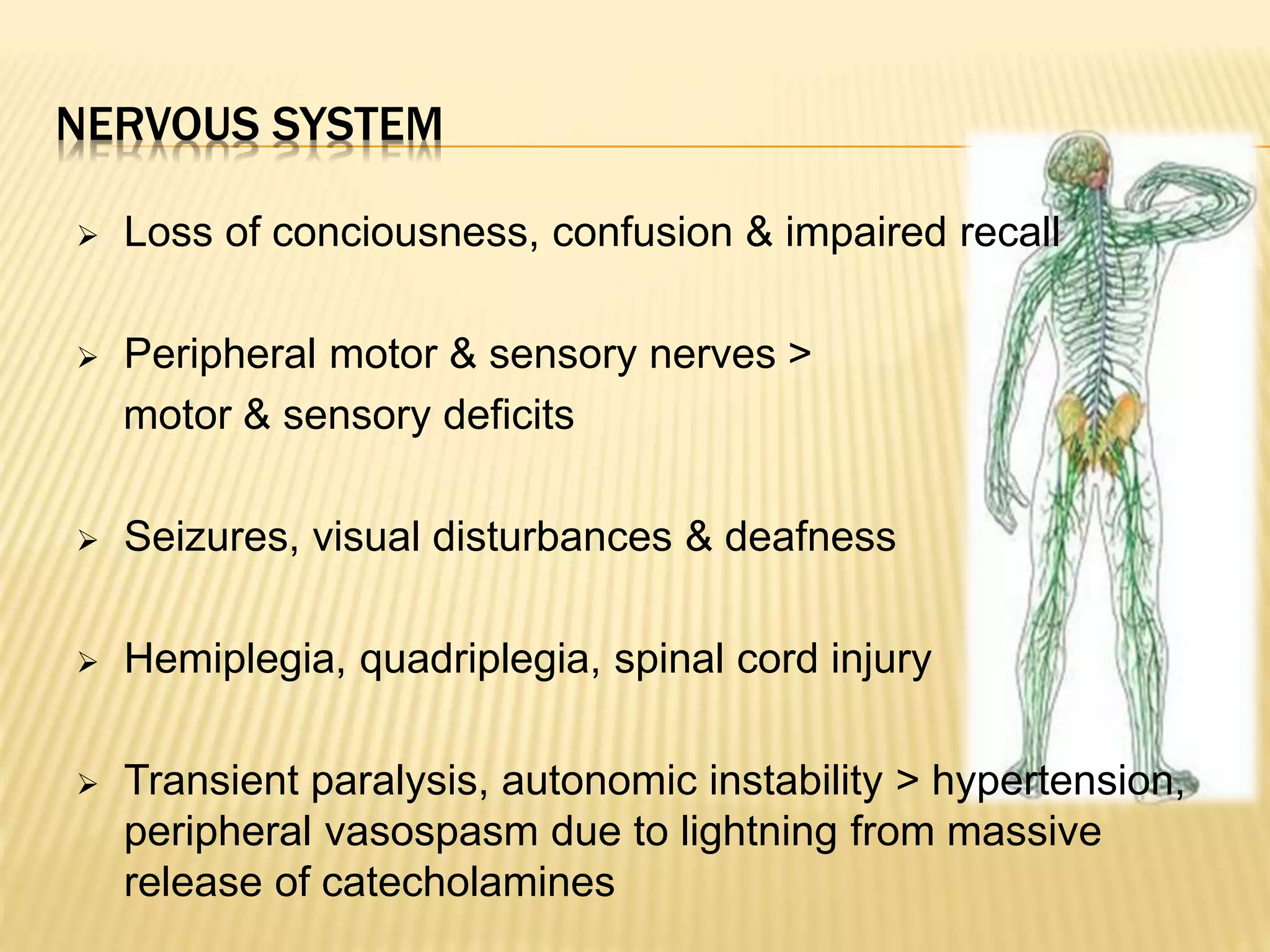
NERVOUS SYSTEM
 Loss of conciousness, confusion & impaired recall
 Peripheral motor & sensory nerves >
motor & sensory deficits
 Seizures, visual disturbances & deafness
 Hemiplegia, quadriplegia, spinal cord injury
 Transient paralysis, autonomic instability > hypertension,
peripheral vasospasm due to lightning from massive
release of catecholamines
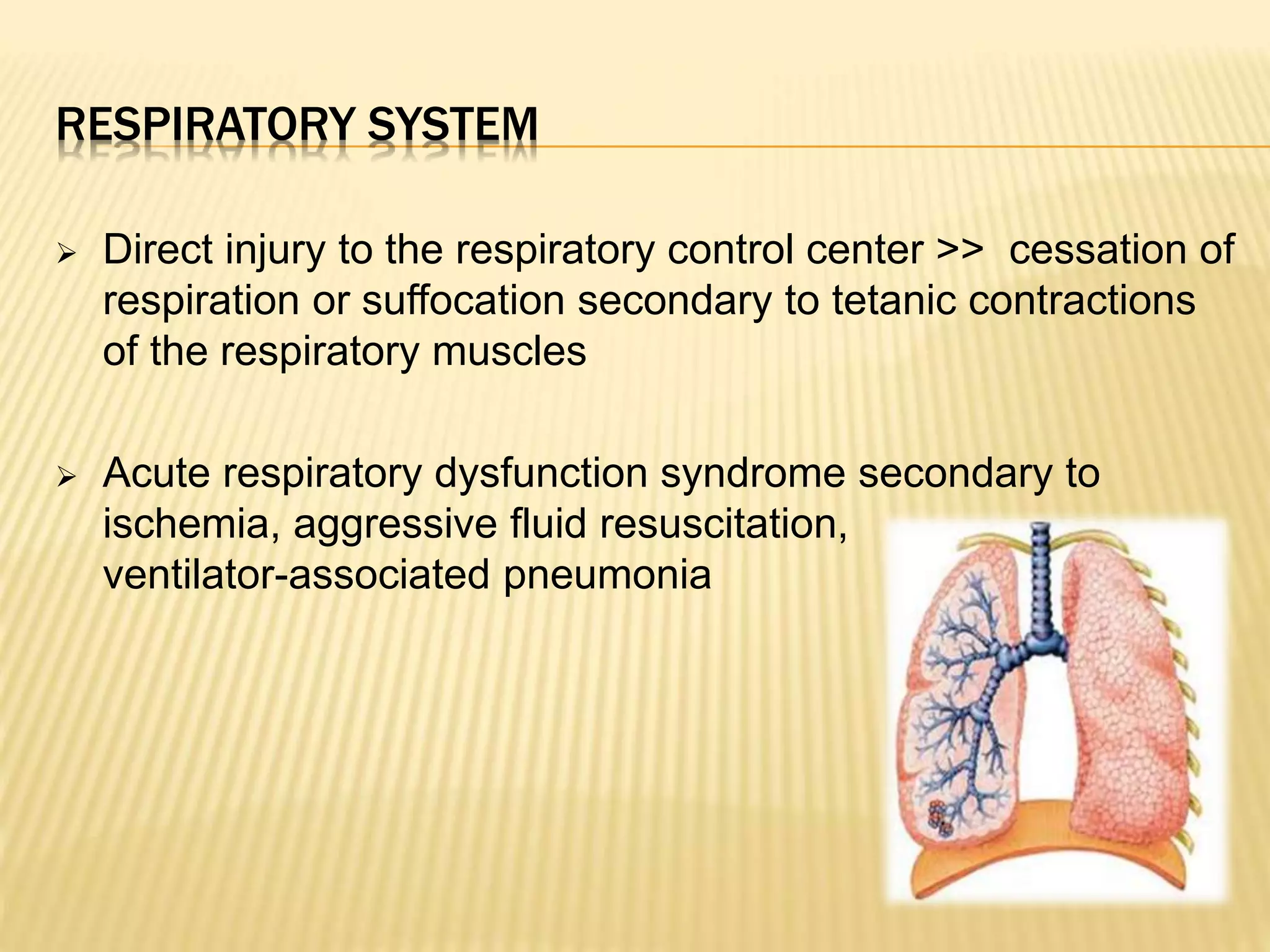
RESPIRATORY SYSTEM
 Direct injury to the respiratory control center >> cessation of
respiration or suffocation secondary to tetanic contractions
of the respiratory muscles
 Acute respiratory dysfunction syndrome secondary to
ischemia, aggressive fluid resuscitation,
ventilator-associated pneumonia
OTHER SYSTEMS
 Kidneys susceptible to anoxic/ischemic injury
 Release of myoglobin & creatinine phosphokinase >
renal tubular damage > renal failure
 Fractures
 Transient autonomic disturbances > fixed pupils may
be perceived as severe brain injury or even death
 Temporary sensorineural hearing loss
Better Safe
Than Sorry
PREVENTION OF
ELECTRICAL HAZARDS
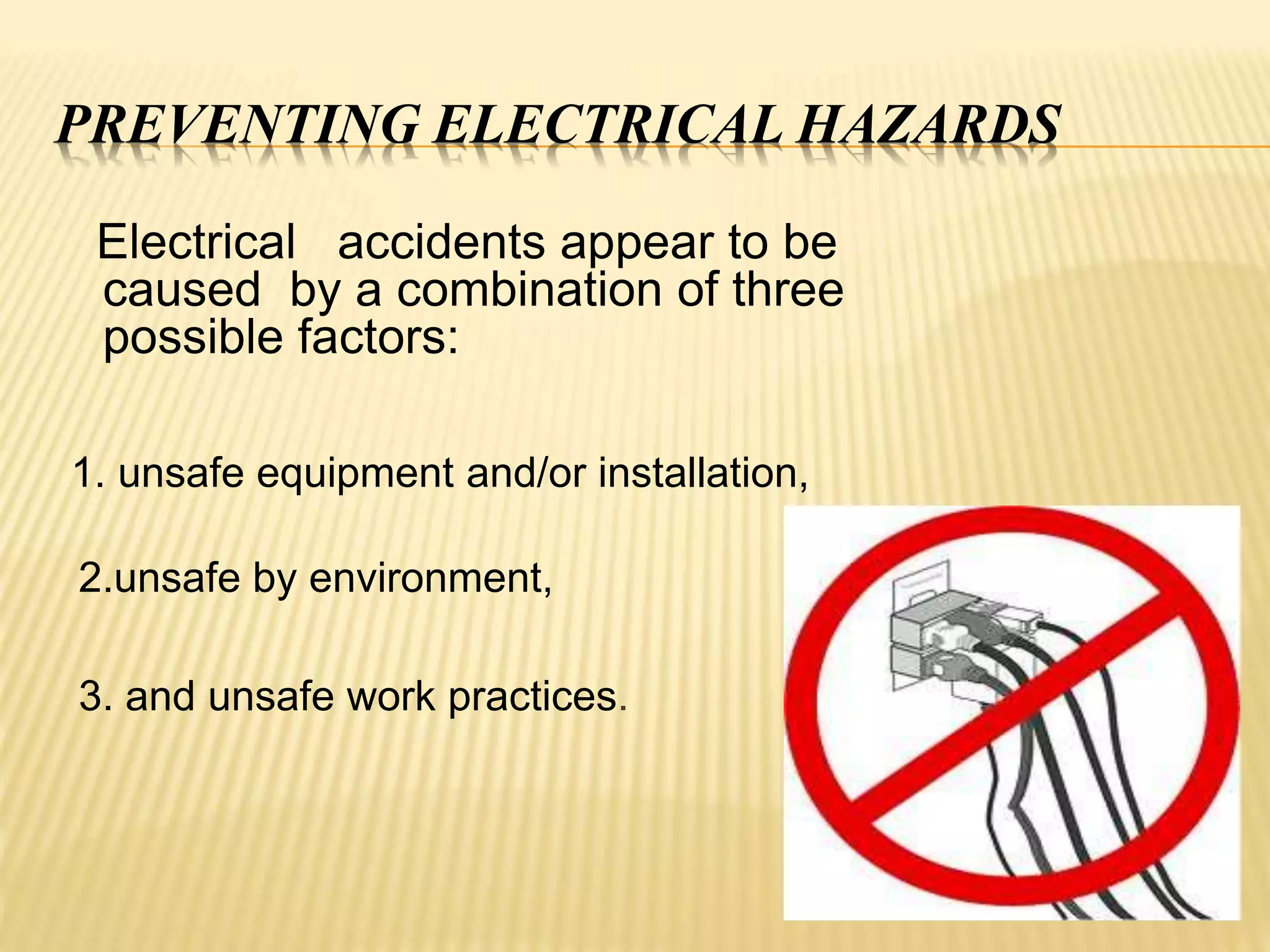
PREVENTING ELECTRICAL HAZARDS
Electrical accidents appear to be
caused by a combination of three
possible factors:
1. unsafe equipment and/or installation,
2.unsafe by environment,
3. and unsafe work practices.
PREVENTING ELECTRICAL HAZARDS
These include:
 Insulation
 Guarding
 Grounding
 Electrical protective devices:
 Fuses & circuit breakers
 Ground fault circuit interrupter
 Isolation transformer & Line isolation monitor
 Safe work practices
INSULATION
 One way to safeguard
individuals from
electrically energized
wires and parts is
through insulation.
 An insulator is any
material with high
resistance to electric
current.
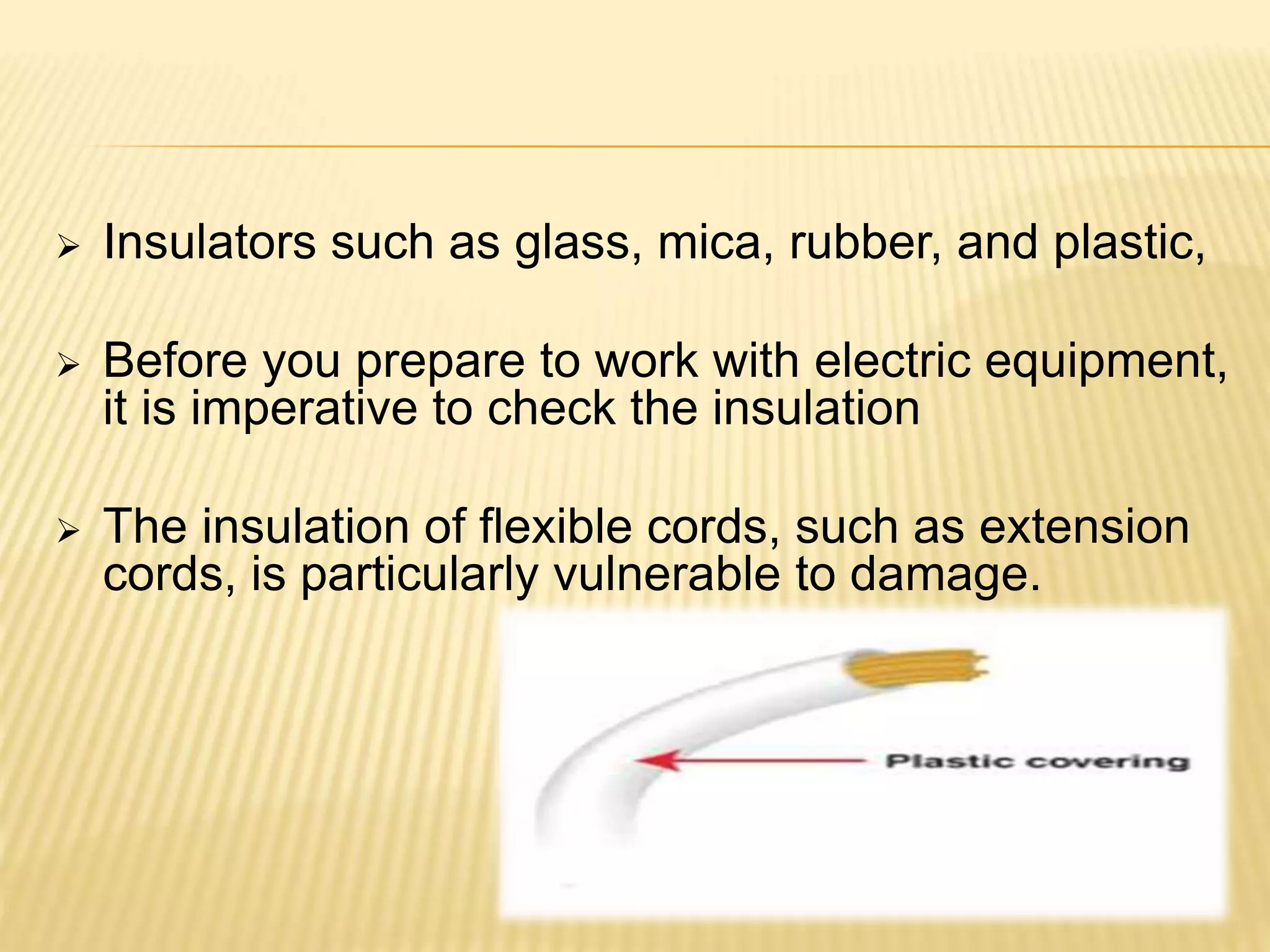
 Insulators such as glass, mica, rubber, and plastic,
 Before you prepare to work with electric equipment,
it is imperative to check the insulation
 The insulation of flexible cords, such as extension
cords, is particularly vulnerable to damage.
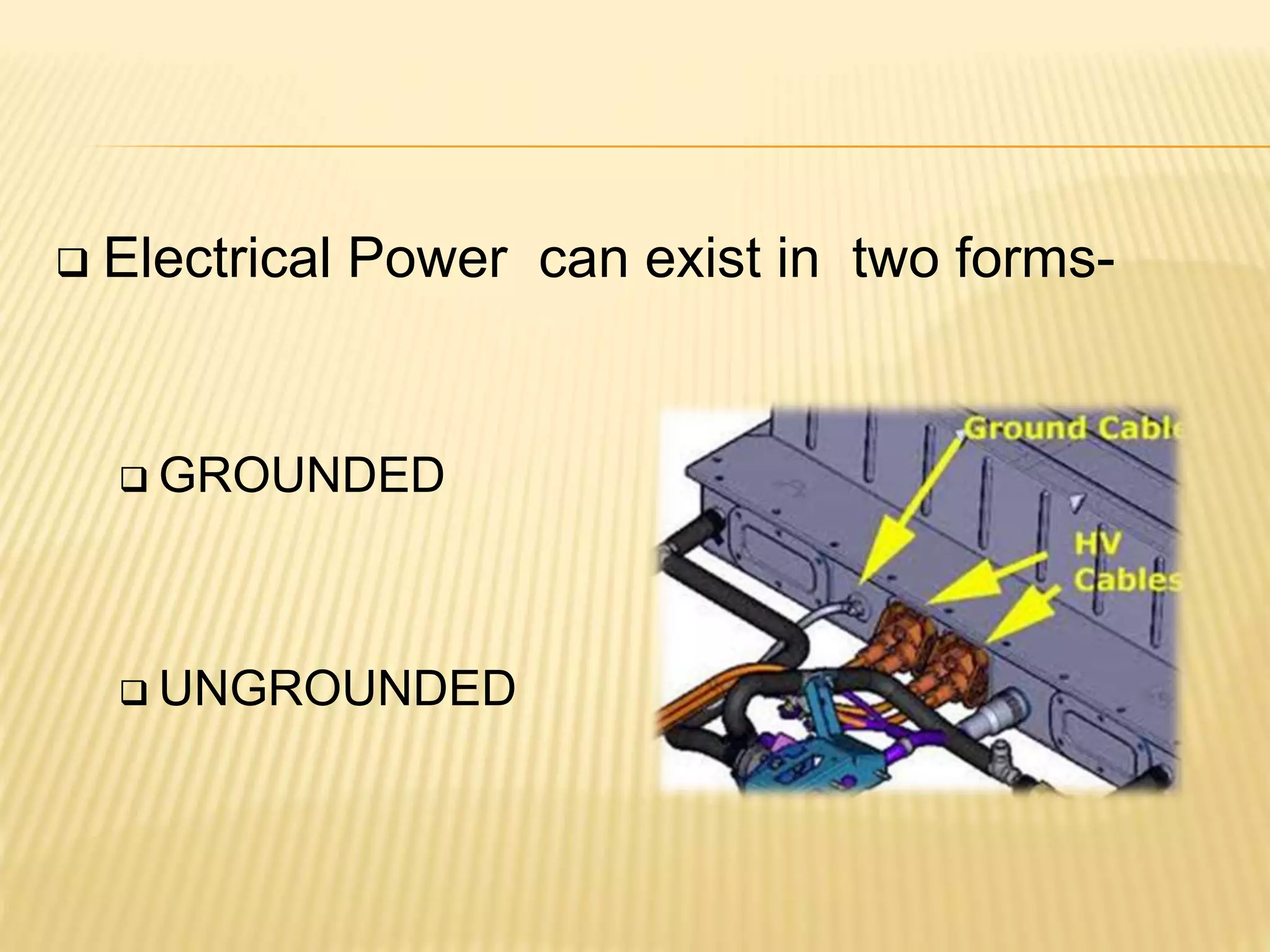
 Electrical Power can exist in two forms-
 GROUNDED
 UNGROUNDED
GROUNDING
 The "ground" refers to a conductive body, usually the earth,
and means a conductive connection, whether intentional or
accidental, by which an electric circuit or equipment is
connected to earth or the ground plane.
 Method of protecting from electric shock.
 Secondary protective measure.
 By "grounding" a tool or electrical system, a low-
resistance path to the earth is intentionally created.
UNGROUNDED
GROUNDED
GROUNDING
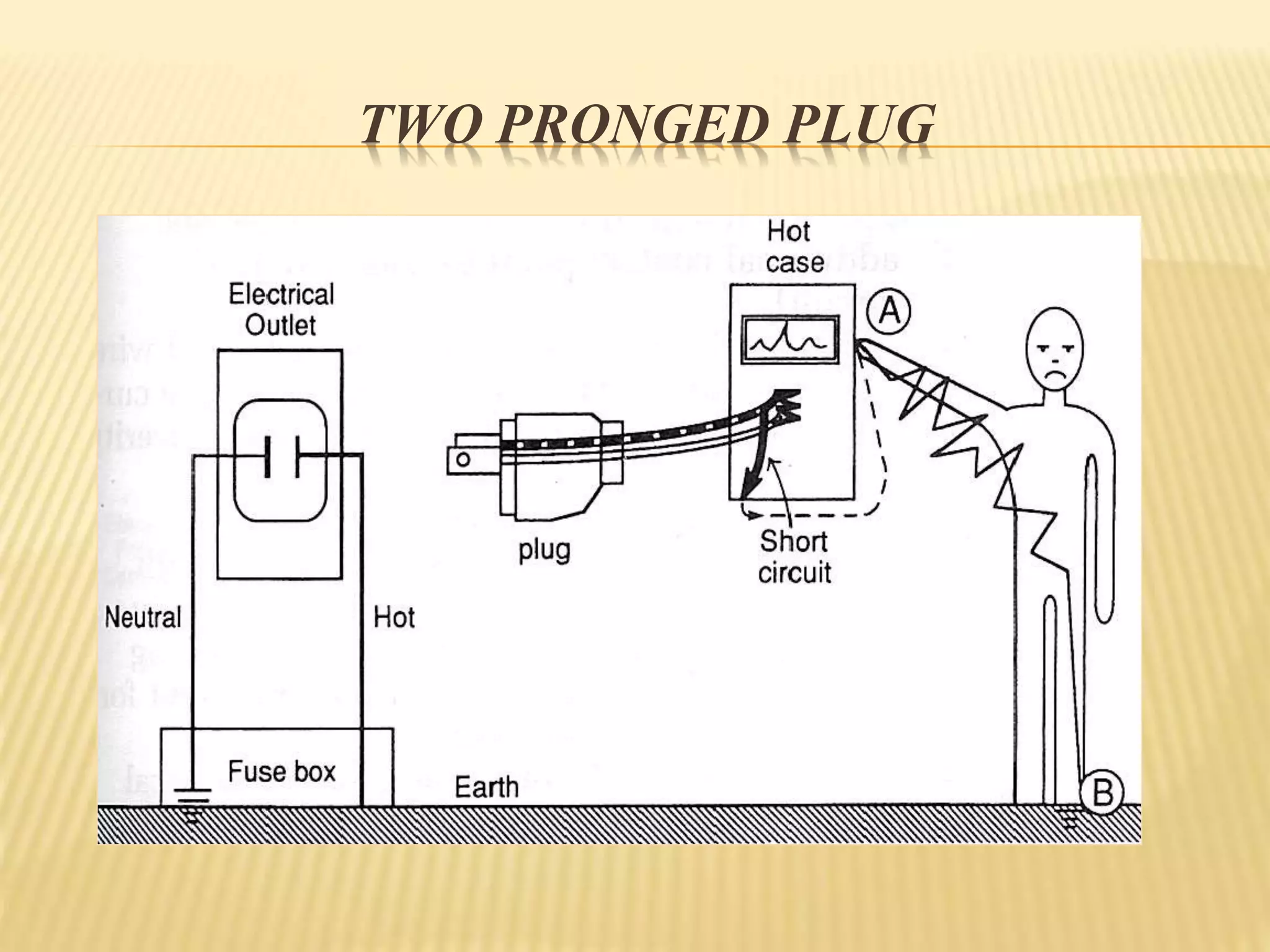
 Think about your house:
 2 prong outlets = no ground
 3 prong outlets = grounded
 Modern homes have a ground
to reduce amount of shock
TWO PRONGED PLUG
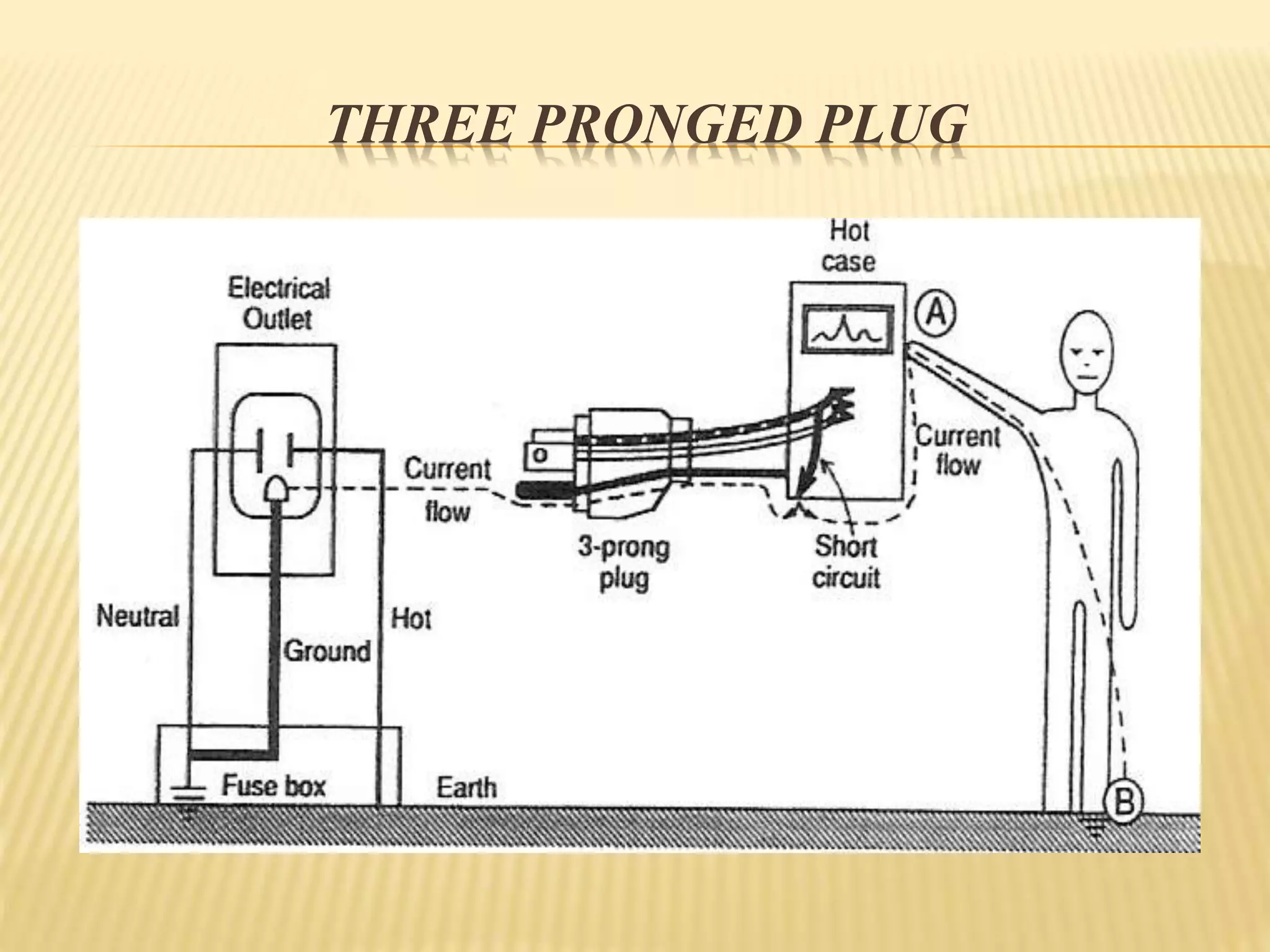
THREE PRONGED PLUG
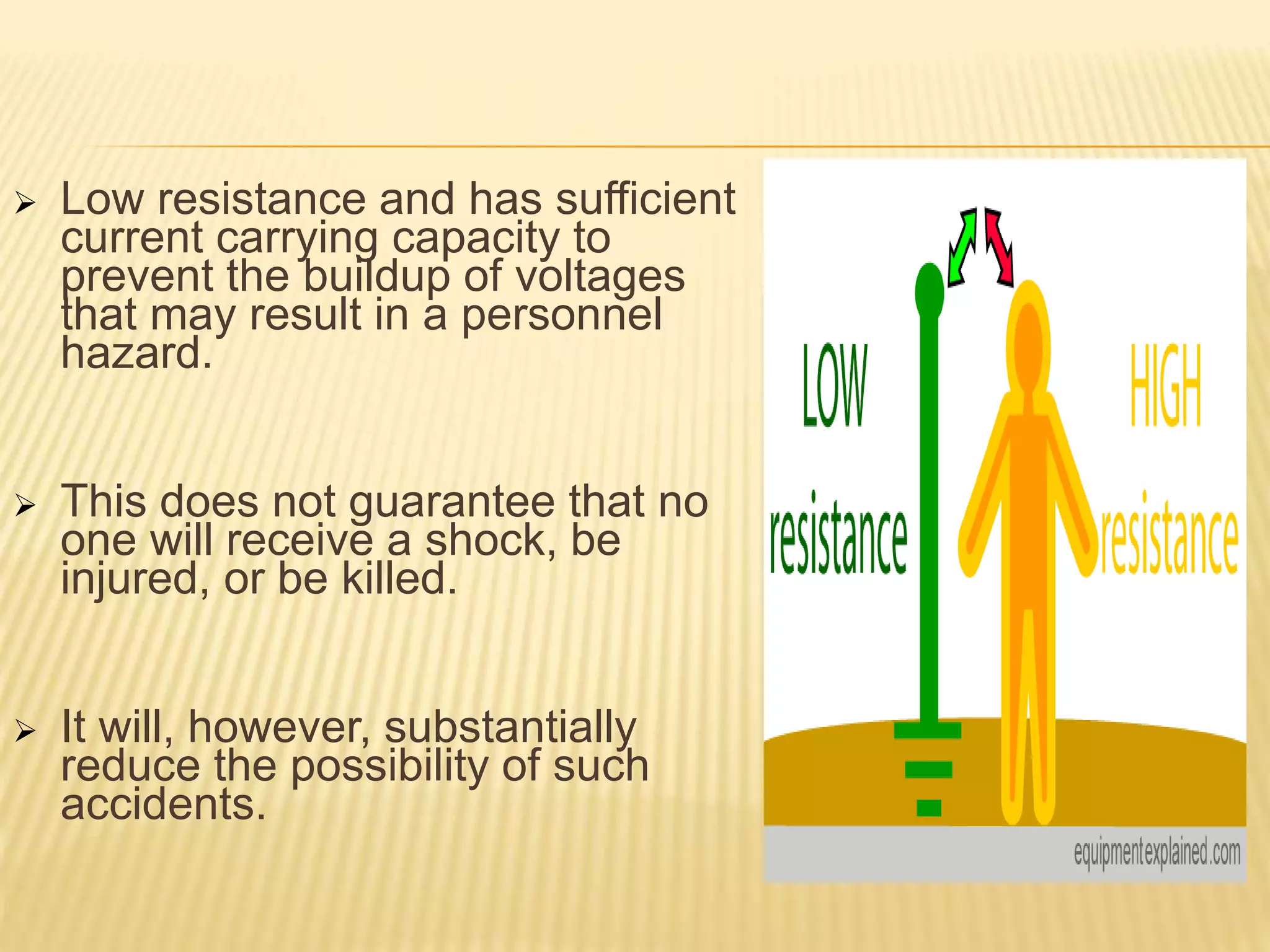
 Low resistance and has sufficient
current carrying capacity to
prevent the buildup of voltages
that may result in a personnel
hazard.
 This does not guarantee that no
one will receive a shock, be
injured, or be killed.
 It will, however, substantially
reduce the possibility of such
accidents.
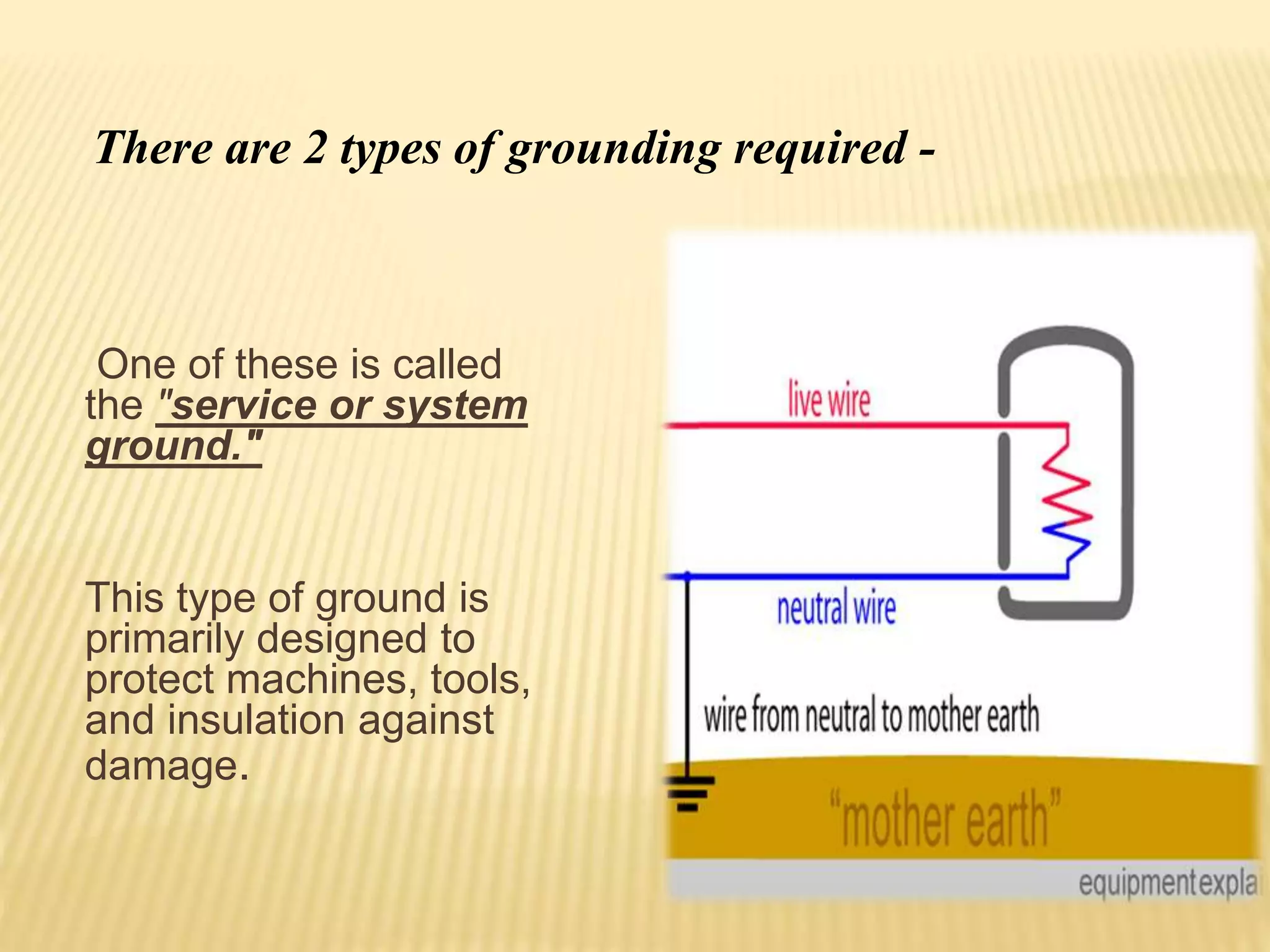
One of these is called
the "service or system
ground."
This type of ground is
primarily designed to
protect machines, tools,
and insulation against
damage.
There are 2 types of grounding required -
To offer enhanced protection, an
additional ground, called the
"equipment ground"
This additional ground
safeguards the electric
equipment operator in the event
that a malfunction causes any
metal on the tool to become
accidentally energized.
The resulting heavy surge of
current will then activate the
circuit protection devices and
open the circuit.
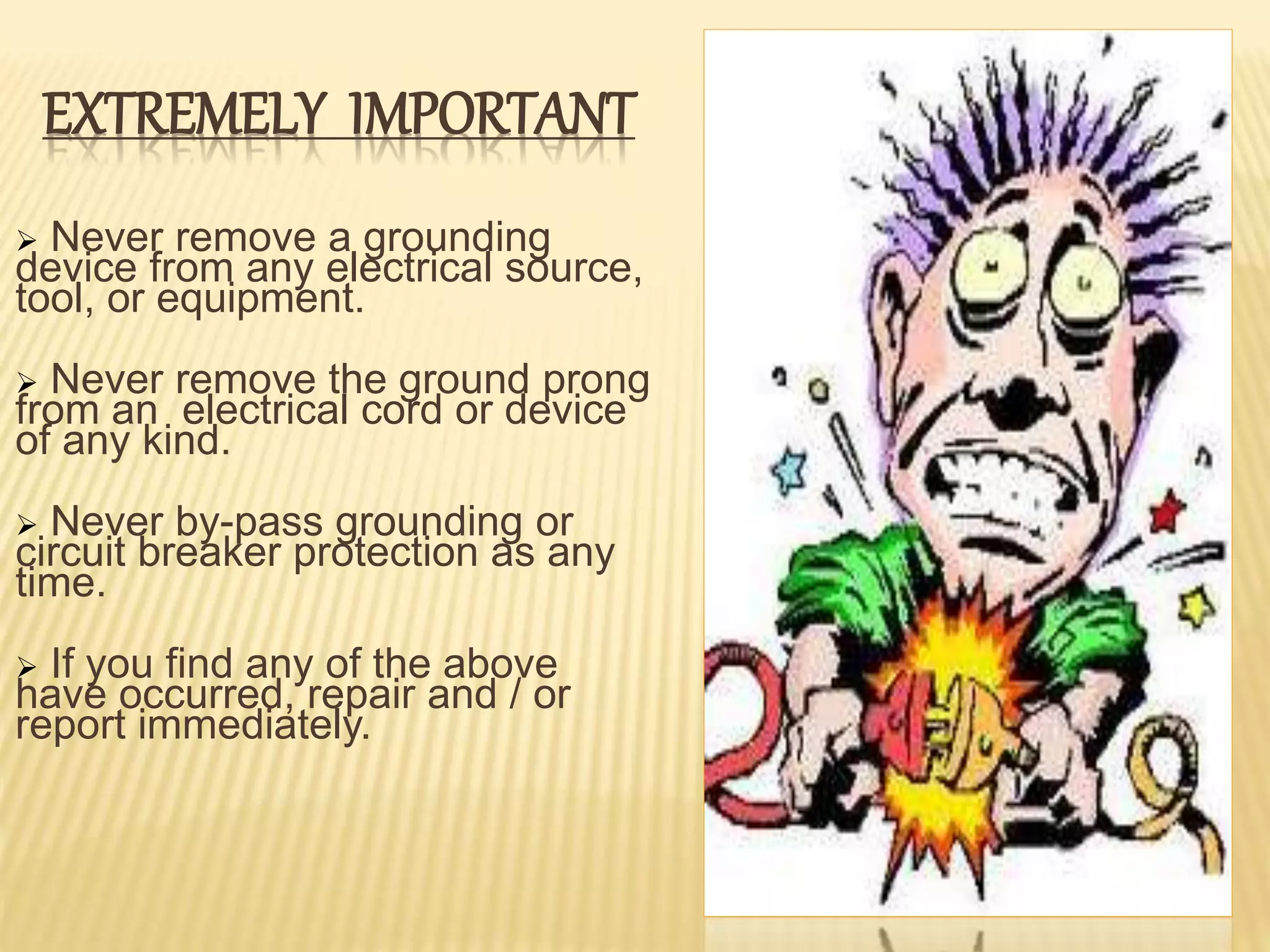
EXTREMELY IMPORTANT
 Never remove a grounding
device from any electrical source,
tool, or equipment.
 Never remove the ground prong
from an electrical cord or device
of any kind.
 Never by-pass grounding or
circuit breaker protection as any
time.
 If you find any of the above
have occurred, repair and / or
report immediately.
CIRCUIT PROTECTION DEVICES
 Circuit protection devices are designed to
automatically limit or shut off the flow of electricity
in the event of a ground-fault,
overload, or short circuit in the wiring system.
 Fuses, circuit breakers, ground-fault circuit
interrupters, isolation transformer and line isolation
monitor
CIRCUIT PROTECTION DEVICES
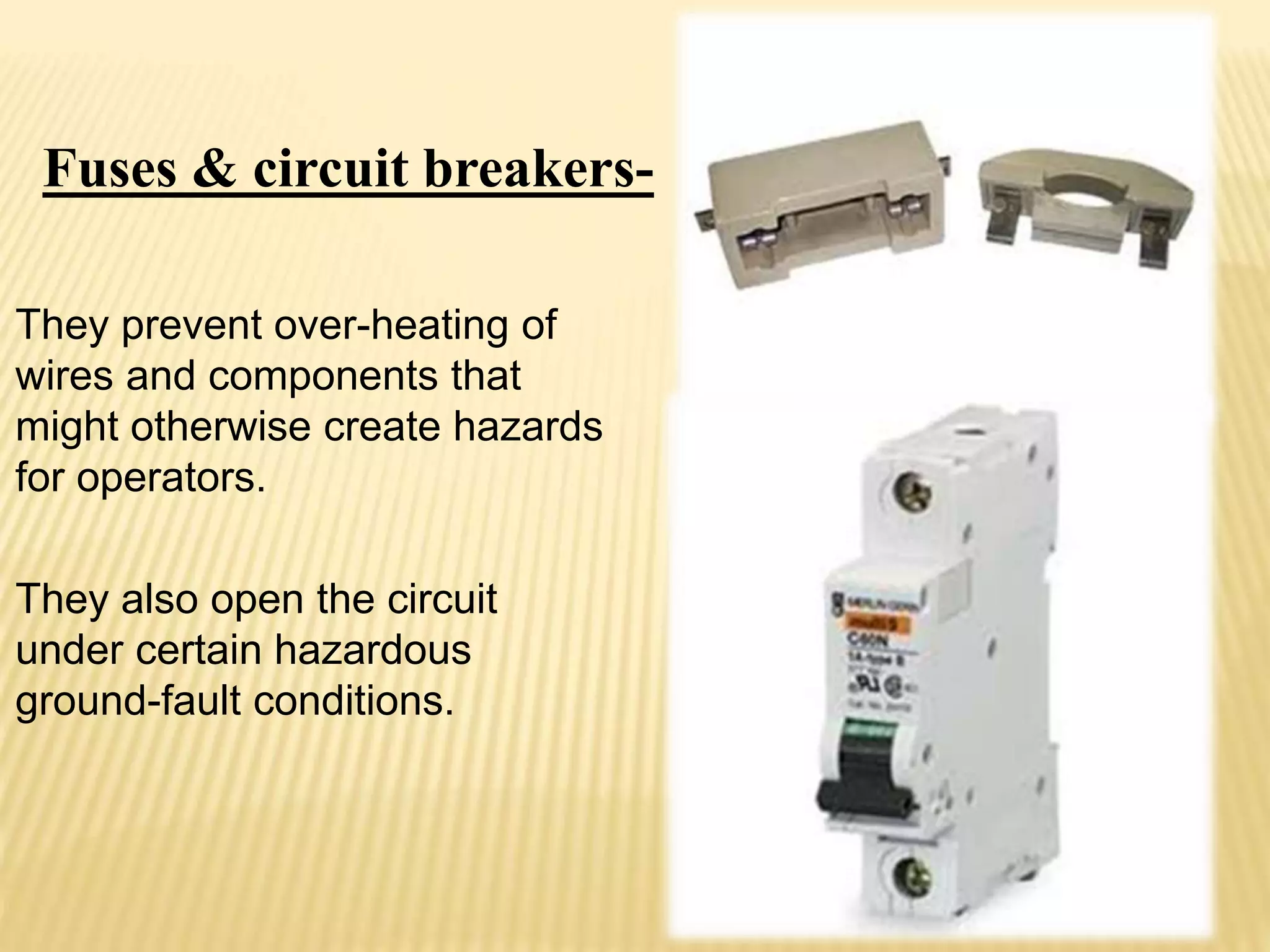
Fuses & circuit breakers-
monitor the amount of current
that the circuit will carry.
 Fuses are designed to melt when too
much current flows through them.
 Circuit breakers, on the other
hand, are designed to trip open the
circuit by electro-mechanical means.
They prevent over-heating of
wires and components that
might otherwise create hazards
for operators.
They also open the circuit
under certain hazardous
ground-fault conditions.
Fuses & circuit breakers-
GUARDING
Live parts of electric equipment
operating at 50 volts or more must
be guarded against accidental
contact. This is accomplished by:
 Location in a room, vault, or similar
enclosure accessible only to
qualified persons
 Use of permanent, substantial
partitions or screens to exclude
unqualified persons
 Elevation of 8 feet (2.44 meters) or
more above the floor.
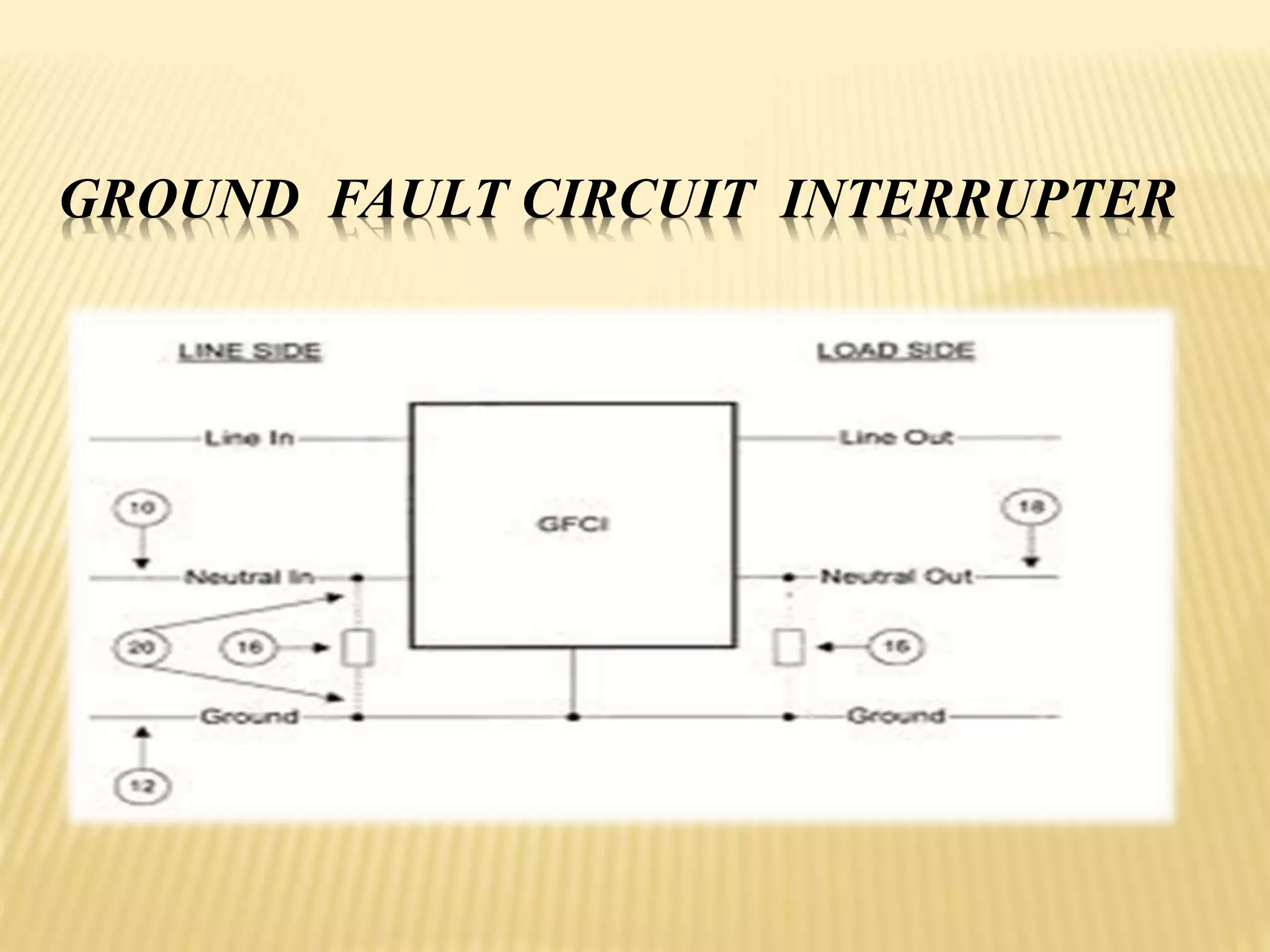
GROUND FAULT CIRCUIT INTERRUPTER
 The ground-fault circuit interrupter, or GFCI, is designed to
shutoff electric power within as little as 1/40 of a second.
 It works by comparing the amount of current going to electric
equipment against the amount of current returning from the
equipment along the circuit conductors.
 If the current difference exceeds 6 milliamperes, the GFCI
interrupts the current quickly enough to prevent electrocution.
GROUND FAULT CIRCUIT INTERRUPTER
UNGROUNDING
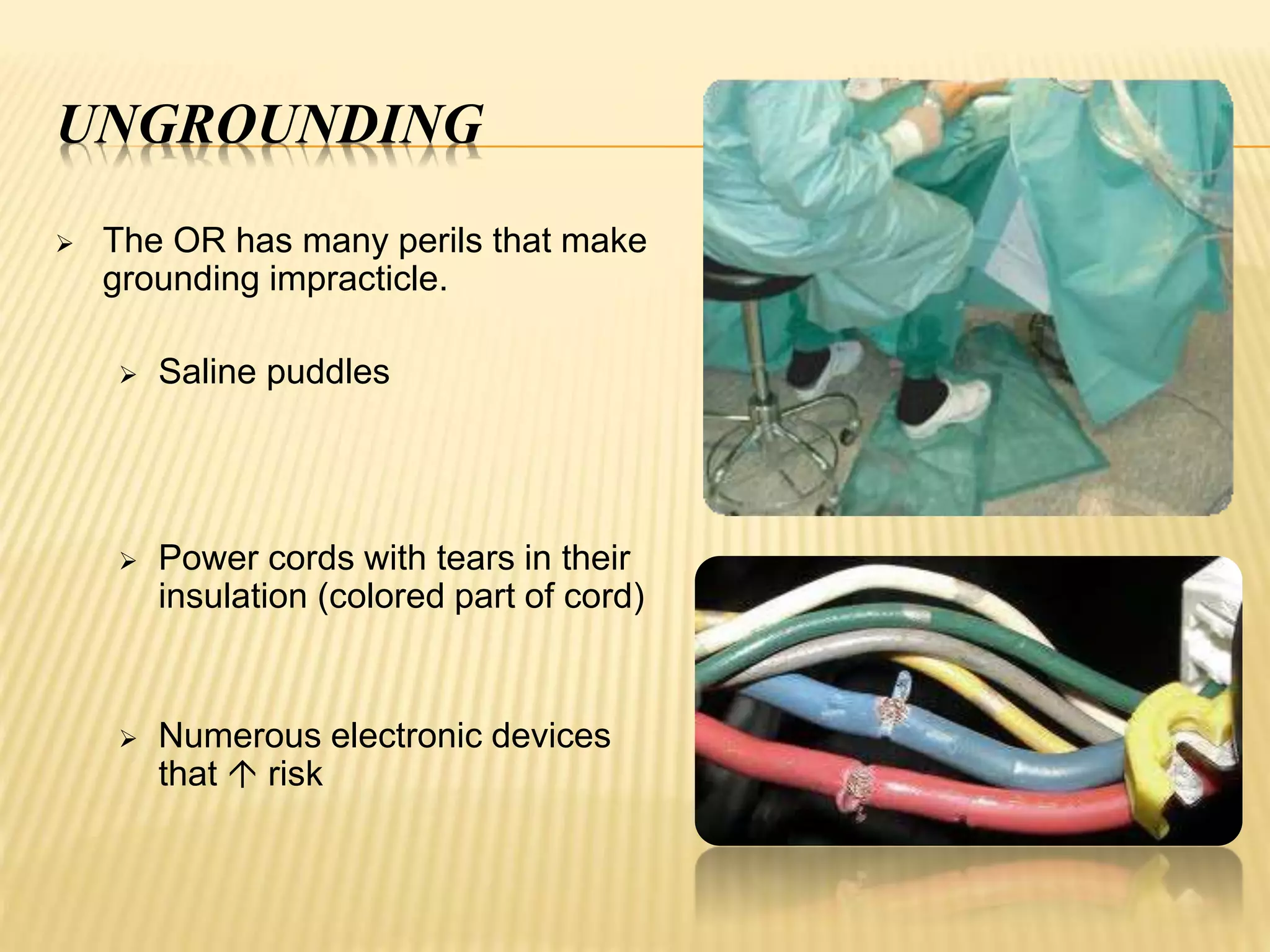
 The OR has many perils that make
grounding impracticle.
 Saline puddles
 Power cords with tears in their
insulation (colored part of cord)
 Numerous electronic devices
that  risk
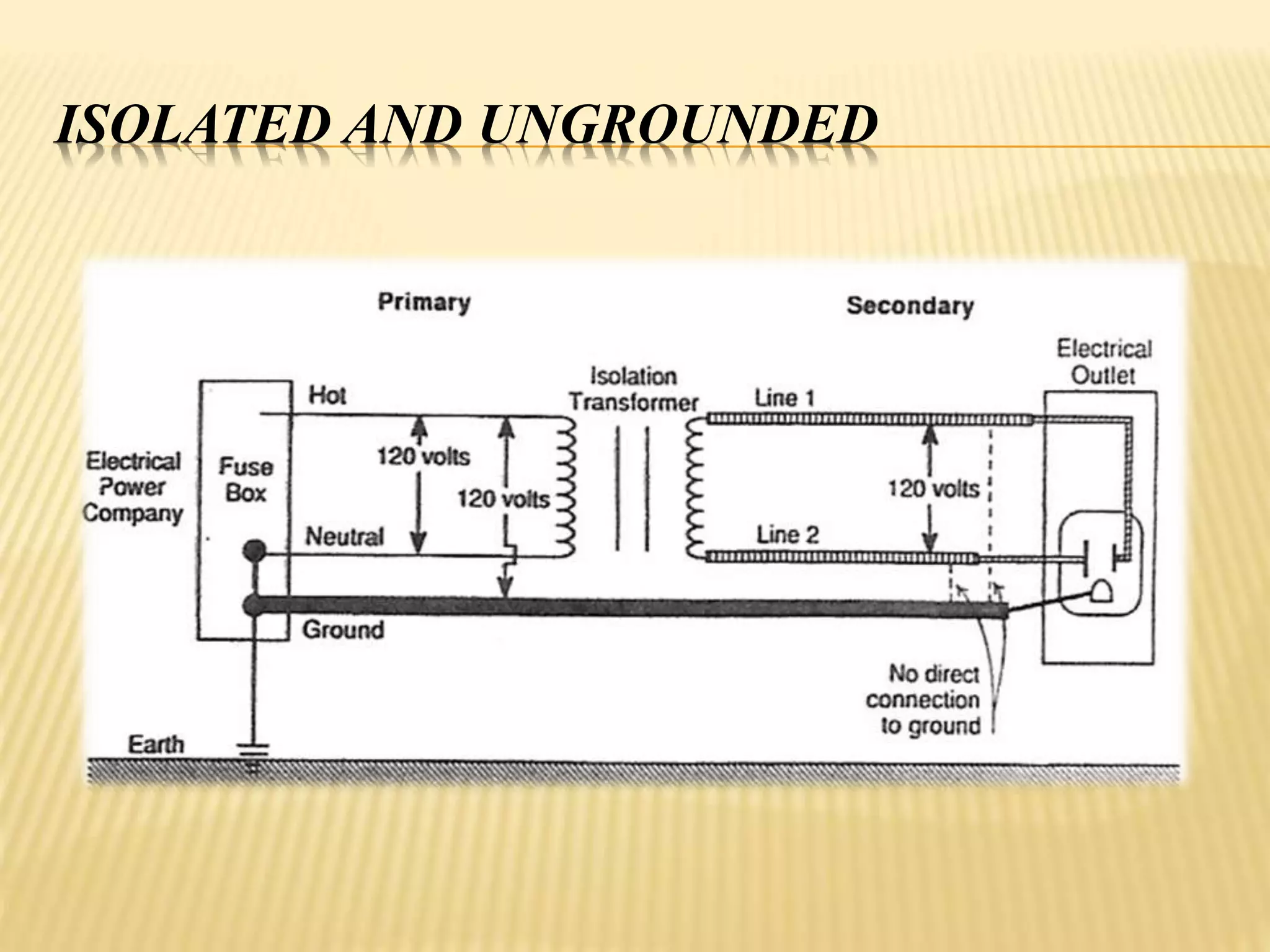
UNGROUNDING – ISOLATED POWER
 Isolated Power System provides protection from
Macroshock.
 Faulty equipment plugged into an isolated power system
does not present a shock hazard.
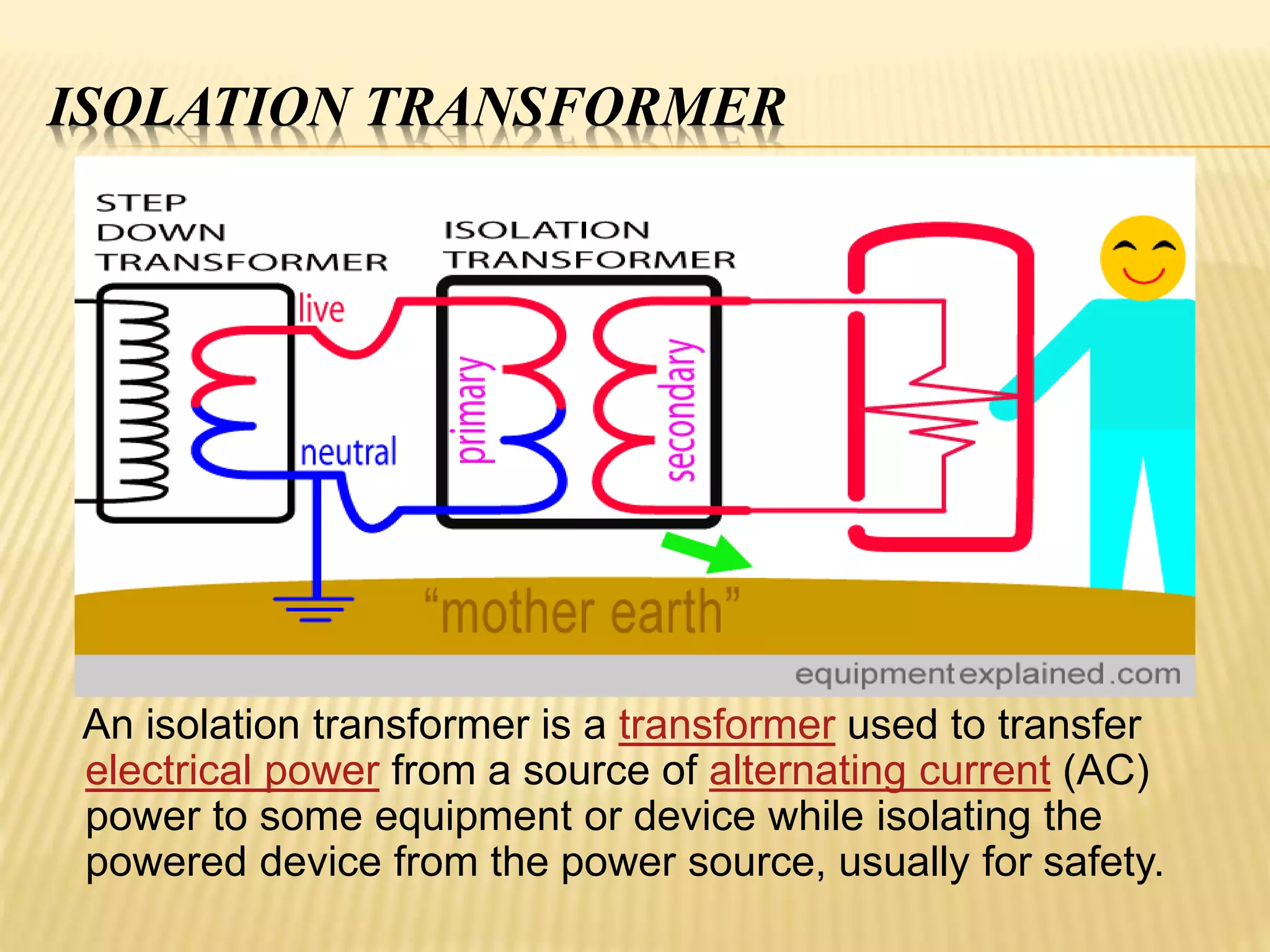
ISOLATION TRANSFORMER
An isolation transformer is a transformer used to transfer
electrical power from a source of alternating current (AC)
power to some equipment or device while isolating the
powered device from the power source, usually for safety.
ISOLATED AND UNGROUNDED
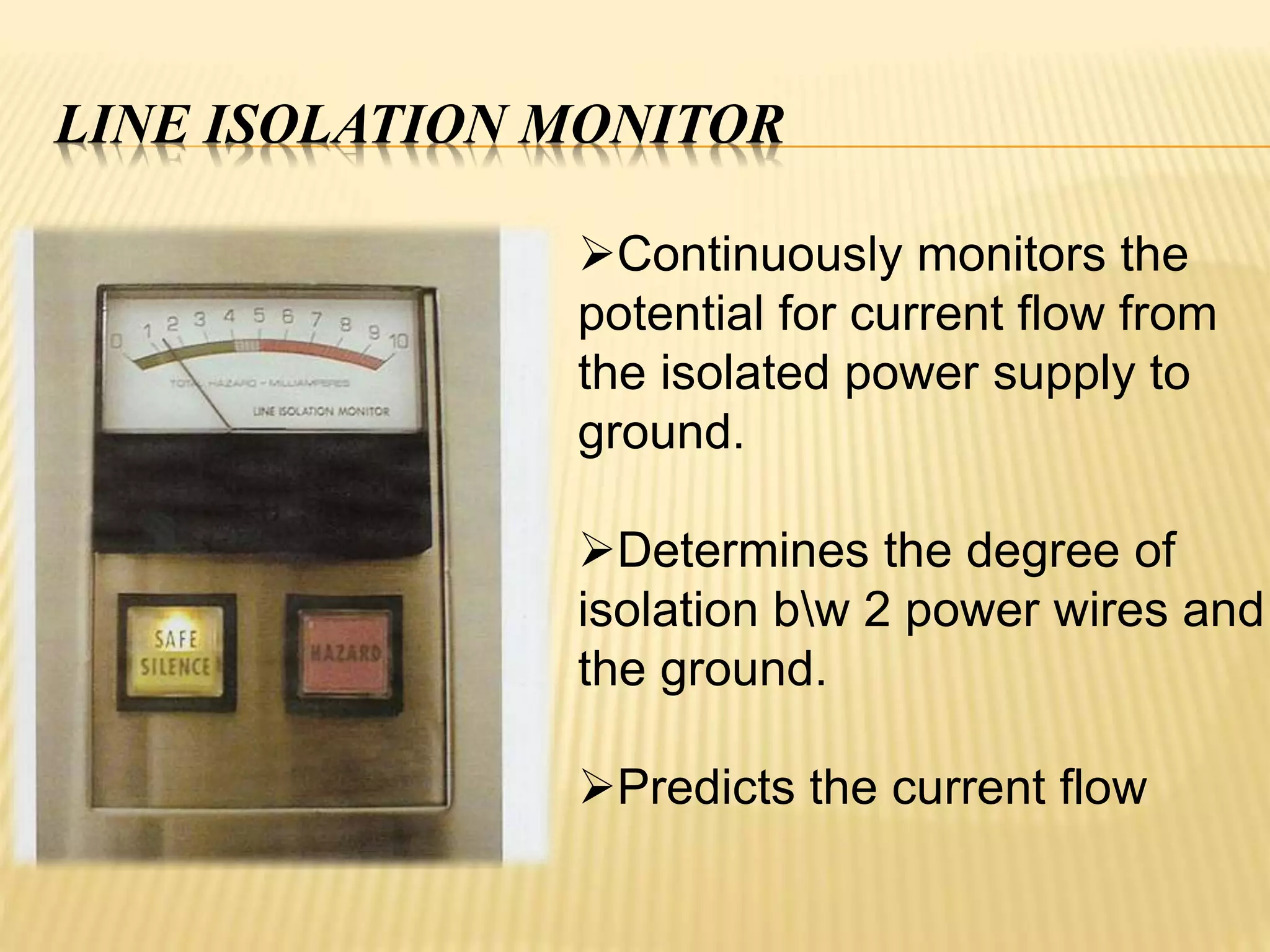
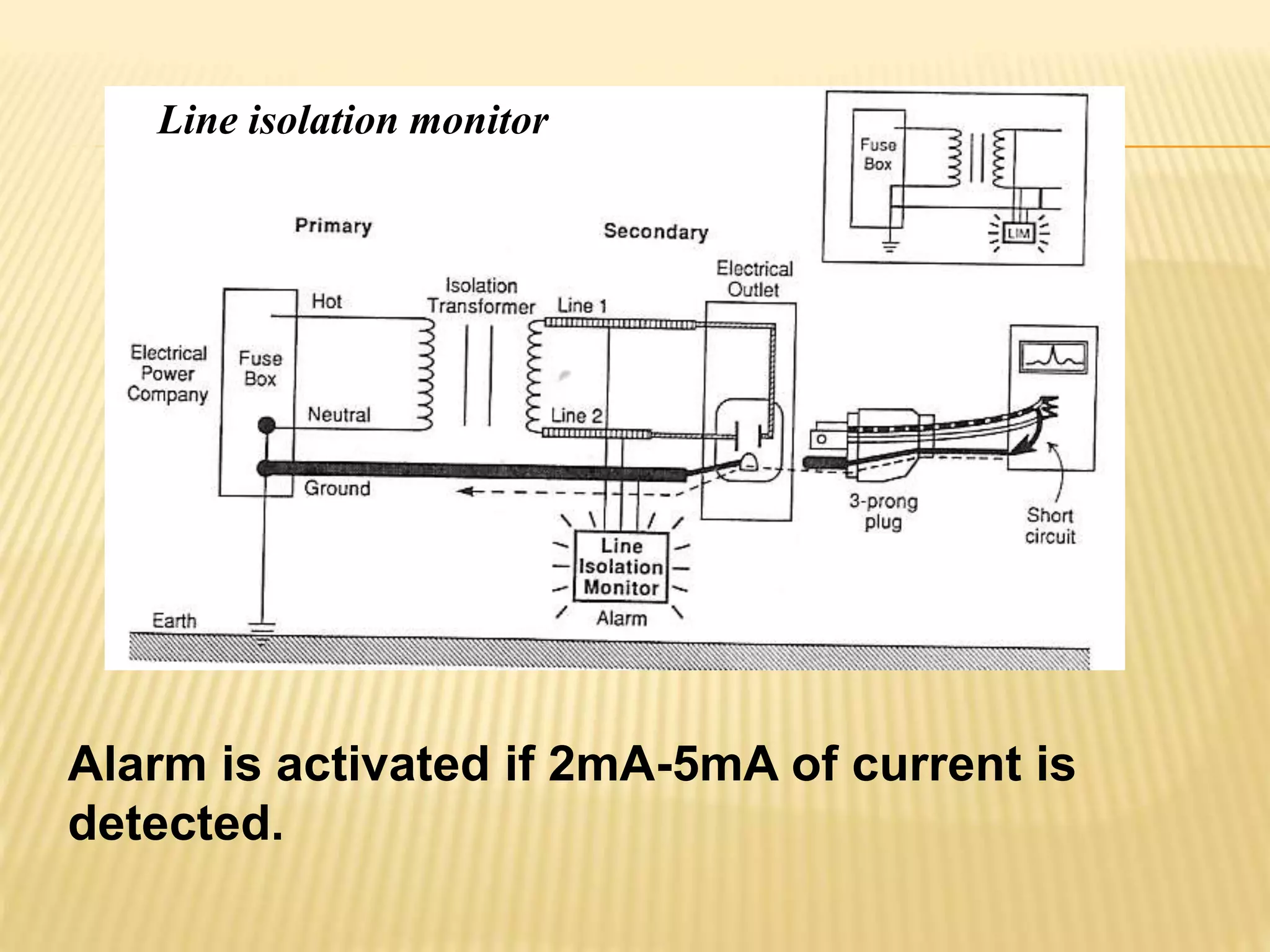
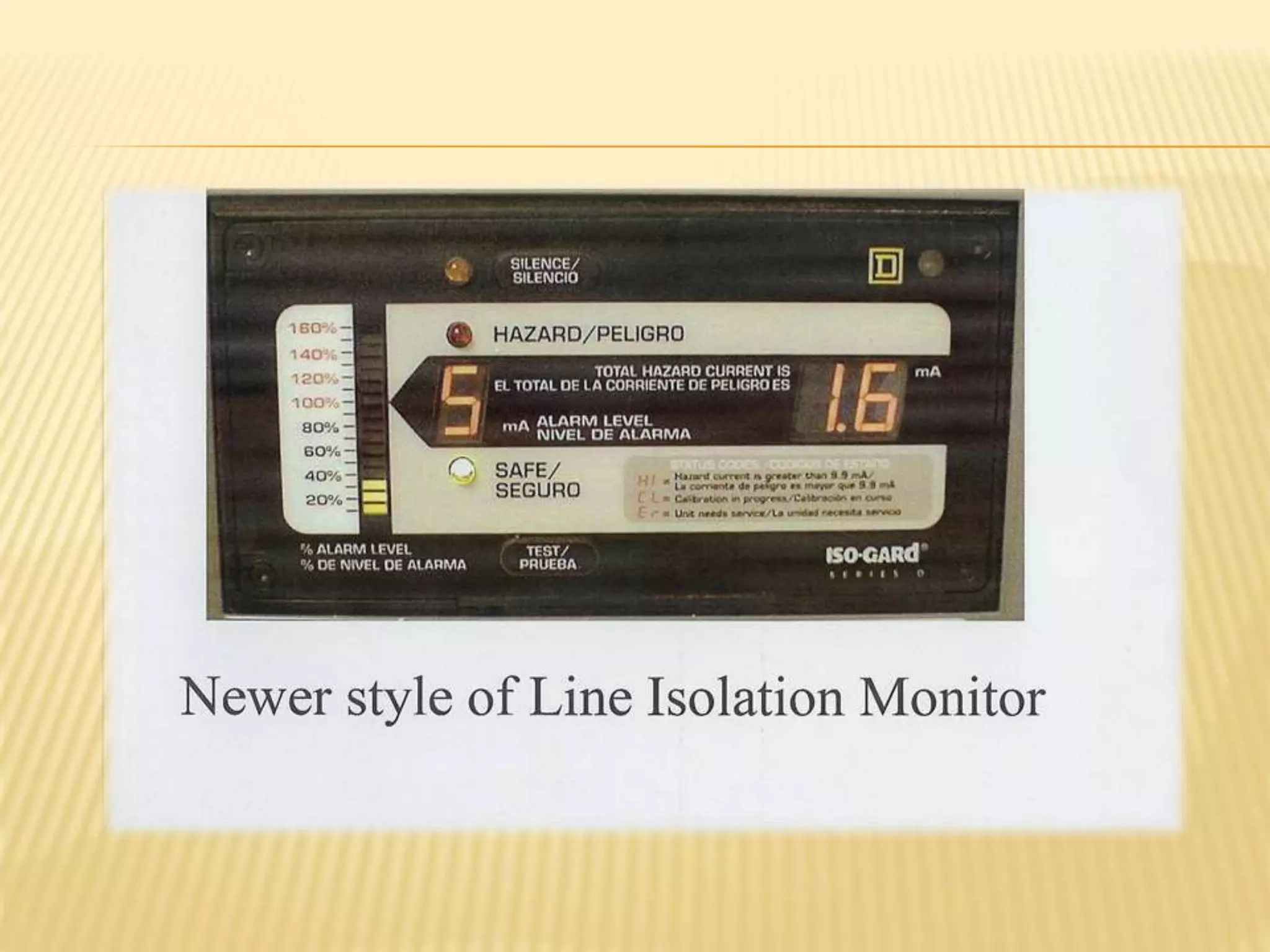
LINE ISOLATION MONITOR
Continuously monitors the
potential for current flow from
the isolated power supply to
ground.
Determines the degree of
isolation bw 2 power wires and
the ground.
Predicts the current flow
Alarm is activated if 2mA-5mA of current is
detected.
Line isolation monitor
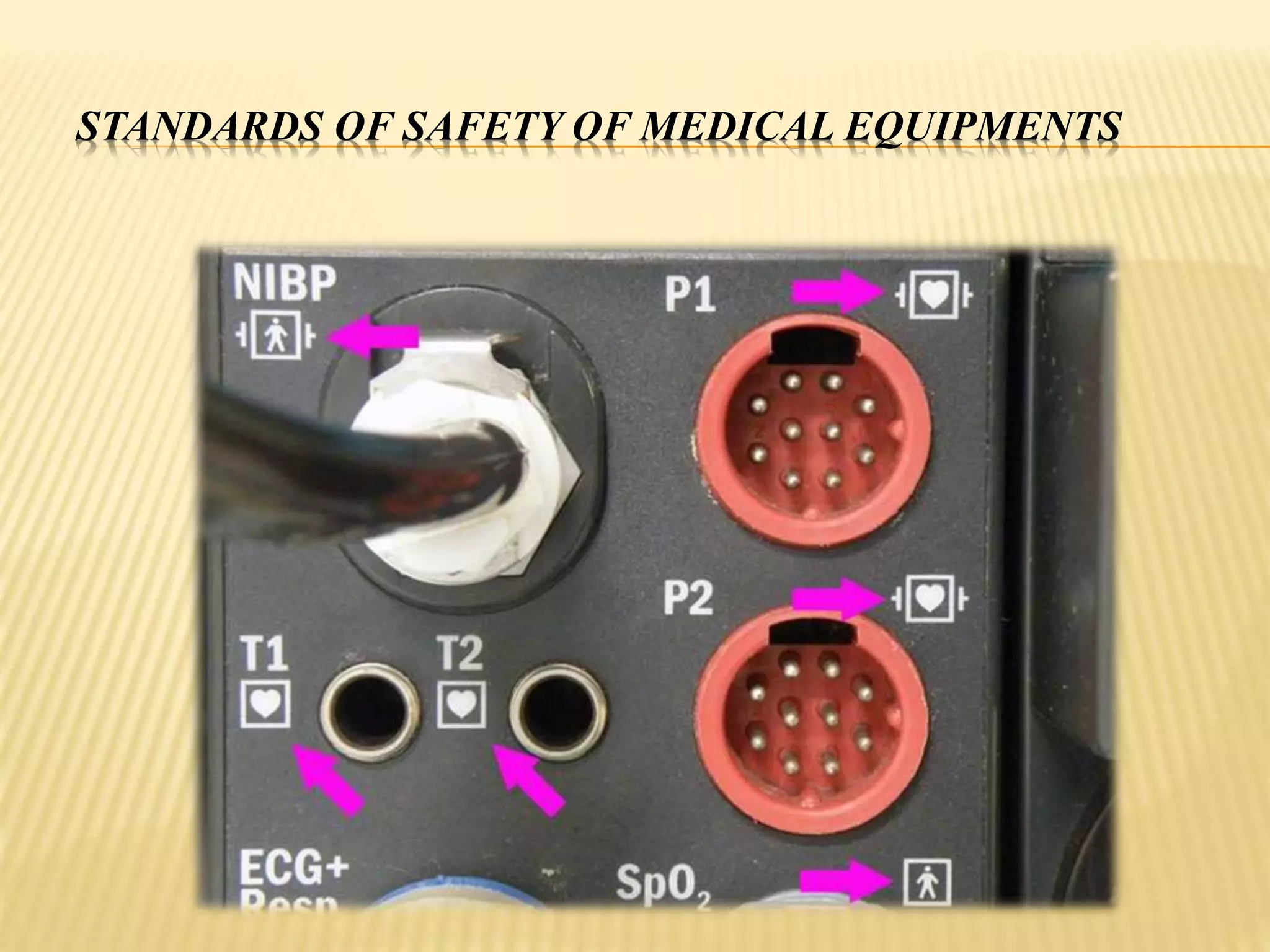
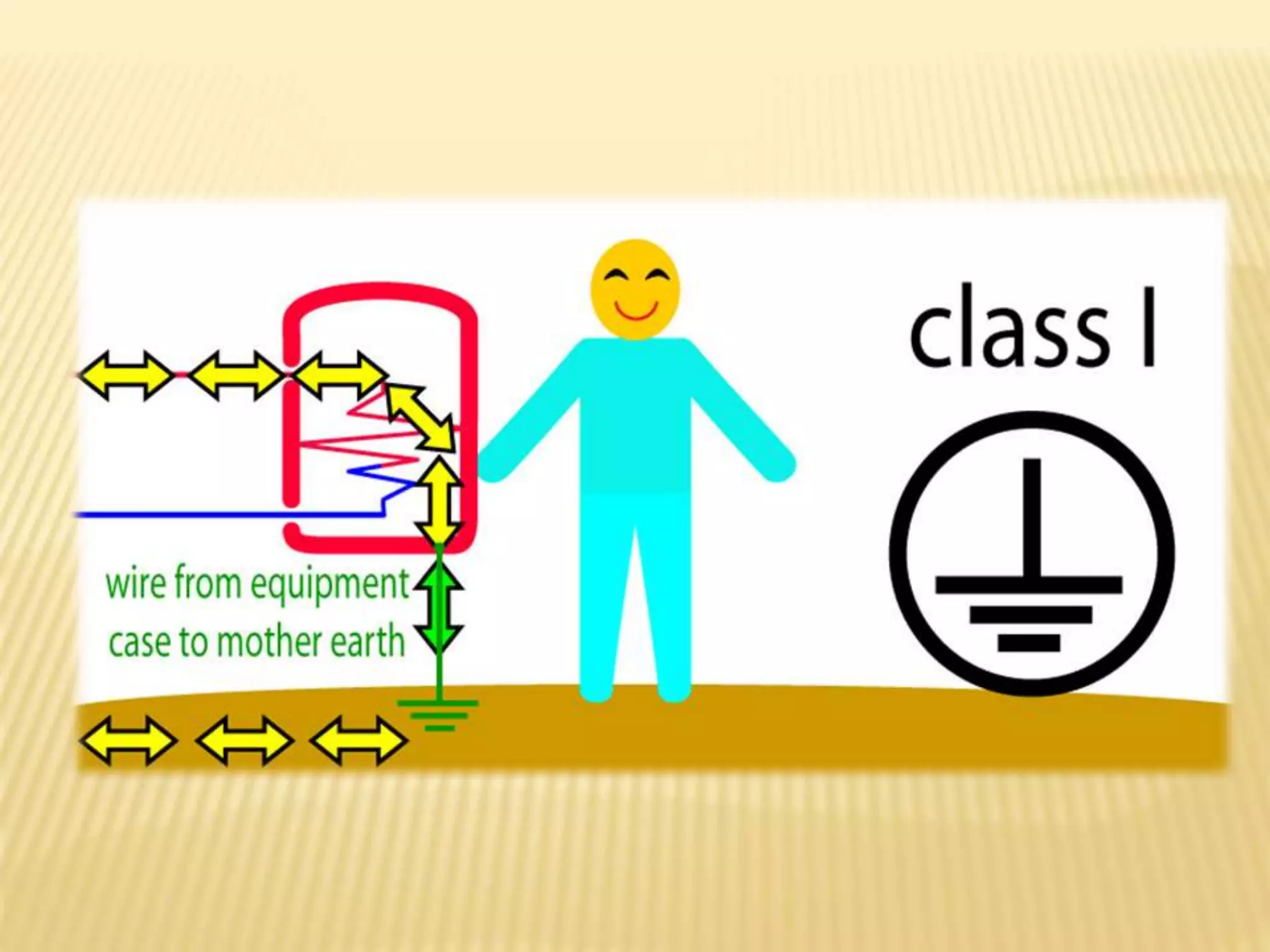
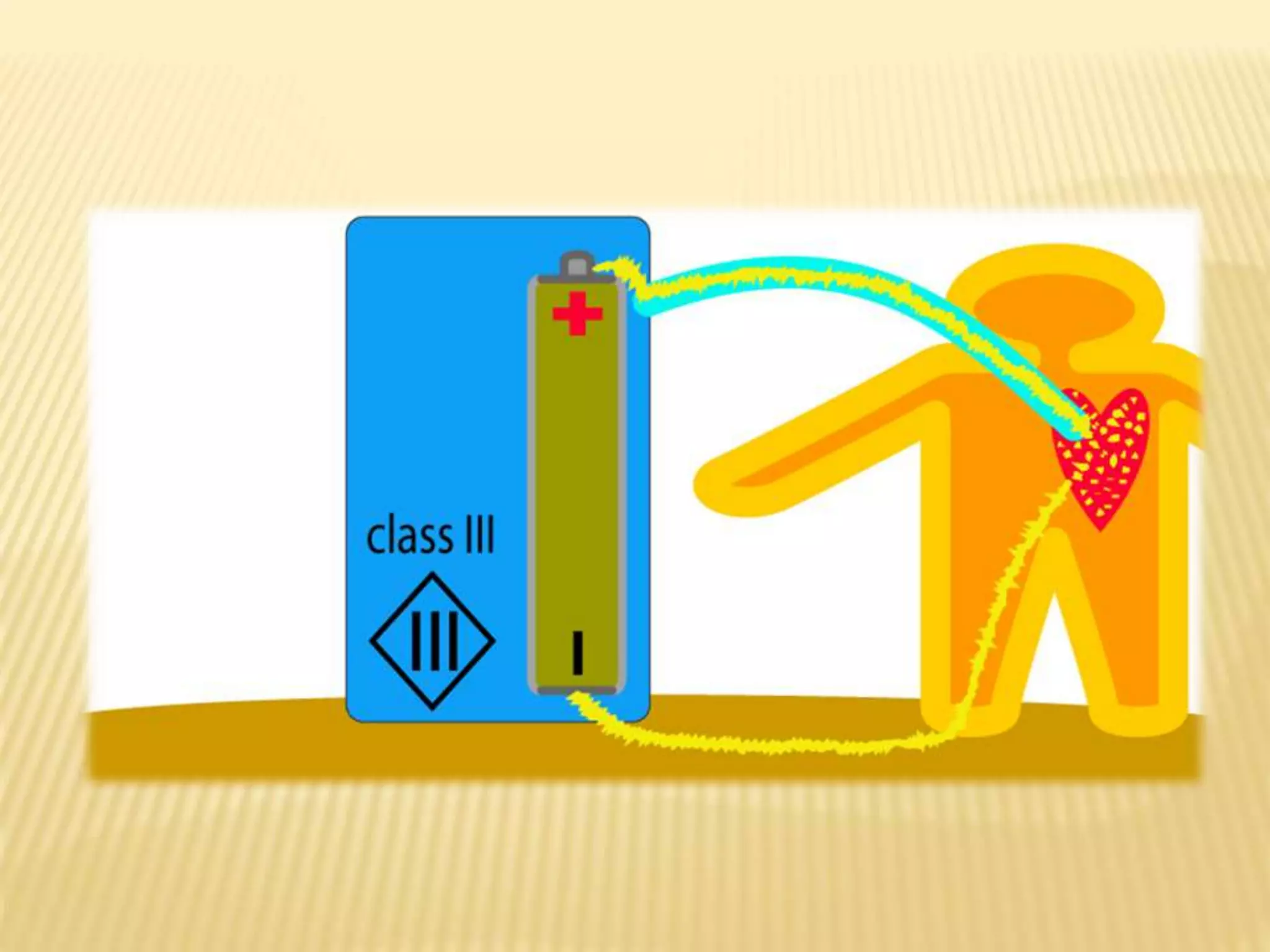
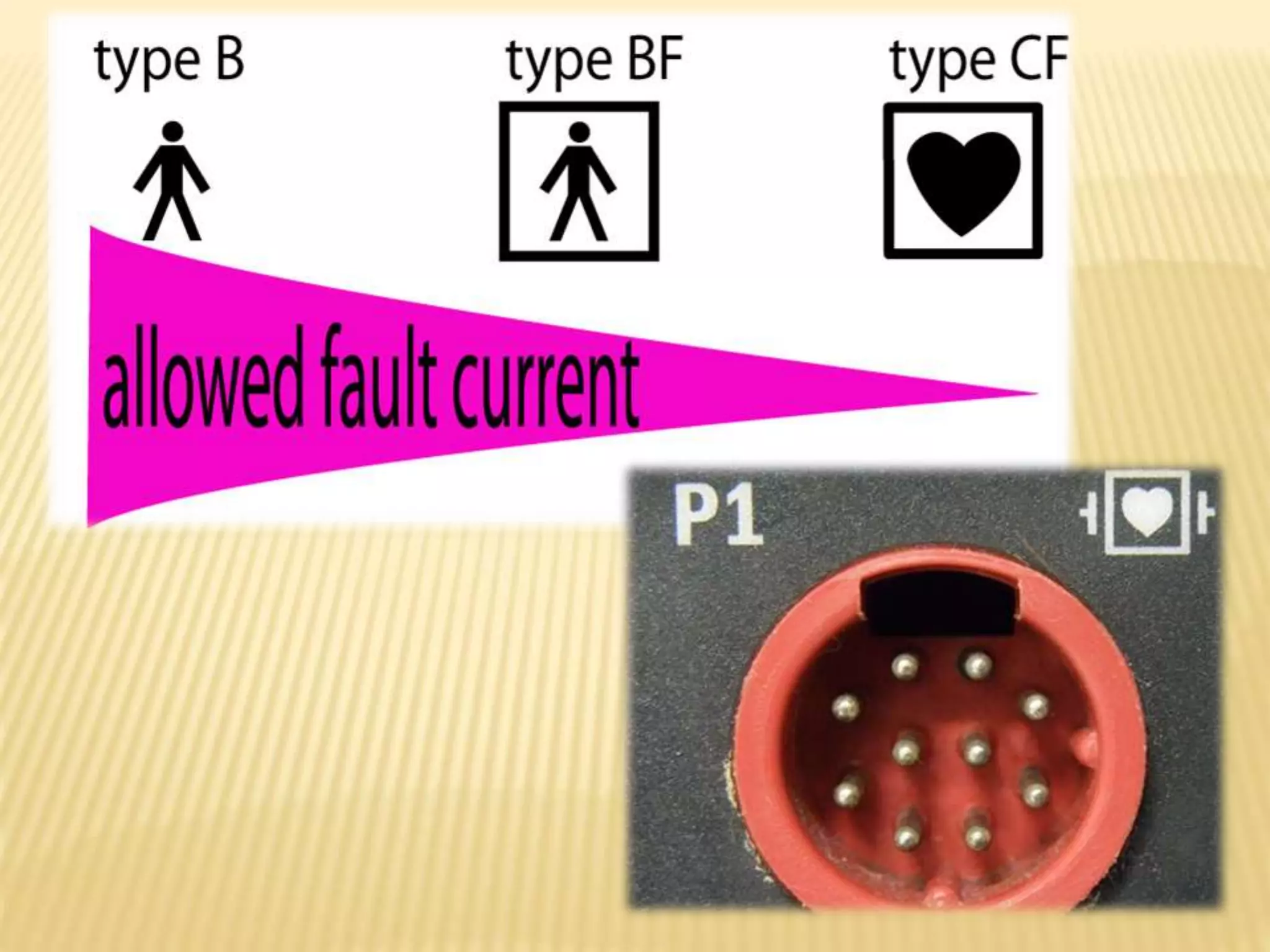
STANDARDS OF SAFETY OF MEDICAL EQUIPMENTS
British Standard symbols used on medical equipments-
SAFE WORK PRACTICES
While working with electric equipment need to use safe
work practices.
These include:
 Switch off electric equipment before inspecting or
making repairs
 Using electric tools that are in good condition
 Using appropriate protective equipment
CARE OF CORDS & EQUIPMENTS
 Power tools and extension cords must be inspected
each time they are used.
 They must be taken out of service immediately upon
discovery of worn or broken insulation.
DON’T
 Don’t plug in equipment
with wet hands
 Don’t plug in equipment
when cord is wet
 Don’t drape cords over hot or sharp
objects
 Don’t run cords where they cause
tripping hazard
 Don’t use extension cords unless
authorized
MANAGEMENT OF ELECTRICAL
HAZARDS
PERSONS AT RISK -
o PATIENT
o DOCTORS
o NURSING STAFF
o OTHER PERSONES PRESENT IN OPERATING
ROOM
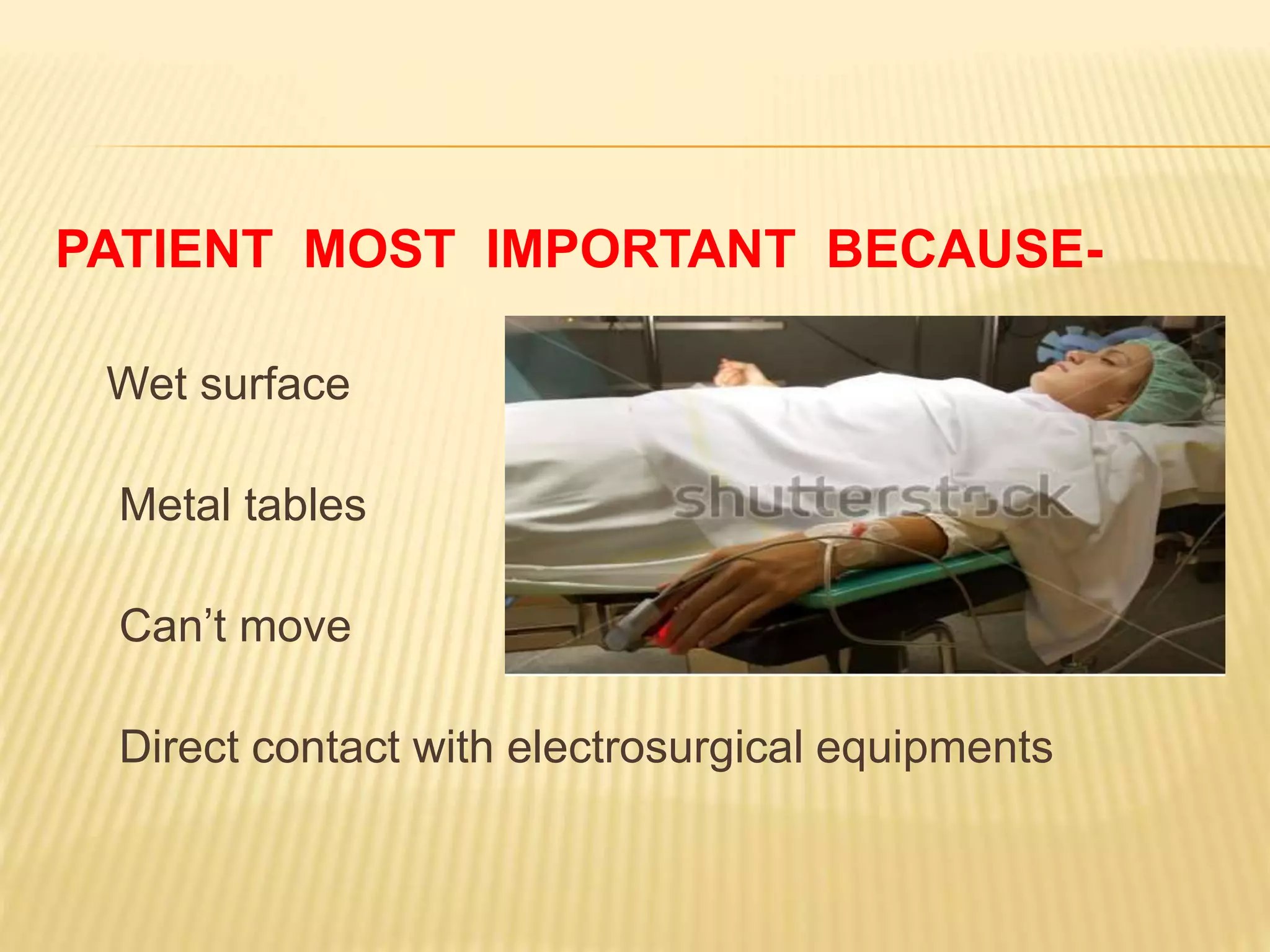
PATIENT MOST IMPORTANT BECAUSE-
Wet surface
Metal tables
Can’t move
Direct contact with electrosurgical equipments
GUPTA K, PREM KUMAR GV, BANSAL A, MEHTA Y
BURN INJURY BY DISPLACEMENT OF ELECTROCAUTERY PLATE.
INDIAN J ANAESTH [SERIAL ONLINE] 2011 [CITED 2013 FEB 2];55:634-5.
AVAILABLE
FROM: HTTP://WWW.IJAWEB.ORG/TEXT.ASP?2011/55/6/634/90636
ELECTROCAUTERY
PRINCIPLE
 High current enters body through small surface
area electrode i.e. cutting tool producing high
resistance R, small area, causes local tissue
heating which leads to cutting and coagulation.
 Operate at frequency approximately 300 kHz
to 2 MHz, to prevent cardiac arrhythmias.
UNIPOLAR VS BIPOLAR
 UNIPOLAR-
Electric current that enters in body travels
through the body and collected outside
surgical field by grounding pad.
 BIPOLAR-
Current enters in body through one electrode
collected millimeters away from second
identical electrode .
PRECAUTIONS
GROUNDING PAD - Wide area, well jelled
and with good contact with body.
Unipolar cautery should be avoided in
neurosurgery patient and patient with AICD.
Remove all metal
ornaments such as ear
rings and bangles.
 IF present, keep the
grounding pad on
same side of surgery
NOT on OPPOSITE
side.
 RECONCENTRATION
ELECTRO-QUATERY WITH LARGE CONTACT
ELECTRO-QUATERY WITH POOR CONTACT
ELECTROCAUTERY WITH AICD-
RESPONSE TO CAUTERY—
Inhibition of pacing.
Asynchronous pacing.
Reset to backup mode.
Ventricular fibrillation .
Myocardial burns rare.
PRECAUTIONS TO BE TAKEN-
 Use bipolar cautery.
 Limit use to minimal.
 Use grounding pad close to operative site and
away from pacemaker site.
 Do not use cautery within 15 cm of pacemaker
site .
 Frequency of cautery should be limited for 1 sec
burst every 10 sec.
 Pacemaker should be changed to asynchronous
mode by magnet or by programmer before using
cautery.
 Provision of alternate temporary pacing should be
there in operative room.
 Drugs like ISOPROTERENOL , ATROPINE should
be available.
 Defibrillation – paddles should be kept as far as
possible from pulse generator , if possible antero
posterior.
 Pacemaker devise should be rechecked after
procedure.
Abdelmalak B, Jagannathan
N, Arain FD, Cymbor S,
McLain R, Tetzlaff JE
Electromagnetic interference
in a pacemaker during
cauterization with the
coagulating, not cutting
mode.
J Anaesthesiol Clin
Pharmacol [serial online]
2011 [cited 2013 Feb
2];27:527-30. Available
from: http://www.joacp.org/te
xt.asp?2011/27/4/527/86600
ABSTRACT
 Electromagnetic interference in pacemakers has almost always been
reported in association with the cutting mode of monopolar
electrocautery and rarely in association with the coagulation mode.
 We report a case of electrocautery-induced electromagnetic
interference with a DDDR pacemaker (dual-chamber paced, dual-
chamber sensed, dual response to sensing, and rate modulated) in the
coagulating and not cutting mode during a spine procedure. We also
discuss the factors affecting intraoperative electromagnetic interference.
 A 74-year-old man experienced intraoperative electromagnetic
interference that resulted in asystole caused by surgical electrocautery
in the coagulation mode while the electrodispersive pad was placed at
different locations and distances from the operating site (This
electromagnetic interference did not occur during the use of the cutting
mode). However, because of careful management, the outcome was
favorable. Clinicians should be aware that the coagulation mode of
electrocautery can cause electromagnetic interference and
hemodynamic instability. Heightened vigilance and preparedness can
ensure a favorable outcome.
Figure 1: Patient's electrocardiogram (EKG) tracing and arterial line
wave form showing normal sinus rhythm with good perfusion prior to
the application of electrocautery
Patient's electrocardiogram (EKG) tracing and arterial line wave
form showing bradycardia evolving to asystole as a result of EMI
during electrocauterization with coagulation mode while the
electrodispersive pad was on the opposite shoulder of the
pacemaker. A similar response was seen when the electrodispersive
pad was moved to the contralateral thigh
Patient's electrocardiogram (EKG) tracing and arterial line wave
form showing minimal EMI not affecting arterial line tracing during
electrocauterization with cutting mode while the electrodispersive
pad was on the contralateral thigh
DEFIBRILLATORS-
 Defibrillators are one of the most important thing in operating
room.
 If improperly used it may lead to electrical injuries
COMMON MISTAKES –
 Insufficient force is applied to paddles and contact is poor.
 paddles applied to irregular surface or bony prominences.
 Insufficient or wrong kind of jell is used.
 Another conductive medium between paddles.
PREVENTION-
 Defibrillator should be checked daily.
 Adequate jelly should be applied.
 Skin contact should be good as indicated by
indicator on pads.
 Ensure there is no other conductive medium .
 Before delivering shock check and say clearly and
loudly
“ I CLEAR, YOU CLEAR, EVERYBODY CLEAR”.
MRI ROOM-
 One of potential space for electrical accidents.
 Routine equipments cant be used.
 Magnetic field can induce changes in ECG along with
heating and thermal injuries at the site of ECG
electrode and pulse oxymeter- ANTENNA EFFECT.
 Cardio scope and pulse oxymeter wire should be
kept straight , avoid loops and multiple contacts with
patient.
 Use MRI compatible pulse oxymeter with fiber optic
signal linking between sensor and monitor.
 Temperature probe with RF filter should be used.
 Absolute exclusion of ferromagnetic material .
SAFETY MEASURES-
 Regular check of all electrical equipments.
 Team work- Involvement of surgeon, anaesthetist,
nursing staff along with biomedical engineering
department.
 Proper checklist before every procedure.
 Proper grounding.
 Fire plans.
GENERAL PRECAUTIONS-
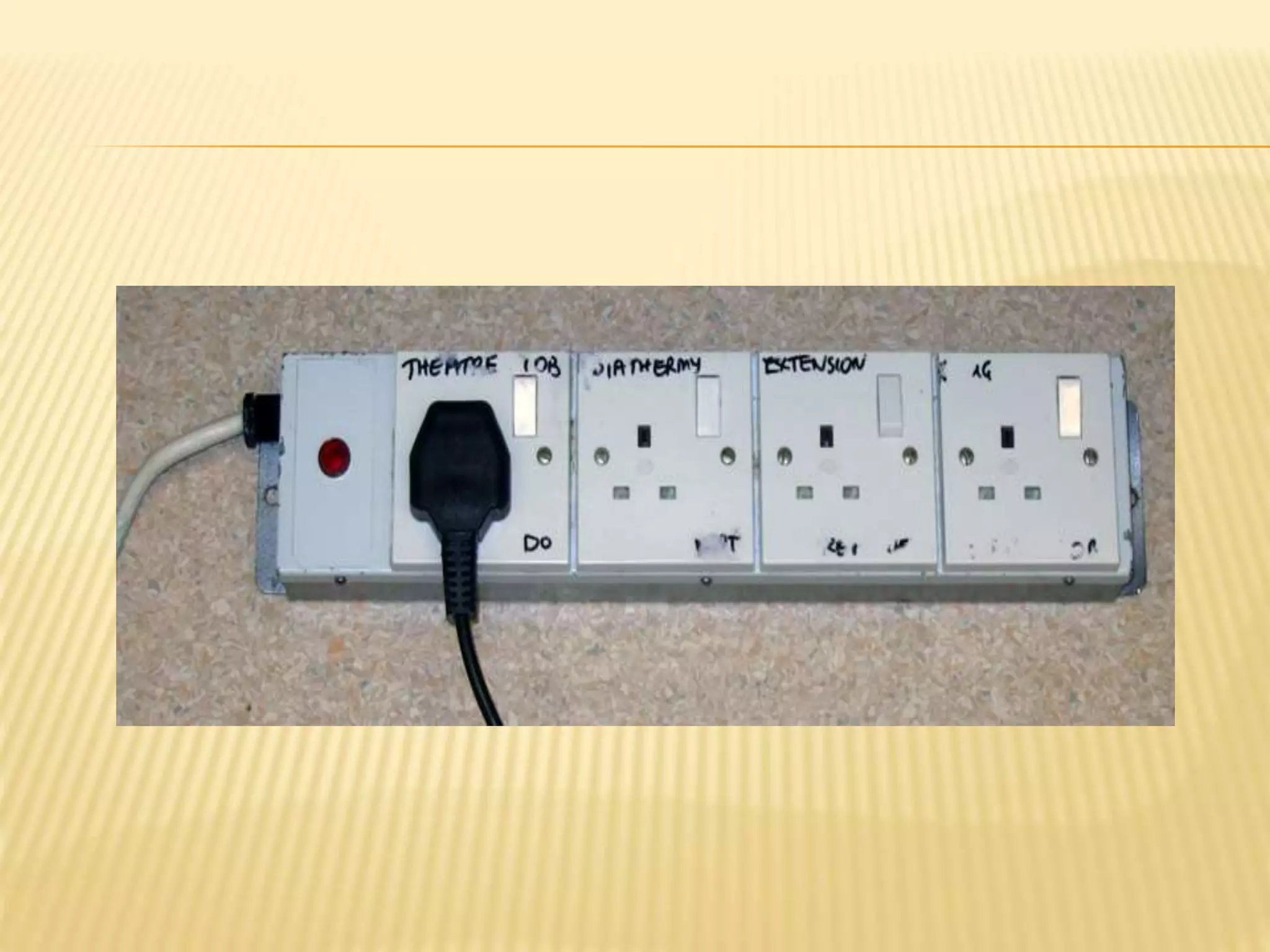
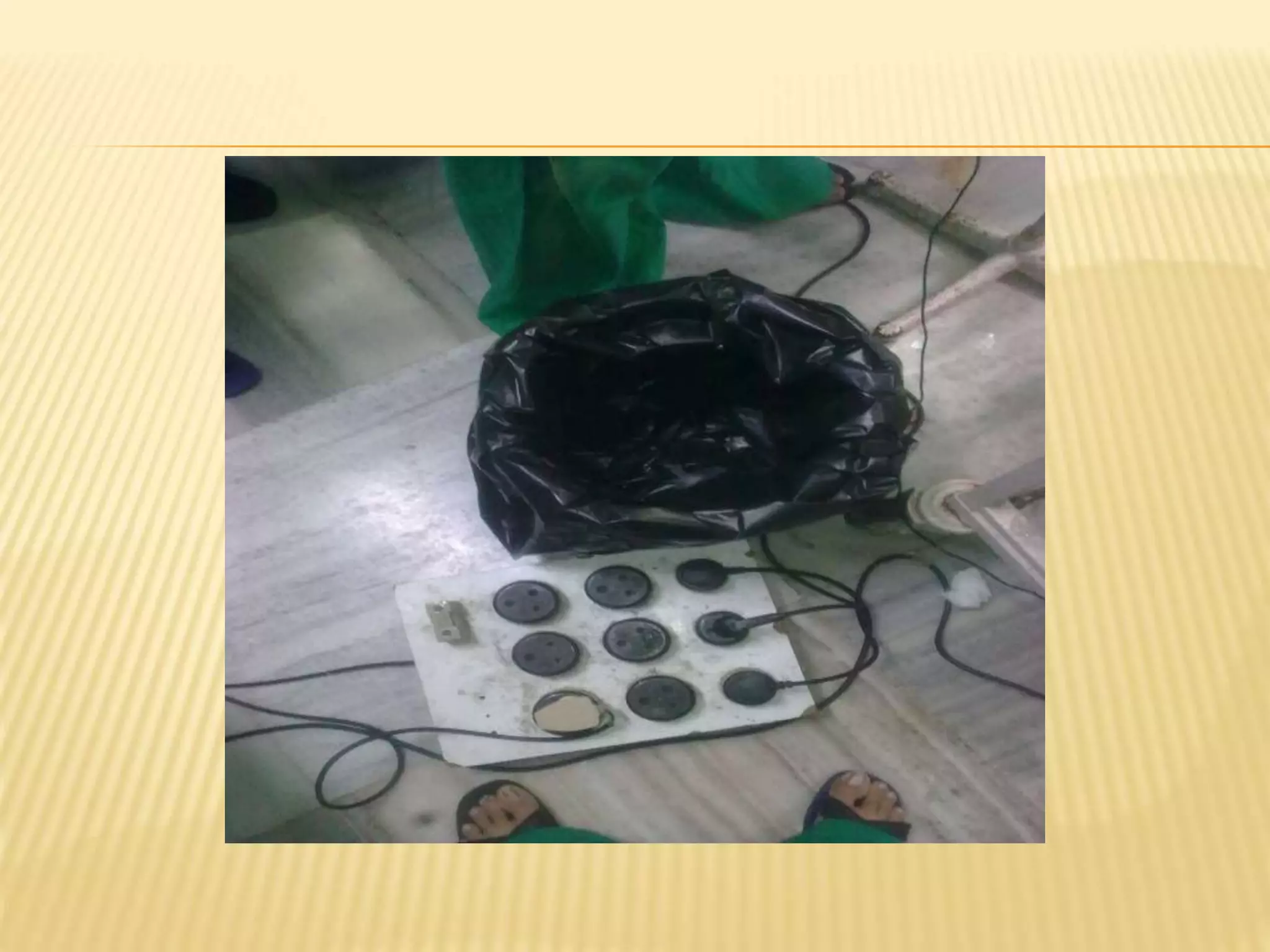
 Multiple plugs extension boxes should not be placed
on floors as they may come in contact with fluid and
electrolyte solutions.
 Ceiling mounted tracks can be used to bring
electrical outlet close to operating table.
 Power chords that come down the wall should not
cross traffic lines.
 Power taps in operating room should have water tight
or flip covers so that water should not enter in it
 Electrosurgical and laser units may interfere with
operation of other equipments , so should be away from
monitors.
 Electrosurgical equipments and monitors should be
attached in separate circuit.
 Electrosurgical equipments and monitors should be
periodically inspected by biomedical engineering
department.
 This equipments should be regularly calibrated.
 Wear and tear of chords should be regularly checked
and replaced.
 Monitors should be handled with respect.
 Infusion pump should be draped with watertight
covers .
 Care should be taken while moving equipments.
Work shouldn’t be
THANK YOU

Electrical safety in OR

  • 1.
    Dr. Pallavi Dr. Sanjay Dr.Suresh Dr. Setuvarun Dr. Yamini Seth G.S.M.C. & K.E.M.H. ELETRICAL SAFETY IN OPEARTING ROOM
  • 4.
    CURRENT (I) –amperes (A) VOLTAGE DIFFERENCE (V) - volts RESISTANCE (R)- ohms I
  • 5.
  • 6.
  • 7.
  • 9.
    HOW CAN ELECTRICITYFLOW THROUGH BODY? Two ways:  Resistive coupling  Capacitive coupling
  • 10.
    RESISTIVE COUPLING When thebody makes a direct physical connection with the electrical circuit, its due to resistive coupling. • Faulty equipments • Leakage current
  • 11.
    CAPACITIVE COUPLING Body actslike a capacitor, which stores the electrical charge. In case of direct current, current flows for a brief period until the source and receiver are at same potential. In case of alternating current, body would continuously charge and discharge, and current will continuously flow.
  • 12.
    ELECTRICAL CURRENT EXISTSIN 2 FORMS :  Direct Current (DC)- Electrons flow in only one direction. Used in certain medical equipment: defibrillators, pacemakers, electrical scalpels.  Alternating Current (AC)- Electrons flow back and forth through a conductor in a cyclic fashion It is used in household and offices and is standardized to a frequency of 60 cycles/sec (60 Hz) AC is far more efficient and also more dangerous than DC (~ 3 times): tetanic muscle contractions that prolong the contact of victim with source
  • 13.
    DETERMINANTS OF ELECTRICALINJURIES  Current density  Current intensity  Tissue resistance
  • 14.
    The pathway thatcurrent takes through the body will determine which tissues are damaged. The effect of the size of current and current pathway can be considered together as current density. This is the amount of current flowing per unit area. Macroshock current is distributed somewhat evenly through body parts. Microshock current path is through a single point, usually the heart Term used to describe the very low level shocks that go undetected
  • 15.
    For example, a50 Hz alternating current flowing between each hand the current has passed through the whole of the trunk with only a small part of it passing through the heart, i.e. the myocardial current density is relatively low. However, if the current flows directly into the myocardium (or in very close proximity to it), for any given current, the current density will be much greater. In these circumstances, a substantially smaller current (50 μA at 50 Hz) can cause ventricular fibrillation.
  • 16.
    MICROSHOCK  Dangerous toan “electrically sensitive” patient - with breaks in skin like abrasions, wet dressings, pacemakers, or monitoring lines connected to a transducer. Examples of equipment that may allow microshock include central venous catheters, intracardiac pacemakers with an external lead and, to a lesser extent, a temperature probe placed in the oesophagus immediately behind the left atrium.
  • 18.
     Nerves andblood vessels are the best conductors: path of least resistance for current after it enters the body  The least resistance is found in nerves, blood, mucous membranes and muscles  The highest resistance is found in bones, fat and tendons  Skin’s resistance ranging between 40,000 and 100,000 Ω depending on thickness  Moist mucus membranes: significant orofacial injury to infants and toddlers Exposure of different parts of the body to the same voltage >> same current >> different degree of damage because resistance varies.
  • 19.
    ELECTRICAL INJURY TOSPECIFIC TISSUES & ORGANS Cardiovascular System-  Direct necrosis of the myocardium- Focal or diffuse Widespread, discrete, patchy contraction band necrosis involving the myocardium, nodal tissue, conduction pathways and coronary arteries  Cardiac dysrhythmias- AC > 50-100 mA with hand-to-hand or hand-to-foot transmission > ventricular fibrillation High-voltage current (AC or DC) > ventricular asystole
  • 20.
    Possible mechanisms: 1) Arrythmogenicfoci due to myocardial necrosis (esp. SA Node injury) 2) Alterations in the Na+ - K+ adenosine triphosphatase concentration 3) Changes in the permeability of myocyte membranes 4) Anoxic injury (respiratory arrest precedes the injury to the heart)
  • 21.
     Large arteriesnot acutely affected because their rapid flow dissipate heat. Medial necrosis: aneurysm formation and rupture  Smaller vessels acutely affected due to coagulation necrosis  compartment syndrome
  • 22.
    NERVOUS SYSTEM  Lossof conciousness, confusion & impaired recall  Peripheral motor & sensory nerves > motor & sensory deficits  Seizures, visual disturbances & deafness  Hemiplegia, quadriplegia, spinal cord injury  Transient paralysis, autonomic instability > hypertension, peripheral vasospasm due to lightning from massive release of catecholamines
  • 23.
    RESPIRATORY SYSTEM  Directinjury to the respiratory control center >> cessation of respiration or suffocation secondary to tetanic contractions of the respiratory muscles  Acute respiratory dysfunction syndrome secondary to ischemia, aggressive fluid resuscitation, ventilator-associated pneumonia
  • 24.
    OTHER SYSTEMS  Kidneyssusceptible to anoxic/ischemic injury  Release of myoglobin & creatinine phosphokinase > renal tubular damage > renal failure  Fractures  Transient autonomic disturbances > fixed pupils may be perceived as severe brain injury or even death  Temporary sensorineural hearing loss
  • 25.
  • 26.
  • 27.
    PREVENTING ELECTRICAL HAZARDS Electricalaccidents appear to be caused by a combination of three possible factors: 1. unsafe equipment and/or installation, 2.unsafe by environment, 3. and unsafe work practices.
  • 28.
    PREVENTING ELECTRICAL HAZARDS Theseinclude:  Insulation  Guarding  Grounding  Electrical protective devices:  Fuses & circuit breakers  Ground fault circuit interrupter  Isolation transformer & Line isolation monitor  Safe work practices
  • 29.
    INSULATION  One wayto safeguard individuals from electrically energized wires and parts is through insulation.  An insulator is any material with high resistance to electric current.
  • 30.
     Insulators suchas glass, mica, rubber, and plastic,  Before you prepare to work with electric equipment, it is imperative to check the insulation  The insulation of flexible cords, such as extension cords, is particularly vulnerable to damage.
  • 31.
     Electrical Powercan exist in two forms-  GROUNDED  UNGROUNDED
  • 32.
    GROUNDING  The "ground"refers to a conductive body, usually the earth, and means a conductive connection, whether intentional or accidental, by which an electric circuit or equipment is connected to earth or the ground plane.  Method of protecting from electric shock.  Secondary protective measure.  By "grounding" a tool or electrical system, a low- resistance path to the earth is intentionally created.
  • 33.
  • 34.
    GROUNDING  Think aboutyour house:  2 prong outlets = no ground  3 prong outlets = grounded  Modern homes have a ground to reduce amount of shock
  • 35.
  • 36.
  • 37.
     Low resistanceand has sufficient current carrying capacity to prevent the buildup of voltages that may result in a personnel hazard.  This does not guarantee that no one will receive a shock, be injured, or be killed.  It will, however, substantially reduce the possibility of such accidents.
  • 38.
    One of theseis called the "service or system ground." This type of ground is primarily designed to protect machines, tools, and insulation against damage. There are 2 types of grounding required -
  • 39.
    To offer enhancedprotection, an additional ground, called the "equipment ground" This additional ground safeguards the electric equipment operator in the event that a malfunction causes any metal on the tool to become accidentally energized. The resulting heavy surge of current will then activate the circuit protection devices and open the circuit.
  • 40.
    EXTREMELY IMPORTANT  Neverremove a grounding device from any electrical source, tool, or equipment.  Never remove the ground prong from an electrical cord or device of any kind.  Never by-pass grounding or circuit breaker protection as any time.  If you find any of the above have occurred, repair and / or report immediately.
  • 41.
    CIRCUIT PROTECTION DEVICES Circuit protection devices are designed to automatically limit or shut off the flow of electricity in the event of a ground-fault, overload, or short circuit in the wiring system.  Fuses, circuit breakers, ground-fault circuit interrupters, isolation transformer and line isolation monitor
  • 42.
    CIRCUIT PROTECTION DEVICES Fuses& circuit breakers- monitor the amount of current that the circuit will carry.  Fuses are designed to melt when too much current flows through them.  Circuit breakers, on the other hand, are designed to trip open the circuit by electro-mechanical means.
  • 43.
    They prevent over-heatingof wires and components that might otherwise create hazards for operators. They also open the circuit under certain hazardous ground-fault conditions. Fuses & circuit breakers-
  • 44.
    GUARDING Live parts ofelectric equipment operating at 50 volts or more must be guarded against accidental contact. This is accomplished by:  Location in a room, vault, or similar enclosure accessible only to qualified persons  Use of permanent, substantial partitions or screens to exclude unqualified persons  Elevation of 8 feet (2.44 meters) or more above the floor.
  • 45.
    GROUND FAULT CIRCUITINTERRUPTER  The ground-fault circuit interrupter, or GFCI, is designed to shutoff electric power within as little as 1/40 of a second.  It works by comparing the amount of current going to electric equipment against the amount of current returning from the equipment along the circuit conductors.  If the current difference exceeds 6 milliamperes, the GFCI interrupts the current quickly enough to prevent electrocution.
  • 46.
  • 47.
    UNGROUNDING  The ORhas many perils that make grounding impracticle.  Saline puddles  Power cords with tears in their insulation (colored part of cord)  Numerous electronic devices that  risk
  • 48.
    UNGROUNDING – ISOLATEDPOWER  Isolated Power System provides protection from Macroshock.  Faulty equipment plugged into an isolated power system does not present a shock hazard.
  • 49.
    ISOLATION TRANSFORMER An isolationtransformer is a transformer used to transfer electrical power from a source of alternating current (AC) power to some equipment or device while isolating the powered device from the power source, usually for safety.
  • 50.
  • 51.
    LINE ISOLATION MONITOR Continuouslymonitors the potential for current flow from the isolated power supply to ground. Determines the degree of isolation bw 2 power wires and the ground. Predicts the current flow
  • 52.
    Alarm is activatedif 2mA-5mA of current is detected. Line isolation monitor
  • 54.
    STANDARDS OF SAFETYOF MEDICAL EQUIPMENTS
  • 55.
    British Standard symbolsused on medical equipments-
  • 65.
    SAFE WORK PRACTICES Whileworking with electric equipment need to use safe work practices. These include:  Switch off electric equipment before inspecting or making repairs  Using electric tools that are in good condition  Using appropriate protective equipment
  • 66.
    CARE OF CORDS& EQUIPMENTS  Power tools and extension cords must be inspected each time they are used.  They must be taken out of service immediately upon discovery of worn or broken insulation.
  • 72.
    DON’T  Don’t plugin equipment with wet hands  Don’t plug in equipment when cord is wet  Don’t drape cords over hot or sharp objects  Don’t run cords where they cause tripping hazard  Don’t use extension cords unless authorized
  • 73.
  • 74.
    PERSONS AT RISK- o PATIENT o DOCTORS o NURSING STAFF o OTHER PERSONES PRESENT IN OPERATING ROOM
  • 75.
    PATIENT MOST IMPORTANTBECAUSE- Wet surface Metal tables Can’t move Direct contact with electrosurgical equipments
  • 76.
    GUPTA K, PREMKUMAR GV, BANSAL A, MEHTA Y BURN INJURY BY DISPLACEMENT OF ELECTROCAUTERY PLATE. INDIAN J ANAESTH [SERIAL ONLINE] 2011 [CITED 2013 FEB 2];55:634-5. AVAILABLE FROM: HTTP://WWW.IJAWEB.ORG/TEXT.ASP?2011/55/6/634/90636
  • 77.
  • 78.
    PRINCIPLE  High currententers body through small surface area electrode i.e. cutting tool producing high resistance R, small area, causes local tissue heating which leads to cutting and coagulation.  Operate at frequency approximately 300 kHz to 2 MHz, to prevent cardiac arrhythmias.
  • 79.
    UNIPOLAR VS BIPOLAR UNIPOLAR- Electric current that enters in body travels through the body and collected outside surgical field by grounding pad.  BIPOLAR- Current enters in body through one electrode collected millimeters away from second identical electrode .
  • 80.
    PRECAUTIONS GROUNDING PAD -Wide area, well jelled and with good contact with body. Unipolar cautery should be avoided in neurosurgery patient and patient with AICD.
  • 81.
    Remove all metal ornamentssuch as ear rings and bangles.  IF present, keep the grounding pad on same side of surgery NOT on OPPOSITE side.  RECONCENTRATION
  • 82.
  • 83.
  • 84.
    ELECTROCAUTERY WITH AICD- RESPONSETO CAUTERY— Inhibition of pacing. Asynchronous pacing. Reset to backup mode. Ventricular fibrillation . Myocardial burns rare.
  • 85.
    PRECAUTIONS TO BETAKEN-  Use bipolar cautery.  Limit use to minimal.  Use grounding pad close to operative site and away from pacemaker site.  Do not use cautery within 15 cm of pacemaker site .
  • 86.
     Frequency ofcautery should be limited for 1 sec burst every 10 sec.  Pacemaker should be changed to asynchronous mode by magnet or by programmer before using cautery.  Provision of alternate temporary pacing should be there in operative room.  Drugs like ISOPROTERENOL , ATROPINE should be available.  Defibrillation – paddles should be kept as far as possible from pulse generator , if possible antero posterior.  Pacemaker devise should be rechecked after procedure.
  • 87.
    Abdelmalak B, Jagannathan N,Arain FD, Cymbor S, McLain R, Tetzlaff JE Electromagnetic interference in a pacemaker during cauterization with the coagulating, not cutting mode. J Anaesthesiol Clin Pharmacol [serial online] 2011 [cited 2013 Feb 2];27:527-30. Available from: http://www.joacp.org/te xt.asp?2011/27/4/527/86600
  • 88.
    ABSTRACT  Electromagnetic interferencein pacemakers has almost always been reported in association with the cutting mode of monopolar electrocautery and rarely in association with the coagulation mode.  We report a case of electrocautery-induced electromagnetic interference with a DDDR pacemaker (dual-chamber paced, dual- chamber sensed, dual response to sensing, and rate modulated) in the coagulating and not cutting mode during a spine procedure. We also discuss the factors affecting intraoperative electromagnetic interference.  A 74-year-old man experienced intraoperative electromagnetic interference that resulted in asystole caused by surgical electrocautery in the coagulation mode while the electrodispersive pad was placed at different locations and distances from the operating site (This electromagnetic interference did not occur during the use of the cutting mode). However, because of careful management, the outcome was favorable. Clinicians should be aware that the coagulation mode of electrocautery can cause electromagnetic interference and hemodynamic instability. Heightened vigilance and preparedness can ensure a favorable outcome.
  • 89.
    Figure 1: Patient'selectrocardiogram (EKG) tracing and arterial line wave form showing normal sinus rhythm with good perfusion prior to the application of electrocautery
  • 90.
    Patient's electrocardiogram (EKG)tracing and arterial line wave form showing bradycardia evolving to asystole as a result of EMI during electrocauterization with coagulation mode while the electrodispersive pad was on the opposite shoulder of the pacemaker. A similar response was seen when the electrodispersive pad was moved to the contralateral thigh
  • 91.
    Patient's electrocardiogram (EKG)tracing and arterial line wave form showing minimal EMI not affecting arterial line tracing during electrocauterization with cutting mode while the electrodispersive pad was on the contralateral thigh
  • 92.
    DEFIBRILLATORS-  Defibrillators areone of the most important thing in operating room.  If improperly used it may lead to electrical injuries COMMON MISTAKES –  Insufficient force is applied to paddles and contact is poor.  paddles applied to irregular surface or bony prominences.  Insufficient or wrong kind of jell is used.  Another conductive medium between paddles.
  • 93.
    PREVENTION-  Defibrillator shouldbe checked daily.  Adequate jelly should be applied.  Skin contact should be good as indicated by indicator on pads.  Ensure there is no other conductive medium .  Before delivering shock check and say clearly and loudly “ I CLEAR, YOU CLEAR, EVERYBODY CLEAR”.
  • 94.
    MRI ROOM-  Oneof potential space for electrical accidents.  Routine equipments cant be used.  Magnetic field can induce changes in ECG along with heating and thermal injuries at the site of ECG electrode and pulse oxymeter- ANTENNA EFFECT.  Cardio scope and pulse oxymeter wire should be kept straight , avoid loops and multiple contacts with patient.
  • 95.
     Use MRIcompatible pulse oxymeter with fiber optic signal linking between sensor and monitor.  Temperature probe with RF filter should be used.  Absolute exclusion of ferromagnetic material .
  • 96.
    SAFETY MEASURES-  Regularcheck of all electrical equipments.  Team work- Involvement of surgeon, anaesthetist, nursing staff along with biomedical engineering department.  Proper checklist before every procedure.  Proper grounding.  Fire plans.
  • 97.
    GENERAL PRECAUTIONS-  Multipleplugs extension boxes should not be placed on floors as they may come in contact with fluid and electrolyte solutions.  Ceiling mounted tracks can be used to bring electrical outlet close to operating table.  Power chords that come down the wall should not cross traffic lines.  Power taps in operating room should have water tight or flip covers so that water should not enter in it
  • 98.
     Electrosurgical andlaser units may interfere with operation of other equipments , so should be away from monitors.  Electrosurgical equipments and monitors should be attached in separate circuit.  Electrosurgical equipments and monitors should be periodically inspected by biomedical engineering department.  This equipments should be regularly calibrated.
  • 99.
     Wear andtear of chords should be regularly checked and replaced.  Monitors should be handled with respect.  Infusion pump should be draped with watertight covers .  Care should be taken while moving equipments.
  • 100.
  • 101.