
Prepared by:
Bhargav Joshi
Jaypal Chavda
Nikit Rajani
Jay Raval
Vishal Ghoghari
Dept. of Business Admin., Bhavnagar University,
Bhavnagar.
Guided by:
Dr. B.C. AJMERA
SUBMITTED TO:
RECEIVABLE MANAGEMENT
CASH MANAGEMENT
INVENTORY MANAGEMENT
ASPECTS OF MANAGEMENT OF DEBTORS
CREDIT POLICY – Decision on credit period to be
allowed , early payment discount rates etc .
 CREDIT ANALYSIS – Decision on whether credit can
be extended to a particular customer .
CONTROL OVER RECEIVABLES –Step for debtor
follow –up , faster collection of debtors.
IMPORTANT OF PROPER
MANAGEMENT OF RECEIVABLE
 HIGH INVESTMENT
 LOW INVESTMENT
COSTS OF MAINTAINIG
RECEIVABLES
 INTEREST ON INVESTMENT
 ADMINISTRATIVE COSTS
 DELINQUENCY COSTS
 COLLECTION COSTS
 DEFAULTING COSTS
FACTOR AFFECTING CREDIT PERIOD
 NATURE OF PRODUCT
 QUANTUM OF SALES
 CUSTOMS AND PRACTIES
 FUND AVALIABLE WITH THE COMPANY
 CREDIT RISK
FACTOR ANALYSED BEFORE CREDIT
GRANT TO CUSTOMER
 NATURE OF PRODUCT
 NATURE OF CUSTOMER
 QUANTITY PURCHASED
 VALUE OF SALES
 CREDIT WORTHNESS OF THE CUSTOMER
 RISK OF BAD DEBTS
IMPORTANT SOURCE OF CREDIT
INFORMATION OF CUSTOMER
 TRADE REFERENCE
 BANK REFERANCE
 CREDIT BUREAU REPORT
 PAST EXPERIENCE
 PUBLISHED FINANCIAL STATEMENT
Basic steps of receivable
management
 Find out the profit
 Find out the turn over
 Find out the investment
 Find out the total cost
 Find out the next profit
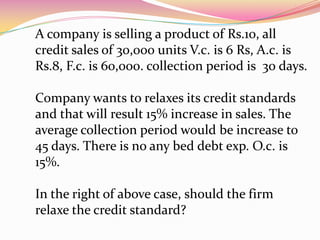
A company is selling a product of Rs.10, all
credit sales of 30,000 units V.c. is 6 Rs, A.c. is
Rs.8, F.c. is 60,000. collection period is 30 days.
Company wants to relaxes its credit standards
and that will result 15% increase in sales. The
average collection period would be increase to
45 days. There is no any bed debt exp. O.c. is
15%.
In the right of above case, should the firm
relaxe the credit standard?
CASH
 Cash is one of the most liquid and important
components of working capital.
 Holding cash involves cost because the worth of cash
held, after a year will be less than the value of cash as
on today.
 Excess of cash balance should not be kept in business
because cash is a non-earning asset.
 Hence, a proper and judicious cash management is of
utmost importance in business.
What Are The Primary Motive
For Cash Management ?
PREVENTION IS BETTER THAN CURE
 TRANSCATION NEEDS
 SPECULATIVE NEEDS
 PRECAUTIONARY NEEDS
 COMPENSATING NEEDS
Objectives of cash management
Meeting payment schedule
• Prevent insolvency
• Relationship is not strained with bank
• Fostering good Relation
• Cash discount can be availed
• Good credit rating
• Pay unexpected expenses
Minimizing funds committed to cash balance
 High level of cash balance
 Low level of cash balance
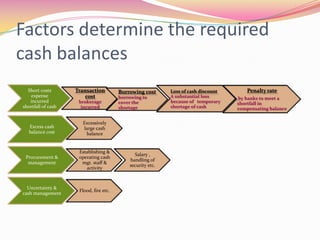
Factors determine the required
cash balances
Short costs
expense
incurred
shortfall of cash
Transaction
cost
brokerage
incurred
Borrowing cost
borrowing to
cover the
shortage
Loss of cash discount
A substantial loss
because of temporary
shortage of cash
Penalty rate
by banks to meet a
shortfall in
compensating balance
Excess cash
balance cost
Excessively
large cash
balance
Procurement &
management
Establishing &
operating cash
mgt. staff &
activity
Salary ,
handling of
security etc.
Uncertainty &
cash management
Flood, fire etc.
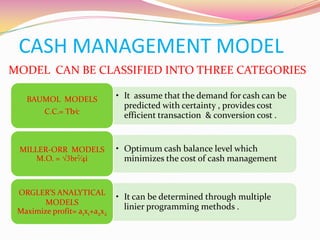
CASH MANAGEMENT MODEL
MODEL CAN BE CLASSIFIED INTO THREE CATEGORIES
• It assume that the demand for cash can be
predicted with certainty , provides cost
efficient transaction & conversion cost .
BAUMOL MODELS
C.C.= Tb⁄c
• Optimum cash balance level which
minimizes the cost of cash management
MILLER-ORR MODELS
M.O. = √3br2⁄4i
• It can be determined through multiple
linier programming methods .
ORGLER’S ANALYTICAL
MODELS
Maximize profit= a1x1+a2x2
Cash budget
 Statement inflow & outflow cash estimate
it’s short term requirement
 The cash budget helps the firm to plan for the actual
receipt and disbursement of cash.
 It has three parts namely, cash collections, cash
payments & cash balance
 The company estimates the sales for
each period during the planning period
Cash management techniques/
process
 Speedy cash collection
 Prompt payment by customers
 Every conversion of payments into cash
 concentration banking
 Lock box system
 Slowing disbursements
 Avoidance of early payment centralized disbursements
Contents
Meaning of Inventory
Concept of inventory
Types of inventory and Reasons for holding inventory
Inventory costs
Purpose of inventory
Tools / Techniques for Inventory control
Functions of inventory
Reasons for inventory carrying
Cost of inventory accumulation
Major activities in inventory control
Conclusion
– Inventory refers to a stock of
goods, commodities, or other economic
resources that are held by firms at a particular
time for their future production requirement and
for meeting future demands.
– Inventory management assist organizations in
minimizing their inventory cost without
compromising on their ability to respond quickly
to customer demand.
Meaning of Inventory
– Inventory control refers to
the process whereby the
investment in materials and
parts carried in stock is
regulated within pre-
determined limits set in
accordance with the
inventory policy established
by the management.
Important Of INVENTORY
 Inventories represent a significant amount of firm's
assets.
 Inventories must be properly managed so that this
investment doesn't become too large, as it would result
in blocked capital which could be put to productive
use elsewhere.
 On the other hand, having too little or small inventory
could result in loss of sales or loss of customer
goodwill. An optimum level of
inventory, therefore, should be maintained.
3/19/2014 23
Concept of inventory
Inventory Can be defined as a usable
resources which is physical and tangible.
Inventory management aims at
maintaining an adequate supply or
something to meet the expected demand
pattern subject to budgeting
considerations.
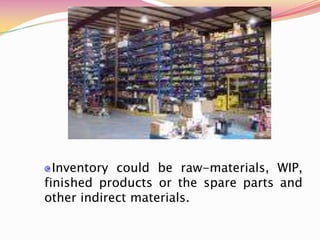
Inventory could be raw-materials, WIP,
finished products or the spare parts and
other indirect materials.
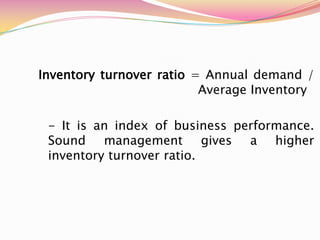
Inventory turnover ratio = Annual demand /
Average Inventory
- It is an index of business performance.
Sound management gives a higher
inventory turnover ratio.
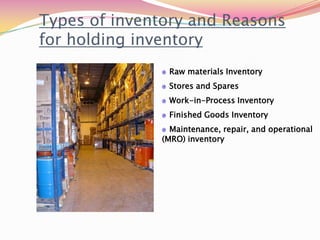
Types of inventory and Reasons
for holding inventory
Raw materials Inventory
Stores and Spares
Work-in-Process Inventory
Finished Goods Inventory
Maintenance, repair, and operational
(MRO) inventory
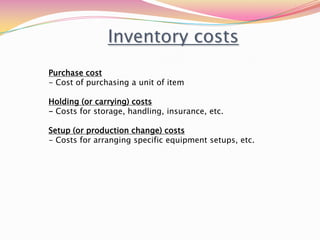
Inventory costs
Purchase cost
- Cost of purchasing a unit of item
Holding (or carrying) costs
- Costs for storage, handling, insurance, etc.
Setup (or production change) costs
- Costs for arranging specific equipment setups, etc.
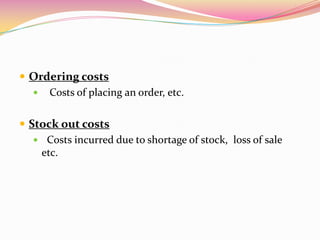
 Ordering costs
 Costs of placing an order, etc.
 Stock out costs
 Costs incurred due to shortage of stock, loss of sale
etc.
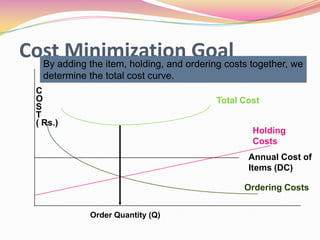
Cost Minimization Goal
Ordering Costs
Holding
Costs
Order Quantity (Q)
C
O
S
T
( Rs.)
Annual Cost of
Items (DC)
Total Cost
By adding the item, holding, and ordering costs together, we
determine the total cost curve.
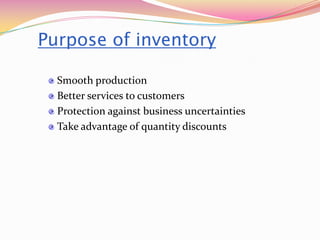
Purpose of inventory
Smooth production
Better services to customers
Protection against business uncertainties
Take advantage of quantity discounts
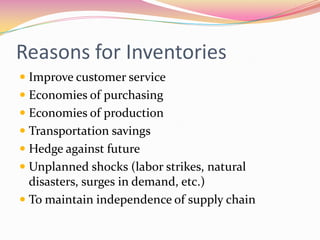
Reasons for Inventories
 Improve customer service
 Economies of purchasing
 Economies of production
 Transportation savings
 Hedge against future
 Unplanned shocks (labor strikes, natural
disasters, surges in demand, etc.)
 To maintain independence of supply chain
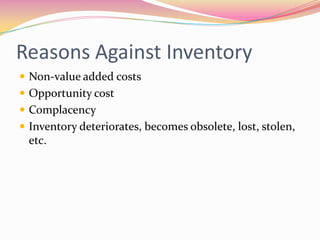
Reasons Against Inventory
 Non-value added costs
 Opportunity cost
 Complacency
 Inventory deteriorates, becomes obsolete, lost, stolen,
etc.
Economic Order Quantity ( EOQ ) model
ABC Analysis
FSN Analysis
HML Analysis
Tools / Techniques for Inventory
control
Functions of inventory
Regularizing demand and supply
Economizing purchases or
productions by lot buying or
batch production
Allowing Organizations to cope with
perishable materials
Inventory can store labour
Cost of inventory accumulation
Disadvantages of
inventory accumulation
 Locking up of working
capital
 More storage space
 High storage charges
 High taxes
 Greater handling and
distribution cost
 Deterioration in
quality
Disadvantages of
inventory depletion
 Production stoppages
 Idle machine capacity
 Burden of fixed overhead
 Failure to meet delivery order
resulting into loss of goodwill
Major activities in inventory control
Planning the inventory
Procurement of inventory
Receiving and inspection of inventory
Carrying and issuing of inventory
Recording the receipts and issues of
inventory
Follow-up function
Material standardization and substitution
 In nutshell, we can say that the
objective of inventory management is to
order the right quantity, at the right
time without disrupting the production
process.
Conclusion
Financial management

Financial management

  • 1.
    Prepared by: Bhargav Joshi JaypalChavda Nikit Rajani Jay Raval Vishal Ghoghari Dept. of Business Admin., Bhavnagar University, Bhavnagar. Guided by: Dr. B.C. AJMERA SUBMITTED TO: RECEIVABLE MANAGEMENT CASH MANAGEMENT INVENTORY MANAGEMENT
  • 3.
    ASPECTS OF MANAGEMENTOF DEBTORS CREDIT POLICY – Decision on credit period to be allowed , early payment discount rates etc .  CREDIT ANALYSIS – Decision on whether credit can be extended to a particular customer . CONTROL OVER RECEIVABLES –Step for debtor follow –up , faster collection of debtors.
  • 4.
    IMPORTANT OF PROPER MANAGEMENTOF RECEIVABLE  HIGH INVESTMENT  LOW INVESTMENT
  • 5.
    COSTS OF MAINTAINIG RECEIVABLES INTEREST ON INVESTMENT  ADMINISTRATIVE COSTS  DELINQUENCY COSTS  COLLECTION COSTS  DEFAULTING COSTS
  • 6.
    FACTOR AFFECTING CREDITPERIOD  NATURE OF PRODUCT  QUANTUM OF SALES  CUSTOMS AND PRACTIES  FUND AVALIABLE WITH THE COMPANY  CREDIT RISK
  • 7.
    FACTOR ANALYSED BEFORECREDIT GRANT TO CUSTOMER  NATURE OF PRODUCT  NATURE OF CUSTOMER  QUANTITY PURCHASED  VALUE OF SALES  CREDIT WORTHNESS OF THE CUSTOMER  RISK OF BAD DEBTS
  • 8.
    IMPORTANT SOURCE OFCREDIT INFORMATION OF CUSTOMER  TRADE REFERENCE  BANK REFERANCE  CREDIT BUREAU REPORT  PAST EXPERIENCE  PUBLISHED FINANCIAL STATEMENT
  • 9.
    Basic steps ofreceivable management  Find out the profit  Find out the turn over  Find out the investment  Find out the total cost  Find out the next profit
  • 10.
    A company isselling a product of Rs.10, all credit sales of 30,000 units V.c. is 6 Rs, A.c. is Rs.8, F.c. is 60,000. collection period is 30 days. Company wants to relaxes its credit standards and that will result 15% increase in sales. The average collection period would be increase to 45 days. There is no any bed debt exp. O.c. is 15%. In the right of above case, should the firm relaxe the credit standard?
  • 12.
    CASH  Cash isone of the most liquid and important components of working capital.  Holding cash involves cost because the worth of cash held, after a year will be less than the value of cash as on today.  Excess of cash balance should not be kept in business because cash is a non-earning asset.  Hence, a proper and judicious cash management is of utmost importance in business.
  • 13.
    What Are ThePrimary Motive For Cash Management ? PREVENTION IS BETTER THAN CURE  TRANSCATION NEEDS  SPECULATIVE NEEDS  PRECAUTIONARY NEEDS  COMPENSATING NEEDS
  • 14.
    Objectives of cashmanagement Meeting payment schedule • Prevent insolvency • Relationship is not strained with bank • Fostering good Relation • Cash discount can be availed • Good credit rating • Pay unexpected expenses Minimizing funds committed to cash balance  High level of cash balance  Low level of cash balance
  • 15.
    Factors determine therequired cash balances Short costs expense incurred shortfall of cash Transaction cost brokerage incurred Borrowing cost borrowing to cover the shortage Loss of cash discount A substantial loss because of temporary shortage of cash Penalty rate by banks to meet a shortfall in compensating balance Excess cash balance cost Excessively large cash balance Procurement & management Establishing & operating cash mgt. staff & activity Salary , handling of security etc. Uncertainty & cash management Flood, fire etc.
  • 16.
    CASH MANAGEMENT MODEL MODELCAN BE CLASSIFIED INTO THREE CATEGORIES • It assume that the demand for cash can be predicted with certainty , provides cost efficient transaction & conversion cost . BAUMOL MODELS C.C.= Tb⁄c • Optimum cash balance level which minimizes the cost of cash management MILLER-ORR MODELS M.O. = √3br2⁄4i • It can be determined through multiple linier programming methods . ORGLER’S ANALYTICAL MODELS Maximize profit= a1x1+a2x2
  • 17.
    Cash budget  Statementinflow & outflow cash estimate it’s short term requirement  The cash budget helps the firm to plan for the actual receipt and disbursement of cash.  It has three parts namely, cash collections, cash payments & cash balance  The company estimates the sales for each period during the planning period
  • 18.
    Cash management techniques/ process Speedy cash collection  Prompt payment by customers  Every conversion of payments into cash  concentration banking  Lock box system  Slowing disbursements  Avoidance of early payment centralized disbursements
  • 19.
    Contents Meaning of Inventory Conceptof inventory Types of inventory and Reasons for holding inventory Inventory costs Purpose of inventory Tools / Techniques for Inventory control Functions of inventory Reasons for inventory carrying Cost of inventory accumulation Major activities in inventory control Conclusion
  • 20.
    – Inventory refersto a stock of goods, commodities, or other economic resources that are held by firms at a particular time for their future production requirement and for meeting future demands. – Inventory management assist organizations in minimizing their inventory cost without compromising on their ability to respond quickly to customer demand. Meaning of Inventory
  • 21.
    – Inventory controlrefers to the process whereby the investment in materials and parts carried in stock is regulated within pre- determined limits set in accordance with the inventory policy established by the management.
  • 22.
    Important Of INVENTORY Inventories represent a significant amount of firm's assets.  Inventories must be properly managed so that this investment doesn't become too large, as it would result in blocked capital which could be put to productive use elsewhere.  On the other hand, having too little or small inventory could result in loss of sales or loss of customer goodwill. An optimum level of inventory, therefore, should be maintained.
  • 23.
    3/19/2014 23 Concept ofinventory Inventory Can be defined as a usable resources which is physical and tangible. Inventory management aims at maintaining an adequate supply or something to meet the expected demand pattern subject to budgeting considerations.
  • 24.
    Inventory could beraw-materials, WIP, finished products or the spare parts and other indirect materials.
  • 25.
    Inventory turnover ratio= Annual demand / Average Inventory - It is an index of business performance. Sound management gives a higher inventory turnover ratio.
  • 26.
    Types of inventoryand Reasons for holding inventory Raw materials Inventory Stores and Spares Work-in-Process Inventory Finished Goods Inventory Maintenance, repair, and operational (MRO) inventory
  • 27.
    Inventory costs Purchase cost -Cost of purchasing a unit of item Holding (or carrying) costs - Costs for storage, handling, insurance, etc. Setup (or production change) costs - Costs for arranging specific equipment setups, etc.
  • 28.
     Ordering costs Costs of placing an order, etc.  Stock out costs  Costs incurred due to shortage of stock, loss of sale etc.
  • 29.
    Cost Minimization Goal OrderingCosts Holding Costs Order Quantity (Q) C O S T ( Rs.) Annual Cost of Items (DC) Total Cost By adding the item, holding, and ordering costs together, we determine the total cost curve.
  • 30.
    Purpose of inventory Smoothproduction Better services to customers Protection against business uncertainties Take advantage of quantity discounts
  • 31.
    Reasons for Inventories Improve customer service  Economies of purchasing  Economies of production  Transportation savings  Hedge against future  Unplanned shocks (labor strikes, natural disasters, surges in demand, etc.)  To maintain independence of supply chain
  • 32.
    Reasons Against Inventory Non-value added costs  Opportunity cost  Complacency  Inventory deteriorates, becomes obsolete, lost, stolen, etc.
  • 33.
    Economic Order Quantity( EOQ ) model ABC Analysis FSN Analysis HML Analysis Tools / Techniques for Inventory control
  • 34.
    Functions of inventory Regularizingdemand and supply Economizing purchases or productions by lot buying or batch production Allowing Organizations to cope with perishable materials Inventory can store labour
  • 35.
    Cost of inventoryaccumulation Disadvantages of inventory accumulation  Locking up of working capital  More storage space  High storage charges  High taxes  Greater handling and distribution cost  Deterioration in quality Disadvantages of inventory depletion  Production stoppages  Idle machine capacity  Burden of fixed overhead  Failure to meet delivery order resulting into loss of goodwill
  • 36.
    Major activities ininventory control Planning the inventory Procurement of inventory Receiving and inspection of inventory Carrying and issuing of inventory Recording the receipts and issues of inventory Follow-up function Material standardization and substitution
  • 37.
     In nutshell,we can say that the objective of inventory management is to order the right quantity, at the right time without disrupting the production process. Conclusion