1
Understanding Global
Politics
Lecture 3: Classical Realism
2
What is realist about realism?
 Avoids the ‘hopeless utopianism’
of idealism
 Based on empirical analysis of
the human condition and the
way the world works
 Some aspects of behaviour are
universal and eternal.
3
Sun Tzu
 The Art of War (written
in the 6th century BC)
 One of the oldest and most
successful books on military
strategy in the world
 National interests should be
the top priority
 There is no place for ethics in
inter-state relations
 Statesmen who pay too much
attention to ethical principles
would do so at their peril
4
Thucydides (471-400 B.C.)
 The first Western writer in the
realist tradition.
 The Peloponnesian War
(between Athens and Sparta in
the fifth century B.C.).
 A study of the struggle for
military and political power.
 The cause of the War—fear, a
dominant characteristic and a
motivating factor for arms races
and war itself.
5
Niccolò Machiavelli (1469-1527)
 The Prince
 Power, balance of power,
formation of alliances, and
causes of conflicts
 The end—security of the
state—is understood to
justify any means necessary
to achieve the end
 The world as it is, not the
world as it should be—ethics
and politics are separated
6
Thomas Hobbes (1588-1679)
 The Leviathan (1660)
http://oregonstate.edu/instruct/phl302
/texts/hobbes/leviathan-
contents.html
7
Hobbes and his ideas
 A creature of his time: Concerned
with nature of political power, basis
of order, and origin of state.
 ‘State of nature’ which was ‘nasty,
brutish and short’
 Mutual vulnerability and self-
preservation mean setting up of
sovereign body.
 But only in domestic context: an
international Leviathan is impossible.
8
E.H. Carr
 The Twenty Years’ Crisis (1939)
 Events of 1930s demonstrate
fragility of international institutions and
the underlying struggle for power.
9
Main assumptions
 Sovereign states are key actors—
unitary and rational
 States are motivated by self-interest
(drive for power and survival)
 Main problem = anarchy (lack of
central sovereign authority to
regulate state relations)
 Therefore, conflict is an ever-present
reality of international relations.
10
Therefore …
 The history of global relations is a
struggle for power: ‘every state for
itself’.
 This means leaders have little freedom
to organise the world and solve its
problems.
 Respect for law is only achieved if it is
reinforced by the threat of force.
 Conflict is inevitable, so must be
strong in face of aggression;
preparation for war is the main
concern of states.
11
Classical Realism
… is an attempt to understand the world
from the point of view of
statesman/diplomat forced to operate in
dangerous and uncertain world.
… provides a guide to action based on
realpolitik (power and power politics
among states) in the interests of the
preservation of nation-states.
12
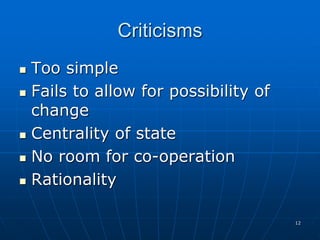
Criticisms
 Too simple
 Fails to allow for possibility of
change
 Centrality of state
 No room for co-operation
 Rationality

Lecture_Week_3.ppt

  • 1.
  • 2.
    2 What is realistabout realism?  Avoids the ‘hopeless utopianism’ of idealism  Based on empirical analysis of the human condition and the way the world works  Some aspects of behaviour are universal and eternal.
  • 3.
    3 Sun Tzu  TheArt of War (written in the 6th century BC)  One of the oldest and most successful books on military strategy in the world  National interests should be the top priority  There is no place for ethics in inter-state relations  Statesmen who pay too much attention to ethical principles would do so at their peril
  • 4.
    4 Thucydides (471-400 B.C.) The first Western writer in the realist tradition.  The Peloponnesian War (between Athens and Sparta in the fifth century B.C.).  A study of the struggle for military and political power.  The cause of the War—fear, a dominant characteristic and a motivating factor for arms races and war itself.
  • 5.
    5 Niccolò Machiavelli (1469-1527) The Prince  Power, balance of power, formation of alliances, and causes of conflicts  The end—security of the state—is understood to justify any means necessary to achieve the end  The world as it is, not the world as it should be—ethics and politics are separated
  • 6.
    6 Thomas Hobbes (1588-1679) The Leviathan (1660) http://oregonstate.edu/instruct/phl302 /texts/hobbes/leviathan- contents.html
  • 7.
    7 Hobbes and hisideas  A creature of his time: Concerned with nature of political power, basis of order, and origin of state.  ‘State of nature’ which was ‘nasty, brutish and short’  Mutual vulnerability and self- preservation mean setting up of sovereign body.  But only in domestic context: an international Leviathan is impossible.
  • 8.
    8 E.H. Carr  TheTwenty Years’ Crisis (1939)  Events of 1930s demonstrate fragility of international institutions and the underlying struggle for power.
  • 9.
    9 Main assumptions  Sovereignstates are key actors— unitary and rational  States are motivated by self-interest (drive for power and survival)  Main problem = anarchy (lack of central sovereign authority to regulate state relations)  Therefore, conflict is an ever-present reality of international relations.
  • 10.
    10 Therefore …  Thehistory of global relations is a struggle for power: ‘every state for itself’.  This means leaders have little freedom to organise the world and solve its problems.  Respect for law is only achieved if it is reinforced by the threat of force.  Conflict is inevitable, so must be strong in face of aggression; preparation for war is the main concern of states.
  • 11.
    11 Classical Realism … isan attempt to understand the world from the point of view of statesman/diplomat forced to operate in dangerous and uncertain world. … provides a guide to action based on realpolitik (power and power politics among states) in the interests of the preservation of nation-states.
  • 12.
    12 Criticisms  Too simple Fails to allow for possibility of change  Centrality of state  No room for co-operation  Rationality