International Relations
Asad Raza Talpur
Sukkur IBA University
REALISM
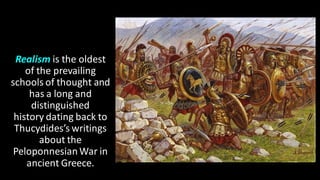
Realism is the oldest
of the prevailing
schools of thought and
has a long and
distinguished
history dating back to
Thucydides’s writings
about the
PeloponnesianWar in
ancient Greece.
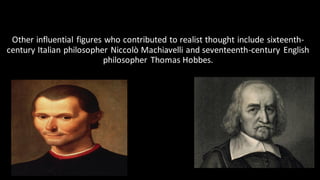
Other influential figures who contributed to realist thought include sixteenth-
century Italian philosopher Niccolò Machiavelli and seventeenth-century English
philosopher Thomas Hobbes.
Realism deserves careful
examination because its
worldview continues to guide
much understanding of
international politics.
What Is the
Realist
Worldview?
Realism, as applied to
contemporary international
politics, views the state as the
most important actor on the
world stage because it answers
to no higher political authority.
States are sovereign: they have
supreme power over their territory
and populace, and no other actor
stands above them to wield legitimacy
and coercive capability and govern the
global system.
Emphasizing the absence of a higher
authority to which states can turn for
protection and resolve disputes, realists
depict world politics as a ceaseless,
repetitive struggle for power where the
strong dominate the weak.
Because each state is ultimately
responsible for its own survival
and feels uncertain about its
neighbors’ intentions, realism claims
that prudent political leaders build
strong armies and allies to enhance
national security.
In other words, international anarchy
leads even well-intentioned leaders
to practice self-help, increase their
own military strength, and
opportunistically align with others to
deter potential enemies.
Realist theory, however, does not
preclude the possibility that rival
powers will cooperate on
arms control or on other security
issues of common interest.
Rather, it simply asserts cooperation
will be rare because states worry about
the unequal distribution of relative
gains, or the unequal distribution of
benefits from cooperation, and the
possibility that the other side will
cheat on agreements.
Realism’s message can be
summarized by the following
assumptions and related
propositions:
People are by nature
selfish and are driven to
compete with others for
domination and self-
advantage.
“The focus on gain and greed is
one reason why morality
cannot be expected to play a
role in relations among states”
or people.
Machiavelli captures the realist view of human
nature in his work The Prince, arguing that
people in general “are ungrateful, fickle, and
deceitful, eager to avoid dangers, and avid for
gain, and while you are useful to them they are
all with you, offering you their blood, their
property, and their sons so long as danger is
remote, but when it approaches they turn on
you.”
By extension, the primary obligation of
every state—the goal to which all other
national objectives should be
subordinated—is to acquire power in
order to promote the national interest.
Power is the “most important
currency in international politics
both to take from others and to
prevent the inevitable effort by
others to steal”.
“Might makes right,” and a
state’s philosophical or ethical
preferences are neither good nor
bad. What matters is whether
they serve its self-interest.
As Thucydides put it, “The
standard of justice depends on the
equality of power to compel . . . the
strong do what they
have the power to do and the weak
accept what they have to accept.”
World politics is a struggle for power—in the
words of Thomas Hobbes, “a war of all against
all”—and the possibility of eradicating the instinct
for power is a hopeless utopian aspiration. In the
pursuit of power, states must acquire sufficient
military capabilities to deter attack by potential
enemies and to exercise influence over others;
hence states “prepare for war to keep peace.”
Economic growth is important
primarily as a means of acquiring and
expanding state power and prestige
and is less relevant to
national security than is military might.
International anarchy and a lack of trust
perpetuate the principle of self-help and
can give rise to the security dilemma. As
a state builds up its power to protect
itself, others inevitably become
threatened and are likely to respond in
kind.
An arms race is commonly seen as a
manifestation of the security dilemma,
for even if a state is truly arming only for
defensive purposes, it is rational in a
self-help system for opponents to
assume the worst and keep pace in any
arms buildup.
If all states seek to maximize power,
stability is maintained with a balance of
power, facilitated by shifts in alliances
that counter another state’s growing
power or expansionist behavior.
Thus, allies might be sought to increase a
state’s ability to defend itself, but their
loyalty and reliability should not be
assumed, and commitments to allies
should be repudiated if it is no longer in a
state’s national interests to honor them.
With their emphasis on the ruthless nature
of international life, realists often question
letting ethical considerations enter foreign
policy deliberations. As they see it, some
policies are driven by strategic imperatives
that may require national leaders to
disregard moral norms.
Embedded in this “philosophy of necessity” is a
distinction between private morality, which
guides the behavior of ordinary people in their
daily lives, and raison d’état (reason of state),
which governs the conduct of leaders
responsible for the security and survival of the
state.
Actions that are dictated by
national interest must be carried
out no matter how repugnant in
the light of private morality.
Reflecting upon his decision in 2009 to send
additional U.S. troops to Afghanistan, in his
acceptance speech for the Nobel Peace Prize
President Obama noted that “I face the
world as it is, and cannot stand idle in the
face of threats to the American people.”
The Evolution of
Realism
We have seen how the intellectual roots of realism
reach back to ancient Greece. They also extend
beyond the Western world to India and China.
Discussions of “power politics” abound in the
Arthashastra, an Indian treatise on statecraft written
during the fourth century BCE by Kautilya, as well as
in works written by Han Fei and Shang Yang in ancient
China.
Modern realism emerged on the eve
of World War II, when the prevailing
belief in a natural
harmony of interests among states
came under attack.
Just a decade earlier, this belief
had led numerous countries to
sign the 1928 Kellogg-Briand
Pact, which renounced war as
an instrument of national
policy.
Now, with Nazi Germany, fascist Italy, and Imperial
Japan all violating the treaty, British historian and
diplomat E. H. Carr (1939) complained that the
assumption of a universal interest in peace had
allowed too many people to “evade the unpalatable
fact of a fundamental divergence of interest between
nations desirous of maintaining the status quo and
nations desirous of changing it.”
In an effort to counter what they saw as
a utopian, legalistic approach to foreign
affairs, Reinhold Niebuhr (1947), Hans J.
Morgenthau (1948), and other realists
painted a pessimistic view of
human nature.
Echoing seventeenth-century philosopher
Baruch Spinoza, many of them pointed to an
innate conflict between passion and reason;
furthermore, in the tradition of St.
Augustine, they stressed that material
appetites enabled passion to overwhelm
reason.
The realists’ picture of international life appeared particularly
persuasive after World War II. The onset of rivalry between
the United States and the Soviet Union, the expansion of the
Cold War into a wider struggle between East and West, and
the periodic crises that threatened to erupt into global
violence all supported the realists’ emphasis on the
inevitability of conflict, the poor prospects for cooperation,
and the divergence of national interests among incorrigibly
selfish, power-seeking states.
Whereas these so-called classical realists
sought to explain state behavior by
examining assumptions about people’s
motives at the individual level of analysis,
the next wave of realist
theorizing emphasized the global level of
analysis.
Neorealism (often called “structural
realism”) understands human identity,
motivation, and behavior as being driven
by the environment in which actors are
situated. In other words, it is “based on a
belief in the shaping power
of conditions over agency.
Kenneth Waltz, the leading proponent
of neorealism, proposed that
international anarchy—not some
allegedly evil side of human nature—
explained why states were locked in
fierce competition with one another.
The absence of a central arbiter was
the defining structural feature of
international politics. Vulnerable and
insecure, states behaved defensively by
forming alliances against looming
threats.
According to Waltz, balances of
power form automatically in
anarchic environments. Even
when they are disrupted, they
are soon restored.
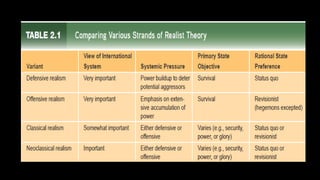
Although there are common themes throughout
realist thought, different variants of realism
emphasize certain features. Classical realism
focuses primarily on “the sources and uses of
national power . . . and the problems that
leaders encounter in conducting foreign policy”.
Structural realism, as envisioned by
Kenneth Waltz, is often referred to
as defensive realism to distinguish it
from the more recent variant,
offensive realism.
Defensive realism sees states as focused on
maintaining security by balancing others
and essentially preserving the status quo,
whereas offensive realism sees states as
seeking to ensure security by aggressively
maximizing their power.
According to offensive realism, states
are locked in perpetual struggle and
must be “primed for offense, because
they can never be sure how much
military capacity they will need in order
to survive over the long run”.
Neoclassical realism draws on both
classical realism and structural realism
to emphasize “how systemic-level
variables are ‘translated through unit-
level intervening variables such as
decision-makers’ perceptions and
domestic state structure’”.
The Limitations of
Realist Thought
However persuasive the realists’ image of
the essential properties of international
politics, their policy recommendations
suffered from a lack of precision in the
way they used such key terms as power
and national interest.
Thus, once analysis moved beyond the assertion that
national leaders should acquire power to serve the
national interest, important questions remained: What
were the key elements of national power? What uses
of power best served the national interest? Did arms
furnish protection or provoke costly arms races? Did
alliances enhance one’s defenses or encourage
threatening counter-alliances?
From the perspective of
realism’s critics, seeking
security by amassing power
was self-defeating.
The quest for absolute security by one state
would be perceived as creating absolute
insecurity for other members of the system,
with the result that everyone would
become locked in an upward spiral of
countermeasures jeopardizing the security
of all.
Realism offered no criteria for
determining what historical data were
significant in evaluating its claims and
what epistemological rules to follow
when interpreting relevant information.
Even the policy recommendations that
purportedly flowed from its logic were
often conflicting. Realists themselves, for
example, were sharply divided as to
whether U.S. intervention in Vietnam
served American national interests and
whether nuclear weapons contributed to
international security.
Similarly, although some observers
used realism to explain the rationale
for the 2003 U.S. invasion of Iraq,
others drew on realist arguments to
criticize the invasion.
A growing number of critics also
pointed out that realism did not
account for significant new
developments in world politics.

For instance, it could not explain the creation of
new commercial and political institutions in
Western Europe in the 1950s and 1960s, where
the cooperative pursuit of mutual advantage
led Europeans away from the unbridled power
politics that had brought them incessant
warfare since the birth of the nation-state some
three centuries earlier.
Similarly, critics challenged that “the end of
the Cold War, the expansion of democracy,
and the increasing importance of global
trade and international organizations . . .
Demand scholarly explanation that realist
theory is unable to provide”.
Others began to worry about realism’s
tendency to disregard ethical principles and
the material and social costs some of its
policy prescriptions imposed, such as
hindered economic growth resulting from
unrestrained military expenditures.
Despite realism’s shortcomings,
many people continue to think about
world politics in the language
constructed by realists, especially in
times of global tension.
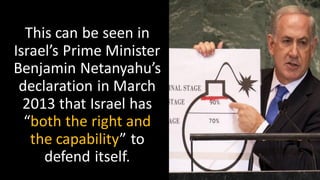
This can be seen in
Israel’s Prime Minister
Benjamin Netanyahu’s
declaration in March
2013 that Israel has
“both the right and
the capability” to
defend itself.
Placing great emphasis on military security
and national self-interest, his statement
comes amid speculation about the
possibility of a unilateral Israeli military
strike in response to Iran’s continuing
pursuit of a nuclear program.
Questions/Comments

Realism perspective international relationship

  • 1.
    International Relations Asad RazaTalpur Sukkur IBA University
  • 2.
  • 3.
    Realism is theoldest of the prevailing schools of thought and has a long and distinguished history dating back to Thucydides’s writings about the PeloponnesianWar in ancient Greece.
  • 4.
    Other influential figureswho contributed to realist thought include sixteenth- century Italian philosopher Niccolò Machiavelli and seventeenth-century English philosopher Thomas Hobbes.
  • 5.
    Realism deserves careful examinationbecause its worldview continues to guide much understanding of international politics.
  • 6.
  • 7.
    Realism, as appliedto contemporary international politics, views the state as the most important actor on the world stage because it answers to no higher political authority.
  • 8.
    States are sovereign:they have supreme power over their territory and populace, and no other actor stands above them to wield legitimacy and coercive capability and govern the global system.
  • 9.
    Emphasizing the absenceof a higher authority to which states can turn for protection and resolve disputes, realists depict world politics as a ceaseless, repetitive struggle for power where the strong dominate the weak.
  • 10.
    Because each stateis ultimately responsible for its own survival and feels uncertain about its neighbors’ intentions, realism claims that prudent political leaders build strong armies and allies to enhance national security.
  • 11.
    In other words,international anarchy leads even well-intentioned leaders to practice self-help, increase their own military strength, and opportunistically align with others to deter potential enemies.
  • 12.
    Realist theory, however,does not preclude the possibility that rival powers will cooperate on arms control or on other security issues of common interest.
  • 13.
    Rather, it simplyasserts cooperation will be rare because states worry about the unequal distribution of relative gains, or the unequal distribution of benefits from cooperation, and the possibility that the other side will cheat on agreements.
  • 14.
    Realism’s message canbe summarized by the following assumptions and related propositions:
  • 15.
    People are bynature selfish and are driven to compete with others for domination and self- advantage.
  • 16.
    “The focus ongain and greed is one reason why morality cannot be expected to play a role in relations among states” or people.
  • 17.
    Machiavelli captures therealist view of human nature in his work The Prince, arguing that people in general “are ungrateful, fickle, and deceitful, eager to avoid dangers, and avid for gain, and while you are useful to them they are all with you, offering you their blood, their property, and their sons so long as danger is remote, but when it approaches they turn on you.”
  • 18.
    By extension, theprimary obligation of every state—the goal to which all other national objectives should be subordinated—is to acquire power in order to promote the national interest.
  • 19.
    Power is the“most important currency in international politics both to take from others and to prevent the inevitable effort by others to steal”.
  • 20.
    “Might makes right,”and a state’s philosophical or ethical preferences are neither good nor bad. What matters is whether they serve its self-interest.
  • 21.
    As Thucydides putit, “The standard of justice depends on the equality of power to compel . . . the strong do what they have the power to do and the weak accept what they have to accept.”
  • 22.
    World politics isa struggle for power—in the words of Thomas Hobbes, “a war of all against all”—and the possibility of eradicating the instinct for power is a hopeless utopian aspiration. In the pursuit of power, states must acquire sufficient military capabilities to deter attack by potential enemies and to exercise influence over others; hence states “prepare for war to keep peace.”
  • 23.
    Economic growth isimportant primarily as a means of acquiring and expanding state power and prestige and is less relevant to national security than is military might.
  • 24.
    International anarchy anda lack of trust perpetuate the principle of self-help and can give rise to the security dilemma. As a state builds up its power to protect itself, others inevitably become threatened and are likely to respond in kind.
  • 25.
    An arms raceis commonly seen as a manifestation of the security dilemma, for even if a state is truly arming only for defensive purposes, it is rational in a self-help system for opponents to assume the worst and keep pace in any arms buildup.
  • 26.
    If all statesseek to maximize power, stability is maintained with a balance of power, facilitated by shifts in alliances that counter another state’s growing power or expansionist behavior.
  • 27.
    Thus, allies mightbe sought to increase a state’s ability to defend itself, but their loyalty and reliability should not be assumed, and commitments to allies should be repudiated if it is no longer in a state’s national interests to honor them.
  • 28.
    With their emphasison the ruthless nature of international life, realists often question letting ethical considerations enter foreign policy deliberations. As they see it, some policies are driven by strategic imperatives that may require national leaders to disregard moral norms.
  • 29.
    Embedded in this“philosophy of necessity” is a distinction between private morality, which guides the behavior of ordinary people in their daily lives, and raison d’état (reason of state), which governs the conduct of leaders responsible for the security and survival of the state.
  • 30.
    Actions that aredictated by national interest must be carried out no matter how repugnant in the light of private morality.
  • 31.
    Reflecting upon hisdecision in 2009 to send additional U.S. troops to Afghanistan, in his acceptance speech for the Nobel Peace Prize President Obama noted that “I face the world as it is, and cannot stand idle in the face of threats to the American people.”
  • 32.
  • 33.
    We have seenhow the intellectual roots of realism reach back to ancient Greece. They also extend beyond the Western world to India and China. Discussions of “power politics” abound in the Arthashastra, an Indian treatise on statecraft written during the fourth century BCE by Kautilya, as well as in works written by Han Fei and Shang Yang in ancient China.
  • 34.
    Modern realism emergedon the eve of World War II, when the prevailing belief in a natural harmony of interests among states came under attack.
  • 35.
    Just a decadeearlier, this belief had led numerous countries to sign the 1928 Kellogg-Briand Pact, which renounced war as an instrument of national policy.
  • 36.
    Now, with NaziGermany, fascist Italy, and Imperial Japan all violating the treaty, British historian and diplomat E. H. Carr (1939) complained that the assumption of a universal interest in peace had allowed too many people to “evade the unpalatable fact of a fundamental divergence of interest between nations desirous of maintaining the status quo and nations desirous of changing it.”
  • 37.
    In an effortto counter what they saw as a utopian, legalistic approach to foreign affairs, Reinhold Niebuhr (1947), Hans J. Morgenthau (1948), and other realists painted a pessimistic view of human nature.
  • 38.
    Echoing seventeenth-century philosopher BaruchSpinoza, many of them pointed to an innate conflict between passion and reason; furthermore, in the tradition of St. Augustine, they stressed that material appetites enabled passion to overwhelm reason.
  • 39.
    The realists’ pictureof international life appeared particularly persuasive after World War II. The onset of rivalry between the United States and the Soviet Union, the expansion of the Cold War into a wider struggle between East and West, and the periodic crises that threatened to erupt into global violence all supported the realists’ emphasis on the inevitability of conflict, the poor prospects for cooperation, and the divergence of national interests among incorrigibly selfish, power-seeking states.
  • 40.
    Whereas these so-calledclassical realists sought to explain state behavior by examining assumptions about people’s motives at the individual level of analysis, the next wave of realist theorizing emphasized the global level of analysis.
  • 41.
    Neorealism (often called“structural realism”) understands human identity, motivation, and behavior as being driven by the environment in which actors are situated. In other words, it is “based on a belief in the shaping power of conditions over agency.
  • 42.
    Kenneth Waltz, theleading proponent of neorealism, proposed that international anarchy—not some allegedly evil side of human nature— explained why states were locked in fierce competition with one another.
  • 43.
    The absence ofa central arbiter was the defining structural feature of international politics. Vulnerable and insecure, states behaved defensively by forming alliances against looming threats.

  • 44.
    According to Waltz,balances of power form automatically in anarchic environments. Even when they are disrupted, they are soon restored.
  • 45.
    Although there arecommon themes throughout realist thought, different variants of realism emphasize certain features. Classical realism focuses primarily on “the sources and uses of national power . . . and the problems that leaders encounter in conducting foreign policy”.
  • 46.
    Structural realism, asenvisioned by Kenneth Waltz, is often referred to as defensive realism to distinguish it from the more recent variant, offensive realism.
  • 47.
    Defensive realism seesstates as focused on maintaining security by balancing others and essentially preserving the status quo, whereas offensive realism sees states as seeking to ensure security by aggressively maximizing their power.
  • 48.
    According to offensiverealism, states are locked in perpetual struggle and must be “primed for offense, because they can never be sure how much military capacity they will need in order to survive over the long run”.
  • 49.
    Neoclassical realism drawson both classical realism and structural realism to emphasize “how systemic-level variables are ‘translated through unit- level intervening variables such as decision-makers’ perceptions and domestic state structure’”.
  • 51.
  • 52.
    However persuasive therealists’ image of the essential properties of international politics, their policy recommendations suffered from a lack of precision in the way they used such key terms as power and national interest.
  • 53.
    Thus, once analysismoved beyond the assertion that national leaders should acquire power to serve the national interest, important questions remained: What were the key elements of national power? What uses of power best served the national interest? Did arms furnish protection or provoke costly arms races? Did alliances enhance one’s defenses or encourage threatening counter-alliances?
  • 54.
    From the perspectiveof realism’s critics, seeking security by amassing power was self-defeating.
  • 55.
    The quest forabsolute security by one state would be perceived as creating absolute insecurity for other members of the system, with the result that everyone would become locked in an upward spiral of countermeasures jeopardizing the security of all.
  • 56.
    Realism offered nocriteria for determining what historical data were significant in evaluating its claims and what epistemological rules to follow when interpreting relevant information.
  • 57.
    Even the policyrecommendations that purportedly flowed from its logic were often conflicting. Realists themselves, for example, were sharply divided as to whether U.S. intervention in Vietnam served American national interests and whether nuclear weapons contributed to international security.
  • 58.
    Similarly, although someobservers used realism to explain the rationale for the 2003 U.S. invasion of Iraq, others drew on realist arguments to criticize the invasion.
  • 59.
    A growing numberof critics also pointed out that realism did not account for significant new developments in world politics.
  • 60.
    For instance, itcould not explain the creation of new commercial and political institutions in Western Europe in the 1950s and 1960s, where the cooperative pursuit of mutual advantage led Europeans away from the unbridled power politics that had brought them incessant warfare since the birth of the nation-state some three centuries earlier.
  • 61.
    Similarly, critics challengedthat “the end of the Cold War, the expansion of democracy, and the increasing importance of global trade and international organizations . . . Demand scholarly explanation that realist theory is unable to provide”.
  • 62.
    Others began toworry about realism’s tendency to disregard ethical principles and the material and social costs some of its policy prescriptions imposed, such as hindered economic growth resulting from unrestrained military expenditures.
  • 63.
    Despite realism’s shortcomings, manypeople continue to think about world politics in the language constructed by realists, especially in times of global tension.
  • 64.
    This can beseen in Israel’s Prime Minister Benjamin Netanyahu’s declaration in March 2013 that Israel has “both the right and the capability” to defend itself.
  • 65.
    Placing great emphasison military security and national self-interest, his statement comes amid speculation about the possibility of a unilateral Israeli military strike in response to Iran’s continuing pursuit of a nuclear program.
  • 66.