International
Relations
HUM
Sana Dar
Theories & Approaches of
International Relations
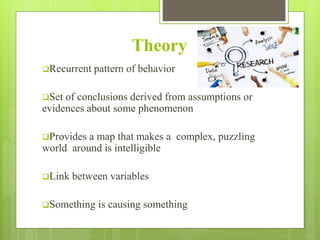
Theory
Recurrent pattern of behavior
Set of conclusions derived from assumptions or
evidences about some phenomenon
Provides a map that makes a complex, puzzling
world around is intelligible
Link between variables
Something is causing something
Purpose of Theory
 Description: Natural phenomenon
(e.g. World is bipolar or unipolar)
 Explanation: Why certain thing has had
happened
(Why did the people voted the way they voted?)
 Prediction: What will happen in future?
(e.g. will there be peace ? Will there be war?)
Types of Theories in IR
1. Explanatory
2. Constitutive
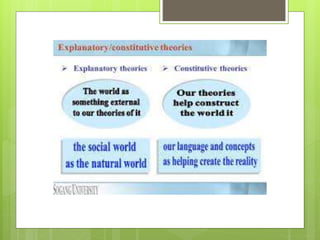
Explanatory
 Objective theories
 Positivist Approach
 Adopt Natural scientific theories
 Formulate theory
 Test the hypothesis
 Make assumptions
 Verify it
 Confirmed hypothesis accepted as law
 unverified rejected as theory
 Narrow scope
Constitutive
 Subjective Theories
 Adopt Social scientific method
 Based on our reflection & interpretation of certain
things that counts
 Social environment is inter linked with each other
 Broader scope
Approaches in
IR
Traditional Approach
Realism
Idealism/Liberalism
Realism
 Most influential theoretical tradition in IR
 Dominant &unquestioned hegemony of IR
 Central approach rest are footnotes to it
 E.H.Carr founder
 Human beings are selfish & in a state of war with all
 History is the sequence of cause& effect
1. World politics is a struggle for power. Power
is most important in IR
Thomas Hobbes “a war of all against all”
Power checks power
All politician in the world wish to maximize power
Balance of power is central mechanism
Politics in not guided y morality
Machiavelli's book “Prince”
Politics is interplay of power and morality
History can only be changed by adopting a path
2. Human selfishness & Aggression is rooted in
their nature
 Selfish nature is held in check by fear of power
 Thucydides “ Peloponnesian War” (Athens &
Sparta)
 International politics is driven by endless struggle for
which has its roots in human nature
 No place for justice law & society
3. Anarchical structure of international system
foster fear jealousy & insecurity
prevents states from entering into
cooperation to end war or conflict
 Structure drive states to war even if
leaders desired peace
Structure of international system
dictates the behavior of a unit
4.Concept of interest is not fix all the time
Political, cultural economical, religious etc context
defines national interest
Interest is dependent upon who interprets history?
Motives are difficult to explain
e.g.
It is for Prime Minister or President to decide the
national interest of Pakistan
5. Universal moral principles cannot be applied
to the actions of states
States do not act on the basis of morality
State is accountable for millions of people
e.g.
It was very difficult choice for Mullah Umar to handed
over Osama Bin Ladin, when US demanded
Elements of Realism
1. Statism
1. Survival
1. Self Help
Statism
 Fundamental actors in world’s politics
 Center piece of Realism
 State has substantial centralized control over social and
economic affairs
 Max Weber: “The monopoly of legitimate use of physical
forces within a given territory”
 State has supreme authority to make & enforce laws
 Security primary objective (no art, culture no society in its
absence)
Organize power internally & domestically
Accumulate international powers external
Sovereign state coexist with other states in an
anarchic system i.e. compete for security,
market, influence etc.
Flawed on empirical and normative grounds
Survival
Primary Objectives of all states
Supreme national interest to which all
political leaders adhere
Leaders adopt ethical code which judges
actions on the basis of outcomes rather than
being right or wrong
Examples:
1. Kashmir issue, Accountability of millions of
people, Nuclear deter etc.
2. Creation of Pakistan 1947, weak state,
survival, alliances to breathe
Flaw lies in unlimited actions states take in the
name of necessity
Self Help
 No other state can guarantee your survival
 International politics does not allow trust,
friendship etc.
 No help in international political environment only
limited or temporary cooperation
 Coexistence can only be achieved by balance of
power & cooperation
Self help is the game which states have
chosen to play
Historical & cotemporary examples
shows events where states have
preferred collective security system in
preference to self help
Idealism
 First Scientific Paradigm in the history of IR
 Perceives world as good & better place to live in if
provided proper environment
 Human nature is good too if given proper facilities
or opportunities
 Society molds human nature
 Ideal world can be created
Components
Security
Democracy
Free Trade
Security
 Collective security system would
mobilize the entire international
community
Global institutions
States should feel secure
E.g.
UNO
Democracy
People should have right to elect
Popular will never go wrong
Democracy with common people
consent can create an ideal place to
live in
Free Trade
Free trade should be allowed
Utilitarianism: Advocates actions that
foster happiness and opposes actions that
cause unhappiness
Greater happiness for greater number
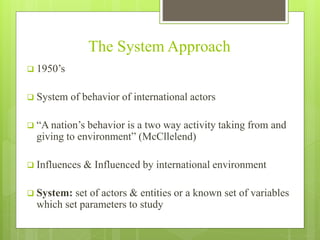
The System Approach
 1950’s
 System of behavior of international actors
 “A nation’s behavior is a two way activity taking from and
giving to environment” (McCllelend)
 Influences & Influenced by international environment
 System: set of actors & entities or a known set of variables
which set parameters to study
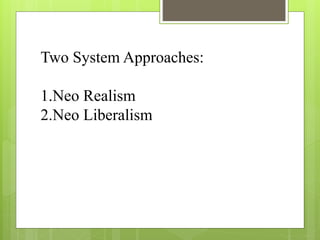
Two System Approaches:
1.Neo Realism
2.Neo Liberalism
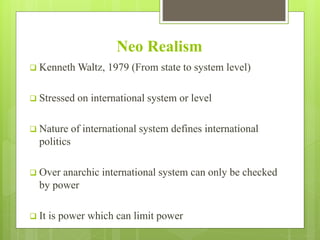
Neo Realism
 Kenneth Waltz, 1979 (From state to system level)
 Stressed on international system or level
 Nature of international system defines international
politics
 Over anarchic international system can only be checked
by power
 It is power which can limit power
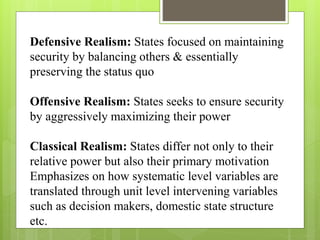
Defensive Realism: States focused on maintaining
security by balancing others & essentially
preserving the status quo
Offensive Realism: States seeks to ensure security
by aggressively maximizing their power
Classical Realism: States differ not only to their
relative power but also their primary motivation
Emphasizes on how systematic level variables are
translated through unit level intervening variables
such as decision makers, domestic state structure
etc.
Neo Liberalism
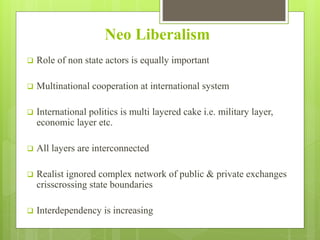
 Role of non state actors is equally important
 Multinational cooperation at international system
 International politics is multi layered cake i.e. military layer,
economic layer etc.
 All layers are interconnected
 Realist ignored complex network of public & private exchanges
crisscrossing state boundaries
 Interdependency is increasing
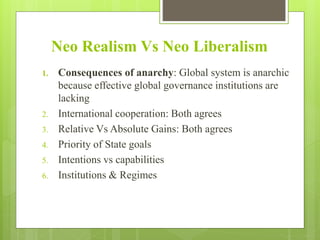
Neo Realism Vs Neo Liberalism
1. Consequences of anarchy: Global system is anarchic
because effective global governance institutions are
lacking
2. International cooperation: Both agrees
3. Relative Vs Absolute Gains: Both agrees
4. Priority of State goals
5. Intentions vs capabilities
6. Institutions & Regimes
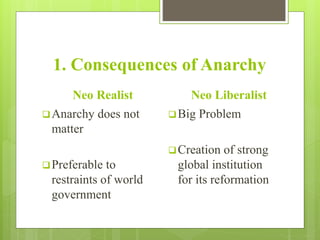
1. Consequences of Anarchy
Neo Realist
Anarchy does not
matter
Preferable to
restraints of world
government
Neo Liberalist
Big Problem
Creation of strong
global institution
for its reformation
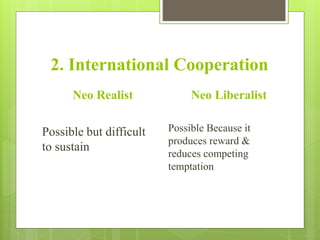
2. International Cooperation
Neo Realist
Possible but difficult
to sustain
Neo Liberalist
Possible Because it
produces reward &
reduces competing
temptation
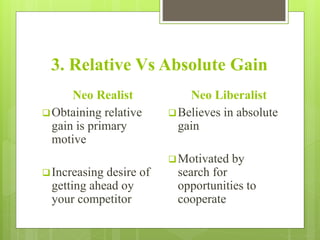
3. Relative Vs Absolute Gain
Neo Realist
Obtaining relative
gain is primary
motive
Increasing desire of
getting ahead oy
your competitor
Neo Liberalist
Believes in absolute
gain
Motivated by
search for
opportunities to
cooperate
4.Priority of State Goal
Neo Realist
Stresses on security
as a primary goal
Neo Liberalist
Believes on economic
welfare as a greater
priority
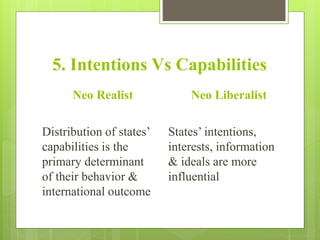
5. Intentions Vs Capabilities
Neo Realist
Distribution of states’
capabilities is the
primary determinant
of their behavior &
international outcome
Neo Liberalist
States’ intentions,
interests, information
& ideals are more
influential
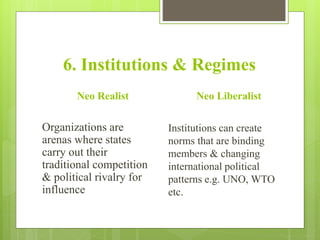
6. Institutions & Regimes
Neo Realist
Organizations are
arenas where states
carry out their
traditional competition
& political rivalry for
influence
Neo Liberalist
Institutions can create
norms that are binding
members & changing
international political
patterns e.g. UNO, WTO
etc.

IR Lec 3 (1) (1).pptx

  • 1.
  • 2.
    Theories & Approachesof International Relations
  • 3.
    Theory Recurrent pattern ofbehavior Set of conclusions derived from assumptions or evidences about some phenomenon Provides a map that makes a complex, puzzling world around is intelligible Link between variables Something is causing something
  • 4.
    Purpose of Theory Description: Natural phenomenon (e.g. World is bipolar or unipolar)  Explanation: Why certain thing has had happened (Why did the people voted the way they voted?)  Prediction: What will happen in future? (e.g. will there be peace ? Will there be war?)
  • 5.
    Types of Theoriesin IR 1. Explanatory 2. Constitutive
  • 6.
    Explanatory  Objective theories Positivist Approach  Adopt Natural scientific theories  Formulate theory  Test the hypothesis  Make assumptions  Verify it  Confirmed hypothesis accepted as law  unverified rejected as theory  Narrow scope
  • 7.
    Constitutive  Subjective Theories Adopt Social scientific method  Based on our reflection & interpretation of certain things that counts  Social environment is inter linked with each other  Broader scope
  • 9.
  • 10.
  • 11.
    Realism  Most influentialtheoretical tradition in IR  Dominant &unquestioned hegemony of IR  Central approach rest are footnotes to it  E.H.Carr founder  Human beings are selfish & in a state of war with all  History is the sequence of cause& effect
  • 12.
    1. World politicsis a struggle for power. Power is most important in IR Thomas Hobbes “a war of all against all” Power checks power All politician in the world wish to maximize power Balance of power is central mechanism Politics in not guided y morality Machiavelli's book “Prince” Politics is interplay of power and morality History can only be changed by adopting a path
  • 13.
    2. Human selfishness& Aggression is rooted in their nature  Selfish nature is held in check by fear of power  Thucydides “ Peloponnesian War” (Athens & Sparta)  International politics is driven by endless struggle for which has its roots in human nature  No place for justice law & society
  • 14.
    3. Anarchical structureof international system foster fear jealousy & insecurity prevents states from entering into cooperation to end war or conflict  Structure drive states to war even if leaders desired peace Structure of international system dictates the behavior of a unit
  • 15.
    4.Concept of interestis not fix all the time Political, cultural economical, religious etc context defines national interest Interest is dependent upon who interprets history? Motives are difficult to explain e.g. It is for Prime Minister or President to decide the national interest of Pakistan
  • 16.
    5. Universal moralprinciples cannot be applied to the actions of states States do not act on the basis of morality State is accountable for millions of people e.g. It was very difficult choice for Mullah Umar to handed over Osama Bin Ladin, when US demanded
  • 17.
    Elements of Realism 1.Statism 1. Survival 1. Self Help
  • 18.
    Statism  Fundamental actorsin world’s politics  Center piece of Realism  State has substantial centralized control over social and economic affairs  Max Weber: “The monopoly of legitimate use of physical forces within a given territory”  State has supreme authority to make & enforce laws  Security primary objective (no art, culture no society in its absence)
  • 19.
    Organize power internally& domestically Accumulate international powers external Sovereign state coexist with other states in an anarchic system i.e. compete for security, market, influence etc. Flawed on empirical and normative grounds
  • 20.
    Survival Primary Objectives ofall states Supreme national interest to which all political leaders adhere Leaders adopt ethical code which judges actions on the basis of outcomes rather than being right or wrong
  • 21.
    Examples: 1. Kashmir issue,Accountability of millions of people, Nuclear deter etc. 2. Creation of Pakistan 1947, weak state, survival, alliances to breathe Flaw lies in unlimited actions states take in the name of necessity
  • 22.
    Self Help  Noother state can guarantee your survival  International politics does not allow trust, friendship etc.  No help in international political environment only limited or temporary cooperation  Coexistence can only be achieved by balance of power & cooperation

  • 23.
    Self help isthe game which states have chosen to play Historical & cotemporary examples shows events where states have preferred collective security system in preference to self help
  • 24.
    Idealism  First ScientificParadigm in the history of IR  Perceives world as good & better place to live in if provided proper environment  Human nature is good too if given proper facilities or opportunities  Society molds human nature  Ideal world can be created
  • 25.
  • 26.
    Security  Collective securitysystem would mobilize the entire international community Global institutions States should feel secure E.g. UNO
  • 27.
    Democracy People should haveright to elect Popular will never go wrong Democracy with common people consent can create an ideal place to live in
  • 28.
    Free Trade Free tradeshould be allowed Utilitarianism: Advocates actions that foster happiness and opposes actions that cause unhappiness Greater happiness for greater number
  • 29.
    The System Approach 1950’s  System of behavior of international actors  “A nation’s behavior is a two way activity taking from and giving to environment” (McCllelend)  Influences & Influenced by international environment  System: set of actors & entities or a known set of variables which set parameters to study
  • 30.
    Two System Approaches: 1.NeoRealism 2.Neo Liberalism
  • 31.
    Neo Realism  KennethWaltz, 1979 (From state to system level)  Stressed on international system or level  Nature of international system defines international politics  Over anarchic international system can only be checked by power  It is power which can limit power
  • 32.
    Defensive Realism: Statesfocused on maintaining security by balancing others & essentially preserving the status quo Offensive Realism: States seeks to ensure security by aggressively maximizing their power Classical Realism: States differ not only to their relative power but also their primary motivation Emphasizes on how systematic level variables are translated through unit level intervening variables such as decision makers, domestic state structure etc.
  • 33.
    Neo Liberalism  Roleof non state actors is equally important  Multinational cooperation at international system  International politics is multi layered cake i.e. military layer, economic layer etc.  All layers are interconnected  Realist ignored complex network of public & private exchanges crisscrossing state boundaries  Interdependency is increasing
  • 34.
    Neo Realism VsNeo Liberalism 1. Consequences of anarchy: Global system is anarchic because effective global governance institutions are lacking 2. International cooperation: Both agrees 3. Relative Vs Absolute Gains: Both agrees 4. Priority of State goals 5. Intentions vs capabilities 6. Institutions & Regimes
  • 35.
    1. Consequences ofAnarchy Neo Realist Anarchy does not matter Preferable to restraints of world government Neo Liberalist Big Problem Creation of strong global institution for its reformation
  • 36.
    2. International Cooperation NeoRealist Possible but difficult to sustain Neo Liberalist Possible Because it produces reward & reduces competing temptation
  • 37.
    3. Relative VsAbsolute Gain Neo Realist Obtaining relative gain is primary motive Increasing desire of getting ahead oy your competitor Neo Liberalist Believes in absolute gain Motivated by search for opportunities to cooperate
  • 38.
    4.Priority of StateGoal Neo Realist Stresses on security as a primary goal Neo Liberalist Believes on economic welfare as a greater priority
  • 39.
    5. Intentions VsCapabilities Neo Realist Distribution of states’ capabilities is the primary determinant of their behavior & international outcome Neo Liberalist States’ intentions, interests, information & ideals are more influential
  • 40.
    6. Institutions &Regimes Neo Realist Organizations are arenas where states carry out their traditional competition & political rivalry for influence Neo Liberalist Institutions can create norms that are binding members & changing international political patterns e.g. UNO, WTO etc.