REAL TIME
KNOWLEDGE
CAPTURE AND
FEEDBACK IN
DESIGN
WORKSPACES
A Better Way Understand Team Interaction and Workflow
• Knowledge capture and Feedback systems, such as interactive table surfaces or smart
whiteboards, have long enabled designers to review and revisit the knowledge artifacts
generated by their creative work.
• Advances in data sensing and computation now allow near real-time analysis and
feedback to be added this toolbox.
• In this presentation ,we define various methodologies , an case study related to work .
• We highlight the potential benefits of real-time design interactions and identify areas
of future exploration for engineering educators and designers.
INTRODUCTION
• Knowledge capture is the process by which knowledge is converted from tacit to explicit
form (residing within people, artifacts or organizational entities) and vice versa through
sub-processes of externalization and internalization. The knowledge being capured might
might reside outside the organizational boundaries including consultants, competitors,
customers, suppliers, etc.
• Externalization is the sub-process through which an organization captures the tacit
knowledge its workers possess so that it can be documented, verbalized and shared. This
a difficult process because tacit knowledge is often difficult to articulate.
• Internalization is the sub-process through which workers acquire tacit knowledge. It
represents the traditional notion of learning. Knowledge capture can also be conducted
outside an organization.
FEEDBACK IN DESIGN
• Design feedback is an integral part of any successful design project, it gives clients an
opportunity to review and critique a design solution that has been presented. It is the
role of the design contact (the representative that liaises with the design team) to
collate and manage internal communications at their end and provide the agency with
a concise list of feedback.
• Below is a step-by-step guide to help you provide any designer with detailed design
feedback that will result in the best outcome for any design project.
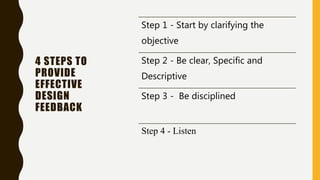
4 STEPS TO
PROVIDE
EFFECTIVE
DESIGN
FEEDBACK
Step 1 - Start by clarifying the
objective
Step 2 - Be clear, Specific and
Descriptive
Step 3 - Be disciplined
Step 4 - Listen
KNOWLEDGE MANAGEMENT METHODOLOGIES THAT
CAN BE USED TO CAPTURE KNOWLEDGE.
• Exit Interview is a tool used to capture the knowledge of departing employees. Many firms
conduct exit interviews, but these are usually focused purely on personnel factors.
• Knowledge Harvesting is a tool used to capture the knowledge of experts and make it
available to others. Knowledge Harvesting converts expertise into knowledge assets. The
organization can be protected from expensive personnel losses and defections, and from
the unavailability of expertise when and where needed.
• Knowledge Jam is a process for bringing out know-how via a facilitated conversation
between knowers and seekers, with a built-in step to circulate or translate what was
learned.
CASE STUDY: KNOWLEDGE CAPTURE AT HP
• One of the three goals in the HP Engagement Knowledge Management program was
capture, which meant capturing the content and experience from customer bids and
projects.
• The formal goal was: Capture content and experience from all customer bids and
projects (project profiles, lessons learned reports, bid/project documents, solution
collateral/service kit content, knowledge briefs).
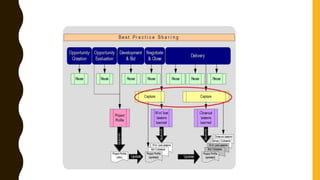
• Across the top of the grid were five categories: opportunity creation, opportunity
evaluation, development and bid, negotiate and close, and delivery. People followed
the roadmap because it was integrated into the process.
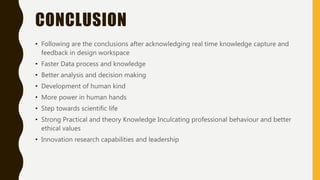
CONCLUSION
• Following are the conclusions after acknowledging real time knowledge capture and
feedback in design workspace
• Faster Data process and knowledge
• Better analysis and decision making
• Development of human kind
• More power in human hands
• Step towards scientific life
• Strong Practical and theory Knowledge Inculcating professional behaviour and better
ethical values
• Innovation research capabilities and leadership
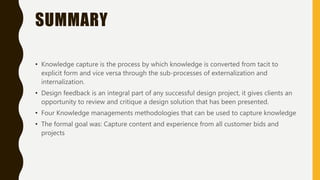
SUMMARY
• Knowledge capture is the process by which knowledge is converted from tacit to
explicit form and vice versa through the sub-processes of externalization and
internalization.
• Design feedback is an integral part of any successful design project, it gives clients an
opportunity to review and critique a design solution that has been presented.
• Four Knowledge managements methodologies that can be used to capture knowledge
• The formal goal was: Capture content and experience from all customer bids and
projects
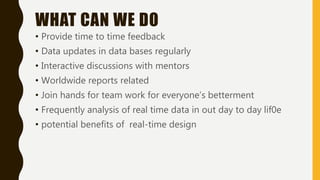
WHAT CAN WE DO
• Provide time to time feedback
• Data updates in data bases regularly
• Interactive discussions with mentors
• Worldwide reports related
• Join hands for team work for everyone’s betterment
• Frequently analysis of real time data in out day to day lif0e
• potential benefits of real-time design
REFRENCES
• https://mediax.stanford.edu/research-projects/sow-leifer-ju/
• https://www.linkedin.com/pulse/knowledge-management-methodologies-stan-
garfield/
• https://www.linkedin.com/pulse/knowledge-capture-process-stan-garfield/
• https://www.butterfly.com.au/blog/design/how-to-provide-effective-design-feedback
• https://www.tlu.ee/~sirvir/Information%20and%20Knowledge%20Management/Frame
work%20for%20IKM/knowledge_management_processes_knowledge_capture.html
THANKYOU
SHEHBAJ SINGH 1706895
UDAY KAKKAR 1706903
D3ITB1 GNDEC,LDH

Real time knowledge capture and feedback in design

  • 1.
    REAL TIME KNOWLEDGE CAPTURE AND FEEDBACKIN DESIGN WORKSPACES A Better Way Understand Team Interaction and Workflow
  • 2.
    • Knowledge captureand Feedback systems, such as interactive table surfaces or smart whiteboards, have long enabled designers to review and revisit the knowledge artifacts generated by their creative work. • Advances in data sensing and computation now allow near real-time analysis and feedback to be added this toolbox. • In this presentation ,we define various methodologies , an case study related to work . • We highlight the potential benefits of real-time design interactions and identify areas of future exploration for engineering educators and designers.
  • 3.
    INTRODUCTION • Knowledge captureis the process by which knowledge is converted from tacit to explicit form (residing within people, artifacts or organizational entities) and vice versa through sub-processes of externalization and internalization. The knowledge being capured might might reside outside the organizational boundaries including consultants, competitors, customers, suppliers, etc. • Externalization is the sub-process through which an organization captures the tacit knowledge its workers possess so that it can be documented, verbalized and shared. This a difficult process because tacit knowledge is often difficult to articulate. • Internalization is the sub-process through which workers acquire tacit knowledge. It represents the traditional notion of learning. Knowledge capture can also be conducted outside an organization.
  • 4.
    FEEDBACK IN DESIGN •Design feedback is an integral part of any successful design project, it gives clients an opportunity to review and critique a design solution that has been presented. It is the role of the design contact (the representative that liaises with the design team) to collate and manage internal communications at their end and provide the agency with a concise list of feedback. • Below is a step-by-step guide to help you provide any designer with detailed design feedback that will result in the best outcome for any design project.
  • 5.
    4 STEPS TO PROVIDE EFFECTIVE DESIGN FEEDBACK Step1 - Start by clarifying the objective Step 2 - Be clear, Specific and Descriptive Step 3 - Be disciplined Step 4 - Listen
  • 6.
    KNOWLEDGE MANAGEMENT METHODOLOGIESTHAT CAN BE USED TO CAPTURE KNOWLEDGE. • Exit Interview is a tool used to capture the knowledge of departing employees. Many firms conduct exit interviews, but these are usually focused purely on personnel factors. • Knowledge Harvesting is a tool used to capture the knowledge of experts and make it available to others. Knowledge Harvesting converts expertise into knowledge assets. The organization can be protected from expensive personnel losses and defections, and from the unavailability of expertise when and where needed. • Knowledge Jam is a process for bringing out know-how via a facilitated conversation between knowers and seekers, with a built-in step to circulate or translate what was learned.
  • 7.
    CASE STUDY: KNOWLEDGECAPTURE AT HP • One of the three goals in the HP Engagement Knowledge Management program was capture, which meant capturing the content and experience from customer bids and projects. • The formal goal was: Capture content and experience from all customer bids and projects (project profiles, lessons learned reports, bid/project documents, solution collateral/service kit content, knowledge briefs). • Across the top of the grid were five categories: opportunity creation, opportunity evaluation, development and bid, negotiate and close, and delivery. People followed the roadmap because it was integrated into the process.
  • 9.
    CONCLUSION • Following arethe conclusions after acknowledging real time knowledge capture and feedback in design workspace • Faster Data process and knowledge • Better analysis and decision making • Development of human kind • More power in human hands • Step towards scientific life • Strong Practical and theory Knowledge Inculcating professional behaviour and better ethical values • Innovation research capabilities and leadership
  • 10.
    SUMMARY • Knowledge captureis the process by which knowledge is converted from tacit to explicit form and vice versa through the sub-processes of externalization and internalization. • Design feedback is an integral part of any successful design project, it gives clients an opportunity to review and critique a design solution that has been presented. • Four Knowledge managements methodologies that can be used to capture knowledge • The formal goal was: Capture content and experience from all customer bids and projects
  • 11.
    WHAT CAN WEDO • Provide time to time feedback • Data updates in data bases regularly • Interactive discussions with mentors • Worldwide reports related • Join hands for team work for everyone’s betterment • Frequently analysis of real time data in out day to day lif0e • potential benefits of real-time design
  • 12.
    REFRENCES • https://mediax.stanford.edu/research-projects/sow-leifer-ju/ • https://www.linkedin.com/pulse/knowledge-management-methodologies-stan- garfield/ •https://www.linkedin.com/pulse/knowledge-capture-process-stan-garfield/ • https://www.butterfly.com.au/blog/design/how-to-provide-effective-design-feedback • https://www.tlu.ee/~sirvir/Information%20and%20Knowledge%20Management/Frame work%20for%20IKM/knowledge_management_processes_knowledge_capture.html
  • 13.
    THANKYOU SHEHBAJ SINGH 1706895 UDAYKAKKAR 1706903 D3ITB1 GNDEC,LDH