DEPARTMENT OF BUSINESS ADMINISTRATION
ENTREPRENEURSHIP DEVELOPMENT III BBA
ENTREPRENEURSHIP DEVELOPMENT
UNIT-III: BUSINESS PLAN PREPARATION
Defining Business Idea – Idea generating techniques- Identification of
business opportunities-Business plan- Perspectives in business plan
preparation- Elements of business plan Business plan failures.
Defining Business Idea
A "business idea" in entrepreneurship is a conceptual vision for a new
venture, which involves creating a product or service that can be
monetized by addressing a market need, often by introducing a unique
solution or improving an existing one, ultimately serving as the
foundation for a potential business venture; it's the initial thought that
guides further development, market research, and business strategy
planning.
Key points about a business idea:
 Focus on problem-solving:
A good business idea identifies a specific problem or unmet need in the
market and aims to provide a solution through a product or service.
 Potential for profit:
The idea should have a clear path to generating revenue and achieving
financial sustainability.
 Market viability:
The target market for the product or service should be sizeable and
accessible.
 Innovation potential:
Ideally, the business idea should offer something new or significantly
improved compared to existing options in the market.
Example of a business idea:
 Developing a mobile app that uses AI to personalize fitness routines
based on user data - This idea addresses the need for tailored workout
plans while leveraging technology to provide a unique solution.
Idea generating techniques
Generating Ideas is one of the most important concepts when it comes to
creative problem-solving and innovation. In this highly changing world,
generating ideas to solve problems is a great trait to have. There are
certain techniques for generating ideas that can be useful. Whether the
individual is an Entrepreneur, a Designer, or anyone who is facing any
problem that needs to be solved, these techniques can be proven as
effective ones.
Techniques for Generating Ideas
1. Understanding the Problem
Understanding the given problem is the most important step to solving
the problem or generating ideas to solve the problem. It involves a
systematic examination and comprehension of the problem the user is
trying to solve. This is the first and the most crucial step in the case of
creative problem-solving. The aim of this step is to lay a strong
foundation that the ideas that will be generated later are well
structured, informed, related to the main problem, and most likely to
lead to the proper solutions. Some of the key characteristics of
Understanding the problem are:
 Problem Definition: Before trying to solve the problem or even
generate an idea, it is necessary to express the problem in the
easiest way possible.
 Gathering Information: To understand the given problem, it is
necessary to do some research and gather as much information as
possible from other sources. This can include market research,
data analysis, receiving feedback from customers, conducting
surveys, etc.
 Identification of Stakeholders: It is also necessary to find out
who will benefit from the solution of the problem, because they
can provide some insights about the problem which will help in
the idea generation process.
2. Towards Solving the Problem
The phase, Towards Solving the Problem, is the swift transition from
understanding the problem to the phase of generating ideas. Once a
deep understanding of the problem has been gained, the solver can
start to think about it and generate ideas to solve the problem and
think about the potential solutions.
 Mind Mapping: Mind Mapping is a visualisation technique that
is used to create a diagram like structure and put the ideas, tasks
etc.
 SCAMPER: SCAMPER technique stands for Substitute,
Combine, Adapt, Modify, Put to another use, Eliminate, and
Reverse is a technique which lets the user to view the problem
from different angles and apply those aforementioned strategies to
generate new ideas.
 Lateral Thinking: Lateral thinking is also another heavily used
approach to generate ideas to solve problems. It seeks solution of
the problem via indirect approaches.
3. Using Your Brain Effectively and Absurdly
This encourages both rational thinking and the deliberate use of the
unconventional concepts to stimulate creativity. It uses the both sides
of a human mind, one that thinks rationally and tries to find the
solution in a more rational manner, and the other which solely lives in
the imaginary world and thinks absurdly. It is helpful to stimulate
creativity in the mind's of the solver and generate ideas.
 Effective Thinking: This aspect of the using our brain effectively
involves using the brain logically and efficiently. It solely
depends upon the structured thinking and analysis of the problem
thoroughly.
 Absurd Thinking: This might sound silly, but sometimes the
absurd and imaginary thinking encourages the user to try some
out of the box approaches to solve the problem.
 Thinking Visually and Conceptually: Using diagrams and Mind
Maps is also helpful to effectively use our brain and generate new
techniques to solve the problem.
4. Mind Mapping
Mind Mapping is a graphical and visualising approach used to
represent the thoughts, ideas, concepts etc. and organise them in a
hierarchical and interconnected manner. It is a very useful tool for
brainstorming , problem solving, learning, planning and representing
complex information. The main function of Mind Mapping is to
recreate the process which happens inside human brain while trying to
think about any solution of a particular problem. Below are the some
of the most important components of a Mind Map:
 Central Idea: This occupies the center of the Mind Map, it
represents the main concept or the main issue which is being
solved.
 Branches: This are the thin lines that are used to join the key
items and themes with the Central Idea in the middle.
 Keywords or Phrases: On each one of the branches (apart from
the central idea), certain keywords or phrases are used to
represent the main idea or issue of that sub-category or branch.
5. Group Creativity
Group Creativity is also known as collaborative creativity is a phase
where a group of individual come together to share their ideas about
solving a same problem. It is the ability of a team to work together to
solve a certain problem given to them by thinking creatively and
develop new concepts collectively to extend the capability of a single
person's thinking power. Some of the most important points about
Group Creativity is mentioned below:
 Diversity of Perspectives: Each group consists of members
whose thinking capabilities are different than the others, they can
come from different backgrounds, hold different experiences.
This diverse atmosphere leads to more creative solutions.
 Brainstorming: Brainstorming are special sessions carried out to
encourage the group members to encourage them and boost their
creativity to generate more ideas. During this sessions the
members are encouraged to share any kind of idea without any
judgement or criticism.
 Collaboration: Collaboration and effective communication
between the group memebers are a necessity for nurturing
creative thinking.
6. Focus Groups
Focus Groups is a Qualitative research method which mostly involves
a small group, but a diverse kind of individuals who freely shares their
thought and opinions on a specific topic given to them. The
discussions of a focus groups are generally mentored by a moderator
or facilitator. Some key characteristics of Focus Groups are:
 Size of the Group: Generally the size of Focus Groups are small,
it typically consists of only 6-10 individuals. It is kept like this
because this is perfect number to get diverse ideas and keeping
hthe encouragement and communication between them.
 Structured Discussion: As a certain moderator or Facilitator is in
charge of a Focus Groups, he or she is in control of what should
be discussed and what structure it would follow.
 Interactive Discussion: As the number of members are kept
small, everyone gets the chance to participate in the discussion
and interact with each other, this helps to discuss the ideas
between them and rectify the mistakes if any.
7. Brainstorming
Brainstorming is a well known problem solving technique used to
generate ideas within a group. Everyone in the group encourages each
other to come up with new ideas whether they are absurd or practical
without any criticism. The main goal of a brainstorm session is to
come up with a solution of the problem or challenge given to them.
Some of the characteristics of Brainstorming are:
 Free Thinking: All the members of the group can share their
thoughts and ideas freely without facing any criticism. The main
goal is to get as many idea as possible.
 Divergent Thinking: It is also a form of Divergent Thinking, it
allows the members to think about multiple possible ways to
solve the problem.
 Done within a group: Brainstorming sessions are usually
conducted in a group. So the idea and the discussion remains
secret to that group members only.
8. Reverse Brainstorming
As the name itself suggests, Reverse Brainstorming is a well known
problem solving technique which works in exactly opposite manner
that of the traditional Brainstorming. Brainstorming sessions are
usually done to generate ideas to solve a problem, whereas the reverse
brainstorming is done to generate ideas which will cause a problem.
Below are some of the key characteristics of Reverse Brainstorming:
 Define the Problem: It starts with defining the problem clearly
and precisely, of whose solution we are trying to find.
 Reverse the Goal: Instead to directly finding the solution to the
problem, encourage the participants to think how to create the
problem or even make it worse. This approach will involve
thinking about the actions, behaviour and different factors which
will lead to the problem.
 Evaluate and Reverse: After collecting a pool of ideas which
causes the problem or make it harder, the participants evaluate
those ideas, then starts the actual brainstorming method to find
the solution of those problems in the traditional way.
9. Synectics
Synectics is a creative problem-solving approach developed by
William J.J Gordon and George M. Prince in 1950s. It has been
derived from the Greek Word "synectikos," which means "bringing
different ideas into unified connection." Synectics is used to establish
connections between unrelated concepts/ideas generated during
brainstorming sessions. It lets the users members to think beyond the
traditional approaches and come up with something out of the box.
Some of the key charactertistics are:
 Use of Analogy and Metaphors: In Synectics, most of the times
it relies on the use of different analogies and metaphors to
establish connections between unrelated topics. By creating a
connection between unrelated topics, new ideas can be generated
easily.
 Relaxation and Playfulness: Creation of a Playful and Relax
environment is necessary in case of Synectics. Relax environment
is helpful to encourage people generate more ideas.
 No Judgement or Criticism: The participants are encouraged to
not to judge others after listening to their ideas and not criticise
them. This allows the other participants to think more freely
without fearing of criticism.
10. The Gordon Method
The Gordon Method is another well known problem solving approach
developed by William JJ Gordon, this method is named after him. He
was an engineer and a creativity expert. He is also known for its work
in creating the Synectic method. The Gordon Method is closely related
to the Synectic method, there are certain differences between them,
like Synectic method is more structured than that of Gordon Method
and it put emphasis on the use of Analogies and Metaphors to generate
ideas. It follows a pre-defined process and uses specific "Operators"
(Like images, diagrams etc as a hint to boost the idea generation),
whereas the Gordon Method allows more flexibility in problem
solving and relies upon the group collaboration, often with a
Facilitator but no operators are used. Some of it's key characteristics
are:
 Clear Problem Statement: The Gordon Method starts with a
clear and concise Problem Statement which needs to be solved.
 Emphasis on Organisational Goal: Gordon Method plays an
important role of putting Emphasis on the Organisation's goal and
objectives which aligns with Creative Thinking.
 Use of Triggers and Stimuli: The Gordon Method uses various
types of Triggers and Stimuli like specific structured questions,
scenarios, or various challenges which can provoke creative ideas.
Identification of business opportunities
Identifying business opportunities in entrepreneurship involves actively
scanning the market to pinpoint unmet needs, emerging trends, or gaps
in existing offerings, where a new product or service can be developed
to cater to a specific customer segment and generate profit; this process
includes analyzing market trends, customer behavior, competition, and
technological advancements to identify potential opportunities for a new
business venture.
Key aspects of identifying business opportunities:
 Market research:
 Consumer analysis: Understanding customer needs, wants, pain
points, demographics, and buying behavior through surveys, focus
groups, and market research reports.
 Industry trends: Identifying emerging trends, technological
advancements, and industry shifts that could create new market
opportunities.
 Competitive analysis: Studying existing competitors to identify gaps
in their offerings, potential areas for differentiation, and market share
opportunities.
 Opportunity recognition methods:
 Personal observation: Identifying problems or inconveniences in
everyday life that could be solved with a new product or service.
 Problem-solving approach: Focusing on addressing specific pain
points or needs within a market segment
 Innovation and adaptation: Identifying opportunities to improve
existing products or services by incorporating new technologies or
features
 Niche market identification: Targeting a specific, underserved
customer segment with tailored solutions
 Evaluating potential opportunities:
 Market viability: Assessing market size, potential customer base, and
demand for the product or service.
 Financial feasibility: Analyzing costs of production, pricing
strategies, potential revenue streams, and expected profitability
 Technical feasibility: Evaluating the availability of technology,
resources, and expertise required to develop the product or service
 Legal and regulatory considerations: Understanding any legal or
regulatory requirements that may impact the business operation
Important factors to consider when identifying business opportunities:
 Local market dynamics: Understanding the specific needs and
characteristics of the local market
 Economic conditions: Considering the overall economic climate and its
impact on consumer spending
 Technological advancements: Identifying emerging technologies that
could enable new business models
 Social and environmental factors: Assessing potential social and
environmental impacts of a new business venture
Steps for identifying business opportunities:
1. 1. Brainstorming:
Generate a wide range of ideas based on personal observations, market
trends, and industry knowledge.
2. 2. Market research:
Conduct thorough market research to gather data on potential customer
segments, competition, and market size.
3. 3. Opportunity evaluation:
Analyze each potential opportunity based on market viability, financial
feasibility, and technical feasibility.
4. 4. Validation:
Test the concept with potential customers through surveys, focus
groups, or prototypes to validate the demand
5. 5. Business plan development:
Create a detailed business plan outlining the strategy, marketing plan,
financial projections, and operational details for the chosen business
opportunity
Business plan
Business Plan
A Business Plan is a blueprint of the step by step procedure that would
be followed in order to convert a business idea into a successful business
venture. It involves the following tasks –
 Identifying business opportunities and an innovative idea
 Researching the external environment for opportunities and threats
 Identifying internal strengths and weaknesses
 Assessing the feasibility of that idea and
 Allocating resources in the best possible manner
Objectives of a Business Plan
 To give direction to the vision of Entrepreneur
 To objectively evaluate the future prospects of the business
 To monitor the progress after implementation of the plan
 To seek loans from Financial Institutions
 To facilitate the decision making process
 To persuade others to join the business
 To identify strengths and weaknesses present in the internal
environment
 To identify opportunities and threats in the external environment
 To assess the feasibility of the business
Perspectives in business plan preparation
Preparation of a Business Plan
A good business plan must identify strengths and weaknesses internal to
the business and the challenges in terms of opportunities and threats to
assess the viability of the business. It must lay down all the necessary
steps that are involved in initiating and operating a proposed business.
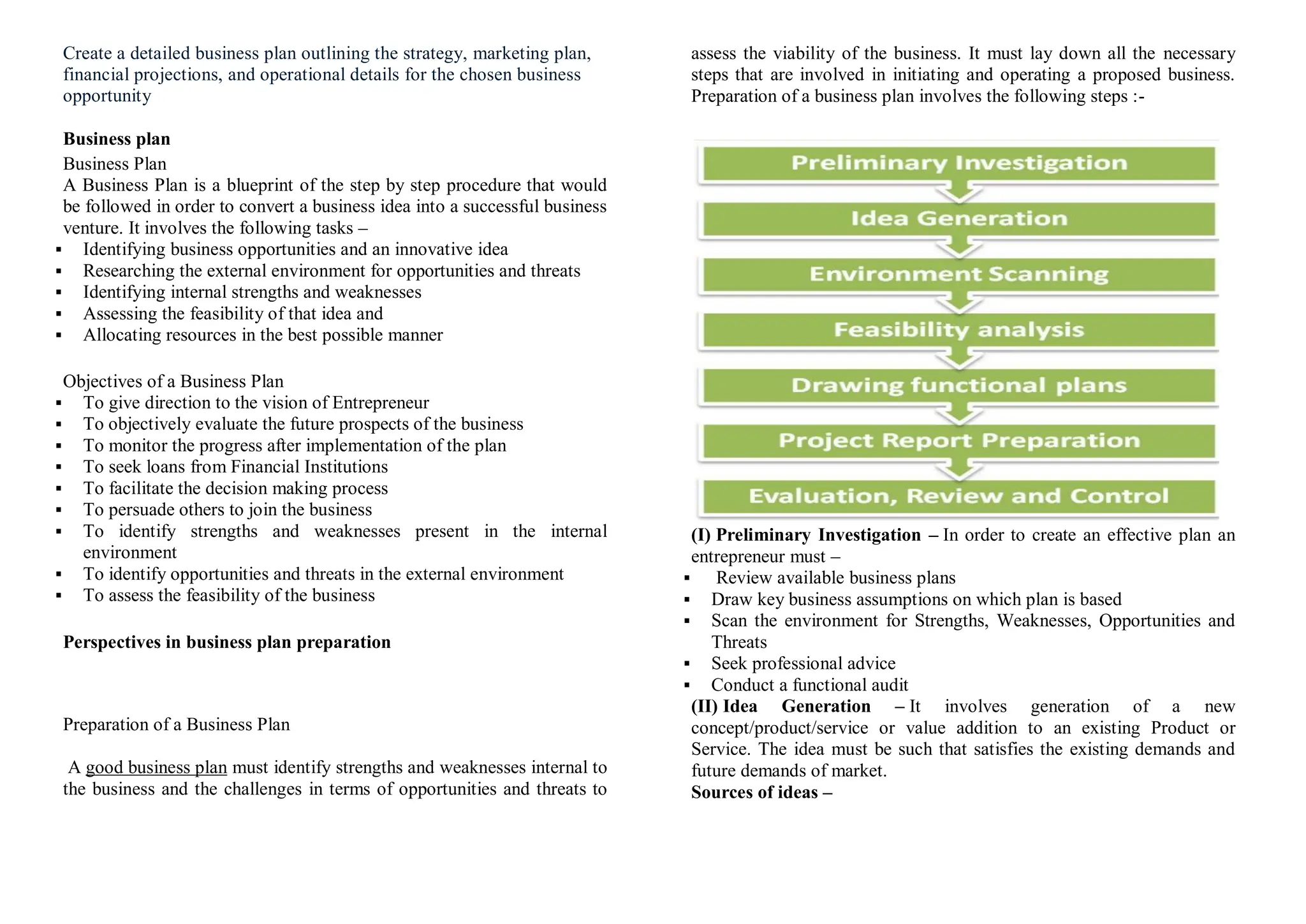
Preparation of a business plan involves the following steps :-
(I) Preliminary Investigation – In order to create an effective plan an
entrepreneur must –
 Review available business plans
 Draw key business assumptions on which plan is based
 Scan the environment for Strengths, Weaknesses, Opportunities and
Threats
 Seek professional advice
 Conduct a functional audit
(II) Idea Generation – It involves generation of a new
concept/product/service or value addition to an existing Product or
Service. The idea must be such that satisfies the existing demands and
future demands of market.
Sources of ideas –
 Consumers
 Existing companies
 Research & Development
 employees
 Dealers/Retailers
Methods of generating ideas –
 Brain storming
 Group discussion
 Data collection through questionnaires
 Invitation of ideas from professionals
 Value addition to existing Product and Service
 Market research
 Import of ideas from products launched abroad
 Commercializing inventions
Screening of ideas is done to identify practical ones and eliminate
impractical one. The most feasible and the most promising idea is
selected for further investigation.
(III) Environment Scanning – The internal and external environment
must be analysed to study the prospective strengths, weaknesses,
opportunities and threats of the business. An entrepreneur must collect
information from all formal and informal sources in order to understand
the supportive and obstructive factors related to the business enterprise.
External Environment –
• Socio cultural appraisal – It involves assessment of the values, beliefs
and norms of a particular society in order to understand their perception
towards a particular idea or product.
• Technological appraisal – It involves assessment of existing technical
know-how and availability of technology necessary to convert an idea
into a product.
• Economic appraisal – It assess the economic environment in terms
consumer price index, inflation, balance of payments, consumption
pattern, per capita income etc.
• Demographic – It involves an assessment of the overall population
pattern of a particular region. Variables like age, education, income
pattern, sex, occupation, distribution etc. help in identifying the size of
target market.
• Government appraisal- It assess various grants, legislations, policies,
incentives, subsidies etc. formed by government.
Internal Environment –
 Availability of Raw materials
 Availability of various machines, tools and equipment required for
production
 Means of Finance and assessment of opening, maintaining and
operating expenses
 Assessment of Present, Potential and Future market
 Assessment of cost, quantity and quality of human resources required
(IV) Feasibility analysis – Feasibility analysis is done to find out
whether the proposed project will be feasible or not. The various
variables that are studied include –
(a) Market Analysis – It is conducted to –
 Estimate the demand of the proposed product in the future
 Estimate the market share of the proposed product in the future
(b) Technical or operational analysis – It is conducted to access the
operational ability of the proposed business. It is very important to find
out the cost and availability of technology. Under Technical analysis
data is collected on following parameters –
 Material availability
 Material requirement planning
 Plant location
 Plant capacity
 Machinery and Equipment
 Plant layout
(C) Financial analysis – A Financial Feasibility test is carried out to
access the financial issues related with the proposed business. The
following estimates have to be carried out –
 Cost of land and building
 Cost of plant and machinery
 Preliminary cost estimation
 Provision for contingencies
 Working capital estimates
 Cost of production
 Sales and production estimates
Based on the above analysis the following projections are made –
 Break-even point
 Cash flow statement
 Balance sheet
(V) Drawing functional plans – If the feasibility plans give a positive
indication a draft business plan is formulated. It involves preparation of
the following functional plans –
(a) Marketing Plan – A marketing plan lays down strategies for
marketing a product/service which can lead to success of business.
These strategies are made in terms of marketing mix (4 P’s) i.e. Product,
Price, Place and Promotion.
(b) Production/Operation Plan –A production plan is made for a
business involved in manufacturing industry while an operation plan is
made for business involved in service industry. It includes strategies for
following –
 Location and reasons for selecting a location
 Physical layout
 Cost and availability of equipment, machine and raw material
 List of suppliers and distributors
 Cost of manufacturing and running operations
 Quality management
 Production scheduling capacity and Inventory management
(c) Organizational Plan – It defines the type of ownership i.e. it could
be a single proprietary, partnership firm, company, private limited or
public limited. It also consists of details about the organization structure
and norms guiding the organization culture.
(d) Financial Plan – It indicates the financial requirement of the
proposed business and furnishes the following details –
 Cost incurred in smooth running of all the financial plans
 Projected cash flows
 Projected income statement
 Projected Break even point
 Projected ratios
 Projected balance sheet
(e) Human Resource Plan – It consists of the details on the following:-
 Manpower requirements
 Recruitment and Selection
 Compensation
 Organization structure
 Wages and Salaries
 Budget
 Remuneration etc.
(VI) Project Report Preparation – It is a written document that
describes step by step, the strategies involved in starting and operating a
business. It is prepared when environmental scanning has been done and
feasibility studies have been carried out.
(VII) Evaluation, Review and Control – In order to keep up with the
dynamic environment and successfully face global competition a
business must be continuously evaluated and reviewed. It is necessary to
periodically evaluate, control and review a business to keep up with the
technological changes and introduce changes in the business strategy.
Elements of business plan Business plan failures.
A "business plan failure" in entrepreneurship refers to a situation where
a company's business plan, which outlines its strategy and goals, proves
ineffective due to poor planning, unrealistic assumptions, inadequate
market research, or a failure to adapt to changing circumstances,
ultimately leading to the business struggling or failing to achieve its
intended objectives.
Common causes of business plan failures:
 Bad business ideas
Nobody likes to talk about it, but the main reason why business plans
fail is bad ideas. Most ideas look great on paper—but all too often,
companies realize they have invested in a bad idea once it is too late.
To avoid this, smart businesses are using “user-driven development”
(UDD) to build new businesses. Lots of ideas seem great until you
figure out that the market doesn’t actually want your product. In
order to ensure that a business idea is sound, entrepreneurs should search
for product validation by reaching out to their target consumers before
sinking huge amounts of time and money into the project.
 Bad Location, Internet Presence, and Marketing
A bad location is self-explanatory if your business relies on location
for foot traffic. Just as dangerous, however, is a poor Internet presence.
These days, your location on the internet and your social media strength
can be just as important as your company's physical location in a
shopping district. An online presence will let people know that they can
give you their business, so if the need is already there, the availability
and visibility of your business is the next important step.
 Unrealistic expectations:
Overestimating potential revenue, market size, or growth rate without
sufficient data to support claims.
 Poor market research:
Not thoroughly understanding the target market, competitor landscape,
and potential challenges within the industry.
 Inadequate financial planning:
Not accurately forecasting expenses, funding needs, and potential cash
flow issues.
 Weak management team:
Lacking the necessary expertise or experience to execute the business
plan effectively.
 Poor marketing strategy:
Not having a well-defined plan to reach and engage the target
audience.
 Failure to adapt:
Inability to adjust the business model or strategy in response to
changing market conditions or customer needs.
 Insufficient funding:
Not securing enough capital to cover operational costs and growth
initiatives.
Specific business plan mistakes that contribute to failure:
 Not having a business plan at all: Failing to document a clear strategy
and roadmap.
 Poor executive summary: Not providing a concise and compelling
overview of the business concept.
 Lack of focus on key metrics: Not defining critical performance
indicators to track progress.
 Overly complex plan: Presenting too much information that is difficult
to navigate and understand.
 Ignoring legal and regulatory requirements: Not considering
necessary licenses, permits, and compliance issues
How to mitigate business plan failures:
 Conduct thorough market research:
Gain deep insights into your target market, competitors, and industry
trends.
 Develop realistic financial projections:
Carefully estimate revenue, expenses, and break-even points.
 Build a strong team:
Assemble individuals with the necessary skills and experience to
execute the plan.
 Regularly monitor and adapt:
Continuously review performance against the plan and make
adjustments as needed.
 Seek expert advice:
Consult with business advisors, mentors, or industry professionals to
identify potential weaknesses.

study about entrepreneurship development

  • 1.
    DEPARTMENT OF BUSINESSADMINISTRATION ENTREPRENEURSHIP DEVELOPMENT III BBA ENTREPRENEURSHIP DEVELOPMENT UNIT-III: BUSINESS PLAN PREPARATION Defining Business Idea – Idea generating techniques- Identification of business opportunities-Business plan- Perspectives in business plan preparation- Elements of business plan Business plan failures. Defining Business Idea A "business idea" in entrepreneurship is a conceptual vision for a new venture, which involves creating a product or service that can be monetized by addressing a market need, often by introducing a unique solution or improving an existing one, ultimately serving as the foundation for a potential business venture; it's the initial thought that guides further development, market research, and business strategy planning. Key points about a business idea:  Focus on problem-solving: A good business idea identifies a specific problem or unmet need in the market and aims to provide a solution through a product or service.  Potential for profit: The idea should have a clear path to generating revenue and achieving financial sustainability.  Market viability: The target market for the product or service should be sizeable and accessible.  Innovation potential: Ideally, the business idea should offer something new or significantly improved compared to existing options in the market. Example of a business idea:  Developing a mobile app that uses AI to personalize fitness routines based on user data - This idea addresses the need for tailored workout plans while leveraging technology to provide a unique solution. Idea generating techniques Generating Ideas is one of the most important concepts when it comes to creative problem-solving and innovation. In this highly changing world, generating ideas to solve problems is a great trait to have. There are certain techniques for generating ideas that can be useful. Whether the individual is an Entrepreneur, a Designer, or anyone who is facing any problem that needs to be solved, these techniques can be proven as effective ones.
  • 2.
    Techniques for GeneratingIdeas 1. Understanding the Problem Understanding the given problem is the most important step to solving the problem or generating ideas to solve the problem. It involves a systematic examination and comprehension of the problem the user is trying to solve. This is the first and the most crucial step in the case of creative problem-solving. The aim of this step is to lay a strong foundation that the ideas that will be generated later are well structured, informed, related to the main problem, and most likely to lead to the proper solutions. Some of the key characteristics of Understanding the problem are:  Problem Definition: Before trying to solve the problem or even generate an idea, it is necessary to express the problem in the easiest way possible.  Gathering Information: To understand the given problem, it is necessary to do some research and gather as much information as possible from other sources. This can include market research, data analysis, receiving feedback from customers, conducting surveys, etc.  Identification of Stakeholders: It is also necessary to find out who will benefit from the solution of the problem, because they can provide some insights about the problem which will help in the idea generation process. 2. Towards Solving the Problem The phase, Towards Solving the Problem, is the swift transition from understanding the problem to the phase of generating ideas. Once a deep understanding of the problem has been gained, the solver can start to think about it and generate ideas to solve the problem and think about the potential solutions.  Mind Mapping: Mind Mapping is a visualisation technique that is used to create a diagram like structure and put the ideas, tasks etc.  SCAMPER: SCAMPER technique stands for Substitute, Combine, Adapt, Modify, Put to another use, Eliminate, and Reverse is a technique which lets the user to view the problem from different angles and apply those aforementioned strategies to generate new ideas.  Lateral Thinking: Lateral thinking is also another heavily used approach to generate ideas to solve problems. It seeks solution of the problem via indirect approaches. 3. Using Your Brain Effectively and Absurdly This encourages both rational thinking and the deliberate use of the unconventional concepts to stimulate creativity. It uses the both sides of a human mind, one that thinks rationally and tries to find the solution in a more rational manner, and the other which solely lives in the imaginary world and thinks absurdly. It is helpful to stimulate creativity in the mind's of the solver and generate ideas.  Effective Thinking: This aspect of the using our brain effectively involves using the brain logically and efficiently. It solely depends upon the structured thinking and analysis of the problem thoroughly.  Absurd Thinking: This might sound silly, but sometimes the absurd and imaginary thinking encourages the user to try some out of the box approaches to solve the problem.
  • 3.
     Thinking Visuallyand Conceptually: Using diagrams and Mind Maps is also helpful to effectively use our brain and generate new techniques to solve the problem. 4. Mind Mapping Mind Mapping is a graphical and visualising approach used to represent the thoughts, ideas, concepts etc. and organise them in a hierarchical and interconnected manner. It is a very useful tool for brainstorming , problem solving, learning, planning and representing complex information. The main function of Mind Mapping is to recreate the process which happens inside human brain while trying to think about any solution of a particular problem. Below are the some of the most important components of a Mind Map:  Central Idea: This occupies the center of the Mind Map, it represents the main concept or the main issue which is being solved.  Branches: This are the thin lines that are used to join the key items and themes with the Central Idea in the middle.  Keywords or Phrases: On each one of the branches (apart from the central idea), certain keywords or phrases are used to represent the main idea or issue of that sub-category or branch. 5. Group Creativity Group Creativity is also known as collaborative creativity is a phase where a group of individual come together to share their ideas about solving a same problem. It is the ability of a team to work together to solve a certain problem given to them by thinking creatively and develop new concepts collectively to extend the capability of a single person's thinking power. Some of the most important points about Group Creativity is mentioned below:  Diversity of Perspectives: Each group consists of members whose thinking capabilities are different than the others, they can come from different backgrounds, hold different experiences. This diverse atmosphere leads to more creative solutions.  Brainstorming: Brainstorming are special sessions carried out to encourage the group members to encourage them and boost their creativity to generate more ideas. During this sessions the members are encouraged to share any kind of idea without any judgement or criticism.  Collaboration: Collaboration and effective communication between the group memebers are a necessity for nurturing creative thinking. 6. Focus Groups Focus Groups is a Qualitative research method which mostly involves a small group, but a diverse kind of individuals who freely shares their thought and opinions on a specific topic given to them. The discussions of a focus groups are generally mentored by a moderator or facilitator. Some key characteristics of Focus Groups are:  Size of the Group: Generally the size of Focus Groups are small, it typically consists of only 6-10 individuals. It is kept like this because this is perfect number to get diverse ideas and keeping hthe encouragement and communication between them.  Structured Discussion: As a certain moderator or Facilitator is in charge of a Focus Groups, he or she is in control of what should be discussed and what structure it would follow.  Interactive Discussion: As the number of members are kept small, everyone gets the chance to participate in the discussion and interact with each other, this helps to discuss the ideas between them and rectify the mistakes if any. 7. Brainstorming Brainstorming is a well known problem solving technique used to generate ideas within a group. Everyone in the group encourages each other to come up with new ideas whether they are absurd or practical without any criticism. The main goal of a brainstorm session is to come up with a solution of the problem or challenge given to them. Some of the characteristics of Brainstorming are:  Free Thinking: All the members of the group can share their thoughts and ideas freely without facing any criticism. The main goal is to get as many idea as possible.  Divergent Thinking: It is also a form of Divergent Thinking, it allows the members to think about multiple possible ways to solve the problem.
  • 4.
     Done withina group: Brainstorming sessions are usually conducted in a group. So the idea and the discussion remains secret to that group members only. 8. Reverse Brainstorming As the name itself suggests, Reverse Brainstorming is a well known problem solving technique which works in exactly opposite manner that of the traditional Brainstorming. Brainstorming sessions are usually done to generate ideas to solve a problem, whereas the reverse brainstorming is done to generate ideas which will cause a problem. Below are some of the key characteristics of Reverse Brainstorming:  Define the Problem: It starts with defining the problem clearly and precisely, of whose solution we are trying to find.  Reverse the Goal: Instead to directly finding the solution to the problem, encourage the participants to think how to create the problem or even make it worse. This approach will involve thinking about the actions, behaviour and different factors which will lead to the problem.  Evaluate and Reverse: After collecting a pool of ideas which causes the problem or make it harder, the participants evaluate those ideas, then starts the actual brainstorming method to find the solution of those problems in the traditional way. 9. Synectics Synectics is a creative problem-solving approach developed by William J.J Gordon and George M. Prince in 1950s. It has been derived from the Greek Word "synectikos," which means "bringing different ideas into unified connection." Synectics is used to establish connections between unrelated concepts/ideas generated during brainstorming sessions. It lets the users members to think beyond the traditional approaches and come up with something out of the box. Some of the key charactertistics are:  Use of Analogy and Metaphors: In Synectics, most of the times it relies on the use of different analogies and metaphors to establish connections between unrelated topics. By creating a connection between unrelated topics, new ideas can be generated easily.  Relaxation and Playfulness: Creation of a Playful and Relax environment is necessary in case of Synectics. Relax environment is helpful to encourage people generate more ideas.  No Judgement or Criticism: The participants are encouraged to not to judge others after listening to their ideas and not criticise them. This allows the other participants to think more freely without fearing of criticism. 10. The Gordon Method The Gordon Method is another well known problem solving approach developed by William JJ Gordon, this method is named after him. He was an engineer and a creativity expert. He is also known for its work in creating the Synectic method. The Gordon Method is closely related to the Synectic method, there are certain differences between them, like Synectic method is more structured than that of Gordon Method and it put emphasis on the use of Analogies and Metaphors to generate ideas. It follows a pre-defined process and uses specific "Operators" (Like images, diagrams etc as a hint to boost the idea generation), whereas the Gordon Method allows more flexibility in problem solving and relies upon the group collaboration, often with a Facilitator but no operators are used. Some of it's key characteristics are:  Clear Problem Statement: The Gordon Method starts with a clear and concise Problem Statement which needs to be solved.  Emphasis on Organisational Goal: Gordon Method plays an important role of putting Emphasis on the Organisation's goal and objectives which aligns with Creative Thinking.  Use of Triggers and Stimuli: The Gordon Method uses various types of Triggers and Stimuli like specific structured questions, scenarios, or various challenges which can provoke creative ideas. Identification of business opportunities Identifying business opportunities in entrepreneurship involves actively scanning the market to pinpoint unmet needs, emerging trends, or gaps in existing offerings, where a new product or service can be developed to cater to a specific customer segment and generate profit; this process includes analyzing market trends, customer behavior, competition, and
  • 5.
    technological advancements toidentify potential opportunities for a new business venture. Key aspects of identifying business opportunities:  Market research:  Consumer analysis: Understanding customer needs, wants, pain points, demographics, and buying behavior through surveys, focus groups, and market research reports.  Industry trends: Identifying emerging trends, technological advancements, and industry shifts that could create new market opportunities.  Competitive analysis: Studying existing competitors to identify gaps in their offerings, potential areas for differentiation, and market share opportunities.  Opportunity recognition methods:  Personal observation: Identifying problems or inconveniences in everyday life that could be solved with a new product or service.  Problem-solving approach: Focusing on addressing specific pain points or needs within a market segment  Innovation and adaptation: Identifying opportunities to improve existing products or services by incorporating new technologies or features  Niche market identification: Targeting a specific, underserved customer segment with tailored solutions  Evaluating potential opportunities:  Market viability: Assessing market size, potential customer base, and demand for the product or service.  Financial feasibility: Analyzing costs of production, pricing strategies, potential revenue streams, and expected profitability  Technical feasibility: Evaluating the availability of technology, resources, and expertise required to develop the product or service  Legal and regulatory considerations: Understanding any legal or regulatory requirements that may impact the business operation Important factors to consider when identifying business opportunities:  Local market dynamics: Understanding the specific needs and characteristics of the local market  Economic conditions: Considering the overall economic climate and its impact on consumer spending  Technological advancements: Identifying emerging technologies that could enable new business models  Social and environmental factors: Assessing potential social and environmental impacts of a new business venture Steps for identifying business opportunities: 1. 1. Brainstorming: Generate a wide range of ideas based on personal observations, market trends, and industry knowledge. 2. 2. Market research: Conduct thorough market research to gather data on potential customer segments, competition, and market size. 3. 3. Opportunity evaluation: Analyze each potential opportunity based on market viability, financial feasibility, and technical feasibility. 4. 4. Validation: Test the concept with potential customers through surveys, focus groups, or prototypes to validate the demand 5. 5. Business plan development:
  • 6.
    Create a detailedbusiness plan outlining the strategy, marketing plan, financial projections, and operational details for the chosen business opportunity Business plan Business Plan A Business Plan is a blueprint of the step by step procedure that would be followed in order to convert a business idea into a successful business venture. It involves the following tasks –  Identifying business opportunities and an innovative idea  Researching the external environment for opportunities and threats  Identifying internal strengths and weaknesses  Assessing the feasibility of that idea and  Allocating resources in the best possible manner Objectives of a Business Plan  To give direction to the vision of Entrepreneur  To objectively evaluate the future prospects of the business  To monitor the progress after implementation of the plan  To seek loans from Financial Institutions  To facilitate the decision making process  To persuade others to join the business  To identify strengths and weaknesses present in the internal environment  To identify opportunities and threats in the external environment  To assess the feasibility of the business Perspectives in business plan preparation Preparation of a Business Plan A good business plan must identify strengths and weaknesses internal to the business and the challenges in terms of opportunities and threats to assess the viability of the business. It must lay down all the necessary steps that are involved in initiating and operating a proposed business. Preparation of a business plan involves the following steps :- (I) Preliminary Investigation – In order to create an effective plan an entrepreneur must –  Review available business plans  Draw key business assumptions on which plan is based  Scan the environment for Strengths, Weaknesses, Opportunities and Threats  Seek professional advice  Conduct a functional audit (II) Idea Generation – It involves generation of a new concept/product/service or value addition to an existing Product or Service. The idea must be such that satisfies the existing demands and future demands of market. Sources of ideas –
  • 7.
     Consumers  Existingcompanies  Research & Development  employees  Dealers/Retailers Methods of generating ideas –  Brain storming  Group discussion  Data collection through questionnaires  Invitation of ideas from professionals  Value addition to existing Product and Service  Market research  Import of ideas from products launched abroad  Commercializing inventions Screening of ideas is done to identify practical ones and eliminate impractical one. The most feasible and the most promising idea is selected for further investigation. (III) Environment Scanning – The internal and external environment must be analysed to study the prospective strengths, weaknesses, opportunities and threats of the business. An entrepreneur must collect information from all formal and informal sources in order to understand the supportive and obstructive factors related to the business enterprise. External Environment – • Socio cultural appraisal – It involves assessment of the values, beliefs and norms of a particular society in order to understand their perception towards a particular idea or product. • Technological appraisal – It involves assessment of existing technical know-how and availability of technology necessary to convert an idea into a product. • Economic appraisal – It assess the economic environment in terms consumer price index, inflation, balance of payments, consumption pattern, per capita income etc. • Demographic – It involves an assessment of the overall population pattern of a particular region. Variables like age, education, income pattern, sex, occupation, distribution etc. help in identifying the size of target market. • Government appraisal- It assess various grants, legislations, policies, incentives, subsidies etc. formed by government. Internal Environment –  Availability of Raw materials  Availability of various machines, tools and equipment required for production  Means of Finance and assessment of opening, maintaining and operating expenses  Assessment of Present, Potential and Future market  Assessment of cost, quantity and quality of human resources required (IV) Feasibility analysis – Feasibility analysis is done to find out whether the proposed project will be feasible or not. The various variables that are studied include – (a) Market Analysis – It is conducted to –  Estimate the demand of the proposed product in the future  Estimate the market share of the proposed product in the future (b) Technical or operational analysis – It is conducted to access the operational ability of the proposed business. It is very important to find out the cost and availability of technology. Under Technical analysis data is collected on following parameters –  Material availability  Material requirement planning  Plant location  Plant capacity  Machinery and Equipment  Plant layout (C) Financial analysis – A Financial Feasibility test is carried out to access the financial issues related with the proposed business. The following estimates have to be carried out –  Cost of land and building  Cost of plant and machinery  Preliminary cost estimation  Provision for contingencies
  • 8.
     Working capitalestimates  Cost of production  Sales and production estimates Based on the above analysis the following projections are made –  Break-even point  Cash flow statement  Balance sheet (V) Drawing functional plans – If the feasibility plans give a positive indication a draft business plan is formulated. It involves preparation of the following functional plans – (a) Marketing Plan – A marketing plan lays down strategies for marketing a product/service which can lead to success of business. These strategies are made in terms of marketing mix (4 P’s) i.e. Product, Price, Place and Promotion. (b) Production/Operation Plan –A production plan is made for a business involved in manufacturing industry while an operation plan is made for business involved in service industry. It includes strategies for following –  Location and reasons for selecting a location  Physical layout  Cost and availability of equipment, machine and raw material  List of suppliers and distributors  Cost of manufacturing and running operations  Quality management  Production scheduling capacity and Inventory management (c) Organizational Plan – It defines the type of ownership i.e. it could be a single proprietary, partnership firm, company, private limited or public limited. It also consists of details about the organization structure and norms guiding the organization culture. (d) Financial Plan – It indicates the financial requirement of the proposed business and furnishes the following details –  Cost incurred in smooth running of all the financial plans  Projected cash flows  Projected income statement  Projected Break even point  Projected ratios  Projected balance sheet (e) Human Resource Plan – It consists of the details on the following:-  Manpower requirements  Recruitment and Selection  Compensation  Organization structure  Wages and Salaries  Budget  Remuneration etc. (VI) Project Report Preparation – It is a written document that describes step by step, the strategies involved in starting and operating a business. It is prepared when environmental scanning has been done and feasibility studies have been carried out. (VII) Evaluation, Review and Control – In order to keep up with the dynamic environment and successfully face global competition a business must be continuously evaluated and reviewed. It is necessary to periodically evaluate, control and review a business to keep up with the technological changes and introduce changes in the business strategy. Elements of business plan Business plan failures. A "business plan failure" in entrepreneurship refers to a situation where a company's business plan, which outlines its strategy and goals, proves ineffective due to poor planning, unrealistic assumptions, inadequate market research, or a failure to adapt to changing circumstances, ultimately leading to the business struggling or failing to achieve its intended objectives. Common causes of business plan failures:  Bad business ideas Nobody likes to talk about it, but the main reason why business plans fail is bad ideas. Most ideas look great on paper—but all too often, companies realize they have invested in a bad idea once it is too late. To avoid this, smart businesses are using “user-driven development” (UDD) to build new businesses. Lots of ideas seem great until you
  • 9.
    figure out thatthe market doesn’t actually want your product. In order to ensure that a business idea is sound, entrepreneurs should search for product validation by reaching out to their target consumers before sinking huge amounts of time and money into the project.  Bad Location, Internet Presence, and Marketing A bad location is self-explanatory if your business relies on location for foot traffic. Just as dangerous, however, is a poor Internet presence. These days, your location on the internet and your social media strength can be just as important as your company's physical location in a shopping district. An online presence will let people know that they can give you their business, so if the need is already there, the availability and visibility of your business is the next important step.  Unrealistic expectations: Overestimating potential revenue, market size, or growth rate without sufficient data to support claims.  Poor market research: Not thoroughly understanding the target market, competitor landscape, and potential challenges within the industry.  Inadequate financial planning: Not accurately forecasting expenses, funding needs, and potential cash flow issues.  Weak management team: Lacking the necessary expertise or experience to execute the business plan effectively.  Poor marketing strategy: Not having a well-defined plan to reach and engage the target audience.  Failure to adapt: Inability to adjust the business model or strategy in response to changing market conditions or customer needs.  Insufficient funding: Not securing enough capital to cover operational costs and growth initiatives. Specific business plan mistakes that contribute to failure:  Not having a business plan at all: Failing to document a clear strategy and roadmap.  Poor executive summary: Not providing a concise and compelling overview of the business concept.  Lack of focus on key metrics: Not defining critical performance indicators to track progress.  Overly complex plan: Presenting too much information that is difficult to navigate and understand.  Ignoring legal and regulatory requirements: Not considering necessary licenses, permits, and compliance issues How to mitigate business plan failures:  Conduct thorough market research: Gain deep insights into your target market, competitors, and industry trends.  Develop realistic financial projections: Carefully estimate revenue, expenses, and break-even points.  Build a strong team: Assemble individuals with the necessary skills and experience to execute the plan.  Regularly monitor and adapt: Continuously review performance against the plan and make adjustments as needed.  Seek expert advice: Consult with business advisors, mentors, or industry professionals to identify potential weaknesses.