CONDITIONAL SENTENCES
AND ITS TYPES
 Conditional sentences are statements discussing
known factors or hypothetical situations and their
consequences. Complete conditional sentences
contain a conditional clause (often referred to as the
if-clause) and the consequence. Consider the
following sentences:
 Examples:
 If a certain condition is true, then a particular result
happens.
 I would travel around the world if I won the lottery.
 When water reaches 100 degrees, it boils.
There are four different types of conditional
sentences in English. Each expresses a different
degree of probability that a situation will occur
or would have occurred under certain
circumstances.
1. Zero Conditional Sentences
2. First Conditional Sentences
3. Second Conditional Sentences
4. Third Conditional Sentences
1. ZERO CONDITIONAL
 Zero conditional sentences express general truths—
situations in which one thing always causes another.
When you use a zero conditional, you’re talking
about a general truth rather than a specific instance
of something.
 Examples:
 If you don’t brush your teeth, you get cavities.
 When people smoke cigarettes, their health suffers.
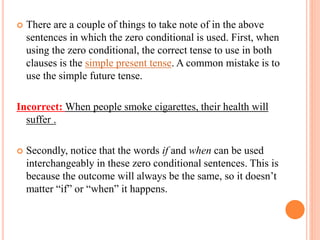
 There are a couple of things to take note of in the above
sentences in which the zero conditional is used. First, when
using the zero conditional, the correct tense to use in both
clauses is the simple present tense. A common mistake is to
use the simple future tense.
Incorrect: When people smoke cigarettes, their health will
suffer .
 Secondly, notice that the words if and when can be used
interchangeably in these zero conditional sentences. This is
because the outcome will always be the same, so it doesn’t
matter “if” or “when” it happens.
2. FIRST CONDITIONAL
 First conditional sentences are used to express
situations in which the outcome is likely (but not
guaranteed) to happen in the future.
 Examples:
 If you rest, you will feel better.
 If you set your mind to a goal, you’ll eventually
achieve it.
 Note that we use the simple present tense in the if-
clause and simple future tense in the main clause—that
is, the clause that expresses the likely outcome.
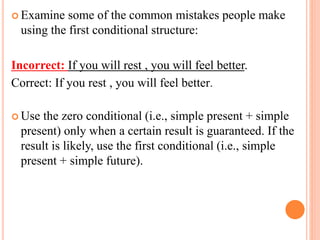
 Examine some of the common mistakes people make
using the first conditional structure:
Incorrect: If you will rest , you will feel better.
Correct: If you rest , you will feel better.
 Use the zero conditional (i.e., simple present + simple
present) only when a certain result is guaranteed. If the
result is likely, use the first conditional (i.e., simple
present + simple future).
3. SECOND CONDITIONAL
 Second conditional sentences are useful for expressing
outcomes that are completely unrealistic or
will not likely happen in the future.
 Example:
 If I inherited a billion dollars, I would travel to the
moon.
 If I owned a zoo, I might let people interact with the
animals more.
 Notice the correct way to structure second conditional
sentences is to use the simple past tense in the if-clause
and an auxiliary modal verb (e.g., could, should, would,
might) in the main clause (the one that expresses the
unrealistic or unlikely outcome).
4. THIRD CONDITIONAL
 Third conditional sentences are used to explain that
present circumstances would be different if something
different had happened in the past.
 Example:
 If you had told me you needed a ride, I would have left
earlier.
 If I had cleaned the house, I could have gone to the
movies.
 Note that when using the third conditional, we use
the past perfect (i.e., had + past participle) in the if-
clause. The modal auxiliary (would, could, should,
etc.) + have + past participle in the main clause
expresses the theoretical situation that could have
happened.
 The third conditional mood expresses a situation that
could have only happened in the past if a certain
condition had been met. That’s why we use the
modal auxiliary verb + have + the past participle.
.pptx

.pptx

  • 1.
  • 2.
     Conditional sentencesare statements discussing known factors or hypothetical situations and their consequences. Complete conditional sentences contain a conditional clause (often referred to as the if-clause) and the consequence. Consider the following sentences:  Examples:  If a certain condition is true, then a particular result happens.  I would travel around the world if I won the lottery.  When water reaches 100 degrees, it boils.
  • 3.
    There are fourdifferent types of conditional sentences in English. Each expresses a different degree of probability that a situation will occur or would have occurred under certain circumstances. 1. Zero Conditional Sentences 2. First Conditional Sentences 3. Second Conditional Sentences 4. Third Conditional Sentences
  • 4.
    1. ZERO CONDITIONAL Zero conditional sentences express general truths— situations in which one thing always causes another. When you use a zero conditional, you’re talking about a general truth rather than a specific instance of something.  Examples:  If you don’t brush your teeth, you get cavities.  When people smoke cigarettes, their health suffers.
  • 5.
     There area couple of things to take note of in the above sentences in which the zero conditional is used. First, when using the zero conditional, the correct tense to use in both clauses is the simple present tense. A common mistake is to use the simple future tense. Incorrect: When people smoke cigarettes, their health will suffer .  Secondly, notice that the words if and when can be used interchangeably in these zero conditional sentences. This is because the outcome will always be the same, so it doesn’t matter “if” or “when” it happens.
  • 6.
    2. FIRST CONDITIONAL First conditional sentences are used to express situations in which the outcome is likely (but not guaranteed) to happen in the future.  Examples:  If you rest, you will feel better.  If you set your mind to a goal, you’ll eventually achieve it.  Note that we use the simple present tense in the if- clause and simple future tense in the main clause—that is, the clause that expresses the likely outcome.
  • 7.
     Examine someof the common mistakes people make using the first conditional structure: Incorrect: If you will rest , you will feel better. Correct: If you rest , you will feel better.  Use the zero conditional (i.e., simple present + simple present) only when a certain result is guaranteed. If the result is likely, use the first conditional (i.e., simple present + simple future).
  • 8.
    3. SECOND CONDITIONAL Second conditional sentences are useful for expressing outcomes that are completely unrealistic or will not likely happen in the future.  Example:  If I inherited a billion dollars, I would travel to the moon.  If I owned a zoo, I might let people interact with the animals more.  Notice the correct way to structure second conditional sentences is to use the simple past tense in the if-clause and an auxiliary modal verb (e.g., could, should, would, might) in the main clause (the one that expresses the unrealistic or unlikely outcome).
  • 9.
    4. THIRD CONDITIONAL Third conditional sentences are used to explain that present circumstances would be different if something different had happened in the past.  Example:  If you had told me you needed a ride, I would have left earlier.  If I had cleaned the house, I could have gone to the movies.
  • 10.
     Note thatwhen using the third conditional, we use the past perfect (i.e., had + past participle) in the if- clause. The modal auxiliary (would, could, should, etc.) + have + past participle in the main clause expresses the theoretical situation that could have happened.  The third conditional mood expresses a situation that could have only happened in the past if a certain condition had been met. That’s why we use the modal auxiliary verb + have + the past participle.