 Sentences used to indicate that an action or state of

being is conditioned on the occurrence of something
else.
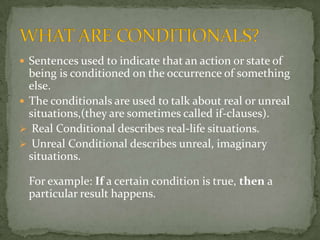
 The conditionals are used to talk about real or unreal
situations,(they are sometimes called if-clauses).
 Real Conditional describes real-life situations.
 Unreal Conditional describes unreal, imaginary
situations.
For example: If a certain condition is true, then a
particular result happens.
Zero Conditional
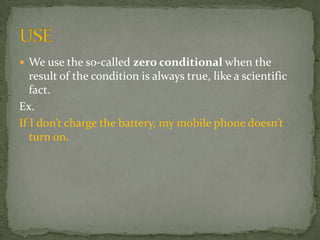
 We use the so-called zero conditional when the

result of the condition is always true, like a scientific
fact.
Ex.
If I don’t charge the battery, my mobile phone doesn’t
turn on.
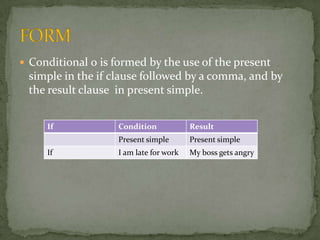
 Conditional 0 is formed by the use of the present

simple in the if clause followed by a comma, and by
the result clause in present simple.
If

Result

Present simple
If

Condition

Present simple

I am late for work

My boss gets angry
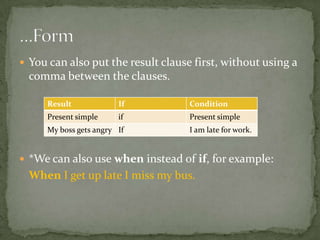
 You can also put the result clause first, without using a

comma between the clauses.
Result

If

Condition

Present simple

if

Present simple

My boss gets angry If

I am late for work.

 *We can also use when instead of if, for example:

When I get up late I miss my bus.
 Notice that we are thinking about a result that is

always true for this condition.
 The result of the condition is an absolute certainty.
We are not thinking about the future or the past, or
even the present. We are thinking about a simple fact.
 We use the present simple tense to talk about the
condition. We also use the present simple tense to talk
about the result.
 The important thing about the zero conditional is
that the condition always has the same result.
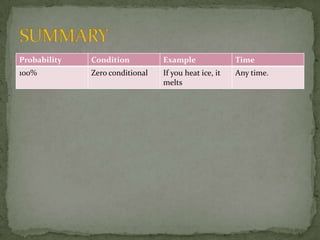
Probability

Condition

Example

Time

100%

Zero conditional

If you heat ice, it
melts

Any time.
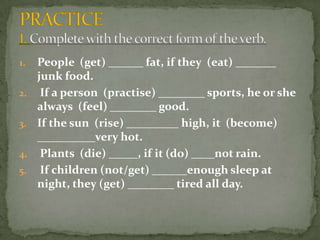
1.
2.
3.
4.
5.

People (get) ______ fat, if they (eat) _______
junk food.
If a person (practise) ________ sports, he or she
always (feel) ________ good.
If the sun (rise) _________ high, it (become)
__________very hot.
Plants (die) _____, if it (do) ____not rain.
If children (not/get) ______enough sleep at
night, they (get) ________ tired all day.
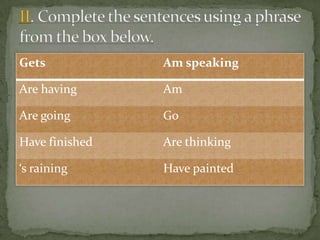
Gets

Am speaking

Are having

Am

Are going

Go

Have finished

Are thinking

‘s raining

Have painted
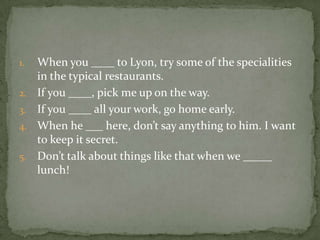
1.
2.
3.
4.
5.

When you ____ to Lyon, try some of the specialities
in the typical restaurants.
If you ____, pick me up on the way.
If you ____ all your work, go home early.
When he ___ here, don’t say anything to him. I want
to keep it secret.
Don’t talk about things like that when we _____
lunch!
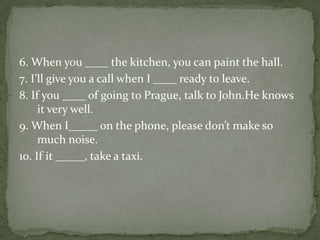
6. When you ____ the kitchen, you can paint the hall.
7. I’ll give you a call when I ____ ready to leave.
8. If you ____ of going to Prague, talk to John.He knows
it very well.
9. When I_____ on the phone, please don’t make so
much noise.
10. If it _____, take a taxi.
Conditionals, zero conditional

Conditionals, zero conditional

  • 2.
     Sentences usedto indicate that an action or state of being is conditioned on the occurrence of something else.  The conditionals are used to talk about real or unreal situations,(they are sometimes called if-clauses).  Real Conditional describes real-life situations.  Unreal Conditional describes unreal, imaginary situations. For example: If a certain condition is true, then a particular result happens.
  • 3.
  • 4.
     We usethe so-called zero conditional when the result of the condition is always true, like a scientific fact. Ex. If I don’t charge the battery, my mobile phone doesn’t turn on.
  • 5.
     Conditional 0is formed by the use of the present simple in the if clause followed by a comma, and by the result clause in present simple. If Result Present simple If Condition Present simple I am late for work My boss gets angry
  • 6.
     You canalso put the result clause first, without using a comma between the clauses. Result If Condition Present simple if Present simple My boss gets angry If I am late for work.  *We can also use when instead of if, for example: When I get up late I miss my bus.
  • 7.
     Notice thatwe are thinking about a result that is always true for this condition.  The result of the condition is an absolute certainty. We are not thinking about the future or the past, or even the present. We are thinking about a simple fact.  We use the present simple tense to talk about the condition. We also use the present simple tense to talk about the result.  The important thing about the zero conditional is that the condition always has the same result.
  • 8.
  • 9.
    1. 2. 3. 4. 5. People (get) ______fat, if they (eat) _______ junk food. If a person (practise) ________ sports, he or she always (feel) ________ good. If the sun (rise) _________ high, it (become) __________very hot. Plants (die) _____, if it (do) ____not rain. If children (not/get) ______enough sleep at night, they (get) ________ tired all day.
  • 10.
    Gets Am speaking Are having Am Aregoing Go Have finished Are thinking ‘s raining Have painted
  • 11.
    1. 2. 3. 4. 5. When you ____to Lyon, try some of the specialities in the typical restaurants. If you ____, pick me up on the way. If you ____ all your work, go home early. When he ___ here, don’t say anything to him. I want to keep it secret. Don’t talk about things like that when we _____ lunch!
  • 12.
    6. When you____ the kitchen, you can paint the hall. 7. I’ll give you a call when I ____ ready to leave. 8. If you ____ of going to Prague, talk to John.He knows it very well. 9. When I_____ on the phone, please don’t make so much noise. 10. If it _____, take a taxi.