Reagents and Reactions
E. Udaya Rajitha
I M. Pharmacy
159V1S0404
1
CONTENTS
 Introduction
 Reactions
 Reagents
 Preparation
 Mechanism
 Applications
2
Introduction
Reagents are used for the qualitative and quantitative
determination of the pharmaceutical preparations, as they
react with particular groups and increase their detectability
by impart colour to the compounds.
3
Reaction Reagent
Diazo coupling reaction BM
Oxidative coupling reaction MBTH
Condensation reaction PDAB, PDAC
Oxidation / Reduction reaction FC
4
Preparation: 100mg of BM reagent powder
100ml of mixture [ acetone : water (7:3) ]
Keep in dark place & protect from light
Mechanism:
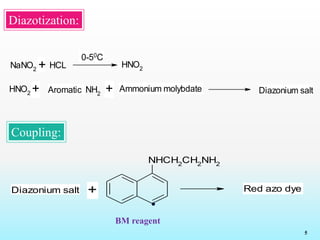
Diazotization
Coupling
BM reagent:
The compounds which contains primary
aromatic amine groups are react with the BM regent and
form red colour azo dye which shows λmax at 550nm.
Diazo coupling reaction:
Diazotization:
5
NaNO2
HCL HNO2
HNO2 NH2
+
0-50C
+ Aromatic Ammonium molybdate+ Diazonium salt
NHCH2
CH2
NH2
Diazonium salt + Red azo dye
Coupling:
BM reagent
Applications:
6
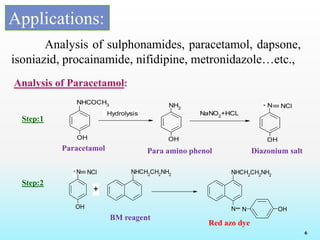
Analysis of sulphonamides, paracetamol, dapsone,
isoniazid, procainamide, nifidipine, metronidazole…etc.,
OH
N NCl NHCH2
CH2
NH2 NHCH2
CH2
NH2
N OHN
+
+
Analysis of Paracetamol:
OH
NHCOCH3
OH
NH2
NaNO2
+HCL
OH
N NCl
Hydrolysis
+
Paracetamol
Step:1
Para amino phenol Diazonium salt
Step:2
BM reagent
Red azo dye
7
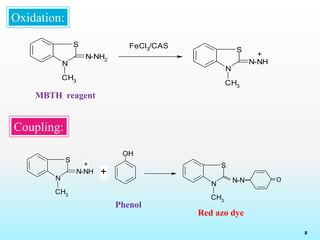
Oxidative coupling reaction:
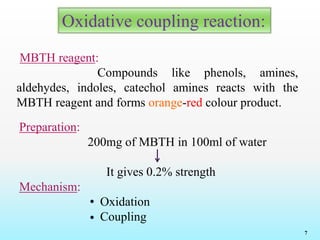
MBTH reagent:
Compounds like phenols, amines,
aldehydes, indoles, catechol amines reacts with the
MBTH reagent and forms orange-red colour product.
Preparation:
200mg of MBTH in 100ml of water
It gives 0.2% strength
Mechanism:
Oxidation
Coupling
8
CH3
S
N-NH2
N
FeCl3
/CAS
CH3
S
N-NH
N
+
CH3
S
N-NH
N
OH
CH3
S
N
N-N O
+
+
Oxidation:
Coupling:
MBTH reagent
Phenol
Red azo dye
9
CH3
S
N-NH2
N
FeCl3
/CAS
CH3
S
N-NH
N
+
CH3
S
N
N-N
CH3
S
N-NH
N HCHO
C
H
H
+
+
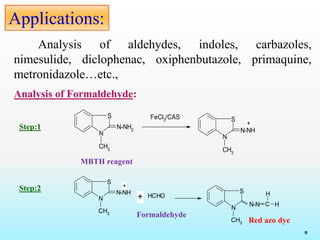
Applications:
Analysis of aldehydes, indoles, carbazoles,
nimesulide, diclophenac, oxiphenbutazole, primaquine,
metronidazole…etc.,
Analysis of Formaldehyde:
Step:1
Step:2
MBTH reagent
Red azo dye
Formaldehyde
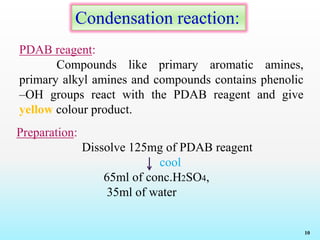
Condensation reaction:
10
PDAB reagent:
Compounds like primary aromatic amines,
primary alkyl amines and compounds contains phenolic
–OH groups react with the PDAB reagent and give
yellow colour product.
Preparation:
Dissolve 125mg of PDAB reagent
cool
65ml of conc.H2SO4,
35ml of water
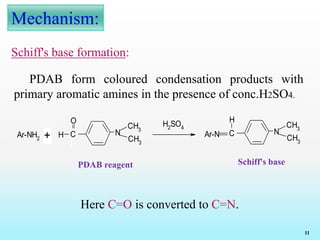
Mechanism:
11
NC
O
H
CH3
CH3
NC
CH3
CH3
H
Ar-NAr-NH2
H2
SO4
+
Schiff's base formation:
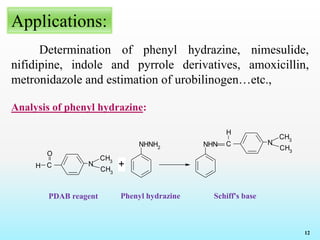
PDAB form coloured condensation products with
primary aromatic amines in the presence of conc.H2SO4.
Here C=O is converted to C=N.
PDAB reagent Schiff's base
12
NC
O
H
CH3
CH3
NHNH2
NC
CH3
CH3
NHN
H
+
Analysis of phenyl hydrazine:
Applications:
Determination of phenyl hydrazine, nimesulide,
nifidipine, indole and pyrrole derivatives, amoxicillin,
metronidazole and estimation of urobilinogen…etc.,
PDAB reagent Phenyl hydrazine Schiff's base
Oxidation / Reduction reaction:
13
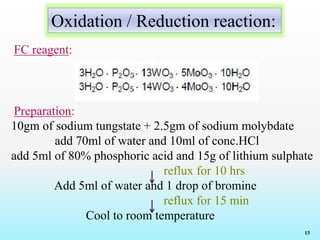
FC reagent:
10gm of sodium tungstate + 2.5gm of sodium molybdate
add 70ml of water and 10ml of conc.HCl
add 5ml of 80% phosphoric acid and 15g of lithium sulphate
reflux for 10 hrs
Add 5ml of water and 1 drop of bromine
reflux for 15 min
Cool to room temperature
Preparation:
14
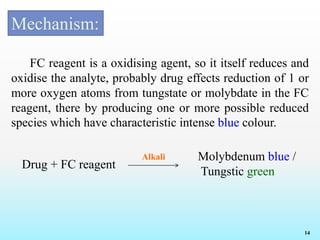
FC reagent is a oxidising agent, so it itself reduces and
oxidise the analyte, probably drug effects reduction of 1 or
more oxygen atoms from tungstate or molybdate in the FC
reagent, there by producing one or more possible reduced
species which have characteristic intense blue colour.
Mechanism:
Drug + FC reagent
Molybdenum blue /
Tungstic green
Alkali
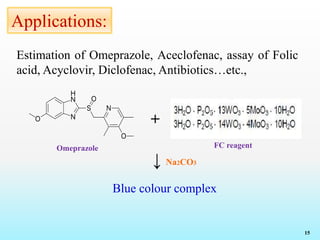
Applications:
15
Estimation of Omeprazole, Aceclofenac, assay of Folic
acid, Acyclovir, Diclofenac, Antibiotics…etc.,
+
Omeprazole FC reagent
↓ Na2CO3
Blue colour complex
16
Other reagents:
• Folins reagent
• Gibbs reagent
• NBS
• FeCl3, Potassium ferri cyanide, 1,10- Phenanthroline
• Froehde Reagent
• 4-(Dimethylamino) Cinnamaldehyde
• Phosphomolybdic acid
• Zwikker Reagent
17
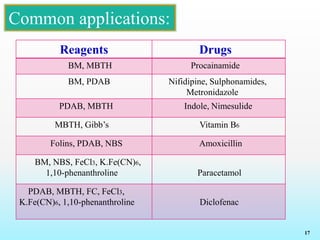
Common applications:
Reagents Drugs
BM, MBTH Procainamide
BM, PDAB Nifidipine, Sulphonamides,
Metronidazole
PDAB, MBTH Indole, Nimesulide
MBTH, Gibb’s Vitamin B6
Folins, PDAB, NBS Amoxicillin
BM, NBS, FeCl3, K.Fe(CN)6,
1,10-phenanthroline Paracetamol
PDAB, MBTH, FC, FeCl3,
K.Fe(CN)6, 1,10-phenanthroline Diclofenac
Conclusion
18
References:
19
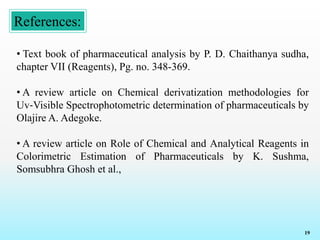
• Text book of pharmaceutical analysis by P. D. Chaithanya sudha,
chapter VII (Reagents), Pg. no. 348-369.
• A review article on Chemical derivatization methodologies for
Uv‐Visible Spectrophotometric determination of pharmaceuticals by
Olajire A. Adegoke.
• A review article on Role of Chemical and Analytical Reagents in
Colorimetric Estimation of Pharmaceuticals by K. Sushma,
Somsubhra Ghosh et al.,
THANK YOU
20

reagents

  • 1.
    Reagents and Reactions E.Udaya Rajitha I M. Pharmacy 159V1S0404 1
  • 2.
    CONTENTS  Introduction  Reactions Reagents  Preparation  Mechanism  Applications 2
  • 3.
    Introduction Reagents are usedfor the qualitative and quantitative determination of the pharmaceutical preparations, as they react with particular groups and increase their detectability by impart colour to the compounds. 3 Reaction Reagent Diazo coupling reaction BM Oxidative coupling reaction MBTH Condensation reaction PDAB, PDAC Oxidation / Reduction reaction FC
  • 4.
    4 Preparation: 100mg ofBM reagent powder 100ml of mixture [ acetone : water (7:3) ] Keep in dark place & protect from light Mechanism: Diazotization Coupling BM reagent: The compounds which contains primary aromatic amine groups are react with the BM regent and form red colour azo dye which shows λmax at 550nm. Diazo coupling reaction:
  • 5.
    Diazotization: 5 NaNO2 HCL HNO2 HNO2 NH2 + 0-50C +Aromatic Ammonium molybdate+ Diazonium salt NHCH2 CH2 NH2 Diazonium salt + Red azo dye Coupling: BM reagent
  • 6.
    Applications: 6 Analysis of sulphonamides,paracetamol, dapsone, isoniazid, procainamide, nifidipine, metronidazole…etc., OH N NCl NHCH2 CH2 NH2 NHCH2 CH2 NH2 N OHN + + Analysis of Paracetamol: OH NHCOCH3 OH NH2 NaNO2 +HCL OH N NCl Hydrolysis + Paracetamol Step:1 Para amino phenol Diazonium salt Step:2 BM reagent Red azo dye
  • 7.
    7 Oxidative coupling reaction: MBTHreagent: Compounds like phenols, amines, aldehydes, indoles, catechol amines reacts with the MBTH reagent and forms orange-red colour product. Preparation: 200mg of MBTH in 100ml of water It gives 0.2% strength Mechanism: Oxidation Coupling
  • 8.
  • 9.
    9 CH3 S N-NH2 N FeCl3 /CAS CH3 S N-NH N + CH3 S N N-N CH3 S N-NH N HCHO C H H + + Applications: Analysis ofaldehydes, indoles, carbazoles, nimesulide, diclophenac, oxiphenbutazole, primaquine, metronidazole…etc., Analysis of Formaldehyde: Step:1 Step:2 MBTH reagent Red azo dye Formaldehyde
  • 10.
    Condensation reaction: 10 PDAB reagent: Compoundslike primary aromatic amines, primary alkyl amines and compounds contains phenolic –OH groups react with the PDAB reagent and give yellow colour product. Preparation: Dissolve 125mg of PDAB reagent cool 65ml of conc.H2SO4, 35ml of water
  • 11.
    Mechanism: 11 NC O H CH3 CH3 NC CH3 CH3 H Ar-NAr-NH2 H2 SO4 + Schiff's base formation: PDABform coloured condensation products with primary aromatic amines in the presence of conc.H2SO4. Here C=O is converted to C=N. PDAB reagent Schiff's base
  • 12.
    12 NC O H CH3 CH3 NHNH2 NC CH3 CH3 NHN H + Analysis of phenylhydrazine: Applications: Determination of phenyl hydrazine, nimesulide, nifidipine, indole and pyrrole derivatives, amoxicillin, metronidazole and estimation of urobilinogen…etc., PDAB reagent Phenyl hydrazine Schiff's base
  • 13.
    Oxidation / Reductionreaction: 13 FC reagent: 10gm of sodium tungstate + 2.5gm of sodium molybdate add 70ml of water and 10ml of conc.HCl add 5ml of 80% phosphoric acid and 15g of lithium sulphate reflux for 10 hrs Add 5ml of water and 1 drop of bromine reflux for 15 min Cool to room temperature Preparation:
  • 14.
    14 FC reagent isa oxidising agent, so it itself reduces and oxidise the analyte, probably drug effects reduction of 1 or more oxygen atoms from tungstate or molybdate in the FC reagent, there by producing one or more possible reduced species which have characteristic intense blue colour. Mechanism: Drug + FC reagent Molybdenum blue / Tungstic green Alkali
  • 15.
    Applications: 15 Estimation of Omeprazole,Aceclofenac, assay of Folic acid, Acyclovir, Diclofenac, Antibiotics…etc., + Omeprazole FC reagent ↓ Na2CO3 Blue colour complex
  • 16.
    16 Other reagents: • Folinsreagent • Gibbs reagent • NBS • FeCl3, Potassium ferri cyanide, 1,10- Phenanthroline • Froehde Reagent • 4-(Dimethylamino) Cinnamaldehyde • Phosphomolybdic acid • Zwikker Reagent
  • 17.
    17 Common applications: Reagents Drugs BM,MBTH Procainamide BM, PDAB Nifidipine, Sulphonamides, Metronidazole PDAB, MBTH Indole, Nimesulide MBTH, Gibb’s Vitamin B6 Folins, PDAB, NBS Amoxicillin BM, NBS, FeCl3, K.Fe(CN)6, 1,10-phenanthroline Paracetamol PDAB, MBTH, FC, FeCl3, K.Fe(CN)6, 1,10-phenanthroline Diclofenac
  • 18.
  • 19.
    References: 19 • Text bookof pharmaceutical analysis by P. D. Chaithanya sudha, chapter VII (Reagents), Pg. no. 348-369. • A review article on Chemical derivatization methodologies for Uv‐Visible Spectrophotometric determination of pharmaceuticals by Olajire A. Adegoke. • A review article on Role of Chemical and Analytical Reagents in Colorimetric Estimation of Pharmaceuticals by K. Sushma, Somsubhra Ghosh et al.,
  • 20.