

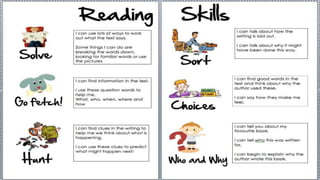

The Reading Skill
You can find magic wherever you look,
Sit back and relax all you need is a book.!!
Reading is a fun activity.
Reading Is essentially a Private or social activity.
The main purposes in writers mind are;
 To present Information
 To interpret information
 To interpret human experience
The Reading Skill
There are different strategies to read:
 First case: A reader will quickly reject to unnecessary things.
 Second case: A reader has to read in detail and cannot afford to avoid
any paragraph.
In our everyday life, we come across different reading material:
 Like Novels, short stories, plays, poems, Letters, Articles, Editorials, Comic
strips ,cartoons etc.
The Reading Skill
We read all these things:
 For pleasure,
 For information
Reading activities can be divided into two categories:
 The Intensive Reading:
 The Extensive Reading
The Reading Skill
Intensive Reading:
 It aims at reading shorter texts, which needs accuracy for detail. (for
Information).
Extensive Reading:
 It focus less on gaining accuracy. (For pleasure).
 Some of us read casually while reading even serious journals, reports.
 Some of us read seriously while reading even classified ads or cartoons.
ANALYSIS OF SKILL OF
READING
A person who can comprehends written English can:
 Read a passage at normal speed
 Understand the lexical and structural meaning
 Use appropriate sounds and intonation patterns
 Guess the meaning of word from context
 Consult a dictionary
 Skip unnecessary passages
ANALYSIS OF SKILL OF
READING
 Read silently
 Distinguish b/w writers opinion and statement of facts
 Locate the topic sentence
 Make summary of passages
 Infer the mood of writer
 Recognize the meaning of various graphics
Silent And Oral Reading
Silent reading:
 It means reading completely silently without even moving the lips.
 It is more efficient way of reading.
 It connects meaning directly with graphic symbols.
Oral reading:
 It is a useful means of mastering the language code.
 It is motivating for the young children.
Terms Of Readings
1. Skimming- to get the main idea.
2. Scanning-to get the specific information from the given text.
3. Previewing-to get idea about book by looking at title,refence,preface and
context.
4. Predicting-kind of guessing game to predict what is in the book.
Terms Of Readings
5. Anticipation-it is global at the entire book level to anticipate what next page would bring.
6. Silent reading-it is a cognitive activity and imagination play an important role
7. Reading in chunks-to get the general idea or the message of the book or the writer.
8. Guessing the Meaning of unfamiliar words-to understand the meaning of un familiar word by
context.
Problems In Learning To Read
English
 No Mastery Over Spoken Form :
Learning to read foreign language is different from learning to read the
mother-tongue.
The implication for the teacher of English is that child must first be made
aware in the spoken form whatever he is going to read.
 The Problem Of English Spelling:
English spelling makes learning to read and write slow and difficult
English spelling is exceptionally complex and irregular
Unlike oriental language, English is not a phonetic language.
Problems In Learning To Read
English
 The Problem Of Script:
English is written in Roman script, different from the other oriental languages
script.
There is additional difficulty of learning two kinds of letters, namely capital
letter and small letter
 The Problem of interference from the mother-tongue
The child carries the habits of reading the mother-tongue to reading of
English
e.g.
lip movement
wrong eye movement
Methods Of Teaching Readings
 The alphabetic method:
This is the oldest method used in Pakistan to teach reading.
To learn words in order, e.g.T-A-B-L-E (table).
 The word method or the look and say method:
It is unit of reading
A word is taught by the help of pictures
Methods Of Teaching Readings
 The phonic method:
It deals with the sounds of letters instead of their names.
 The phrase method:
Phrase is unit of reading.
It has limitation.
 The sentence method:
Here Sentence is a unit of reading.it has few advantages.
Reading Aloud
 Reading is a complex cognitive process of decoding symbols in order to
construct or derive meaning.
 Means of language acquisition and communication.
Reading Aloud
 Purposes:
Provides practice in acquiring correct stress, rhythm and intonation.
Test the student’s knowledge of words.
It provides practice as well as test.
It enables teachers to correct the mistakes of students.
It improves the pronunciation of learners.
It is the basis of silent reading.
Silent Reading
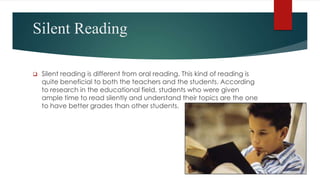
 Silent reading is different from oral reading. This kind of reading is
quite beneficial to both the teachers and the students. According
to research in the educational field, students who were given
ample time to read silently and understand their topics are the one
to have better grades than other students.
Silent Reading
Advantages of silent Reading:
 Exercises of mind:
Silent reading help us in keeping the muscles of the brain in good shape.
 Expands the imagination:
Silent reading expands the imagination of a person. One becomes more confident, self assured of his
ability to understand and appreciate the various aspects of life. The mind is channelized to think about the
different aspects and then questions and derives conclusions about them.
 Keep the whole class busy:
It keeps the whole class busy at the same time. In reading aloud whereas one student is busy in reading
the lesson, the others are passive listeners.
 It Save our time:
It is quicker and saves time. It takes more time to read aloud a passage than to read it silently.
Silent Reading
 It Save our time:
It is quicker and saves time. It takes more time to read aloud a passage than to read it silently.
 Feelings of students:
It includes love for reading and is pleasurable. It gives the student a feeling of power and achievement.
 Concentration towards meaning:
Students are able to concentrate their attention on meaning rather than on pronunciation. Silent reading
helps in greater assimilation of information.
 Conclusion:
At the end we conclude this that the chief purpose of silent reading is to enable him to read with
comprehension and speed.
Conclusion
At the end we conclude this that the chief purpose of
reading aloud is to improve the pronunciation of the
learner, the chief purpose of silent reading is to enable
him to read with comprehension and speed.
The Reading Skill in Linguistics!!!!!

The Reading Skill in Linguistics!!!!!

  • 3.
    The Reading Skill Youcan find magic wherever you look, Sit back and relax all you need is a book.!! Reading is a fun activity. Reading Is essentially a Private or social activity. The main purposes in writers mind are;  To present Information  To interpret information  To interpret human experience
  • 4.
    The Reading Skill Thereare different strategies to read:  First case: A reader will quickly reject to unnecessary things.  Second case: A reader has to read in detail and cannot afford to avoid any paragraph. In our everyday life, we come across different reading material:  Like Novels, short stories, plays, poems, Letters, Articles, Editorials, Comic strips ,cartoons etc.
  • 5.
    The Reading Skill Weread all these things:  For pleasure,  For information Reading activities can be divided into two categories:  The Intensive Reading:  The Extensive Reading
  • 6.
    The Reading Skill IntensiveReading:  It aims at reading shorter texts, which needs accuracy for detail. (for Information). Extensive Reading:  It focus less on gaining accuracy. (For pleasure).  Some of us read casually while reading even serious journals, reports.  Some of us read seriously while reading even classified ads or cartoons.
  • 8.
    ANALYSIS OF SKILLOF READING A person who can comprehends written English can:  Read a passage at normal speed  Understand the lexical and structural meaning  Use appropriate sounds and intonation patterns  Guess the meaning of word from context  Consult a dictionary  Skip unnecessary passages
  • 9.
    ANALYSIS OF SKILLOF READING  Read silently  Distinguish b/w writers opinion and statement of facts  Locate the topic sentence  Make summary of passages  Infer the mood of writer  Recognize the meaning of various graphics
  • 10.
    Silent And OralReading Silent reading:  It means reading completely silently without even moving the lips.  It is more efficient way of reading.  It connects meaning directly with graphic symbols. Oral reading:  It is a useful means of mastering the language code.  It is motivating for the young children.
  • 11.
    Terms Of Readings 1.Skimming- to get the main idea. 2. Scanning-to get the specific information from the given text. 3. Previewing-to get idea about book by looking at title,refence,preface and context. 4. Predicting-kind of guessing game to predict what is in the book.
  • 12.
    Terms Of Readings 5.Anticipation-it is global at the entire book level to anticipate what next page would bring. 6. Silent reading-it is a cognitive activity and imagination play an important role 7. Reading in chunks-to get the general idea or the message of the book or the writer. 8. Guessing the Meaning of unfamiliar words-to understand the meaning of un familiar word by context.
  • 13.
    Problems In LearningTo Read English  No Mastery Over Spoken Form : Learning to read foreign language is different from learning to read the mother-tongue. The implication for the teacher of English is that child must first be made aware in the spoken form whatever he is going to read.  The Problem Of English Spelling: English spelling makes learning to read and write slow and difficult English spelling is exceptionally complex and irregular Unlike oriental language, English is not a phonetic language.
  • 14.
    Problems In LearningTo Read English  The Problem Of Script: English is written in Roman script, different from the other oriental languages script. There is additional difficulty of learning two kinds of letters, namely capital letter and small letter  The Problem of interference from the mother-tongue The child carries the habits of reading the mother-tongue to reading of English e.g. lip movement wrong eye movement
  • 15.
    Methods Of TeachingReadings  The alphabetic method: This is the oldest method used in Pakistan to teach reading. To learn words in order, e.g.T-A-B-L-E (table).  The word method or the look and say method: It is unit of reading A word is taught by the help of pictures
  • 16.
    Methods Of TeachingReadings  The phonic method: It deals with the sounds of letters instead of their names.  The phrase method: Phrase is unit of reading. It has limitation.  The sentence method: Here Sentence is a unit of reading.it has few advantages.
  • 17.
    Reading Aloud  Readingis a complex cognitive process of decoding symbols in order to construct or derive meaning.  Means of language acquisition and communication.
  • 18.
    Reading Aloud  Purposes: Providespractice in acquiring correct stress, rhythm and intonation. Test the student’s knowledge of words. It provides practice as well as test. It enables teachers to correct the mistakes of students. It improves the pronunciation of learners. It is the basis of silent reading.
  • 19.
    Silent Reading  Silentreading is different from oral reading. This kind of reading is quite beneficial to both the teachers and the students. According to research in the educational field, students who were given ample time to read silently and understand their topics are the one to have better grades than other students.
  • 20.
    Silent Reading Advantages ofsilent Reading:  Exercises of mind: Silent reading help us in keeping the muscles of the brain in good shape.  Expands the imagination: Silent reading expands the imagination of a person. One becomes more confident, self assured of his ability to understand and appreciate the various aspects of life. The mind is channelized to think about the different aspects and then questions and derives conclusions about them.  Keep the whole class busy: It keeps the whole class busy at the same time. In reading aloud whereas one student is busy in reading the lesson, the others are passive listeners.  It Save our time: It is quicker and saves time. It takes more time to read aloud a passage than to read it silently.
  • 21.
    Silent Reading  ItSave our time: It is quicker and saves time. It takes more time to read aloud a passage than to read it silently.  Feelings of students: It includes love for reading and is pleasurable. It gives the student a feeling of power and achievement.  Concentration towards meaning: Students are able to concentrate their attention on meaning rather than on pronunciation. Silent reading helps in greater assimilation of information.  Conclusion: At the end we conclude this that the chief purpose of silent reading is to enable him to read with comprehension and speed.
  • 22.
    Conclusion At the endwe conclude this that the chief purpose of reading aloud is to improve the pronunciation of the learner, the chief purpose of silent reading is to enable him to read with comprehension and speed.