Lesson Design in
Teaching Prose
Presented by: Marjorie Clavejo
How do we teach prose?
A prose lesson is not for memorization of
questions and answers but for learning a
language.
Steps in teaching prose:
1. Previous Knowledge.
The teacher should know how much
knowledge students already possess
regarding the lesson.
Steps in teaching prose:
2. Motivation
Every subject or language demands
motivation to attract the attention of
students. So teachers should motivate
the students to study the lesson.
Steps in teaching prose:
3. Presentation
The teacher has to present the
lesson keeping in view the
attention, retention and grasp of
the students.
Presentation part includes following subdivisions:
a.Model reading by the Teacher
b.Pronunciation Drill
c.Loud Reading by the Students
d.Exposition and Explanation
The teacher can employ the following methods for
exposition words:
5.Contrasted word
Method
6.Derivation Method
7.Reference Method
1.Direct Method
2.Translation Method
3.Usage Method
4.Similar word Method
Presentation part includes following subdivisions:
e. Difficult words/structures to be dealt
with
f. Silent Reading by the Students
Steps in teaching prose:
4. Comprehension Questions
After the silent reading, some
questions should be asked to test
pupil’s comprehension of the
passage
Steps in teaching prose:
5. Recapitulation
The teacher may again sum up
what was taught in the day’s
lesson.
Steps in teaching prose:
6. Evaluation
The main objective of evaluation is
to test whether the set objective
has been achieved or not.
Some examples of evaluation are:
a. Explain the passage either orally or in writing.
b. Fill in the blanks.
c. Some simple and important questions from the
prose lesson.
d. Writing some difficult words on the blackboard and
asking individual students to read, explain, give
meaning, or frame sentences.
e. Dramatizing the prose lesson
Steps in teaching prose:
7. Assignment
Assigning homework is the final
stage of a lesson plan.
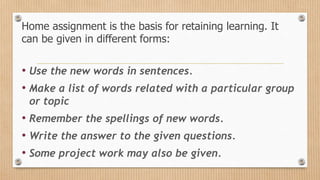
Home assignment is the basis for retaining learning. It
can be given in different forms:
• Use the new words in sentences.
• Make a list of words related with a particular group
or topic
• Remember the spellings of new words.
• Write the answer to the given questions.
• Some project work may also be given.
REFERENCE: https://www.studocu.com/ph/document/st-bernadette-of-lourdes-
college/bachelor-of-secondary-major-in-english/literature-report-handout/40312941
Thank You!

Lesson Design in Teaching Prose.pptx

  • 1.
    Lesson Design in TeachingProse Presented by: Marjorie Clavejo
  • 2.
    How do weteach prose? A prose lesson is not for memorization of questions and answers but for learning a language.
  • 3.
    Steps in teachingprose: 1. Previous Knowledge. The teacher should know how much knowledge students already possess regarding the lesson.
  • 4.
    Steps in teachingprose: 2. Motivation Every subject or language demands motivation to attract the attention of students. So teachers should motivate the students to study the lesson.
  • 5.
    Steps in teachingprose: 3. Presentation The teacher has to present the lesson keeping in view the attention, retention and grasp of the students.
  • 6.
    Presentation part includesfollowing subdivisions: a.Model reading by the Teacher b.Pronunciation Drill c.Loud Reading by the Students d.Exposition and Explanation
  • 7.
    The teacher canemploy the following methods for exposition words: 5.Contrasted word Method 6.Derivation Method 7.Reference Method 1.Direct Method 2.Translation Method 3.Usage Method 4.Similar word Method
  • 8.
    Presentation part includesfollowing subdivisions: e. Difficult words/structures to be dealt with f. Silent Reading by the Students
  • 9.
    Steps in teachingprose: 4. Comprehension Questions After the silent reading, some questions should be asked to test pupil’s comprehension of the passage
  • 10.
    Steps in teachingprose: 5. Recapitulation The teacher may again sum up what was taught in the day’s lesson.
  • 11.
    Steps in teachingprose: 6. Evaluation The main objective of evaluation is to test whether the set objective has been achieved or not.
  • 12.
    Some examples ofevaluation are: a. Explain the passage either orally or in writing. b. Fill in the blanks. c. Some simple and important questions from the prose lesson. d. Writing some difficult words on the blackboard and asking individual students to read, explain, give meaning, or frame sentences. e. Dramatizing the prose lesson
  • 13.
    Steps in teachingprose: 7. Assignment Assigning homework is the final stage of a lesson plan.
  • 14.
    Home assignment isthe basis for retaining learning. It can be given in different forms: • Use the new words in sentences. • Make a list of words related with a particular group or topic • Remember the spellings of new words. • Write the answer to the given questions. • Some project work may also be given.
  • 15.

Editor's Notes

  • #3 Create an outline to get ready: Introduce the era (Use a mix of media and text) Organize your artifacts to outline what life was like during the era you are presenting Think about using a storyboard to outline your images and ideas Make sure you prepare a clear and well rounded presentation of all aspects of the era (People, jobs, food, transportation, etc. What else should you include so the audience feels like they have visited your era?)