



















FORMAL AND INFOMAL
DEFINITONS
Prepared by:
Sarah Jean Reyes
Guessing Game!
• The class will be divided into two (2)
groups.
• Each group must have one (1)
representative.
• The representative will get a word from
the pool of words and must describe it
using adjectives.
• All descriptions must be what is seen
physically or its characteristics and
function. No stating of the exact term.
OBJECTIVE (S):
I can…
1. Identify informal and formal definitions
2. Distinguish formal definition from
informal definition
3. Make examples of formal and informal
definition
DEFINITON
• It is the formal statement of
the meaning or significance
of a word, phrase, idiom,
etc., as found in
dictionaries.
How do we define terms?
Types of definition:
Formal and Informal
A formal definition…
• is based upon a concise, logical pattern that
includes as much information as it can
within a minimum amount of space. The
primary reason to include definitions in your
writing is to avoid misunderstanding with
your audience.
A formal definition consists of three
parts.
•The term (word or phrase) to be defined
•The class of object or concept to which the term
belongs.
•The differentiating characteristics that
distinguish it from all others of its class
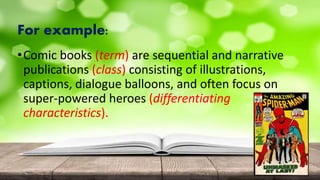
For example:
•Comic books (term) are sequential and narrative
publications (class) consisting of illustrations,
captions, dialogue balloons, and often focus on
super-powered heroes (differentiating
characteristics).
For example:
•Water (term) is a liquid (class) made up of
molecules of hydrogen and oxygen in the ratio of
2 to 1 (differentiating characteristics).
For example:
•Astronomy (term) is a branch of scientific study
(class) primarily concerned with celestial objects
inside and outside of the earth's atmosphere
(differentiating characteristics).
• Although these examples should illustrate the
manner in which the three parts work together,
they are not the most realistic cases. Most readers
will already be quite familiar with the concepts of
water, comic books, and astronomy. For this
reason, it is important to know when and why you
should include definitions in your writing.
When to Use Definitions?
When your writing contains a term that may be key to
audience understanding and that term could likely be
unfamiliar to them.
Example:
"Stellar Wobble is a measurable variation of speed wherein
a star's velocity is shifted by the gravitational pull of a
foreign body."
When to Use Definitions?
When a commonly used word or phrase has layers of subjectivity or
evaluation in the way you choose to define it.
Example:
"Throughout this essay, the term classic gaming will refer specifically to
playing video games produced for the Atari, the original Nintendo
Entertainment System, and any systems in-between.“
Note: not everyone may define "classic gaming" within this same time
span; therefore, it is important to define your terms
When to Use Definitions?
When the etymology (origin and history) of a common word
might prove interesting or will help expand upon a point.
Example:
"Pagan can be traced back to Roman military slang for an incompetent
soldier. In this sense, Christians who consider themselves soldiers of
Christ are using the term not only to suggest a person's secular status
but also their lack of bravery.'
Additional Tips for Writing Definitions
•Avoid defining with "X is when" and "X is where" statements.
These introductory adverb phrases should be avoided. Define a
noun with a noun, a verb with a verb, and so forth.
•Do not define a word by mere repetition or merely restating the
word.
"Rhyming poetry consists of lines that contain end rhymes.“
Better:
"Rhyming poetry is an artform consisting of lines whose final
words consistently contain identical, final stressed vowel sounds."
Additional Tips for Writing Definitions
• Define a word in simple and familiar terms. Your definition of an
unfamiliar word should not lead your audience towards looking up
more words in order to understand your definition.
• Keep the class portion of your definition small but adequate. It should
be large enough to include all members of the term you are defining
but no larger. Avoid adding personal details to definitions. Although
you may think the story about your Grandfather will perfectly
encapsulate the concept of stinginess, your audience may fail to
relate. Offering personal definitions may only increase the likeliness of
misinterpretation that you are trying to avoid.
In an Informal Definition…
• the writer uses known words or examples
to explain an unknown term. These
definitions may
be synonyms or antonyms introduced
by or, in other words, or like. It could also
be stipulation, analogy, or illustration.
Informal definition example:
• Freedom, also referred to as liberty or independence,
is a state people reach when they are free to think and
do whatever they please.
Let’s practice:
Many prisoners of war have been victims of cruel and
unusual punishment; people were shocked and
horrified when they learned of the water torture,
temperature extremes, and sensory overloads that the
prisoners were subjected to.
Let’s practice:
Many prisoners of war have been victims of cruel and
unusual punishment; people were shocked and
horrified when they learned of the water torture,
temperature extremes, and sensory overloads that the
prisoners were subjected to.
INFORMAL DEFINITION
Let’s practice:
• The Cornell University Law School website
defines cruel and unusual punishment (noun) as
"punishment that is extremely excessive in relation to
the crime, shocking to ordinary sensibilities, or
equivalent to torture."
Let’s practice:
• The Cornell University Law School website
defines cruel and unusual punishment (noun) as
"punishment that is extremely excessive in relation to
the crime, shocking to ordinary sensibilities, or
equivalent to torture.“
FORMAL DEFINITION
Let’s practice:
Practice making formal
and informal definitions.
Answer the exercises
found in your textbook.
Did we meet our objectives?
I learn to…
1. Identify informal and formal definitions
2. Distinguish formal definition from
informal definition
3. Make examples of formal and informal
definition
Sources:
• https://owl.english.purdue.edu/owl/re
source/622/01/
• http://content.nroc.org/Developmenta
lEnglish/unit05/Foundations/identifyin
g-types-of-definitions.html
Formal and infomal definitons

Formal and infomal definitons

  • 1.
  • 2.
    Guessing Game! • Theclass will be divided into two (2) groups. • Each group must have one (1) representative. • The representative will get a word from the pool of words and must describe it using adjectives. • All descriptions must be what is seen physically or its characteristics and function. No stating of the exact term.
  • 3.
    OBJECTIVE (S): I can… 1.Identify informal and formal definitions 2. Distinguish formal definition from informal definition 3. Make examples of formal and informal definition
  • 4.
    DEFINITON • It isthe formal statement of the meaning or significance of a word, phrase, idiom, etc., as found in dictionaries.
  • 5.
    How do wedefine terms?
  • 6.
  • 7.
    A formal definition… •is based upon a concise, logical pattern that includes as much information as it can within a minimum amount of space. The primary reason to include definitions in your writing is to avoid misunderstanding with your audience.
  • 8.
    A formal definitionconsists of three parts. •The term (word or phrase) to be defined •The class of object or concept to which the term belongs. •The differentiating characteristics that distinguish it from all others of its class
  • 9.
    For example: •Comic books(term) are sequential and narrative publications (class) consisting of illustrations, captions, dialogue balloons, and often focus on super-powered heroes (differentiating characteristics).
  • 10.
    For example: •Water (term)is a liquid (class) made up of molecules of hydrogen and oxygen in the ratio of 2 to 1 (differentiating characteristics).
  • 11.
    For example: •Astronomy (term)is a branch of scientific study (class) primarily concerned with celestial objects inside and outside of the earth's atmosphere (differentiating characteristics).
  • 12.
    • Although theseexamples should illustrate the manner in which the three parts work together, they are not the most realistic cases. Most readers will already be quite familiar with the concepts of water, comic books, and astronomy. For this reason, it is important to know when and why you should include definitions in your writing.
  • 13.
    When to UseDefinitions? When your writing contains a term that may be key to audience understanding and that term could likely be unfamiliar to them. Example: "Stellar Wobble is a measurable variation of speed wherein a star's velocity is shifted by the gravitational pull of a foreign body."
  • 14.
    When to UseDefinitions? When a commonly used word or phrase has layers of subjectivity or evaluation in the way you choose to define it. Example: "Throughout this essay, the term classic gaming will refer specifically to playing video games produced for the Atari, the original Nintendo Entertainment System, and any systems in-between.“ Note: not everyone may define "classic gaming" within this same time span; therefore, it is important to define your terms
  • 15.
    When to UseDefinitions? When the etymology (origin and history) of a common word might prove interesting or will help expand upon a point. Example: "Pagan can be traced back to Roman military slang for an incompetent soldier. In this sense, Christians who consider themselves soldiers of Christ are using the term not only to suggest a person's secular status but also their lack of bravery.'
  • 16.
    Additional Tips forWriting Definitions •Avoid defining with "X is when" and "X is where" statements. These introductory adverb phrases should be avoided. Define a noun with a noun, a verb with a verb, and so forth. •Do not define a word by mere repetition or merely restating the word. "Rhyming poetry consists of lines that contain end rhymes.“ Better: "Rhyming poetry is an artform consisting of lines whose final words consistently contain identical, final stressed vowel sounds."
  • 17.
    Additional Tips forWriting Definitions • Define a word in simple and familiar terms. Your definition of an unfamiliar word should not lead your audience towards looking up more words in order to understand your definition. • Keep the class portion of your definition small but adequate. It should be large enough to include all members of the term you are defining but no larger. Avoid adding personal details to definitions. Although you may think the story about your Grandfather will perfectly encapsulate the concept of stinginess, your audience may fail to relate. Offering personal definitions may only increase the likeliness of misinterpretation that you are trying to avoid.
  • 18.
    In an InformalDefinition… • the writer uses known words or examples to explain an unknown term. These definitions may be synonyms or antonyms introduced by or, in other words, or like. It could also be stipulation, analogy, or illustration.
  • 19.
    Informal definition example: •Freedom, also referred to as liberty or independence, is a state people reach when they are free to think and do whatever they please.
  • 20.
    Let’s practice: Many prisonersof war have been victims of cruel and unusual punishment; people were shocked and horrified when they learned of the water torture, temperature extremes, and sensory overloads that the prisoners were subjected to.
  • 21.
    Let’s practice: Many prisonersof war have been victims of cruel and unusual punishment; people were shocked and horrified when they learned of the water torture, temperature extremes, and sensory overloads that the prisoners were subjected to. INFORMAL DEFINITION
  • 22.
    Let’s practice: • TheCornell University Law School website defines cruel and unusual punishment (noun) as "punishment that is extremely excessive in relation to the crime, shocking to ordinary sensibilities, or equivalent to torture."
  • 23.
    Let’s practice: • TheCornell University Law School website defines cruel and unusual punishment (noun) as "punishment that is extremely excessive in relation to the crime, shocking to ordinary sensibilities, or equivalent to torture.“ FORMAL DEFINITION
  • 24.
    Let’s practice: Practice makingformal and informal definitions. Answer the exercises found in your textbook.
  • 25.
    Did we meetour objectives? I learn to… 1. Identify informal and formal definitions 2. Distinguish formal definition from informal definition 3. Make examples of formal and informal definition
  • 26.