David Didau
researchED English & MFL
Oxford, 1st April 2017
The
importance of
reading
fluency
On today’s menu
• Impenetrable diagrams
• Maps, graphs and percentages!
• Some sciency bits
• An experience of being crap at reading
• 4th century theologians
• A mini (very unscientific) experiment
• Scooby Doo
Reading is complex
Skilled reading:
Fluent execution and
coordination of word
recognition and text
comprehension.
The Many Strands that are Woven into Skilled Reading
(Scarborough, 2001)
Language comprehension
Background knowledge
(facts, concepts, etc.)
Vocabulary
(Breadth, precision, links, etc.)
Language structures
(syntax, semantics, etc.)
Verbal reasoning
(inference, metaphor, etc.)
Literacy knowledge
(print, concepts, genres etc.)
Word recognition
Phonological awareness
(syllables, phonemes, etc.)
Decoding
(alphabetic principle, spelling-
sound correspondences)
Sight recognition
(of familiar words)
There is no correlation between ‘word
recognition’ skills and intelligence
If thee was, we would need to find evidence of the following
propositions:
1. that the pattern of information-processing skills that underlie the
reading deficits of low-IQ poor readers is different from the
information-processing skills that underlie the reading deficits of
high-IQ poor readers
2. that the neuroanatomical differences that underlie the cognitive
deficits of these two groups are different
3. that low- and high-IQ poor readers require different treatments to
remediate their reading problems
4. that there is differential etiology in the two groups based on
different heritability of the component deficits.
Stanovich (2005): “there is a wealth of evidence regarding [these propositions]
that is largely negative”.
So, what does cause reading
difficulty?
• Glue ear?
– “It’s estimated that one in five children around the age
of two will be affected by glue ear at any given time,
and about 8 in every 10 children will have had glue
ear at least once by the time they’re 10 years old.”
www.nhs.uk
• Visual problems?
– Maybe 1 in 5 children with undiagnosed visual issues
Optometry Today
• English orthography?
Errors in word reading at
the end of first grade
Seymour, Aro & Erskine (2003)
What’s going wrong?
All languages are not equal
7 years 8 years 9 years
20
40
60
80
English
French
Spanish
Goswami et al 1998
• At the age of 9 a French child does not read
as well as a 7 year old Spanish child.
• It takes 2 additional years of schooling for an
English child to reach the level of a French
child.
Evolution of error rates in pseudo word reading
0
Alphabetic Codes
English
(deep orthography)
44 smallest speech sounds (phonemes)
47+ units of sound /k+s/ /kw/ /y+oo/ /ul/
170+ spelling alternatives (graphemes)
(double that for rare & unique spellings)
Spanish
(shallow orthography)
24 phonemes
40 graphemes
Fewer spelling alternatives than
sounds in English.
Memory affects comprehension
Working
memory
Long-term
memory
Attention
Learning
Remembering
Environment
Schemas
Long-term memory
• Declarative memory – what you think about
(propositional knowledge)
• Non-declarative memory – what you think
with (procedural knowledge)
• Schemas take up (roughly) the same space
in working memory as isolated facts
• Through practice we can automatise
procedural knowledge so that it becomes
background knowledge.
The importance of fluency
They gradually ascended for half a mile
then found themselves at the top of a
considerable eminence where the
wood ceased theand eye was instantly
caught by Pemberley House situated on
the opposite side of the valley , into
which the road with some abruptness
wound.
Is comprehension possible?
1. What did they climb?
2. Where did the characters find
themselves?
3. At what point did they first see Pemberley
House?
4. Where was the house in relation to the
characters?
5. How did the author describe the road?
Comprehension depends on reading
speed
They gradually ascended for
half a mile then found
themselves at the top of a
considerable eminence
where the wood ceased and
the eye was instantly caught
by Pemberley House situated
on the opposite side of the
valley, into which the road
with some abruptness
wound.
1. What did they climb?
2. Where did the
characters find
themselves?
3. At what point did they
first see Pemberley
House?
4. Where was the house
in relation to the
characters?
5. How did the author
describe the road?
The cognitive processes
Visual auditory
• Attention
• Blocking
distractions
• Visual systems
• Application of rules
associating letters
to sounds
• Saccades
Language
comprehension
• Meaning of words
• Semantic &
grammatical systems
• Inference & hypothesis
• Anticipation
What’s going on in memory?
Background knowledge is what you think with
not about.
Long-term
• Accuracy
• Fluency
• Prior knowledge
• Vocabulary
• Stories
Fast, automatic,
invisible
Working
• Inferences
• Clarifications
• Hypotheses
• Predictions
• Stories
Requires attention
& effort
Into the classroom…
• Many students ‘hate’ reading but everyone loves
stories
• Independent reading is only likely to be beneficial if
students can decode fluently
• How can you practice fluency?
• Is listening ‘cheating’?
– Reading comprehension is highly correlated with listening
comprehension (Bell & Perfetti, 1994; Gernsbacher, Varner, & Faust,
1990)
– For difficult-to-understand texts, prosody can be a real aid
to understanding. (Kosslyn & Matt, 1977)
• Don’t make students ‘read along’
Episodic
buffer
Visuo-spatial
sketchpad
Phonological
loop
Episodic LTM
Visual
semantics
Language
Working memory model
Fluid components
Crystallised components
Central executive
Baddeley, Working Memory: Theories,
Models, and Controversies (2011)
The phonological loop system
Phonological
store
Auditory
control
processes
Auditory word
presentation
(listening)
Visual word
presentation
(reading)
Words are ‘stored’ for about 2 seconds
before needing to be rehearsed.
The silent voice
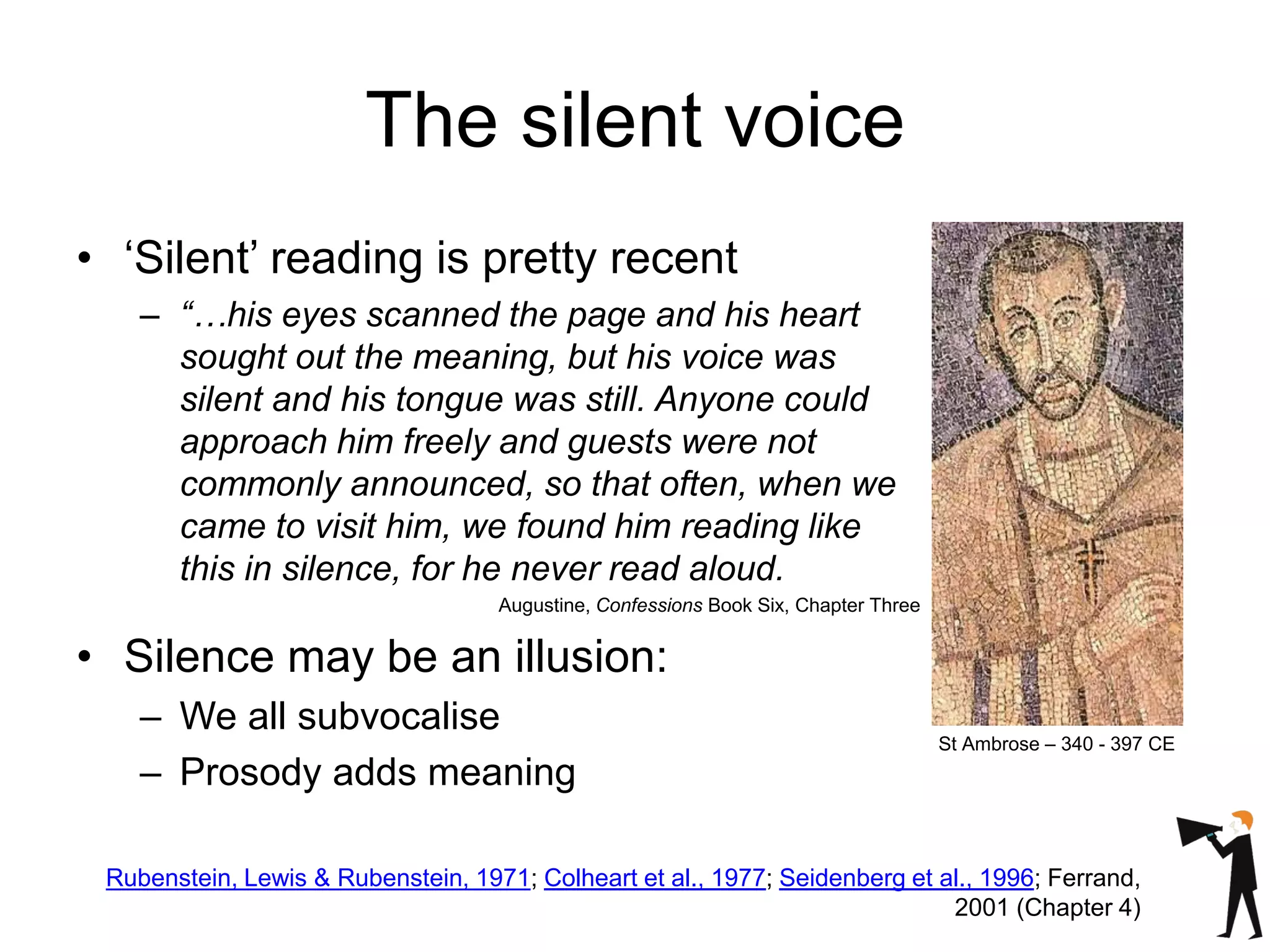
• ‘Silent’ reading is pretty recent
– “…his eyes scanned the page and his heart
sought out the meaning, but his voice was
silent and his tongue was still. Anyone could
approach him freely and guests were not
commonly announced, so that often, when we
came to visit him, we found him reading like
this in silence, for he never read aloud.
Augustine, Confessions Book Six, Chapter Three
• Silence may be an illusion:
– We all subvocalise
– Prosody adds meaning
St Ambrose – 340 - 397 CE
Rubenstein, Lewis & Rubenstein, 1971; Colheart et al., 1977; Seidenberg et al., 1996; Ferrand,
2001 (Chapter 4)
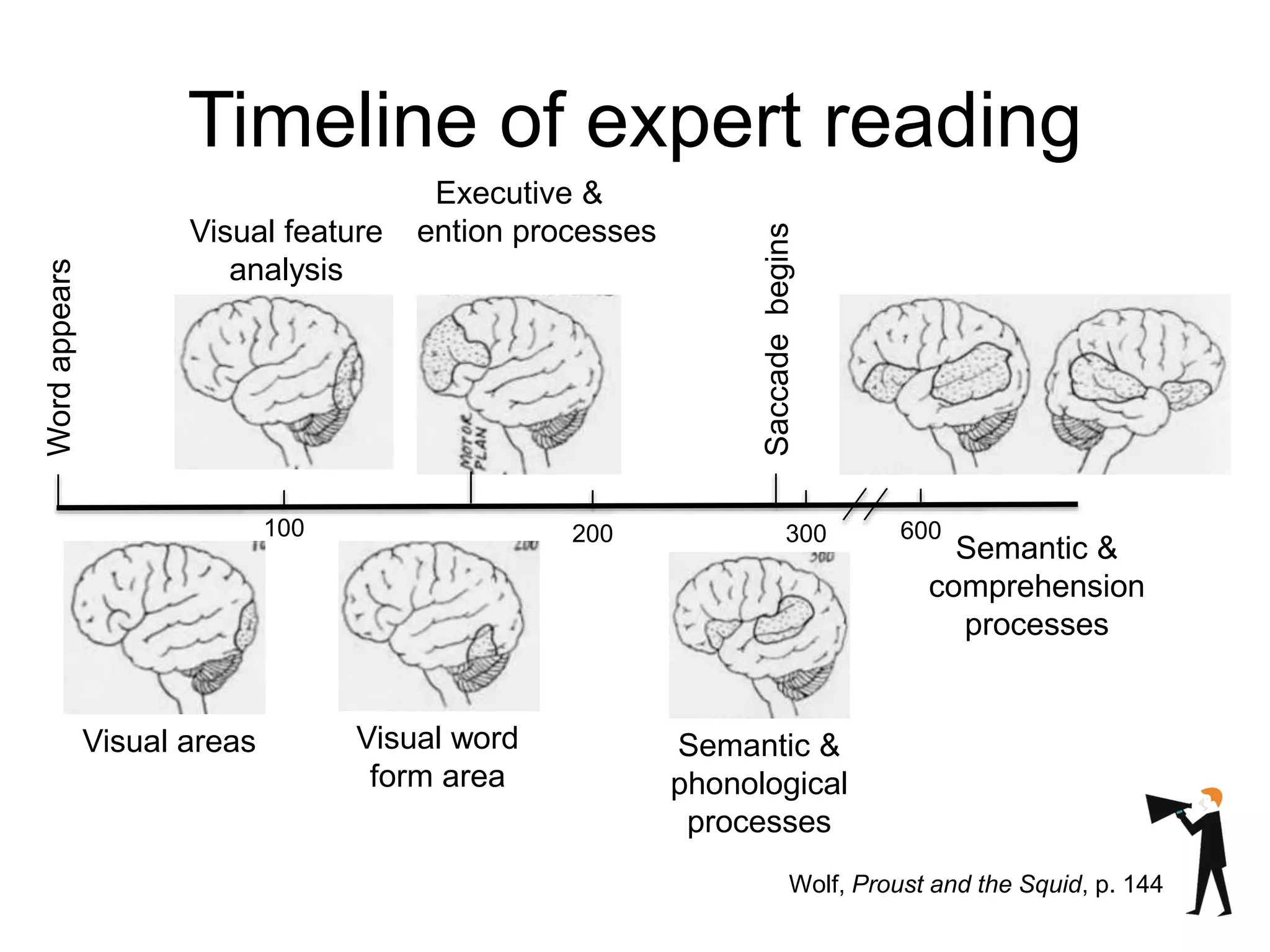
Timeline of expert reading
Wolf, Proust and the Squid, p. 144
Wordappears
100 200 300 600
Saccadebegins
Semantic &
comprehension
processes
Visual word
form area
Visual areas
Executive &
attention processesVisual feature
analysis
Semantic &
phonological
processes
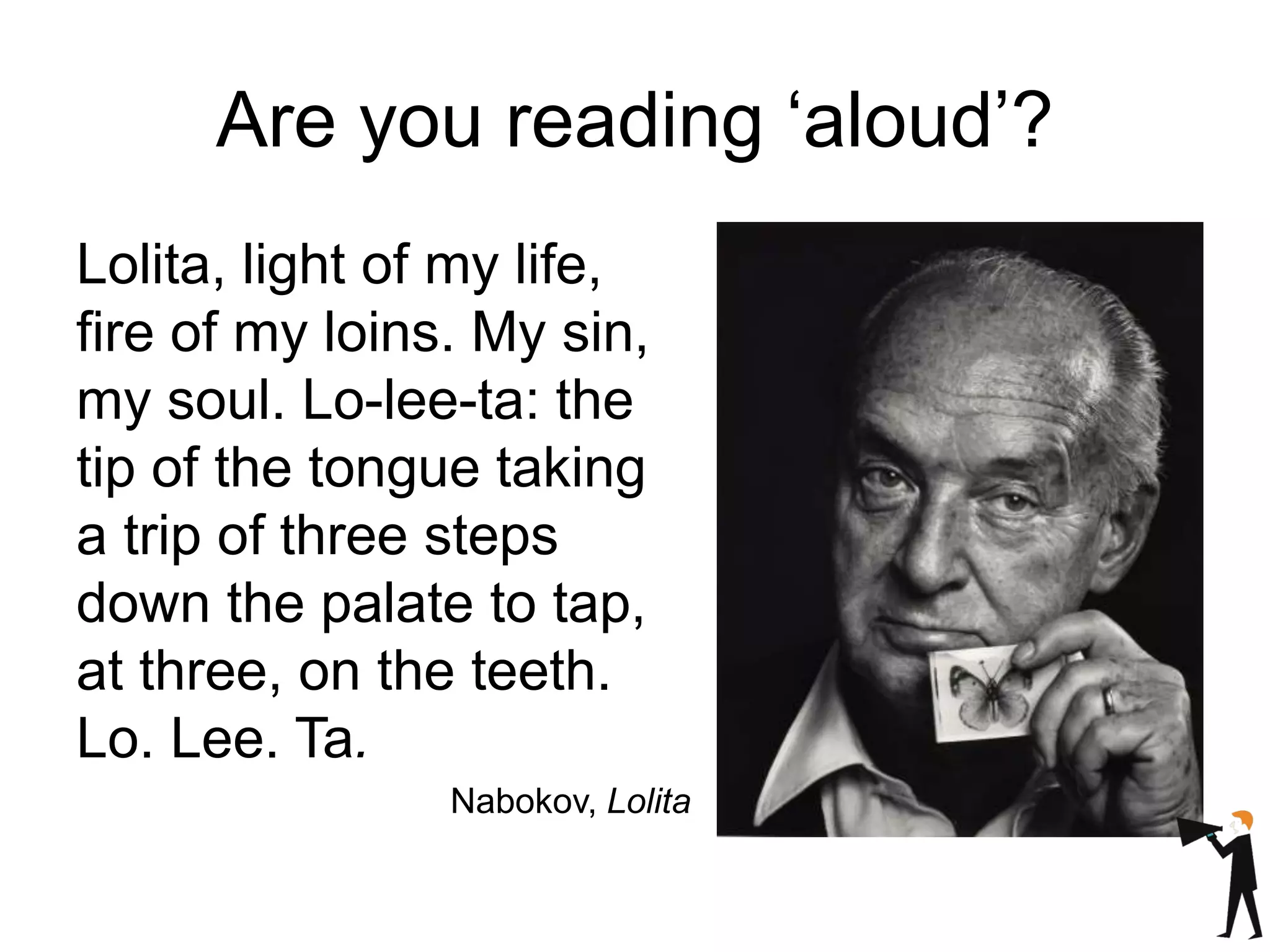
Are you reading ‘aloud’?
Lolita, light of my life,
fire of my loins. My sin,
my soul. Lo-lee-ta: the
tip of the tongue taking
a trip of three steps
down the palate to tap,
at three, on the teeth.
Lo. Lee. Ta.
Nabokov, Lolita
An experiment…
“Hello, my name is ______ and you are
reading this in my voice.”
A B C
The limits of sound
• “Covert access to the pronunciation of written words
is an automatic step in reading, but this conversion
may not be indispensible.”
Dehaene, Reading in the Brain (p.29)
• How do we make sense of homophones?(muscles,
mussels)
• Sometimes we can’t pronounce a word:
– Worcestershire
• Sometimes we don’t want to:
– Otorhinolaryngologist
Key messages
1. Reading fluency is not linked to intelligence
2. English is harder to attain fluency in than most other
languages
3. Fluency affects comprehension
4. The procedural knowledge of decoding can be
automatised as non-declarative memory
5. Listening helps weaker readers comprehend text as
long as they don’t have to read along.
@ D a v i d D i d a u
l e a r n i n g s p y . c o . u k
d d i d a u @ g m a i l . c o m
There’s nothing good or bad but
thinking makes it so

The importance of reading fluency

  • 1.
    David Didau researchED English& MFL Oxford, 1st April 2017 The importance of reading fluency
  • 2.
    On today’s menu •Impenetrable diagrams • Maps, graphs and percentages! • Some sciency bits • An experience of being crap at reading • 4th century theologians • A mini (very unscientific) experiment • Scooby Doo
  • 3.
    Reading is complex Skilledreading: Fluent execution and coordination of word recognition and text comprehension. The Many Strands that are Woven into Skilled Reading (Scarborough, 2001) Language comprehension Background knowledge (facts, concepts, etc.) Vocabulary (Breadth, precision, links, etc.) Language structures (syntax, semantics, etc.) Verbal reasoning (inference, metaphor, etc.) Literacy knowledge (print, concepts, genres etc.) Word recognition Phonological awareness (syllables, phonemes, etc.) Decoding (alphabetic principle, spelling- sound correspondences) Sight recognition (of familiar words)
  • 4.
    There is nocorrelation between ‘word recognition’ skills and intelligence If thee was, we would need to find evidence of the following propositions: 1. that the pattern of information-processing skills that underlie the reading deficits of low-IQ poor readers is different from the information-processing skills that underlie the reading deficits of high-IQ poor readers 2. that the neuroanatomical differences that underlie the cognitive deficits of these two groups are different 3. that low- and high-IQ poor readers require different treatments to remediate their reading problems 4. that there is differential etiology in the two groups based on different heritability of the component deficits. Stanovich (2005): “there is a wealth of evidence regarding [these propositions] that is largely negative”.
  • 5.
    So, what doescause reading difficulty? • Glue ear? – “It’s estimated that one in five children around the age of two will be affected by glue ear at any given time, and about 8 in every 10 children will have had glue ear at least once by the time they’re 10 years old.” www.nhs.uk • Visual problems? – Maybe 1 in 5 children with undiagnosed visual issues Optometry Today • English orthography?
  • 6.
    Errors in wordreading at the end of first grade Seymour, Aro & Erskine (2003) What’s going wrong?
  • 7.
    All languages arenot equal 7 years 8 years 9 years 20 40 60 80 English French Spanish Goswami et al 1998 • At the age of 9 a French child does not read as well as a 7 year old Spanish child. • It takes 2 additional years of schooling for an English child to reach the level of a French child. Evolution of error rates in pseudo word reading 0
  • 8.
    Alphabetic Codes English (deep orthography) 44smallest speech sounds (phonemes) 47+ units of sound /k+s/ /kw/ /y+oo/ /ul/ 170+ spelling alternatives (graphemes) (double that for rare & unique spellings) Spanish (shallow orthography) 24 phonemes 40 graphemes Fewer spelling alternatives than sounds in English.
  • 9.
  • 10.
  • 11.
    Long-term memory • Declarativememory – what you think about (propositional knowledge) • Non-declarative memory – what you think with (procedural knowledge) • Schemas take up (roughly) the same space in working memory as isolated facts • Through practice we can automatise procedural knowledge so that it becomes background knowledge.
  • 12.
    The importance offluency They gradually ascended for half a mile then found themselves at the top of a considerable eminence where the wood ceased theand eye was instantly caught by Pemberley House situated on the opposite side of the valley , into which the road with some abruptness wound.
  • 13.
    Is comprehension possible? 1.What did they climb? 2. Where did the characters find themselves? 3. At what point did they first see Pemberley House? 4. Where was the house in relation to the characters? 5. How did the author describe the road?
  • 14.
    Comprehension depends onreading speed They gradually ascended for half a mile then found themselves at the top of a considerable eminence where the wood ceased and the eye was instantly caught by Pemberley House situated on the opposite side of the valley, into which the road with some abruptness wound. 1. What did they climb? 2. Where did the characters find themselves? 3. At what point did they first see Pemberley House? 4. Where was the house in relation to the characters? 5. How did the author describe the road?
  • 15.
    The cognitive processes Visualauditory • Attention • Blocking distractions • Visual systems • Application of rules associating letters to sounds • Saccades Language comprehension • Meaning of words • Semantic & grammatical systems • Inference & hypothesis • Anticipation
  • 16.
    What’s going onin memory? Background knowledge is what you think with not about. Long-term • Accuracy • Fluency • Prior knowledge • Vocabulary • Stories Fast, automatic, invisible Working • Inferences • Clarifications • Hypotheses • Predictions • Stories Requires attention & effort
  • 17.
    Into the classroom… •Many students ‘hate’ reading but everyone loves stories • Independent reading is only likely to be beneficial if students can decode fluently • How can you practice fluency? • Is listening ‘cheating’? – Reading comprehension is highly correlated with listening comprehension (Bell & Perfetti, 1994; Gernsbacher, Varner, & Faust, 1990) – For difficult-to-understand texts, prosody can be a real aid to understanding. (Kosslyn & Matt, 1977) • Don’t make students ‘read along’
  • 18.
    Episodic buffer Visuo-spatial sketchpad Phonological loop Episodic LTM Visual semantics Language Working memorymodel Fluid components Crystallised components Central executive Baddeley, Working Memory: Theories, Models, and Controversies (2011)
  • 19.
    The phonological loopsystem Phonological store Auditory control processes Auditory word presentation (listening) Visual word presentation (reading) Words are ‘stored’ for about 2 seconds before needing to be rehearsed.
  • 20.
    The silent voice •‘Silent’ reading is pretty recent – “…his eyes scanned the page and his heart sought out the meaning, but his voice was silent and his tongue was still. Anyone could approach him freely and guests were not commonly announced, so that often, when we came to visit him, we found him reading like this in silence, for he never read aloud. Augustine, Confessions Book Six, Chapter Three • Silence may be an illusion: – We all subvocalise – Prosody adds meaning St Ambrose – 340 - 397 CE Rubenstein, Lewis & Rubenstein, 1971; Colheart et al., 1977; Seidenberg et al., 1996; Ferrand, 2001 (Chapter 4)
  • 21.
    Timeline of expertreading Wolf, Proust and the Squid, p. 144 Wordappears 100 200 300 600 Saccadebegins Semantic & comprehension processes Visual word form area Visual areas Executive & attention processesVisual feature analysis Semantic & phonological processes
  • 22.
    Are you reading‘aloud’? Lolita, light of my life, fire of my loins. My sin, my soul. Lo-lee-ta: the tip of the tongue taking a trip of three steps down the palate to tap, at three, on the teeth. Lo. Lee. Ta. Nabokov, Lolita
  • 23.
    An experiment… “Hello, myname is ______ and you are reading this in my voice.” A B C
  • 24.
    The limits ofsound • “Covert access to the pronunciation of written words is an automatic step in reading, but this conversion may not be indispensible.” Dehaene, Reading in the Brain (p.29) • How do we make sense of homophones?(muscles, mussels) • Sometimes we can’t pronounce a word: – Worcestershire • Sometimes we don’t want to: – Otorhinolaryngologist
  • 25.
    Key messages 1. Readingfluency is not linked to intelligence 2. English is harder to attain fluency in than most other languages 3. Fluency affects comprehension 4. The procedural knowledge of decoding can be automatised as non-declarative memory 5. Listening helps weaker readers comprehend text as long as they don’t have to read along.
  • 26.
    @ D av i d D i d a u l e a r n i n g s p y . c o . u k d d i d a u @ g m a i l . c o m There’s nothing good or bad but thinking makes it so