Re-engineering Engineering
Vinod Khosla
Kleiner Perkins Caufield & Byers
vkhosla@kpcb.com
Sept 2000
1
There’s Change And Then
There Is Change!
“…every strategic inflection point [is]
characterized by a ‘10X’ change …”
“There’s wind and then there is a typhoon,
there are waves and then there’s a tsunami”
- Andy Grove
2
he Environment

3
The Environment
•
•
•
•
•
•
•
•
•

Hyper efficiency or Adam Smith II
Hyper speed
Winner take all economy
Value add transparency
Risk as a requirement?
Change as a process
Technology as a driver
Diseconomy of Scale
Technostructure & Infostructure
4
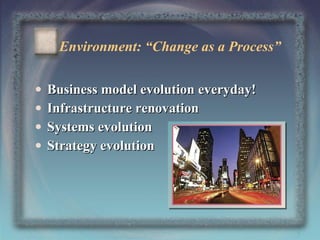
Environment: “Change as a Process”
•
•
•
•

Business model evolution everyday!
Infrastructure renovation
Systems evolution
Strategy evolution

5
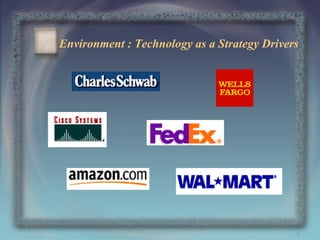
Environment : Technology as a Strategy Drivers

6
Environment : Diseconomies of Scale
• Diseconomies of process / hierarchy
• Time for information disbursement
• Lack of “real time” – poor cost & poor
partner experience
• The six month “learning curve” edge in a
short product cycle world!
7
Technostructure & Infostructure
•
•
•
•
•

Specialization & complexity of technology
Decision-making: top down or bottom up?
The role of the “fringe” employee
Nuances as pitfalls
Horizontal & vertical communication
& cooperation - not top down
• Information based, dynamic decision
making
8
The Environment -It’s Not About a
“Website”
•
•
•
•
•
•
•
•

Brand building – pull vs. push vs. information
Product marketing & research- a new paradigm?
Cost of services and goods
New variables– customer database, personalized
product
Logistics (Fed Ex), buying (FreeMarkets), admin.
Operations: ordering, billing, service,
returns, inventory...
Transparency
New models- eLance, eBay, Priceline, Amazon

9
New Networks, New Possibilities
• Internet data centers
• High bandwidth last mile
• Total bandwidth exploding
• Connectivity - “evernet”, “everyplace”
• Applications over IP-VPNs
• ASP’s

10
he CIO’s Issues

11
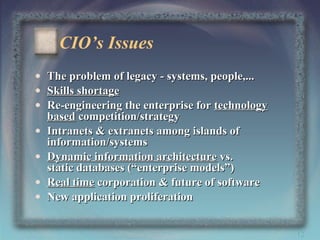
CIO’s Issues
•
•
•
•
•
•
•

The problem of legacy - systems, people,...
Skills shortage
Re-engineering the enterprise for technology
based competition/strategy
Intranets & extranets among islands of
information/systems
Dynamic information architecture vs.
static databases (“enterprise models”)
Real time corporation & future of software
New application proliferation
12
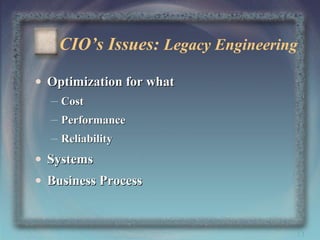
CIO’s Issues: Legacy Engineering
• Optimization for what
– Cost
– Performance
– Reliability
• Systems
• Business Process

13
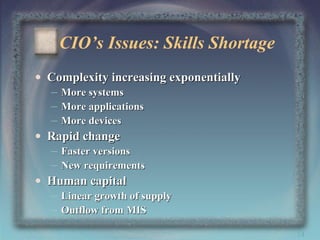
CIO’s Issues: Skills Shortage
• Complexity increasing exponentially
– More systems
– More applications
– More devices
• Rapid change
– Faster versions
– New requirements
• Human capital
– Linear growth of supply
– Outflow from MIS
14
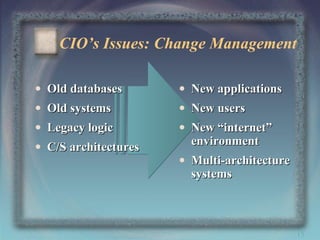
CIO’s Issues: Change Management
• Old databases
• Old systems

• New applications
• New users

• Legacy logic
• C/S architectures

• New “internet”
environment
• Multi-architecture
systems

15
CIO’s Issues: Real-Time Corporation
• Manual processes
• Batch processes
• Disconnected systems
• Limited “partner” connectivity (EDI)
• Increasing “real time” requirements

16
CIO’s Issues: Information Architecture
•
•
•
•
•
•

Intranets
Extranets
Multi-architecture environment
Personalization
Manageability
Business strategy ready infrastructure
• Unified customer data (Epiphany)
• Partner information integration
(contract manufacturer)
• Billing & more

17
CIO’s Issues: Engineering Methodology
•
•
•
•
•
•
•
•

Evolvability
Specialization
Experimentation
Change isolation
Diversity
Connectivity oriented
Best of breed oriented
Standards
18
he Road Ahead

19
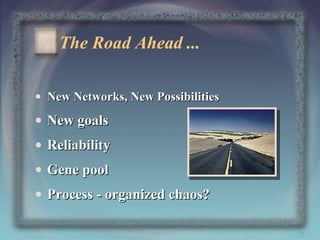
The Road Ahead ...
• New Networks, New Possibilities

• New goals
• Reliability
• Gene pool
• Process - organized chaos?
20
New Networks, New Possibilities
• Internet scale data centers
• High bandwidth (really!) last mile
• Total bandwidth explosion (Continues…)
• Connectivity - “evernet”, “everyplace”,
“everydevice” (wireless plus more)
• Applications over IP, wireless, …transition
• ASP’s
21
Road Ahead: “New” Goals
• Complexity thru federation NOT integration
• Adaptability & evolvability
• Configurable NOT customized
• Modularity – “micro” open systems model
• Personalization
• Application interoperability, unified UI
• Dramatically new management systems
22
Road Ahead : A “new” Reliability
• The shuttle Challenger: designed not to
fail
• Biological systems: designed to fail
gracefully
• Complex systems: “evolutionary
approach”
• 24/7 mission critical systems (Routers vs.
phone network)
23
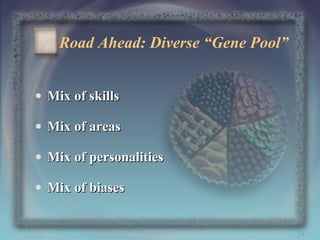
Road Ahead: Diverse “Gene Pool”
• Mix of skills
• Mix of areas
• Mix of personalities
• Mix of biases
24
Road Ahead: Organized Chaos “process”
The Shepherd or the Sargent?

• The flakes vs. architects vs. implementors
• Experimentation
• Execution
• Budgets, schedules, tasks vs. project stage

25
ew Areas
for Innovation

26
New Areas for Innovation
• “Extranet information architecture”
• Virtual computer
• Network services - “decomposing” the computer

27
New Area: “Ibase” for the “Extranet”
The Extranet Information Architecture
•
•
•
•
•
•
•
•
•

Multi-architecture architectures
Messaging paradigms
Heterogeneous databases
Metadata
Entitlement: authentication, authorization...
Inter-enterprise MIS, diverse environments
Translation
EAI
Connectivity- speeds, modes, devices
28
Case Study: Asera “IBASE”
• Architecture for multi-architecture
integration
• Unification of the UI - “personal portal”
• Universal, application independent
“entitlement system”
• Messaging, EAI, translation…
• Customizable and personalized
• Not quite flexible “business object modeling”
• Not quite the work flow and rules engine
29
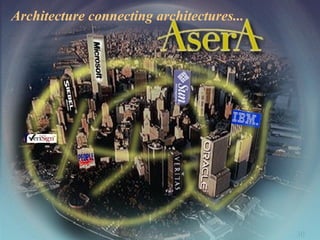
Architecture connecting architectures...

30
31
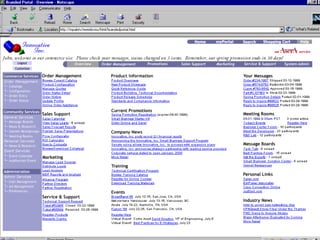
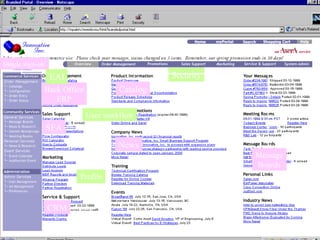
Single sign-on

Security

EAI
Catalog

Back Office
ERP

User workflow

SFA
News
Message
Boards
Profile

CRM
32
New Area: “Virtual Computer”
A Computer Distributed Over the Internet

• Scalability of hardware - add & delete
• Self management
• Geographic distribution
• Load balancing, caching, COS, … services
• “Network operating system” for the IBASE
33
Case Study: Router Networks
• Behave as “one” machine
• System self-adjusts to “node” failures
• Capacity can be added/deleted - “self
organizing”
• Geographically disbursed

34
New Areas: Network Services
The “decomposed” Computer Architecture
•
•
•
•
•
•

Storage services
Database services
Web servers/HTTP servers
TCP/IP session servers
Application servers
Composite services
– Replication
– Load balancing
– Distribution
35
Case Study: Zambeel

…distributed data services

36
Re-engineering Databases
Databases Changing Needs

•
•
•
•
•
•

Data vs. “other”
Metadata
QOS, reliability vs cost vs. access time
Distribution
Scalability: size, concurrent users ...
Security

37
Re-engineering Databases
Databases Changing Needs
• Entitlement system, security
• Changing hardware – routers as a model of
HW/SW interaction & evolution
• Changing application environments
• “Need” diversity: traditional databases, content,
portal data, evolution, “free web” vs. corporate
• Database use: tables, relations, emergent
behavior, analysis types, browsing, version
control, logic vs. data
38
Re-engineering Databases
Database Needs Asilomar Report on Database (12/98)
• Large enterprises have hundreds, sometimes thousands, of
large-scale, complex packaged and custom applications.
Interoperation between these applications is essential for the
flexibility needed by enterprises to introduce new web-based
applications services, meet regulator requirements, reduce time
to market, reduce costs, and execute business mergers.
• Because of gizmos, we foresee an explosion in the size and scale
of data clients and servers -- trillions of gizmos will need billions
of servers. The number, mobility, and intermittent connectivity
of gizmos render current client-server and three-tier software
architectures unsuitable for supporting such devices. Most
gizmos will not have a user interface and cannot have a database
administrator -- they must be self-managing, very secure, and
very reliable.
39
Re-engineering Databases
“Plug & Play Database Management Systems Report
Asilomar Report on Database (12/98)
• No knobs operation; a no-knobs system must adapt as conditions change
• Have the database system automatically discover and interact with the other
database systems accessible on the network. This information discovery process
will require that database systems provide substantially more metadata that
describes the meaning of the objects they manage.
• Billions of web clients will be accessing millions of databases. Enterprises will set
up large-scale federated database systems.
• Imprecise information will not only appear as the output of queries; it already
appears in data sources as well
• Most organizations need continuous system operation. Designing a software
system that never fails requires remote replicas and dynamic reconfiguration.
Made to not fail or fail gracefully?
• Changing needs at the app level and changing hardware environment –
no assumptions
• The information utility: make it easy for everyone to store, organize, access,
and analyze the majority of human information online

40
Case Studies - “Issues”
• Oracle
– “Poor” implementations
– Is Oracle or the implementation the problem?
– People or technology the invariant problem?
• Windows/NT
– Slow innovation
– One size fits all
– Not very flexible
41
Case Study: “Solutions”- Linux
• Modularity
• High customizability
• Higher reliability
• Short “version cycle”

42
Linux
…engineering from the bottom up
…powerful testimony to the power of evolution
…the invisible hand of Adam smith

43
Linux: Cathedral and the Bazaar
Eric Raymond:
• Ideas are many…..the trick is to recognize the good ones.
• Be Modular
• Be flexible: Change your mind and approach.
• Release early and often
• Peer review is essential
• Feedback is key to rapid and effective code development and
debugging.
• Beta testers are your most valuable resource
44
Evolvable Systems (Sharky)
•Only solutions that produce partial results
when partially implemented are evolvable
•What is, is wrong
•Evolution is cleverer than you are
Centrally designed protocols start out strong and
improve logarithmically….evolvable protocols start
up weak and improve exponentially
45
Linux: A Bazaar at the Edge of Chaos
Linux has dazzled engineers, users, and
critics alike with its immense complexity
and dazzling performance. Its existence
owes as much to accidental luck as to
ingenious hack. It is a story of something
out of nothing, a powerful testimony to
the power of evolution.
Given the essential
ingredients of evolution …
any system, natural or
artificial, can evolve into a
complex design through
incremental changes
explored in parallel.
Analytically, Linux is twice
improbably - once for its
technical complexity, and
twice for its social complexity.

46
Linux: A Bazaar at the Edge of Chaos
The Linux project has neither
top-down planning nor a
central body vested with
binding and enforcing
authorities. Its power, the
source of its bubbling
creativity, is instead in the
ceaseless interactivity among
its developers.
It is not individual
efficacy that propels
collective action, but
group efficacy that
motivates individual
contribution.

Coordination is a crucial
element sustaining collective
efforts, giving the Linux
project its integrity that
unfolds the seemingly chaotic
yet infinitely creative
process of evolution.

47
Linux: A Bazaar at the Edge of Chaos
Providing a public good is
not simply a matter of
pooling efforts, but also of
coordinating efforts.

Given the essential
ingredients of evolution …
any system, natural or
artificial, can evolve into a
complex design through
incremental changes
explored in parallel.

48
Linux: Personal Views
• Powerful Development Mechanisms
• Methodology : Ultimate “open system”
• Maybe evolutionary “biological” systems
approach works?

49
Personal Views : Development Mechanisms
• Modular development
• Successive refinement
• Aggressive peer review
• Forced “Architecture, Architecture,
Architecture”
50
Personal Views : Methodology
Ultimate “Open System”
• Origin of “open systems” circa 1982
• Methodologically forced openness
• Methodologically forced modularity
• Methodologically forced adaptability

51
Personal Views : Biological System?
• “Emergent”?
• Biological resiliency?
• Biological, incremental evolution?
• Defects cause variation/experimentation?
• Complexity theory proof?
52
Reading:
• The Cathedral and the Bazaar (Eric Raymond)
• In Praise of Evolvable Systems (Clay Shirky)
• The Circus Midget and the Fossilized Dinosaur
Turd (Martin Hock)
• Linux: A Bazaar at the Edge of Chaos (Ko
Kusabara)
53
Economics
• The relative cost of computing and human attention
has changed
• This new economics requires that computer systems be
autoeverything: autoinstalling automanaging,
autohealing, and autoprogramming
• Computers can augment human intelligence by
analyzing and summarizing data,
by organizing it, by intelligently answering direct
questions and by informing people when interesting
things happen
• The cost of “failure” is increasing exponentially
54
The Weather Forecast …
• Rate of change will accelerate - life will be
more complex, busier . . .
• Adaptability, agility & momentum will be
the key to success!
• Innovation, opportunities &
entrepreneurship will thrive
• Disruption will be the order of the day
• Fun, fortunes & failure will be in
abundance
55
Comments?
Resumes?
Business Plans?
vkhosla@kpcb.com
www.kpcb.com/team/vinod.html
Impact on Software Architecture
• New tradeoffs for the new, diverse
networked environment
• Architecture for integration -- plug and
play application architecture
• Configurable and personalized
• Rapid deployment
• Ease of change management
• Continuous availability
57
Application Challenges
• Flexible business object modeling
• Business workflow engines
– Rapid business process modeling
– Rapid business process change
– Intranet/Extranet enabled
• Business rule engines
– Complex business processing rules
– Customization/profiling rules
• Doing all these right!
58
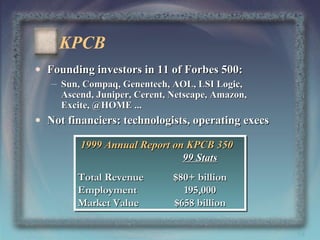
KPCB
• Founding investors in 11 of Forbes 500:
– Sun, Compaq, Genentech, AOL, LSI Logic,
Ascend, Juniper, Cerent, Netscape, Amazon,
Excite, @HOME ...

• Not financiers: technologists, operating execs
1999 Annual Report on KPCB 350
99 Stats
99 Stats
Total Revenue
Total Revenue
Employment
Employment
Market Value
Market Value

$80+ billion
$80+ billion
195,000
195,000
$658 billion
$658 billion
59
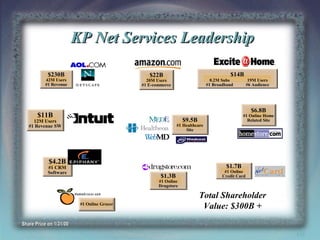
KP Net Services Leadership
$230B

$14B

$22B

42M Users
42M Users
#1 Revenue
#1 Revenue

0.2M Subs
0.2M
#1 Broadband
#1 Broadband

20M Users
20M Users
#1 E-commerce
#1 E-commerce

19M Users
19M Users
#6 Audience
#6 Audience

$6.8B

$11B

#1 Online Home
#1 Online Home
Related Site
Related Site

$9.5B

12M Users
#1 Revenue SW

#1 Healthcare
#1 Healthcare
Site
Site

$4.2B

$1.7B

#1 CRM
Software

$1.3B

#1 Online
#1 Online
Drugstore
Drugstore

#1 Online Grocer
#1 Online Grocer

#1 Online
#1 Online
Credit Card
Credit

Total Shareholder
Value: $300B +

Share Price on 1/31/00

60
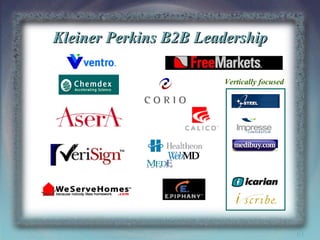
Kleiner Perkins B2B Leadership
Vertically focused

IronPlanet

61
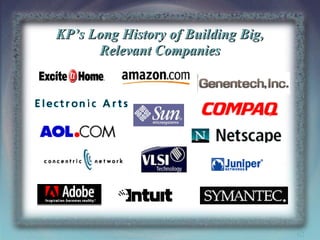
KP’s Long History of Building Big,
Relevant Companies

62
63
64
…

65
66

Re-Engineering Engineering

  • 1.
    Re-engineering Engineering Vinod Khosla KleinerPerkins Caufield & Byers vkhosla@kpcb.com Sept 2000 1
  • 2.
    There’s Change AndThen There Is Change! “…every strategic inflection point [is] characterized by a ‘10X’ change …” “There’s wind and then there is a typhoon, there are waves and then there’s a tsunami” - Andy Grove 2
  • 3.
  • 4.
    The Environment • • • • • • • • • Hyper efficiencyor Adam Smith II Hyper speed Winner take all economy Value add transparency Risk as a requirement? Change as a process Technology as a driver Diseconomy of Scale Technostructure & Infostructure 4
  • 5.
    Environment: “Change asa Process” • • • • Business model evolution everyday! Infrastructure renovation Systems evolution Strategy evolution 5
  • 6.
    Environment : Technologyas a Strategy Drivers 6
  • 7.
    Environment : Diseconomiesof Scale • Diseconomies of process / hierarchy • Time for information disbursement • Lack of “real time” – poor cost & poor partner experience • The six month “learning curve” edge in a short product cycle world! 7
  • 8.
    Technostructure & Infostructure • • • • • Specialization& complexity of technology Decision-making: top down or bottom up? The role of the “fringe” employee Nuances as pitfalls Horizontal & vertical communication & cooperation - not top down • Information based, dynamic decision making 8
  • 9.
    The Environment -It’sNot About a “Website” • • • • • • • • Brand building – pull vs. push vs. information Product marketing & research- a new paradigm? Cost of services and goods New variables– customer database, personalized product Logistics (Fed Ex), buying (FreeMarkets), admin. Operations: ordering, billing, service, returns, inventory... Transparency New models- eLance, eBay, Priceline, Amazon 9
  • 10.
    New Networks, NewPossibilities • Internet data centers • High bandwidth last mile • Total bandwidth exploding • Connectivity - “evernet”, “everyplace” • Applications over IP-VPNs • ASP’s 10
  • 11.
  • 12.
    CIO’s Issues • • • • • • • The problemof legacy - systems, people,... Skills shortage Re-engineering the enterprise for technology based competition/strategy Intranets & extranets among islands of information/systems Dynamic information architecture vs. static databases (“enterprise models”) Real time corporation & future of software New application proliferation 12
  • 13.
    CIO’s Issues: LegacyEngineering • Optimization for what – Cost – Performance – Reliability • Systems • Business Process 13
  • 14.
    CIO’s Issues: SkillsShortage • Complexity increasing exponentially – More systems – More applications – More devices • Rapid change – Faster versions – New requirements • Human capital – Linear growth of supply – Outflow from MIS 14
  • 15.
    CIO’s Issues: ChangeManagement • Old databases • Old systems • New applications • New users • Legacy logic • C/S architectures • New “internet” environment • Multi-architecture systems 15
  • 16.
    CIO’s Issues: Real-TimeCorporation • Manual processes • Batch processes • Disconnected systems • Limited “partner” connectivity (EDI) • Increasing “real time” requirements 16
  • 17.
    CIO’s Issues: InformationArchitecture • • • • • • Intranets Extranets Multi-architecture environment Personalization Manageability Business strategy ready infrastructure • Unified customer data (Epiphany) • Partner information integration (contract manufacturer) • Billing & more 17
  • 18.
    CIO’s Issues: EngineeringMethodology • • • • • • • • Evolvability Specialization Experimentation Change isolation Diversity Connectivity oriented Best of breed oriented Standards 18
  • 19.
  • 20.
    The Road Ahead... • New Networks, New Possibilities • New goals • Reliability • Gene pool • Process - organized chaos? 20
  • 21.
    New Networks, NewPossibilities • Internet scale data centers • High bandwidth (really!) last mile • Total bandwidth explosion (Continues…) • Connectivity - “evernet”, “everyplace”, “everydevice” (wireless plus more) • Applications over IP, wireless, …transition • ASP’s 21
  • 22.
    Road Ahead: “New”Goals • Complexity thru federation NOT integration • Adaptability & evolvability • Configurable NOT customized • Modularity – “micro” open systems model • Personalization • Application interoperability, unified UI • Dramatically new management systems 22
  • 23.
    Road Ahead :A “new” Reliability • The shuttle Challenger: designed not to fail • Biological systems: designed to fail gracefully • Complex systems: “evolutionary approach” • 24/7 mission critical systems (Routers vs. phone network) 23
  • 24.
    Road Ahead: Diverse“Gene Pool” • Mix of skills • Mix of areas • Mix of personalities • Mix of biases 24
  • 25.
    Road Ahead: OrganizedChaos “process” The Shepherd or the Sargent? • The flakes vs. architects vs. implementors • Experimentation • Execution • Budgets, schedules, tasks vs. project stage 25
  • 26.
  • 27.
    New Areas forInnovation • “Extranet information architecture” • Virtual computer • Network services - “decomposing” the computer 27
  • 28.
    New Area: “Ibase”for the “Extranet” The Extranet Information Architecture • • • • • • • • • Multi-architecture architectures Messaging paradigms Heterogeneous databases Metadata Entitlement: authentication, authorization... Inter-enterprise MIS, diverse environments Translation EAI Connectivity- speeds, modes, devices 28
  • 29.
    Case Study: Asera“IBASE” • Architecture for multi-architecture integration • Unification of the UI - “personal portal” • Universal, application independent “entitlement system” • Messaging, EAI, translation… • Customizable and personalized • Not quite flexible “business object modeling” • Not quite the work flow and rules engine 29
  • 30.
  • 31.
  • 32.
    Single sign-on Security EAI Catalog Back Office ERP Userworkflow SFA News Message Boards Profile CRM 32
  • 33.
    New Area: “VirtualComputer” A Computer Distributed Over the Internet • Scalability of hardware - add & delete • Self management • Geographic distribution • Load balancing, caching, COS, … services • “Network operating system” for the IBASE 33
  • 34.
    Case Study: RouterNetworks • Behave as “one” machine • System self-adjusts to “node” failures • Capacity can be added/deleted - “self organizing” • Geographically disbursed 34
  • 35.
    New Areas: NetworkServices The “decomposed” Computer Architecture • • • • • • Storage services Database services Web servers/HTTP servers TCP/IP session servers Application servers Composite services – Replication – Load balancing – Distribution 35
  • 36.
  • 37.
    Re-engineering Databases Databases ChangingNeeds • • • • • • Data vs. “other” Metadata QOS, reliability vs cost vs. access time Distribution Scalability: size, concurrent users ... Security 37
  • 38.
    Re-engineering Databases Databases ChangingNeeds • Entitlement system, security • Changing hardware – routers as a model of HW/SW interaction & evolution • Changing application environments • “Need” diversity: traditional databases, content, portal data, evolution, “free web” vs. corporate • Database use: tables, relations, emergent behavior, analysis types, browsing, version control, logic vs. data 38
  • 39.
    Re-engineering Databases Database NeedsAsilomar Report on Database (12/98) • Large enterprises have hundreds, sometimes thousands, of large-scale, complex packaged and custom applications. Interoperation between these applications is essential for the flexibility needed by enterprises to introduce new web-based applications services, meet regulator requirements, reduce time to market, reduce costs, and execute business mergers. • Because of gizmos, we foresee an explosion in the size and scale of data clients and servers -- trillions of gizmos will need billions of servers. The number, mobility, and intermittent connectivity of gizmos render current client-server and three-tier software architectures unsuitable for supporting such devices. Most gizmos will not have a user interface and cannot have a database administrator -- they must be self-managing, very secure, and very reliable. 39
  • 40.
    Re-engineering Databases “Plug &Play Database Management Systems Report Asilomar Report on Database (12/98) • No knobs operation; a no-knobs system must adapt as conditions change • Have the database system automatically discover and interact with the other database systems accessible on the network. This information discovery process will require that database systems provide substantially more metadata that describes the meaning of the objects they manage. • Billions of web clients will be accessing millions of databases. Enterprises will set up large-scale federated database systems. • Imprecise information will not only appear as the output of queries; it already appears in data sources as well • Most organizations need continuous system operation. Designing a software system that never fails requires remote replicas and dynamic reconfiguration. Made to not fail or fail gracefully? • Changing needs at the app level and changing hardware environment – no assumptions • The information utility: make it easy for everyone to store, organize, access, and analyze the majority of human information online 40
  • 41.
    Case Studies -“Issues” • Oracle – “Poor” implementations – Is Oracle or the implementation the problem? – People or technology the invariant problem? • Windows/NT – Slow innovation – One size fits all – Not very flexible 41
  • 42.
    Case Study: “Solutions”-Linux • Modularity • High customizability • Higher reliability • Short “version cycle” 42
  • 43.
    Linux …engineering from thebottom up …powerful testimony to the power of evolution …the invisible hand of Adam smith 43
  • 44.
    Linux: Cathedral andthe Bazaar Eric Raymond: • Ideas are many…..the trick is to recognize the good ones. • Be Modular • Be flexible: Change your mind and approach. • Release early and often • Peer review is essential • Feedback is key to rapid and effective code development and debugging. • Beta testers are your most valuable resource 44
  • 45.
    Evolvable Systems (Sharky) •Onlysolutions that produce partial results when partially implemented are evolvable •What is, is wrong •Evolution is cleverer than you are Centrally designed protocols start out strong and improve logarithmically….evolvable protocols start up weak and improve exponentially 45
  • 46.
    Linux: A Bazaarat the Edge of Chaos Linux has dazzled engineers, users, and critics alike with its immense complexity and dazzling performance. Its existence owes as much to accidental luck as to ingenious hack. It is a story of something out of nothing, a powerful testimony to the power of evolution. Given the essential ingredients of evolution … any system, natural or artificial, can evolve into a complex design through incremental changes explored in parallel. Analytically, Linux is twice improbably - once for its technical complexity, and twice for its social complexity. 46
  • 47.
    Linux: A Bazaarat the Edge of Chaos The Linux project has neither top-down planning nor a central body vested with binding and enforcing authorities. Its power, the source of its bubbling creativity, is instead in the ceaseless interactivity among its developers. It is not individual efficacy that propels collective action, but group efficacy that motivates individual contribution. Coordination is a crucial element sustaining collective efforts, giving the Linux project its integrity that unfolds the seemingly chaotic yet infinitely creative process of evolution. 47
  • 48.
    Linux: A Bazaarat the Edge of Chaos Providing a public good is not simply a matter of pooling efforts, but also of coordinating efforts. Given the essential ingredients of evolution … any system, natural or artificial, can evolve into a complex design through incremental changes explored in parallel. 48
  • 49.
    Linux: Personal Views •Powerful Development Mechanisms • Methodology : Ultimate “open system” • Maybe evolutionary “biological” systems approach works? 49
  • 50.
    Personal Views :Development Mechanisms • Modular development • Successive refinement • Aggressive peer review • Forced “Architecture, Architecture, Architecture” 50
  • 51.
    Personal Views :Methodology Ultimate “Open System” • Origin of “open systems” circa 1982 • Methodologically forced openness • Methodologically forced modularity • Methodologically forced adaptability 51
  • 52.
    Personal Views :Biological System? • “Emergent”? • Biological resiliency? • Biological, incremental evolution? • Defects cause variation/experimentation? • Complexity theory proof? 52
  • 53.
    Reading: • The Cathedraland the Bazaar (Eric Raymond) • In Praise of Evolvable Systems (Clay Shirky) • The Circus Midget and the Fossilized Dinosaur Turd (Martin Hock) • Linux: A Bazaar at the Edge of Chaos (Ko Kusabara) 53
  • 54.
    Economics • The relativecost of computing and human attention has changed • This new economics requires that computer systems be autoeverything: autoinstalling automanaging, autohealing, and autoprogramming • Computers can augment human intelligence by analyzing and summarizing data, by organizing it, by intelligently answering direct questions and by informing people when interesting things happen • The cost of “failure” is increasing exponentially 54
  • 55.
    The Weather Forecast… • Rate of change will accelerate - life will be more complex, busier . . . • Adaptability, agility & momentum will be the key to success! • Innovation, opportunities & entrepreneurship will thrive • Disruption will be the order of the day • Fun, fortunes & failure will be in abundance 55
  • 56.
  • 57.
    Impact on SoftwareArchitecture • New tradeoffs for the new, diverse networked environment • Architecture for integration -- plug and play application architecture • Configurable and personalized • Rapid deployment • Ease of change management • Continuous availability 57
  • 58.
    Application Challenges • Flexiblebusiness object modeling • Business workflow engines – Rapid business process modeling – Rapid business process change – Intranet/Extranet enabled • Business rule engines – Complex business processing rules – Customization/profiling rules • Doing all these right! 58
  • 59.
    KPCB • Founding investorsin 11 of Forbes 500: – Sun, Compaq, Genentech, AOL, LSI Logic, Ascend, Juniper, Cerent, Netscape, Amazon, Excite, @HOME ... • Not financiers: technologists, operating execs 1999 Annual Report on KPCB 350 1999 Annual Report on KPCB 350 99 Stats 99 Stats Total Revenue Total Revenue Employment Employment Market Value Market Value $80+ billion $80+ billion 195,000 195,000 $658 billion $658 billion 59
  • 60.
    KP Net ServicesLeadership $230B $14B $22B 42M Users 42M Users #1 Revenue #1 Revenue 0.2M Subs 0.2M #1 Broadband #1 Broadband 20M Users 20M Users #1 E-commerce #1 E-commerce 19M Users 19M Users #6 Audience #6 Audience $6.8B $11B #1 Online Home #1 Online Home Related Site Related Site $9.5B 12M Users #1 Revenue SW #1 Healthcare #1 Healthcare Site Site $4.2B $1.7B #1 CRM Software $1.3B #1 Online #1 Online Drugstore Drugstore #1 Online Grocer #1 Online Grocer #1 Online #1 Online Credit Card Credit Total Shareholder Value: $300B + Share Price on 1/31/00 60
  • 61.
    Kleiner Perkins B2BLeadership Vertically focused IronPlanet 61
  • 62.
    KP’s Long Historyof Building Big, Relevant Companies 62
  • 63.
  • 64.
  • 65.
  • 66.

Editor's Notes

  • #2 <number>
  • #3 <number> Andy Grove excerpt: “... you can’t judge the significance of strategic inflection points by the quality of the first version. You need to draw on your experience. Perhaps you remember your reaction to the first PC you ever saw. It probably didn’t strike you as a revolutionary device. So it is with the Internet. Now, as you stare at your computer screen that’s connected to the Internet, waiting for a World Wide Web page to slowly materialize, let your imagination flow a bit. What might this experience be like if transmission speed doubled? Or better yet, if it were improved by “10X”? ---> the point is that there is still the vast majority of change yet to come with respect to the Internet… let me try and convince you that it is bigger than it seems!
  • #9 Andy Grove excerpt: One last lesson, and this is a key one: It seems that companies that successfully navigate through strategic inflection points have a good dialectic between bottom-up and top-down actions. Bottom-up actions come from the ranks of middle managers, who by the nature of their jobs are exposed to the first whiffs of the winds of change, who are located at the periphery of the action where change is first perceived (remember, snow melts at the periphery) and who therefore catch on early. But, by the nature of their work, they can only affect things locally: The production planners can wafer allocation but they can hardly affect marketing strategy. Their actions must meet halfway the actions generated by senior management. While those managers are isolated from the winds of change, once they commit themselves to a new direction, they can affect the strategy of the entire organization.” ...while Intel’s business changed and management was looking for clever memory strategies and arguing among themselves, trying to figure out how to fight an unwinnable war, men and women lower in the organization, unbeknownst to us, got us ready to execute the strategic turn that saved our necks and gave us a great future.
  • #32 The Asera service delivers your branded demand chain management system via a web portal to all your channels of distribution--- personalized to meet the unique needs of each channel relationship. With the Asera service you can facilitate the processes of commerce such as catalog, configuration order placement order status and customer support-- greatly improving timelines, accuracy and cost of doing business with your channels and end customers You can deliver content-- information about your products, services and channel related programs such as promotions and marketing programs-- to improve your channels focus and ability to reach your target markets Through the delivery of supplier/channel/customer community functions you can facilitate value add information exchange between all parties involved in the demand chain--improving the effectiveness of your channels and keeping more closely in touch with your marketplace. Imagine being able to benefit from the interaction of your annual user or channel conference--- 24 hours a day-- 365 days a year. Finally-- with the Asera service you can personalize the function , content and delegated authority delivered--- to meet the needs of each of your constituents, further increasing the the value you deliver and the loyalty of your channels and customers
  • #33 The Asera service delivers your branded demand chain management system via a web portal to all your channels of distribution--- personalized to meet the unique needs of each channel relationship. With the Asera service you can facilitate the processes of commerce such as catalog, configuration order placement order status and customer support-- greatly improving timelines, accuracy and cost of doing business with your channels and end customers You can deliver content-- information about your products, services and channel related programs such as promotions and marketing programs-- to improve your channels focus and ability to reach your target markets Through the delivery of supplier/channel/customer community functions you can facilitate value add information exchange between all parties involved in the demand chain--improving the effectiveness of your channels and keeping more closely in touch with your marketplace. Imagine being able to benefit from the interaction of your annual user or channel conference--- 24 hours a day-- 365 days a year. Finally-- with the Asera service you can personalize the function , content and delegated authority delivered--- to meet the needs of each of your constituents, further increasing the the value you deliver and the loyalty of your channels and customers
  • #56 <number> remember - it is not the only thing, not even the main thing….family , relationships, enjoyment are to me at least more important story of the lawyer (Stevens story)
  • #57 <number>