Disaster Recovery Site
Implementation
Configuration and Requirements
SQLServer
Author
By JBH Syed| BSCS | MSDEIM | MCTS | MCITP | OCA | OCP | OCE | SCJP | ITL V3F | COBIT 5F | PRINCE2
• Astute corporate resource with 10+ years of corporate experience with emphasis on database management, programming, software
development, testing, web technologies and product improvement for corporations. Combines expert software and database
management expertise with strong qualifications in Software, Data Engineering & Information Management.
Concurrently, manage all the database functions for the current company. Industry experience in Information Technology. Strong
understanding of the complex challenges in Software Development and problem troubleshooting. An expert on identifying and solving
problems, gaining new business contacts, reducing costs, coordinating staff and evaluating performance. Professional traits include;
problem-solving, decision-making, time management, multitasking, analytical thinking, effective communication, and computer
competencies.
• Oracle Certified Professional OCA on 9i
• Oracle Certified Professional OCP on 9i
• Oracle Certified Professional OCP on 10g
• Oracle Certified Professional OCP on 11g
• Oracle Certified Professional OCP on 12c
• Oracle Certified Professional OCP on MySQL 5
• Oracle Certified Professional OCE on 10g managing on Linux
• Oracle Certified Professional OCP on E-Business Apps DBA
• Microsoft Certified Technology Specialist on SQL Server 2005
• Microsoft Certified Technology Specialist on SQL Server 2008
• Microsoft Certified IT Professional on SQL Server 2005
• Microsoft Certified IT Professional on SQL Server 2008
• Sun Certified Java Programmer 5.0
• IBM Certified Database(DB2) Associate 9.0
• ITIL V3 Foundation Certified
• COBIT 5 Foundation Certified
• PRINCE2 Foundation Certified
Agenda
• Modes of DataTransfer
• Replication
• Types of Replication
• Log Shipping
• Mirroring
• Log Shipping Requirements
• Log Shipping Configuration
• Network upload and download bandwidth requirement
By JBH Syed| BSCS | MSDEIM | MCTS | MCITP | OCA | OCP | OCE | SCJP | ITL V3F | COBIT 5F | PRINCE2
Modes of DataTransfer
• Replication
• Log Shipping
• Mirroring
• Custom Service
By JBH Syed| BSCS | MSDEIM | MCTS | MCITP | OCA | OCP | OCE | SCJP | ITL V3F | COBIT 5F | PRINCE2
Replication
• Replication in computing involves sharing information so as to ensure
consistency between redundant resources, such as software or hardware
components, to improve reliability, fault-tolerance, or accessibility
(Wikipedia)
By JBH Syed| BSCS | MSDEIM | MCTS | MCITP | OCA | OCP | OCE | SCJP | ITL V3F | COBIT 5F | PRINCE2
Types of Replication
• Transactional
• Merge
• Snapshot
• The type of replication you choose for an application depends on many factors,
including the physical replication environment, the type and quantity of data to
be replicated, and whether the data is updated at the Subscriber.The physical
environment includes the number and location of computers involved in
replication and whether these computers are clients (workstations, laptops, or
handheld devices) or servers. (Microsoft)
By JBH Syed| BSCS | MSDEIM | MCTS | MCITP | OCA | OCP | OCE | SCJP | ITL V3F | COBIT 5F | PRINCE2
Transactional Replication
• Transactional replication is implemented by the SQL Server Snapshot
Agent, Log Reader Agent, and DistributionAgent.The Snapshot Agent
prepares snapshot files containing schema and data of published tables and
database objects, stores the files in the snapshot folder, and records
synchronization jobs in the distribution database on the Distributor.
(Microsoft)
By JBH Syed| BSCS | MSDEIM | MCTS | MCITP | OCA | OCP | OCE | SCJP | ITL V3F | COBIT 5F | PRINCE2
Merge Replication
• Merge replication is implemented by the SQL Server Snapshot Agent and
Merge Agent. If the publication is unfiltered or uses static filters, the
Snapshot Agent creates a single snapshot. If the publication uses
parameterized filters, the Snapshot Agent creates a snapshot for each
partition of data.The Merge Agent applies the initial snapshots to the
Subscribers. It also merges incremental data changes that occurred at the
Publisher or Subscribers after the initial snapshot was created, and detects
and resolves any conflicts according to rules you configure. (Microsoft)
By JBH Syed| BSCS | MSDEIM | MCTS | MCITP | OCA | OCP | OCE | SCJP | ITL V3F | COBIT 5F | PRINCE2
Snapshot Replication
• By default, all three types of replication use a snapshot to initialize
Subscribers.The SQL Server Snapshot Agent always generates the
snapshot files, but the agent that delivers the files differs depending on the
type of replication being used. Snapshot replication and transactional
replication use the DistributionAgent to deliver the files, whereas merge
replication uses the SQL Server Merge Agent.The Snapshot Agent runs at
the Distributor.The DistributionAgent and MergeAgent run at the
Distributor for push subscriptions, or at Subscribers for pull subscriptions.
(Microsoft)
By JBH Syed| BSCS | MSDEIM | MCTS | MCITP | OCA | OCP | OCE | SCJP | ITL V3F | COBIT 5F | PRINCE2
Log Shipping
• SQL Server Log shipping allows you to automatically send transaction log
backups from a primary database on a primary server instance to one or
more secondary databases on separate secondary server instances.The
transaction log backups are applied to each of the secondary databases
individually.An optional third server instance, known as themonitor server,
records the history and status of backup and restore operations and,
optionally, raises alerts if these operations fail to occur as scheduled.
(Microsoft)
By JBH Syed| BSCS | MSDEIM | MCTS | MCITP | OCA | OCP | OCE | SCJP | ITL V3F | COBIT 5F | PRINCE2
Mirroring
• This feature is going to remove in the future release of MS SQL Server
therefore we are not going to discuss on it.
By JBH Syed| BSCS | MSDEIM | MCTS | MCITP | OCA | OCP | OCE | SCJP | ITL V3F | COBIT 5F | PRINCE2
Log Shipping Requirements
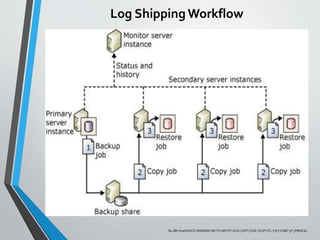
The primary server instance runs the backup job to back up the transaction log
on the primary database.This server instance then places the log backup into a
primary log-backup file, which it sends to the backup folder. In this figure,
the backup folder is on a shared directory—the backup share.
Each of the three secondary server instances runs its own copy job to copy the
primary log-backup file to its own local destination folder.
Each secondary server instance runs its own restore job to restore the log
backup from the local destination folder onto the local secondary database.
The primary and secondary server instances send their own history and status to
the monitor server instance.
By JBH Syed| BSCS | MSDEIM | MCTS | MCITP | OCA | OCP | OCE | SCJP | ITL V3F | COBIT 5F | PRINCE2
Log Shipping Requirements
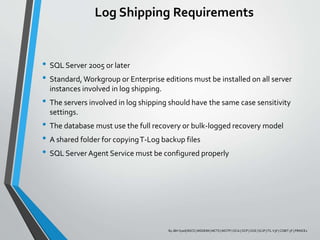
• SQL Server 2005 or later
• Standard, Workgroup or Enterprise editions must be installed on all server
instances involved in log shipping.
• The servers involved in log shipping should have the same case sensitivity
settings.
• The database must use the full recovery or bulk-logged recovery model
• A shared folder for copyingT-Log backup files
• SQL Server Agent Service must be configured properly
By JBH Syed| BSCS | MSDEIM | MCTS | MCITP | OCA | OCP | OCE | SCJP | ITL V3F | COBIT 5F | PRINCE2
Log Shipping Configuration
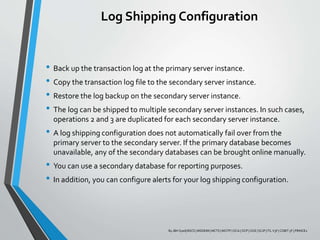
• Back up the transaction log at the primary server instance.
• Copy the transaction log file to the secondary server instance.
• Restore the log backup on the secondary server instance.
• The log can be shipped to multiple secondary server instances. In such cases,
operations 2 and 3 are duplicated for each secondary server instance.
• A log shipping configuration does not automatically fail over from the
primary server to the secondary server. If the primary database becomes
unavailable, any of the secondary databases can be brought online manually.
• You can use a secondary database for reporting purposes.
• In addition, you can configure alerts for your log shipping configuration.
By JBH Syed| BSCS | MSDEIM | MCTS | MCITP | OCA | OCP | OCE | SCJP | ITL V3F | COBIT 5F | PRINCE2
Log Shipping Workflow
By JBH Syed| BSCS | MSDEIM | MCTS | MCITP | OCA | OCP | OCE | SCJP | ITL V3F | COBIT 5F | PRINCE2
Network Bandwidth Requirement
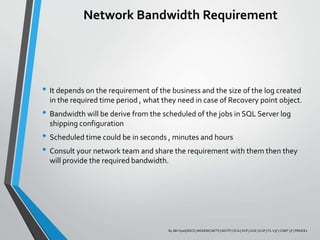
• It depends on the requirement of the business and the size of the log created
in the required time period , what they need in case of Recovery point object.
• Bandwidth will be derive from the scheduled of the jobs in SQL Server log
shipping configuration
• Scheduled time could be in seconds , minutes and hours
• Consult your network team and share the requirement with them then they
will provide the required bandwidth.
By JBH Syed| BSCS | MSDEIM | MCTS | MCITP | OCA | OCP | OCE | SCJP | ITL V3F | COBIT 5F | PRINCE2

SQL Server Disaster Recovery Implementation

  • 1.
  • 2.
    Author By JBH Syed|BSCS | MSDEIM | MCTS | MCITP | OCA | OCP | OCE | SCJP | ITL V3F | COBIT 5F | PRINCE2 • Astute corporate resource with 10+ years of corporate experience with emphasis on database management, programming, software development, testing, web technologies and product improvement for corporations. Combines expert software and database management expertise with strong qualifications in Software, Data Engineering & Information Management. Concurrently, manage all the database functions for the current company. Industry experience in Information Technology. Strong understanding of the complex challenges in Software Development and problem troubleshooting. An expert on identifying and solving problems, gaining new business contacts, reducing costs, coordinating staff and evaluating performance. Professional traits include; problem-solving, decision-making, time management, multitasking, analytical thinking, effective communication, and computer competencies. • Oracle Certified Professional OCA on 9i • Oracle Certified Professional OCP on 9i • Oracle Certified Professional OCP on 10g • Oracle Certified Professional OCP on 11g • Oracle Certified Professional OCP on 12c • Oracle Certified Professional OCP on MySQL 5 • Oracle Certified Professional OCE on 10g managing on Linux • Oracle Certified Professional OCP on E-Business Apps DBA • Microsoft Certified Technology Specialist on SQL Server 2005 • Microsoft Certified Technology Specialist on SQL Server 2008 • Microsoft Certified IT Professional on SQL Server 2005 • Microsoft Certified IT Professional on SQL Server 2008 • Sun Certified Java Programmer 5.0 • IBM Certified Database(DB2) Associate 9.0 • ITIL V3 Foundation Certified • COBIT 5 Foundation Certified • PRINCE2 Foundation Certified
  • 3.
    Agenda • Modes ofDataTransfer • Replication • Types of Replication • Log Shipping • Mirroring • Log Shipping Requirements • Log Shipping Configuration • Network upload and download bandwidth requirement By JBH Syed| BSCS | MSDEIM | MCTS | MCITP | OCA | OCP | OCE | SCJP | ITL V3F | COBIT 5F | PRINCE2
  • 4.
    Modes of DataTransfer •Replication • Log Shipping • Mirroring • Custom Service By JBH Syed| BSCS | MSDEIM | MCTS | MCITP | OCA | OCP | OCE | SCJP | ITL V3F | COBIT 5F | PRINCE2
  • 5.
    Replication • Replication incomputing involves sharing information so as to ensure consistency between redundant resources, such as software or hardware components, to improve reliability, fault-tolerance, or accessibility (Wikipedia) By JBH Syed| BSCS | MSDEIM | MCTS | MCITP | OCA | OCP | OCE | SCJP | ITL V3F | COBIT 5F | PRINCE2
  • 6.
    Types of Replication •Transactional • Merge • Snapshot • The type of replication you choose for an application depends on many factors, including the physical replication environment, the type and quantity of data to be replicated, and whether the data is updated at the Subscriber.The physical environment includes the number and location of computers involved in replication and whether these computers are clients (workstations, laptops, or handheld devices) or servers. (Microsoft) By JBH Syed| BSCS | MSDEIM | MCTS | MCITP | OCA | OCP | OCE | SCJP | ITL V3F | COBIT 5F | PRINCE2
  • 7.
    Transactional Replication • Transactionalreplication is implemented by the SQL Server Snapshot Agent, Log Reader Agent, and DistributionAgent.The Snapshot Agent prepares snapshot files containing schema and data of published tables and database objects, stores the files in the snapshot folder, and records synchronization jobs in the distribution database on the Distributor. (Microsoft) By JBH Syed| BSCS | MSDEIM | MCTS | MCITP | OCA | OCP | OCE | SCJP | ITL V3F | COBIT 5F | PRINCE2
  • 8.
    Merge Replication • Mergereplication is implemented by the SQL Server Snapshot Agent and Merge Agent. If the publication is unfiltered or uses static filters, the Snapshot Agent creates a single snapshot. If the publication uses parameterized filters, the Snapshot Agent creates a snapshot for each partition of data.The Merge Agent applies the initial snapshots to the Subscribers. It also merges incremental data changes that occurred at the Publisher or Subscribers after the initial snapshot was created, and detects and resolves any conflicts according to rules you configure. (Microsoft) By JBH Syed| BSCS | MSDEIM | MCTS | MCITP | OCA | OCP | OCE | SCJP | ITL V3F | COBIT 5F | PRINCE2
  • 9.
    Snapshot Replication • Bydefault, all three types of replication use a snapshot to initialize Subscribers.The SQL Server Snapshot Agent always generates the snapshot files, but the agent that delivers the files differs depending on the type of replication being used. Snapshot replication and transactional replication use the DistributionAgent to deliver the files, whereas merge replication uses the SQL Server Merge Agent.The Snapshot Agent runs at the Distributor.The DistributionAgent and MergeAgent run at the Distributor for push subscriptions, or at Subscribers for pull subscriptions. (Microsoft) By JBH Syed| BSCS | MSDEIM | MCTS | MCITP | OCA | OCP | OCE | SCJP | ITL V3F | COBIT 5F | PRINCE2
  • 10.
    Log Shipping • SQLServer Log shipping allows you to automatically send transaction log backups from a primary database on a primary server instance to one or more secondary databases on separate secondary server instances.The transaction log backups are applied to each of the secondary databases individually.An optional third server instance, known as themonitor server, records the history and status of backup and restore operations and, optionally, raises alerts if these operations fail to occur as scheduled. (Microsoft) By JBH Syed| BSCS | MSDEIM | MCTS | MCITP | OCA | OCP | OCE | SCJP | ITL V3F | COBIT 5F | PRINCE2
  • 11.
    Mirroring • This featureis going to remove in the future release of MS SQL Server therefore we are not going to discuss on it. By JBH Syed| BSCS | MSDEIM | MCTS | MCITP | OCA | OCP | OCE | SCJP | ITL V3F | COBIT 5F | PRINCE2
  • 12.
    Log Shipping Requirements Theprimary server instance runs the backup job to back up the transaction log on the primary database.This server instance then places the log backup into a primary log-backup file, which it sends to the backup folder. In this figure, the backup folder is on a shared directory—the backup share. Each of the three secondary server instances runs its own copy job to copy the primary log-backup file to its own local destination folder. Each secondary server instance runs its own restore job to restore the log backup from the local destination folder onto the local secondary database. The primary and secondary server instances send their own history and status to the monitor server instance. By JBH Syed| BSCS | MSDEIM | MCTS | MCITP | OCA | OCP | OCE | SCJP | ITL V3F | COBIT 5F | PRINCE2
  • 13.
    Log Shipping Requirements •SQL Server 2005 or later • Standard, Workgroup or Enterprise editions must be installed on all server instances involved in log shipping. • The servers involved in log shipping should have the same case sensitivity settings. • The database must use the full recovery or bulk-logged recovery model • A shared folder for copyingT-Log backup files • SQL Server Agent Service must be configured properly By JBH Syed| BSCS | MSDEIM | MCTS | MCITP | OCA | OCP | OCE | SCJP | ITL V3F | COBIT 5F | PRINCE2
  • 14.
    Log Shipping Configuration •Back up the transaction log at the primary server instance. • Copy the transaction log file to the secondary server instance. • Restore the log backup on the secondary server instance. • The log can be shipped to multiple secondary server instances. In such cases, operations 2 and 3 are duplicated for each secondary server instance. • A log shipping configuration does not automatically fail over from the primary server to the secondary server. If the primary database becomes unavailable, any of the secondary databases can be brought online manually. • You can use a secondary database for reporting purposes. • In addition, you can configure alerts for your log shipping configuration. By JBH Syed| BSCS | MSDEIM | MCTS | MCITP | OCA | OCP | OCE | SCJP | ITL V3F | COBIT 5F | PRINCE2
  • 15.
    Log Shipping Workflow ByJBH Syed| BSCS | MSDEIM | MCTS | MCITP | OCA | OCP | OCE | SCJP | ITL V3F | COBIT 5F | PRINCE2
  • 16.
    Network Bandwidth Requirement •It depends on the requirement of the business and the size of the log created in the required time period , what they need in case of Recovery point object. • Bandwidth will be derive from the scheduled of the jobs in SQL Server log shipping configuration • Scheduled time could be in seconds , minutes and hours • Consult your network team and share the requirement with them then they will provide the required bandwidth. By JBH Syed| BSCS | MSDEIM | MCTS | MCITP | OCA | OCP | OCE | SCJP | ITL V3F | COBIT 5F | PRINCE2