Hector Quintero Casanova
    University of Edinburgh


The Web Ontology Language
Why bother?
Why bother?
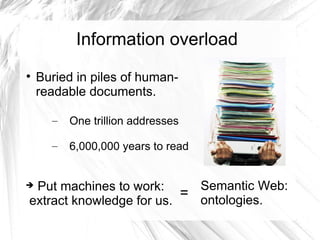
Information overload

    Buried in piles of human-
    readable documents.

      –   One trillion addresses

      –   6,000,000 years to read


Put machines to work:      Semantic Web:
extract knowledge for us.
                          = ontologies.
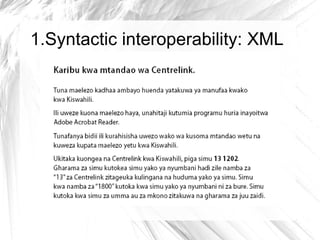
1.Syntactic interoperability: XML

    Fact: To spread knowledge, don't do Swahili.

    XML is a “common language” or syntax which
    things can be described in.

         XML is perfect for sharing meta-data and...

          … No more and no less. XML is just the
          vehicle for meaning (semantics).
2.Semantic grammar: RDF

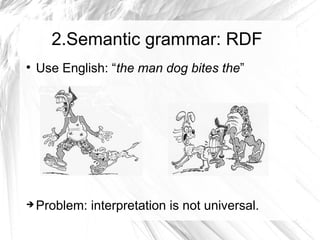
    Use English: “the man dog bites the”


   Problem: interpretation is not universal.
2.Semantic grammar: RDF

    Fact: English without a grammar is a mess.

    RDF amounts to the grammar for describing
    meaning: exposes relationships.

      –   Uses assertions: “The dog bites the man”.

      –   Those use a certain vocabulary: bites.

      –   Vocabulary must be provided.

Note: XML normally used as underlying syntax
3.Semantic interoperability: RDFS

    Sensible English: define status of the man

    Answer: The man had a P.E.

      –   P.E. = Physical Examination.
               The man is alive and kicking.

      –   P.E. = Pleural Effusion.
               The man might be in trouble.


   Problem: subject to multiple interpretation.
3.Semantic interoperability: RDFS

    Fact: Cryptic English is worse than Swahili

    RDF Schema provides an object-oriented
    “framework” for defining vocabulary.
      –   Uses hierarchy and inheritance relationships.
      –   “Standard” actions such as subClassOf.

• RDF + RDFS = universally describe domain
      –   Semantically-strong taxonomies (e.g. biology)

   We don't need OWL at all?
3.Semantic interoperability: RDFS

    Fact: Cryptic English is worse than Swahili

    RDF Schema provides an object-oriented
    “framework” for defining vocabulary.
      –   Uses hierarchy and inheritance relationships.
      –   “Standard” actions such as subClassOf.

• RDF + RDFS = universally describe language
               Ontology modelling domain
      –   Semantically-strong taxonomies (e.g. biology)

   We don't need OWL at all?
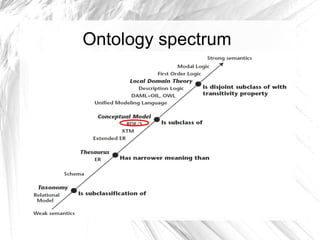
Ontology spectrum
Ontology spectrum

    RDF/S cannot model all ontologies.

    Enhance expressiveness of RDF/S.
         OWL = W3C's attempt to extend RDFS


    But with expressiveness comes complexity
      –   Bad for inference rules
         W3C's solution is 3 flavours: Full, DL, Lite.


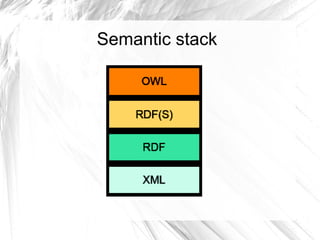
    Semantic formula = XML + RDF/S + OWL
Semantic stack

The Web Ontology Language

  • 1.
    Hector Quintero Casanova University of Edinburgh The Web Ontology Language
  • 2.
  • 3.
  • 4.
    Information overload  Buried in piles of human- readable documents. – One trillion addresses – 6,000,000 years to read Put machines to work: Semantic Web: extract knowledge for us. = ontologies.
  • 5.
  • 6.
    1.Syntactic interoperability: XML  Fact: To spread knowledge, don't do Swahili.  XML is a “common language” or syntax which things can be described in.  XML is perfect for sharing meta-data and...  … No more and no less. XML is just the vehicle for meaning (semantics).
  • 7.
    2.Semantic grammar: RDF  Use English: “the man dog bites the”  Problem: interpretation is not universal.
  • 8.
    2.Semantic grammar: RDF  Fact: English without a grammar is a mess.  RDF amounts to the grammar for describing meaning: exposes relationships. – Uses assertions: “The dog bites the man”. – Those use a certain vocabulary: bites. – Vocabulary must be provided. Note: XML normally used as underlying syntax
  • 9.
    3.Semantic interoperability: RDFS  Sensible English: define status of the man  Answer: The man had a P.E. – P.E. = Physical Examination.  The man is alive and kicking. – P.E. = Pleural Effusion.  The man might be in trouble.  Problem: subject to multiple interpretation.
  • 10.
    3.Semantic interoperability: RDFS  Fact: Cryptic English is worse than Swahili  RDF Schema provides an object-oriented “framework” for defining vocabulary. – Uses hierarchy and inheritance relationships. – “Standard” actions such as subClassOf. • RDF + RDFS = universally describe domain – Semantically-strong taxonomies (e.g. biology)  We don't need OWL at all?
  • 11.
    3.Semantic interoperability: RDFS  Fact: Cryptic English is worse than Swahili  RDF Schema provides an object-oriented “framework” for defining vocabulary. – Uses hierarchy and inheritance relationships. – “Standard” actions such as subClassOf. • RDF + RDFS = universally describe language Ontology modelling domain – Semantically-strong taxonomies (e.g. biology)  We don't need OWL at all?
  • 12.
  • 13.
    Ontology spectrum  RDF/S cannot model all ontologies.  Enhance expressiveness of RDF/S.  OWL = W3C's attempt to extend RDFS  But with expressiveness comes complexity – Bad for inference rules  W3C's solution is 3 flavours: Full, DL, Lite.  Semantic formula = XML + RDF/S + OWL
  • 14.