Positive Behavioral Interventions & IDEA
New Opportunities for Teaching.
Presentation – By Humera
Ali
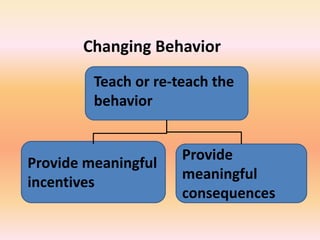
Changing Behavior
The challenge for parents and
educators is to find new ways of
understanding the interactions
between a child and his or her
environment so that useful
interventions can de developed that
lead to lasting behavior change
Changing Behavior
Provide meaningful
incentives
Provide
meaningful
consequences
Teach or re-teach the
behavior
Children Model Adult Behavior
In the classroom, the teacher is the model for student
behavior. At home, the parents provide the model.
A teacher who yells, threatens or punishes excessively is
setting the standard for the future adult behaviors of
students by demonstrating to the students how to
respond to the undesirable behaviors of others. The
same is true of parents.
Teachers and parents who rely on punishment as a
primary intervention may increase the level of
unacceptable behaviors as children begin to copy the
behaviors of their model
Perspectives of Behavior
There are basically two attitudes that
people have about the behaviors of
children, which is
really polarities of thought.
1.The child IS a problem.
2.The child HAS a problem.
Negative Perspective of Behavior
The child IS a problem.
When a teacher uses punishment frequently, he or she runs
the risk of becoming associated with negative consequences,
and a student may come to fear or avoid the teacher.
Or, the student may become angry and try to “get even ”by
escalating his or her behavior, walking out of the room, or
refusing to accept a punishment, such as refusing to go to
time-out.
This cycle of behavior often results in severe consequences to
the student .
Negative Perspective of Behavior
The child IS a problem.
But what message is the student receiving?
Where is the instruction in this approach?
When negative behaviors result in excluding a
student from his or her classroom, the student
may learn that the behavior is successful in
helping him or her to avoid doing the required
work.
Exclusion may actually be reinforcing the
negative behavior it was designed to correct.
Positive Perspective of Behavior
The child HAS a problem
When adults understand the
motivation behind misbehavior,
their attitudes often change.
In positive approach resides the
opportunity for instruction.
Positive Perspective of Behavior
The child HAS a problem.
What we do:
I. Teach academic skills.
II. Teach behavioral skills.
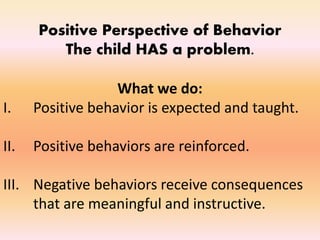
Positive Perspective of Behavior
The child HAS a problem.
What we do:
I. Positive behavior is expected and taught.
II. Positive behaviors are reinforced.
III. Negative behaviors receive consequences
that are meaningful and instructive.
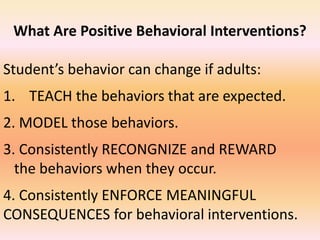
What Are Positive Behavioral Interventions?
Student’s behavior can change if adults:
1. TEACH the behaviors that are expected.
2. MODEL those behaviors.
3. Consistently RECONGNIZE and REWARD
the behaviors when they occur.
4. Consistently ENFORCE MEANINGFUL
CONSEQUENCES for behavioral interventions.
Positive Intervention
Positive behavioral interventions are planned
interventions that take place:
I. Before the onset of problem behaviors.
II. Before escalation of those behaviors.
III. To prevent the behaviors from reoccurring.
If it is possible to identify events in the environment
that contribute to problem behavior (class size,
teacher-student interaction, curriculum, etc.) it may
be possible to modify those events sufficiently to
inhibit or reduce the behavior.
Examples
What We Know About Behavior…
Fixing problems does not lead to desired
outcomes:
“If you stop swearing, you will have a job…”
“Finishing work will get you a friend…”
If we do not teach students what to do instead
of what they are doing, they will continue to do
what they do –and get better at it!
Teach the Behavior You Expect
1. Begin with 2 to 5 simple rules.
Example: Be respectful of others.
2. Describe what the rules mean in specific
terms.
Example: Respect means speaking in a normal
tone of voice.
Respect means keeping your hands and feet to
yourself.
Teach the Behavior You Expect
3. Provide instruction about what to do instead.
State your expectations for behavior.
Provide examples of expected behavior.
4. Discuss and model the expected behaviors.
At home and in the actual locations.
Re-teach regularly.
Teach the Behavior You Expect
5. Be sure the expectation is positive.
 Positive: “Once you have finished your
chores, you may go to Mary’s house.”
X Negative:“You cannot go to Mary’s house
until the chores are finished.”
Provide Meaningful Positive Incentives
Teaching is not always enough to change
behavior over the long haul.
Students need to be recognized and
rewarded when they are meeting the
expectations that have been established.
Positive recognition (rewards, other
reinforcements, praise) must occur more
frequently than negative recognition (at
least a 4 to 1 ratio).
Interventions That Work
Preventive Cueing (Signal Interference)
Used to alert the student who is doing
something unacceptable.
A frown, shake of the head, making eye contact,
pointing to a seat for a wandering student, or
snap of the fingers can convey the need to pay
attention or to stop behaviors before they
escalate.
Do not show approval when using preventative
cueing.
Use “I "Messages
A 3-part verbal intervention to help a student
understand the impact of his or her behavior:
1.Describe the behavior;
2.Describe its effect on teacher, parent or
others;
3.Describe your feelings about the
misbehavior.
Caution: When children do not like their
teacher, “I "messages may cause an increase in
the behavior.
Positive Phrasing
Let a student know exactly what behavior is
expected, not just what is not expected.
State the reinforcement for carrying out the
desired behavior:
•“You will be able to go outside with
friends during recess if you keep your
hands on the desk during discussion "or
•“I will call on you to answer as soon as you raise
your hand.”
Place low priority behavior before high
priority behavior–such as scheduling spelling
before recess.
Teach students how to keep track of their
own behaviors(self-monitoring; a check sheet
to show frequency and occurrence of a specific
behavior).
Move about the classroom . Acknowledge anything
a student has done acceptably well.
Give attention to a student who is
performing well, so that other students
can hear.
Encourage students to ask for help but
do not withhold it for students who are
too shy or angry to ask.
Find opportunities for a student to be of
service–line leader, food drives, etc.
Provide advance notice of a change in
activities and give reminders .

Behaviour Intervention

  • 1.
    Positive Behavioral Interventions& IDEA New Opportunities for Teaching. Presentation – By Humera Ali
  • 2.
    Changing Behavior The challengefor parents and educators is to find new ways of understanding the interactions between a child and his or her environment so that useful interventions can de developed that lead to lasting behavior change
  • 3.
  • 4.
    Children Model AdultBehavior In the classroom, the teacher is the model for student behavior. At home, the parents provide the model. A teacher who yells, threatens or punishes excessively is setting the standard for the future adult behaviors of students by demonstrating to the students how to respond to the undesirable behaviors of others. The same is true of parents. Teachers and parents who rely on punishment as a primary intervention may increase the level of unacceptable behaviors as children begin to copy the behaviors of their model
  • 5.
    Perspectives of Behavior Thereare basically two attitudes that people have about the behaviors of children, which is really polarities of thought. 1.The child IS a problem. 2.The child HAS a problem.
  • 6.
    Negative Perspective ofBehavior The child IS a problem. When a teacher uses punishment frequently, he or she runs the risk of becoming associated with negative consequences, and a student may come to fear or avoid the teacher. Or, the student may become angry and try to “get even ”by escalating his or her behavior, walking out of the room, or refusing to accept a punishment, such as refusing to go to time-out. This cycle of behavior often results in severe consequences to the student .
  • 7.
    Negative Perspective ofBehavior The child IS a problem. But what message is the student receiving? Where is the instruction in this approach? When negative behaviors result in excluding a student from his or her classroom, the student may learn that the behavior is successful in helping him or her to avoid doing the required work. Exclusion may actually be reinforcing the negative behavior it was designed to correct.
  • 8.
    Positive Perspective ofBehavior The child HAS a problem When adults understand the motivation behind misbehavior, their attitudes often change. In positive approach resides the opportunity for instruction.
  • 9.
    Positive Perspective ofBehavior The child HAS a problem. What we do: I. Teach academic skills. II. Teach behavioral skills.
  • 10.
    Positive Perspective ofBehavior The child HAS a problem. What we do: I. Positive behavior is expected and taught. II. Positive behaviors are reinforced. III. Negative behaviors receive consequences that are meaningful and instructive.
  • 11.
    What Are PositiveBehavioral Interventions? Student’s behavior can change if adults: 1. TEACH the behaviors that are expected. 2. MODEL those behaviors. 3. Consistently RECONGNIZE and REWARD the behaviors when they occur. 4. Consistently ENFORCE MEANINGFUL CONSEQUENCES for behavioral interventions.
  • 12.
    Positive Intervention Positive behavioralinterventions are planned interventions that take place: I. Before the onset of problem behaviors. II. Before escalation of those behaviors. III. To prevent the behaviors from reoccurring. If it is possible to identify events in the environment that contribute to problem behavior (class size, teacher-student interaction, curriculum, etc.) it may be possible to modify those events sufficiently to inhibit or reduce the behavior.
  • 13.
    Examples What We KnowAbout Behavior… Fixing problems does not lead to desired outcomes: “If you stop swearing, you will have a job…” “Finishing work will get you a friend…” If we do not teach students what to do instead of what they are doing, they will continue to do what they do –and get better at it!
  • 14.
    Teach the BehaviorYou Expect 1. Begin with 2 to 5 simple rules. Example: Be respectful of others. 2. Describe what the rules mean in specific terms. Example: Respect means speaking in a normal tone of voice. Respect means keeping your hands and feet to yourself.
  • 15.
    Teach the BehaviorYou Expect 3. Provide instruction about what to do instead. State your expectations for behavior. Provide examples of expected behavior. 4. Discuss and model the expected behaviors. At home and in the actual locations. Re-teach regularly.
  • 16.
    Teach the BehaviorYou Expect 5. Be sure the expectation is positive.  Positive: “Once you have finished your chores, you may go to Mary’s house.” X Negative:“You cannot go to Mary’s house until the chores are finished.”
  • 17.
    Provide Meaningful PositiveIncentives Teaching is not always enough to change behavior over the long haul. Students need to be recognized and rewarded when they are meeting the expectations that have been established. Positive recognition (rewards, other reinforcements, praise) must occur more frequently than negative recognition (at least a 4 to 1 ratio).
  • 18.
    Interventions That Work PreventiveCueing (Signal Interference) Used to alert the student who is doing something unacceptable. A frown, shake of the head, making eye contact, pointing to a seat for a wandering student, or snap of the fingers can convey the need to pay attention or to stop behaviors before they escalate. Do not show approval when using preventative cueing.
  • 19.
    Use “I "Messages A3-part verbal intervention to help a student understand the impact of his or her behavior: 1.Describe the behavior; 2.Describe its effect on teacher, parent or others; 3.Describe your feelings about the misbehavior. Caution: When children do not like their teacher, “I "messages may cause an increase in the behavior.
  • 20.
    Positive Phrasing Let astudent know exactly what behavior is expected, not just what is not expected. State the reinforcement for carrying out the desired behavior: •“You will be able to go outside with friends during recess if you keep your hands on the desk during discussion "or •“I will call on you to answer as soon as you raise your hand.”
  • 21.
    Place low prioritybehavior before high priority behavior–such as scheduling spelling before recess. Teach students how to keep track of their own behaviors(self-monitoring; a check sheet to show frequency and occurrence of a specific behavior). Move about the classroom . Acknowledge anything a student has done acceptably well.
  • 22.
    Give attention toa student who is performing well, so that other students can hear. Encourage students to ask for help but do not withhold it for students who are too shy or angry to ask. Find opportunities for a student to be of service–line leader, food drives, etc. Provide advance notice of a change in activities and give reminders .