CONSEQUENCE-BASED
BEHAVIOR
INTERVENTIONS
PSY 3570: Practicum with Special Populations
Consequences
 Consequences are stimuli that are presented
or removed contingent on the occurrence of
behavior
Reinforcers
Aversive Stimuli
 The delivery of these consequences determine
the type of contingency controlling the
behavior
2
Consequence-Based Interventions
 Consequence-based interventions decrease
the likelihood that an inappropriate behavior
will occur again
 Consequence-based interventions decrease or
eliminate inappropriate behavior by altering
the controlling contingency
3
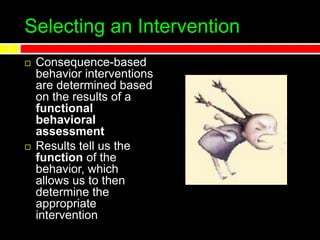
Selecting an Intervention
 Consequence-based
behavior interventions
are determined based
on the results of a
functional
behavioral
assessment
 Results tell us the
function of the
behavior, which
allows us to then
determine the
appropriate
intervention
4
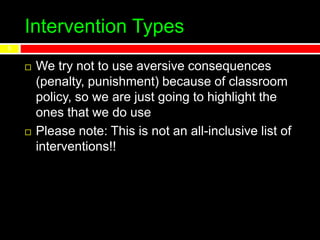
Intervention Types
5
 We try not to use aversive consequences
(penalty, punishment) because of classroom
policy, so we are just going to highlight the
ones that we do use
 Please note: This is not an all-inclusive list of
interventions!!
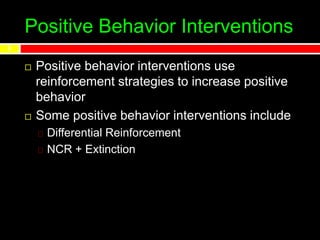
Positive Behavior Interventions
6
 Positive behavior interventions use
reinforcement strategies to increase positive
behavior
 Some positive behavior interventions include
Differential Reinforcement
NCR + Extinction
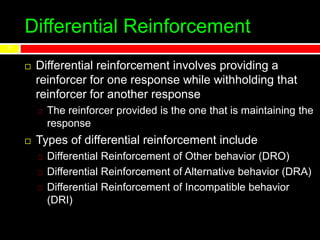
Differential Reinforcement
7
 Differential reinforcement involves providing a
reinforcer for one response while withholding that
reinforcer for another response
The reinforcer provided is the one that is maintaining the
response
 Types of differential reinforcement include
Differential Reinforcement of Other behavior (DRO)
Differential Reinforcement of Alternative behavior (DRA)
Differential Reinforcement of Incompatible behavior
(DRI)
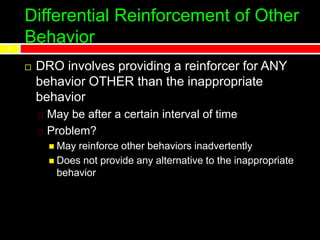
Differential Reinforcement of Other
Behavior8
 DRO involves providing a reinforcer for ANY
behavior OTHER than the inappropriate
behavior
May be after a certain interval of time
Problem?
 May reinforce other behaviors inadvertently
 Does not provide any alternative to the inappropriate
behavior
Differential Reinforcement of
Alternative Behavior9
 DRA involves providing a reinforcer for a
desirable, alternative behavior, and
withholding reinforcement for the inappropriate
behavior
Focuses on teaching behaviors that are more
adaptive than, but serve the same function as, the
problem behavior
Examples of a DRA
 Using a PECS exchange, rather than tantrumming to
gain access to a reinforcer
Differential Reinforcement of
Incompatible Behavior10
 DRI involves reinforcing behavior that makes it
physically impossible to engage in the
inappropriate behavior
For example, if a child puts their hands in their
pockets, they cannot slap their peers
NCR + Extinction
11
 Non-contingent reinforcement involves
presenting a reinforcer on a fixed- or variable-
time interval, independent of behavior
This is an antecedent intervention
 Along with NCR, we also use extinction for the
inappropriate behavior
Extinction involves removing the reinforcement or
escape contingency for a previously reinforced
response
Also referred to as planned ignoring
Interventions
12
 We often use antecedent and consequence-
based interventions together to decrease the
probability that inappropriate behaviors will
occur
What does this mean for your
child?13
 Some of your children may have one of the
positive behavior interventions currently in
place
If you feel one would be appropriate for your
child, talk to their support coordinator

Consequence Interventions

  • 1.
  • 2.
    Consequences  Consequences arestimuli that are presented or removed contingent on the occurrence of behavior Reinforcers Aversive Stimuli  The delivery of these consequences determine the type of contingency controlling the behavior 2
  • 3.
    Consequence-Based Interventions  Consequence-basedinterventions decrease the likelihood that an inappropriate behavior will occur again  Consequence-based interventions decrease or eliminate inappropriate behavior by altering the controlling contingency 3
  • 4.
    Selecting an Intervention Consequence-based behavior interventions are determined based on the results of a functional behavioral assessment  Results tell us the function of the behavior, which allows us to then determine the appropriate intervention 4
  • 5.
    Intervention Types 5  Wetry not to use aversive consequences (penalty, punishment) because of classroom policy, so we are just going to highlight the ones that we do use  Please note: This is not an all-inclusive list of interventions!!
  • 6.
    Positive Behavior Interventions 6 Positive behavior interventions use reinforcement strategies to increase positive behavior  Some positive behavior interventions include Differential Reinforcement NCR + Extinction
  • 7.
    Differential Reinforcement 7  Differentialreinforcement involves providing a reinforcer for one response while withholding that reinforcer for another response The reinforcer provided is the one that is maintaining the response  Types of differential reinforcement include Differential Reinforcement of Other behavior (DRO) Differential Reinforcement of Alternative behavior (DRA) Differential Reinforcement of Incompatible behavior (DRI)
  • 8.
    Differential Reinforcement ofOther Behavior8  DRO involves providing a reinforcer for ANY behavior OTHER than the inappropriate behavior May be after a certain interval of time Problem?  May reinforce other behaviors inadvertently  Does not provide any alternative to the inappropriate behavior
  • 9.
    Differential Reinforcement of AlternativeBehavior9  DRA involves providing a reinforcer for a desirable, alternative behavior, and withholding reinforcement for the inappropriate behavior Focuses on teaching behaviors that are more adaptive than, but serve the same function as, the problem behavior Examples of a DRA  Using a PECS exchange, rather than tantrumming to gain access to a reinforcer
  • 10.
    Differential Reinforcement of IncompatibleBehavior10  DRI involves reinforcing behavior that makes it physically impossible to engage in the inappropriate behavior For example, if a child puts their hands in their pockets, they cannot slap their peers
  • 11.
    NCR + Extinction 11 Non-contingent reinforcement involves presenting a reinforcer on a fixed- or variable- time interval, independent of behavior This is an antecedent intervention  Along with NCR, we also use extinction for the inappropriate behavior Extinction involves removing the reinforcement or escape contingency for a previously reinforced response Also referred to as planned ignoring
  • 12.
    Interventions 12  We oftenuse antecedent and consequence- based interventions together to decrease the probability that inappropriate behaviors will occur
  • 13.
    What does thismean for your child?13  Some of your children may have one of the positive behavior interventions currently in place If you feel one would be appropriate for your child, talk to their support coordinator