Optics
Sanjeev Kumar Singh
Aperture stop
Any element, be it the rim of a lens or a separate diaphragm,
that determines the amount of light reaching the image is
known as the aperture stop (abbreviated A.S.)
Entrance and Exit Pupils
The entrance pupil of a system is the image of the aperture stop as seen from
an axial point on the object looking through those elements preceding the
stop.
Entrance Pupils
Exit Pupils
Exit pupil is the image of the A.S. as seen from an axial point on the image looking
through the interposed lenses, if there are any.
Chief Ray
It is defined to be any ray from an off-axis object point that passes through the center of
the aperture stop. The chief ray enters the optical system along a line directed toward
the midpoint of the entrance pupil, Enp, and leaves the system along a line passing
through the center of the exit pupil, Exp.
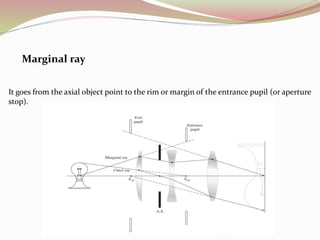
Marginal ray
It goes from the axial object point to the rim or margin of the entrance pupil (or aperture
stop).
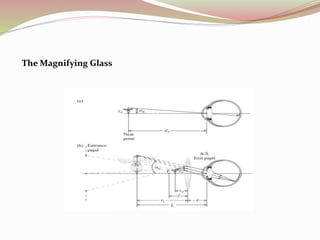
The Magnifying Glass
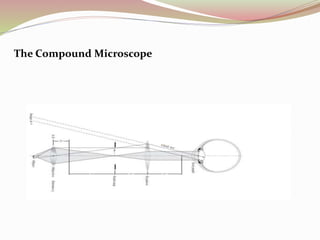
The Compound Microscope
Aberrations
There are two main types: chromatic aberrations (which arise from the fact
that n is actually a function of frequency or color) and monochromatic
aberrations.
There are monochromatic aberrations such as spherical aberration, coma, and
astigmatism that deteriorate the image, making it unclear.
Monochromatic Aberrations
•Spherical Aberration
spherical aberration, or SA, corresponds to a dependence of focal length
on aperture for nonparaxial rays.
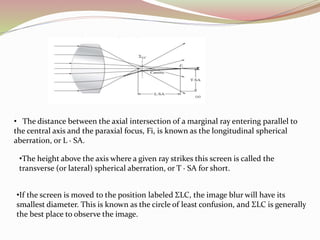
• The distance between the axial intersection of a marginal ray entering parallel to
the central axis and the paraxial focus, Fi, is known as the longitudinal spherical
aberration, or L · SA.
•The height above the axis where a given ray strikes this screen is called the
transverse (or lateral) spherical aberration, or T · SA for short.
•If the screen is moved to the position labeled ΣLC, the image blur will have its
smallest diameter. This is known as the circle of least confusion, and ΣLC is generally
the best place to observe the image.
Coma, or comatic aberration, is an image-degrading, monochromatic, primary
aberration associated with an object point even a short distance from the axis.
Coma
Astigmatism
When an object point lies an appreciable distance from the optical axis, the incident
cone of rays will strike the lens asymmetrically, giving rise to a third primary aberration
known as astigmatism.
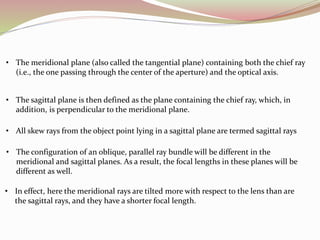
• The meridional plane (also called the tangential plane) containing both the chief ray
(i.e., the one passing through the center of the aperture) and the optical axis.
• The sagittal plane is then defined as the plane containing the chief ray, which, in
addition, is perpendicular to the meridional plane.
• All skew rays from the object point lying in a sagittal plane are termed sagittal rays
• The configuration of an oblique, parallel ray bundle will be different in the
meridional and sagittal planes. As a result, the focal lengths in these planes will be
different as well.
• In effect, here the meridional rays are tilted more with respect to the lens than are
the sagittal rays, and they have a shorter focal length.
• This astigmatic difference, as it is often called, increases rapidly as the rays become more
oblique, that is, as the object point moves farther off the axis, and is, of course, zero on
axis.
Chromatic Aberrations
• The axial distance between two such focal points spanning a given frequency range
(e.g., blue to red) is termed the axial (or longitudinal) chromatic aberration, A · CA
for short.
• The vertical distance between two such image points (most often taken to be blue and
red) is a measure of the lateral chromatic aberration, L · CA, or lateral color.

Ray optics

  • 1.
  • 2.
    Aperture stop Any element,be it the rim of a lens or a separate diaphragm, that determines the amount of light reaching the image is known as the aperture stop (abbreviated A.S.)
  • 3.
    Entrance and ExitPupils The entrance pupil of a system is the image of the aperture stop as seen from an axial point on the object looking through those elements preceding the stop. Entrance Pupils
  • 4.
    Exit Pupils Exit pupilis the image of the A.S. as seen from an axial point on the image looking through the interposed lenses, if there are any.
  • 5.
    Chief Ray It isdefined to be any ray from an off-axis object point that passes through the center of the aperture stop. The chief ray enters the optical system along a line directed toward the midpoint of the entrance pupil, Enp, and leaves the system along a line passing through the center of the exit pupil, Exp.
  • 6.
    Marginal ray It goesfrom the axial object point to the rim or margin of the entrance pupil (or aperture stop).
  • 7.
  • 8.
  • 9.
    Aberrations There are twomain types: chromatic aberrations (which arise from the fact that n is actually a function of frequency or color) and monochromatic aberrations. There are monochromatic aberrations such as spherical aberration, coma, and astigmatism that deteriorate the image, making it unclear.
  • 10.
    Monochromatic Aberrations •Spherical Aberration sphericalaberration, or SA, corresponds to a dependence of focal length on aperture for nonparaxial rays.
  • 11.
    • The distancebetween the axial intersection of a marginal ray entering parallel to the central axis and the paraxial focus, Fi, is known as the longitudinal spherical aberration, or L · SA. •The height above the axis where a given ray strikes this screen is called the transverse (or lateral) spherical aberration, or T · SA for short. •If the screen is moved to the position labeled ΣLC, the image blur will have its smallest diameter. This is known as the circle of least confusion, and ΣLC is generally the best place to observe the image.
  • 12.
    Coma, or comaticaberration, is an image-degrading, monochromatic, primary aberration associated with an object point even a short distance from the axis. Coma
  • 13.
    Astigmatism When an objectpoint lies an appreciable distance from the optical axis, the incident cone of rays will strike the lens asymmetrically, giving rise to a third primary aberration known as astigmatism.
  • 14.
    • The meridionalplane (also called the tangential plane) containing both the chief ray (i.e., the one passing through the center of the aperture) and the optical axis. • The sagittal plane is then defined as the plane containing the chief ray, which, in addition, is perpendicular to the meridional plane. • All skew rays from the object point lying in a sagittal plane are termed sagittal rays • The configuration of an oblique, parallel ray bundle will be different in the meridional and sagittal planes. As a result, the focal lengths in these planes will be different as well. • In effect, here the meridional rays are tilted more with respect to the lens than are the sagittal rays, and they have a shorter focal length.
  • 15.
    • This astigmaticdifference, as it is often called, increases rapidly as the rays become more oblique, that is, as the object point moves farther off the axis, and is, of course, zero on axis.
  • 16.
    Chromatic Aberrations • Theaxial distance between two such focal points spanning a given frequency range (e.g., blue to red) is termed the axial (or longitudinal) chromatic aberration, A · CA for short.
  • 17.
    • The verticaldistance between two such image points (most often taken to be blue and red) is a measure of the lateral chromatic aberration, L · CA, or lateral color.