Internet Addressing
A Technical Overview
David R. Conrad
drc@isc.org
Internet Software Consortium
Overview
Background
Internet Address History
Internet Address Allocators
Conclusions
Addresses -- How to get here from there
Addresses provide information on how to
locate something, e.g., what route to take
from here to there.
Internet addresses combine
– a routing portion, known as the network part
– a name portion known as the host part
How to split an Internet address into the
network part and the host part has changed
over time…
The Beginning
Back when the TCP/IP protocols were first
being designed, there was a big argument
between fixed length and variable length
addresses
– Fixed length will always be limited
• But if you make it big enough, no one will notice
– Variable length will always take more cycles to
process
• But there are tricks you can play to minimize the
difference
The decision was made for fixed, 32 bit
addresses
– Rumor has it, by a flip of a coin...
IP version 4 Addresses
32 bit unsigned integers
– possible values 0 - 4,294,967,295
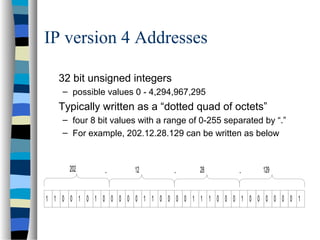
Typically written as a “dotted quad of octets”
– four 8 bit values with a range of 0-255 separated by “.”
– For example, 202.12.28.129 can be written as below
202
1 1 0 0 1 0 1 0 0 0 0 0 1 1 0 0 0 0 1 1 1 0 0 0 1 0 0 0 0 0 0 1
12 28 129. . .
Internet Addresses
A subset of IPv4 addresses
– One of an infinite number
Guaranteed globally unique by the IANA
– Generally allocated by delegated authorities such as Internet
service providers or regional registries
– Assumed to be routable
• Bad assumption
Partitioned into two parts
– A host part that identifies a particular machine on a local or
wide area network
– A network part that gives routers information how to get to
the local or wide area network via the Internet
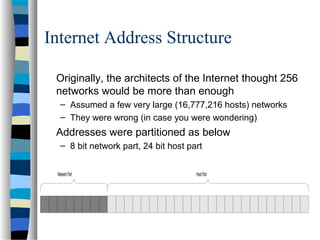
Internet Address Structure
Originally, the architects of the Internet thought 256
networks would be more than enough
– Assumed a few very large (16,777,216 hosts) networks
– They were wrong (in case you were wondering)
Addresses were partitioned as below
– 8 bit network part, 24 bit host part
NetworkPart HostPart
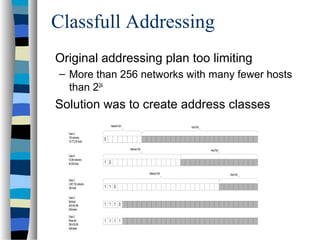
Classfull Addressing
Original addressing plan too limiting
– More than 256 networks with many fewer hosts
than 224
Solution was to create address classes
NetworkPart Host Part
0
Network Part HostPart
1 0
NetworkPart HostPart
1 1 0
1 1 1 0
1 1 1 1
ClassA
128networks
16,777,216 hosts
ClassB
16,384networks
65,536hosts
ClassC
2,097,152networks
256hosts
ClassD
Multicast
268,435,456
Addresses
ClassE
Reserved
268,435,456
Addresses
The Problem
Class A way too big
– 16 million hosts in a flat network is unthinkable
Class B too big
– Even 65536 host addresses is too many in most
cases
• Imagine 65534 hosts all responding to a broadcast
Class C too small
– Most sites initially connecting to the Internet were
large Universities, 256 was too small for them
Need more flexibility!
Subnetting
Classfull addressing was a better fit than
original
– but class A and B networks impossible to manage
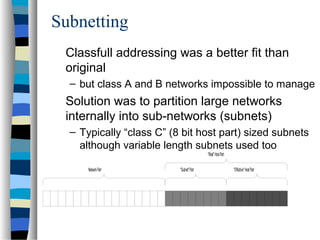
Solution was to partition large networks
internally into sub-networks (subnets)
– Typically “class C” (8 bit host part) sized subnets
although variable length subnets used too
"Real"HostPart
"Subnet"PartNetworkPart "Effective"HostPart
Classless Addressing
Forget what I just told you
– Classfull addressing is officially “Bad”™
• 3 sizes just don’t fit all -- very wasteful
Better solution is to use variable length partitioning
between the host and network parts
– Actual partitioning for a site provided by routing protocol
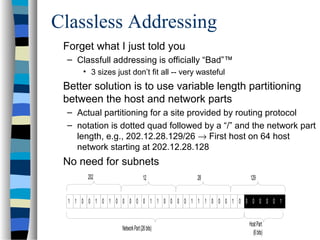
– notation is dotted quad followed by a “/” and the network part
length, e.g., 202.12.28.129/26 → First host on 64 host
network starting at 202.12.28.128
No need for subnets
202
1 1 0 0 1 0 1 0 0 0 0 0 1 1 0 0 0 0 1 1 1 0 0 0 1 0 0 0 0 0 0 1
12 28 129
NetworkPart(26bits)
HostPart
(6bits)
Example of Classless Addressing
2 0 2 .1 2 .2 8 .0 /2 5
1 2 8 h o s ts
2 0 2 .1 2 .2 8 .1 2 8 /2 6
6 4 h o s ts
2 0 2 .1 2 .2 8 .1 9 2 /2 6
6 4 h o s ts
2 0 2 .1 2 .2 8 .1 2 8 /2 5
1 2 8 h o s ts
2 0 2 .1 2 .2 8 .0 /2 4
2 5 6 h o s ts
2 0 2 .1 2 .2 9 .0 /2 4
2 5 6 h o s ts
2 0 2 .1 2 .2 8 .0 /2 3
5 1 2 h o s ts
2 0 2 .1 2 .3 0 .0 /2 4
2 5 6 h o s ts
2 0 2 .1 2 .3 1 .0 /2 5
1 2 8 h o s ts
2 0 2 .1 2 .3 1 .1 2 8 /2 5
1 2 8 h o s ts
2 0 2 .1 2 .3 1 .0 /2 4
2 5 6 h o s ts
2 0 2 .1 2 .2 8 .3 0 /2 3
5 1 2 h o s ts
2 0 2 .1 2 .2 8 .0 /2 2
1 0 2 4 h o s ts
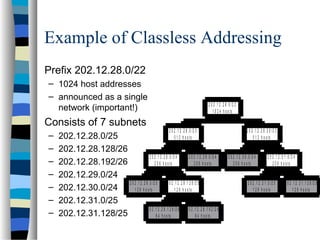
Prefix 202.12.28.0/22
– 1024 host addresses
– announced as a single
network (important!)
Consists of 7 subnets
– 202.12.28.0/25
– 202.12.28.128/26
– 202.12.28.192/26
– 202.12.29.0/24
– 202.12.30.0/24
– 202.12.31.0/25
– 202.12.31.128/25
Summary
Internet addresses are 32 bit fixed
length globally unique numbers
– One subset of all IPv4 address spaces
Internet addresses have evolved over
time to be more flexible and to include
hierarchy
Currently, classless addressing is in use
providing arbitrary host and network
part lengths.

java

  • 1.
    Internet Addressing A TechnicalOverview David R. Conrad drc@isc.org Internet Software Consortium
  • 2.
  • 3.
    Addresses -- Howto get here from there Addresses provide information on how to locate something, e.g., what route to take from here to there. Internet addresses combine – a routing portion, known as the network part – a name portion known as the host part How to split an Internet address into the network part and the host part has changed over time…
  • 4.
    The Beginning Back whenthe TCP/IP protocols were first being designed, there was a big argument between fixed length and variable length addresses – Fixed length will always be limited • But if you make it big enough, no one will notice – Variable length will always take more cycles to process • But there are tricks you can play to minimize the difference The decision was made for fixed, 32 bit addresses – Rumor has it, by a flip of a coin...
  • 5.
    IP version 4Addresses 32 bit unsigned integers – possible values 0 - 4,294,967,295 Typically written as a “dotted quad of octets” – four 8 bit values with a range of 0-255 separated by “.” – For example, 202.12.28.129 can be written as below 202 1 1 0 0 1 0 1 0 0 0 0 0 1 1 0 0 0 0 1 1 1 0 0 0 1 0 0 0 0 0 0 1 12 28 129. . .
  • 6.
    Internet Addresses A subsetof IPv4 addresses – One of an infinite number Guaranteed globally unique by the IANA – Generally allocated by delegated authorities such as Internet service providers or regional registries – Assumed to be routable • Bad assumption Partitioned into two parts – A host part that identifies a particular machine on a local or wide area network – A network part that gives routers information how to get to the local or wide area network via the Internet
  • 7.
    Internet Address Structure Originally,the architects of the Internet thought 256 networks would be more than enough – Assumed a few very large (16,777,216 hosts) networks – They were wrong (in case you were wondering) Addresses were partitioned as below – 8 bit network part, 24 bit host part NetworkPart HostPart
  • 8.
    Classfull Addressing Original addressingplan too limiting – More than 256 networks with many fewer hosts than 224 Solution was to create address classes NetworkPart Host Part 0 Network Part HostPart 1 0 NetworkPart HostPart 1 1 0 1 1 1 0 1 1 1 1 ClassA 128networks 16,777,216 hosts ClassB 16,384networks 65,536hosts ClassC 2,097,152networks 256hosts ClassD Multicast 268,435,456 Addresses ClassE Reserved 268,435,456 Addresses
  • 9.
    The Problem Class Away too big – 16 million hosts in a flat network is unthinkable Class B too big – Even 65536 host addresses is too many in most cases • Imagine 65534 hosts all responding to a broadcast Class C too small – Most sites initially connecting to the Internet were large Universities, 256 was too small for them Need more flexibility!
  • 10.
    Subnetting Classfull addressing wasa better fit than original – but class A and B networks impossible to manage Solution was to partition large networks internally into sub-networks (subnets) – Typically “class C” (8 bit host part) sized subnets although variable length subnets used too "Real"HostPart "Subnet"PartNetworkPart "Effective"HostPart
  • 11.
    Classless Addressing Forget whatI just told you – Classfull addressing is officially “Bad”™ • 3 sizes just don’t fit all -- very wasteful Better solution is to use variable length partitioning between the host and network parts – Actual partitioning for a site provided by routing protocol – notation is dotted quad followed by a “/” and the network part length, e.g., 202.12.28.129/26 → First host on 64 host network starting at 202.12.28.128 No need for subnets 202 1 1 0 0 1 0 1 0 0 0 0 0 1 1 0 0 0 0 1 1 1 0 0 0 1 0 0 0 0 0 0 1 12 28 129 NetworkPart(26bits) HostPart (6bits)
  • 12.
    Example of ClasslessAddressing 2 0 2 .1 2 .2 8 .0 /2 5 1 2 8 h o s ts 2 0 2 .1 2 .2 8 .1 2 8 /2 6 6 4 h o s ts 2 0 2 .1 2 .2 8 .1 9 2 /2 6 6 4 h o s ts 2 0 2 .1 2 .2 8 .1 2 8 /2 5 1 2 8 h o s ts 2 0 2 .1 2 .2 8 .0 /2 4 2 5 6 h o s ts 2 0 2 .1 2 .2 9 .0 /2 4 2 5 6 h o s ts 2 0 2 .1 2 .2 8 .0 /2 3 5 1 2 h o s ts 2 0 2 .1 2 .3 0 .0 /2 4 2 5 6 h o s ts 2 0 2 .1 2 .3 1 .0 /2 5 1 2 8 h o s ts 2 0 2 .1 2 .3 1 .1 2 8 /2 5 1 2 8 h o s ts 2 0 2 .1 2 .3 1 .0 /2 4 2 5 6 h o s ts 2 0 2 .1 2 .2 8 .3 0 /2 3 5 1 2 h o s ts 2 0 2 .1 2 .2 8 .0 /2 2 1 0 2 4 h o s ts Prefix 202.12.28.0/22 – 1024 host addresses – announced as a single network (important!) Consists of 7 subnets – 202.12.28.0/25 – 202.12.28.128/26 – 202.12.28.192/26 – 202.12.29.0/24 – 202.12.30.0/24 – 202.12.31.0/25 – 202.12.31.128/25
  • 13.
    Summary Internet addresses are32 bit fixed length globally unique numbers – One subset of all IPv4 address spaces Internet addresses have evolved over time to be more flexible and to include hierarchy Currently, classless addressing is in use providing arbitrary host and network part lengths.