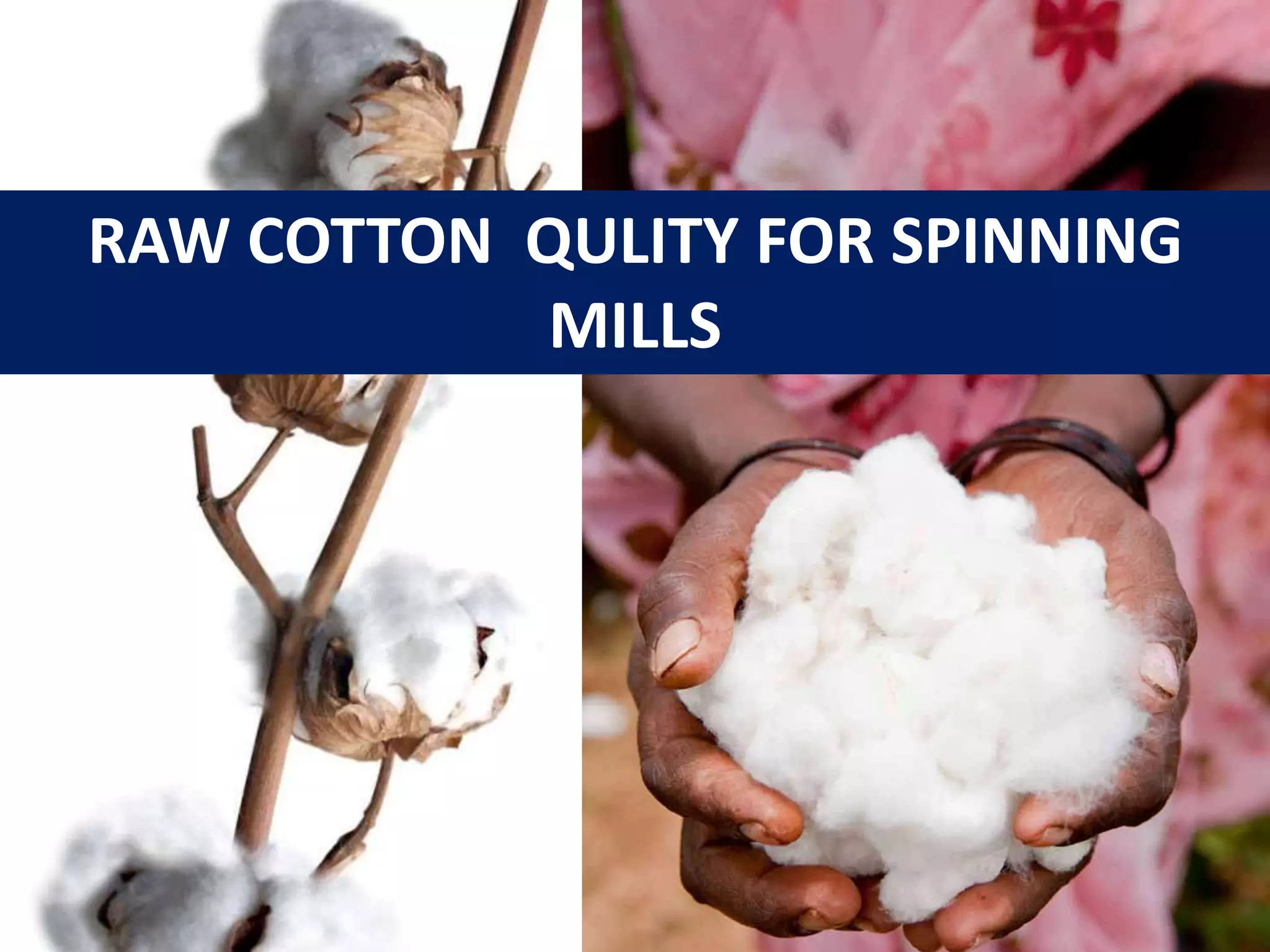

RAW COTTON QULITY FOR SPINNING
MILLS
Prepared By : Mazadul Hasan sheshir
ID: 2010000400008
13th Batch (session 2009-2013)
Department : Wet Processing Technology
Email: mazadulhasan@yahoo.com
Blog : www. Textilelab.blogspot.com (visit)
Southeast University
Department Of Textile Engineering
I/A 251,252 Tejgaon Dhaka Bangladesh
Prepared By :
©right
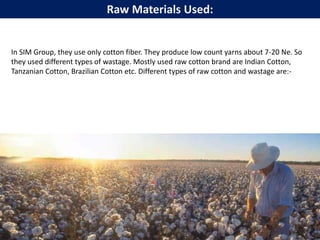
In SIM Group, they use only cotton fiber. They produce low count yarns about 7-20 Ne. So
they used different types of wastage. Mostly used raw cotton brand are Indian Cotton,
Tanzanian Cotton, Brazilian Cotton etc. Different types of raw cotton and wastage are:-
Raw Materials Used:
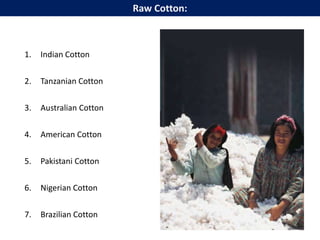
1. Indian Cotton
2. Tanzanian Cotton
3. Australian Cotton
4. American Cotton
5. Pakistani Cotton
6. Nigerian Cotton
7. Brazilian Cotton
Raw Cotton:
1. Doffing-1
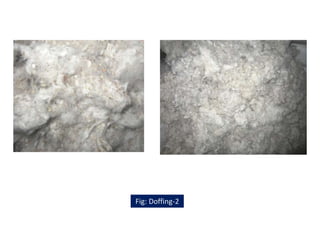
2. Doffing-2
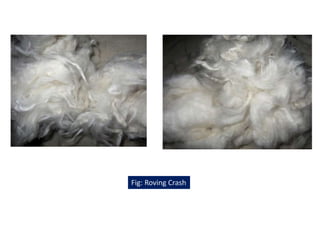
3. Roving Crash
4. Pneumafil
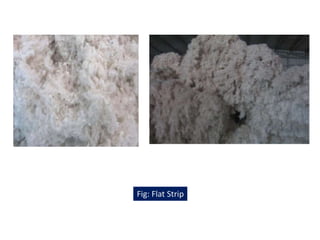
5. Flat Strip
Wastage:
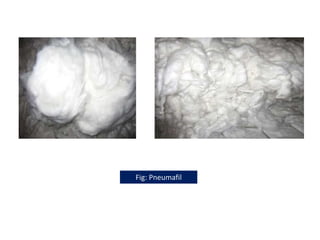
Fig: Pneumafil
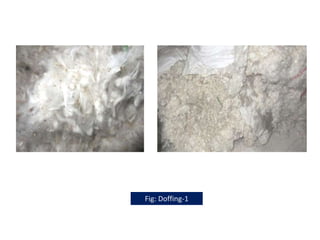
Fig: Doffing-1
Fig: Doffing-2
Fig: Flat Strip
Fig: Roving Crash
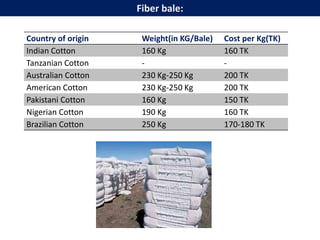
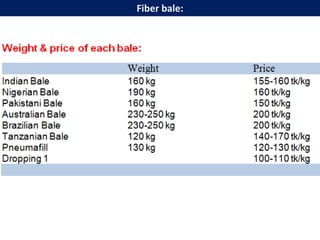
Country of origin Weight(in KG/Bale) Cost per Kg(TK)
Indian Cotton 160 Kg 160 TK
Tanzanian Cotton - -
Australian Cotton 230 Kg-250 Kg 200 TK
American Cotton 230 Kg-250 Kg 200 TK
Pakistani Cotton 160 Kg 150 TK
Nigerian Cotton 190 Kg 160 TK
Brazilian Cotton 250 Kg 170-180 TK
Fiber bale:
Fiber bale:
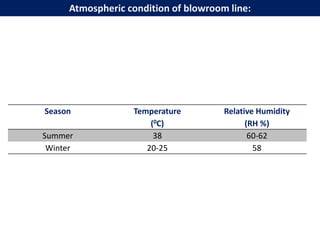
Season Temperature
(0C)
Relative Humidity
(RH %)
Summer 38 60-62
Winter 20-25 58
Atmospheric condition of blowroom line:
PROBLEMS ASSOCIATED WITH PROCESSING OF RAW COTTON FROM DIFFERENT
ORIGIN
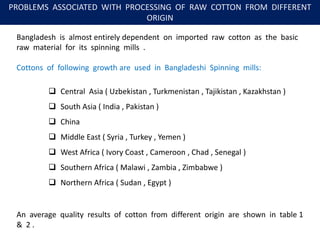
Bangladesh is almost entirely dependent on imported raw cotton as the basic
raw material for its spinning mills .
Cottons of following growth are used in Bangladeshi Spinning mills:
 Central Asia ( Uzbekistan , Turkmenistan , Tajikistan , Kazakhstan )
 South Asia ( India , Pakistan )
 China
 Middle East ( Syria , Turkey , Yemen )
 West Africa ( Ivory Coast , Cameroon , Chad , Senegal )
 Southern Africa ( Malawi , Zambia , Zimbabwe )
 Northern Africa ( Sudan , Egypt )
An average quality results of cotton from different origin are shown in table 1
& 2 .
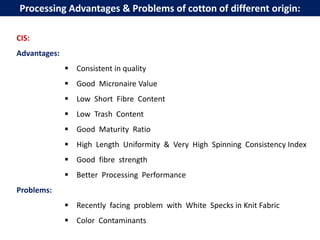
Processing Advantages & Problems of cotton of different origin:
CIS:
Advantages:
 Consistent in quality
 Good Micronaire Value
 Low Short Fibre Content
 Low Trash Content
 Good Maturity Ratio
 High Length Uniformity & Very High Spinning Consistency Index
 Good fibre strength
 Better Processing Performance
Problems:
 Recently facing problem with White Specks in Knit Fabric
 Color Contaminants
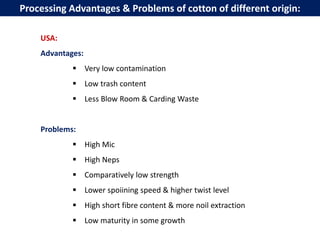
USA:
Advantages:
 Very low contamination
 Low trash content
 Less Blow Room & Carding Waste
Problems:
 High Mic
 High Neps
 Comparatively low strength
 Lower spoiining speed & higher twist level
 High short fibre content & more noil extraction
 Low maturity in some growth
Processing Advantages & Problems of cotton of different origin:
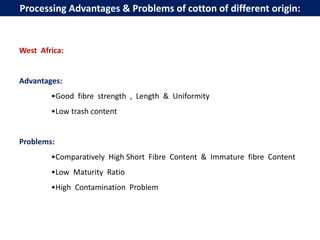
West Africa:
Advantages:
•Good fibre strength , Length & Uniformity
•Low trash content
Problems:
•Comparatively High Short Fibre Content & Immature fibre Content
•Low Maturity Ratio
•High Contamination Problem
Processing Advantages & Problems of cotton of different origin:
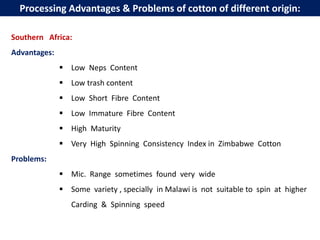
Southern Africa:
Advantages:
 Low Neps Content
 Low trash content
 Low Short Fibre Content
 Low Immature Fibre Content
 High Maturity
 Very High Spinning Consistency Index in Zimbabwe Cotton
Problems:
 Mic. Range sometimes found very wide
 Some variety , specially in Malawi is not suitable to spin at higher
Carding & Spinning speed
Processing Advantages & Problems of cotton of different origin:
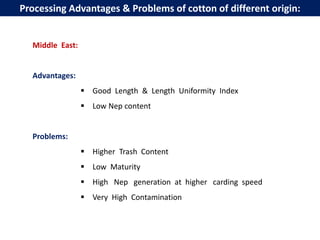
Middle East:
Advantages:
 Good Length & Length Uniformity Index
 Low Nep content
Problems:
 Higher Trash Content
 Low Maturity
 High Nep generation at higher carding speed
 Very High Contamination
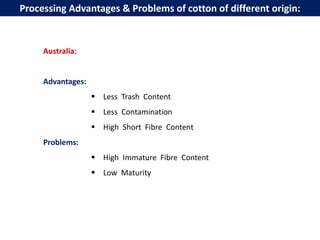
Processing Advantages & Problems of cotton of different origin:
Australia:
Advantages:
 Less Trash Content
 Less Contamination
 High Short Fibre Content
Problems:
 High Immature Fibre Content
 Low Maturity
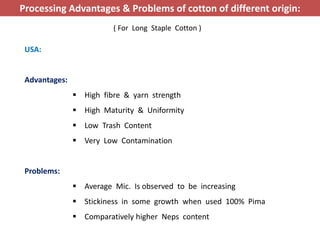
Processing Advantages & Problems of cotton of different origin:
( For Long Staple Cotton )
USA:
Advantages:
 High fibre & yarn strength
 High Maturity & Uniformity
 Low Trash Content
 Very Low Contamination
Problems:
 Average Mic. Is observed to be increasing
 Stickiness in some growth when used 100% Pima
 Comparatively higher Neps content
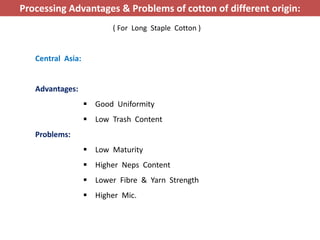
Central Asia:
Advantages:
 Good Uniformity
 Low Trash Content
Problems:
 Low Maturity
 Higher Neps Content
 Lower Fibre & Yarn Strength
 Higher Mic.
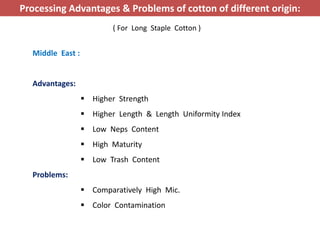
Processing Advantages & Problems of cotton of different origin:
( For Long Staple Cotton )
Middle East :
Advantages:
 Higher Strength
 Higher Length & Length Uniformity Index
 Low Neps Content
 High Maturity
 Low Trash Content
Problems:
 Comparatively High Mic.
 Color Contamination
Processing Advantages & Problems of cotton of different origin:
( For Long Staple Cotton )
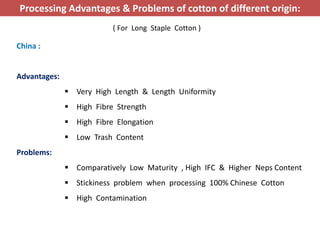
China :
Advantages:
 Very High Length & Length Uniformity
 High Fibre Strength
 High Fibre Elongation
 Low Trash Content
Problems:
 Comparatively Low Maturity , High IFC & Higher Neps Content
 Stickiness problem when processing 100% Chinese Cotton
 High Contamination
Processing Advantages & Problems of cotton of different origin:
( For Long Staple Cotton )
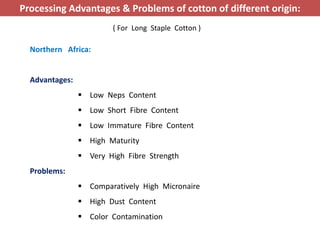
Northern Africa:
Advantages:
 Low Neps Content
 Low Short Fibre Content
 Low Immature Fibre Content
 High Maturity
 Very High Fibre Strength
Problems:
 Comparatively High Micronaire
 High Dust Content
 Color Contamination
Processing Advantages & Problems of cotton of different origin:
( For Long Staple Cotton )
1. Yarn Manufacturing Technology
Link : http://www.facebook.com/pages/Yarn-Manufacturing-Technology/485014954866808
2. Fabric Manufacturing Technology
Link : http://www.facebook.com/pages/Fabric-Manufacturing-Technology/459520217425605
3. Garments Manufacturing Technology
Link : http://www.facebook.com/pages/Garments-Manufacturing-
Technology/472364799463126
3. Wet processing Technology
Link : http://www.facebook.com/pages/Wet-Processing-Technology-Dyeing-/468645219825404
4. Fashion-Design-and-Technology
Link : http://www.facebook.com/pages/Fashion-Design-and-
Technology/587655294583875?ref=ts&fref=ts
My Facebook Textile related Pages
http://www.textilelab.blogspot.com (Visit My Blog for more Info )

Raw matarial

  • 1.
    RAW COTTON QULITYFOR SPINNING MILLS
  • 2.
    Prepared By :Mazadul Hasan sheshir ID: 2010000400008 13th Batch (session 2009-2013) Department : Wet Processing Technology Email: mazadulhasan@yahoo.com Blog : www. Textilelab.blogspot.com (visit) Southeast University Department Of Textile Engineering I/A 251,252 Tejgaon Dhaka Bangladesh Prepared By : ©right
  • 3.
    In SIM Group,they use only cotton fiber. They produce low count yarns about 7-20 Ne. So they used different types of wastage. Mostly used raw cotton brand are Indian Cotton, Tanzanian Cotton, Brazilian Cotton etc. Different types of raw cotton and wastage are:- Raw Materials Used:
  • 4.
    1. Indian Cotton 2.Tanzanian Cotton 3. Australian Cotton 4. American Cotton 5. Pakistani Cotton 6. Nigerian Cotton 7. Brazilian Cotton Raw Cotton:
  • 9.
    1. Doffing-1 2. Doffing-2 3.Roving Crash 4. Pneumafil 5. Flat Strip Wastage:
  • 11.
  • 12.
  • 13.
  • 14.
  • 15.
  • 16.
    Country of originWeight(in KG/Bale) Cost per Kg(TK) Indian Cotton 160 Kg 160 TK Tanzanian Cotton - - Australian Cotton 230 Kg-250 Kg 200 TK American Cotton 230 Kg-250 Kg 200 TK Pakistani Cotton 160 Kg 150 TK Nigerian Cotton 190 Kg 160 TK Brazilian Cotton 250 Kg 170-180 TK Fiber bale:
  • 17.
  • 18.
    Season Temperature (0C) Relative Humidity (RH%) Summer 38 60-62 Winter 20-25 58 Atmospheric condition of blowroom line:
  • 19.
    PROBLEMS ASSOCIATED WITHPROCESSING OF RAW COTTON FROM DIFFERENT ORIGIN Bangladesh is almost entirely dependent on imported raw cotton as the basic raw material for its spinning mills . Cottons of following growth are used in Bangladeshi Spinning mills:  Central Asia ( Uzbekistan , Turkmenistan , Tajikistan , Kazakhstan )  South Asia ( India , Pakistan )  China  Middle East ( Syria , Turkey , Yemen )  West Africa ( Ivory Coast , Cameroon , Chad , Senegal )  Southern Africa ( Malawi , Zambia , Zimbabwe )  Northern Africa ( Sudan , Egypt ) An average quality results of cotton from different origin are shown in table 1 & 2 .
  • 20.
    Processing Advantages &Problems of cotton of different origin: CIS: Advantages:  Consistent in quality  Good Micronaire Value  Low Short Fibre Content  Low Trash Content  Good Maturity Ratio  High Length Uniformity & Very High Spinning Consistency Index  Good fibre strength  Better Processing Performance Problems:  Recently facing problem with White Specks in Knit Fabric  Color Contaminants
  • 21.
    USA: Advantages:  Very lowcontamination  Low trash content  Less Blow Room & Carding Waste Problems:  High Mic  High Neps  Comparatively low strength  Lower spoiining speed & higher twist level  High short fibre content & more noil extraction  Low maturity in some growth Processing Advantages & Problems of cotton of different origin:
  • 22.
    West Africa: Advantages: •Good fibrestrength , Length & Uniformity •Low trash content Problems: •Comparatively High Short Fibre Content & Immature fibre Content •Low Maturity Ratio •High Contamination Problem Processing Advantages & Problems of cotton of different origin:
  • 23.
    Southern Africa: Advantages:  LowNeps Content  Low trash content  Low Short Fibre Content  Low Immature Fibre Content  High Maturity  Very High Spinning Consistency Index in Zimbabwe Cotton Problems:  Mic. Range sometimes found very wide  Some variety , specially in Malawi is not suitable to spin at higher Carding & Spinning speed Processing Advantages & Problems of cotton of different origin:
  • 24.
    Middle East: Advantages:  GoodLength & Length Uniformity Index  Low Nep content Problems:  Higher Trash Content  Low Maturity  High Nep generation at higher carding speed  Very High Contamination Processing Advantages & Problems of cotton of different origin:
  • 25.
    Australia: Advantages:  Less TrashContent  Less Contamination  High Short Fibre Content Problems:  High Immature Fibre Content  Low Maturity Processing Advantages & Problems of cotton of different origin:
  • 26.
    Processing Advantages &Problems of cotton of different origin: ( For Long Staple Cotton ) USA: Advantages:  High fibre & yarn strength  High Maturity & Uniformity  Low Trash Content  Very Low Contamination Problems:  Average Mic. Is observed to be increasing  Stickiness in some growth when used 100% Pima  Comparatively higher Neps content
  • 27.
    Central Asia: Advantages:  GoodUniformity  Low Trash Content Problems:  Low Maturity  Higher Neps Content  Lower Fibre & Yarn Strength  Higher Mic. Processing Advantages & Problems of cotton of different origin: ( For Long Staple Cotton )
  • 28.
    Middle East : Advantages: Higher Strength  Higher Length & Length Uniformity Index  Low Neps Content  High Maturity  Low Trash Content Problems:  Comparatively High Mic.  Color Contamination Processing Advantages & Problems of cotton of different origin: ( For Long Staple Cotton )
  • 29.
    China : Advantages:  VeryHigh Length & Length Uniformity  High Fibre Strength  High Fibre Elongation  Low Trash Content Problems:  Comparatively Low Maturity , High IFC & Higher Neps Content  Stickiness problem when processing 100% Chinese Cotton  High Contamination Processing Advantages & Problems of cotton of different origin: ( For Long Staple Cotton )
  • 30.
    Northern Africa: Advantages:  LowNeps Content  Low Short Fibre Content  Low Immature Fibre Content  High Maturity  Very High Fibre Strength Problems:  Comparatively High Micronaire  High Dust Content  Color Contamination Processing Advantages & Problems of cotton of different origin: ( For Long Staple Cotton )
  • 32.
    1. Yarn ManufacturingTechnology Link : http://www.facebook.com/pages/Yarn-Manufacturing-Technology/485014954866808 2. Fabric Manufacturing Technology Link : http://www.facebook.com/pages/Fabric-Manufacturing-Technology/459520217425605 3. Garments Manufacturing Technology Link : http://www.facebook.com/pages/Garments-Manufacturing- Technology/472364799463126 3. Wet processing Technology Link : http://www.facebook.com/pages/Wet-Processing-Technology-Dyeing-/468645219825404 4. Fashion-Design-and-Technology Link : http://www.facebook.com/pages/Fashion-Design-and- Technology/587655294583875?ref=ts&fref=ts My Facebook Textile related Pages http://www.textilelab.blogspot.com (Visit My Blog for more Info )