General principles of computation of rations for
ruminants – Balanced ration and its characteristics.
Steps in formulating the ration and Thumb rules of
feeding in cattle and buffalo.
Ration:- A ration is the feed offered for a given animal during a period of 24hrs.
The feed may be given at a time or in proportions at intervals
Balance ration:- A balanced ration is one that furnishes nutrients in such
proportions and amounts that it will properly nourish a given animal for 24hr
period.
The required nutrients must be contained in the amount of dry matter, the animal
is able to consume in the 24hr period.
General principles of computation of rations for ruminants
Desirable characteristics of a Ration
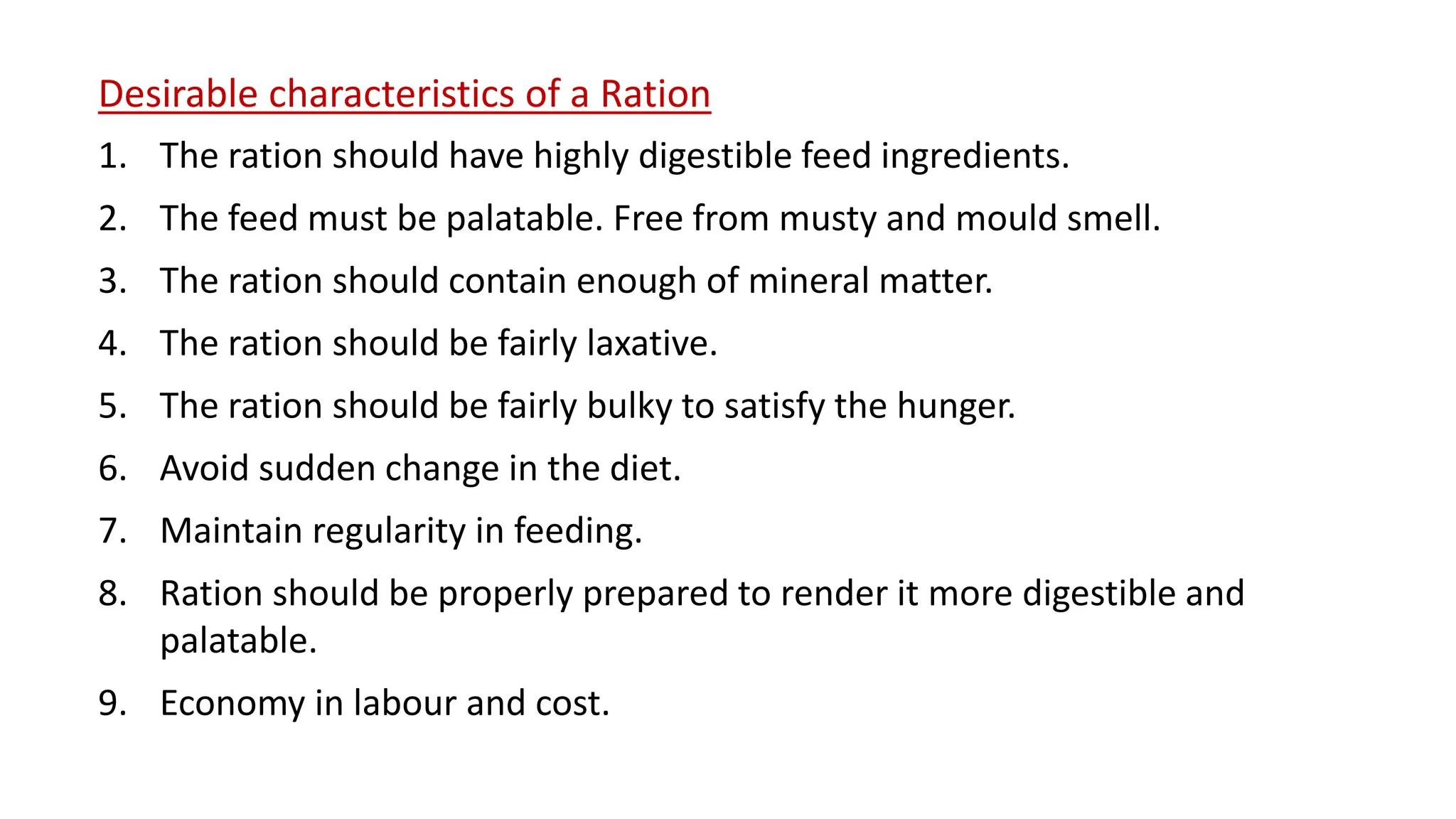
1. The ration should have highly digestible feed ingredients.
2. The feed must be palatable. Free from musty and mould smell.
3. The ration should contain enough of mineral matter.
4. The ration should be fairly laxative.
5. The ration should be fairly bulky to satisfy the hunger.
6. Avoid sudden change in the diet.
7. Maintain regularity in feeding.
8. Ration should be properly prepared to render it more digestible and
palatable.
9. Economy in labour and cost.
Computation of ration for Cattle and buffaloes
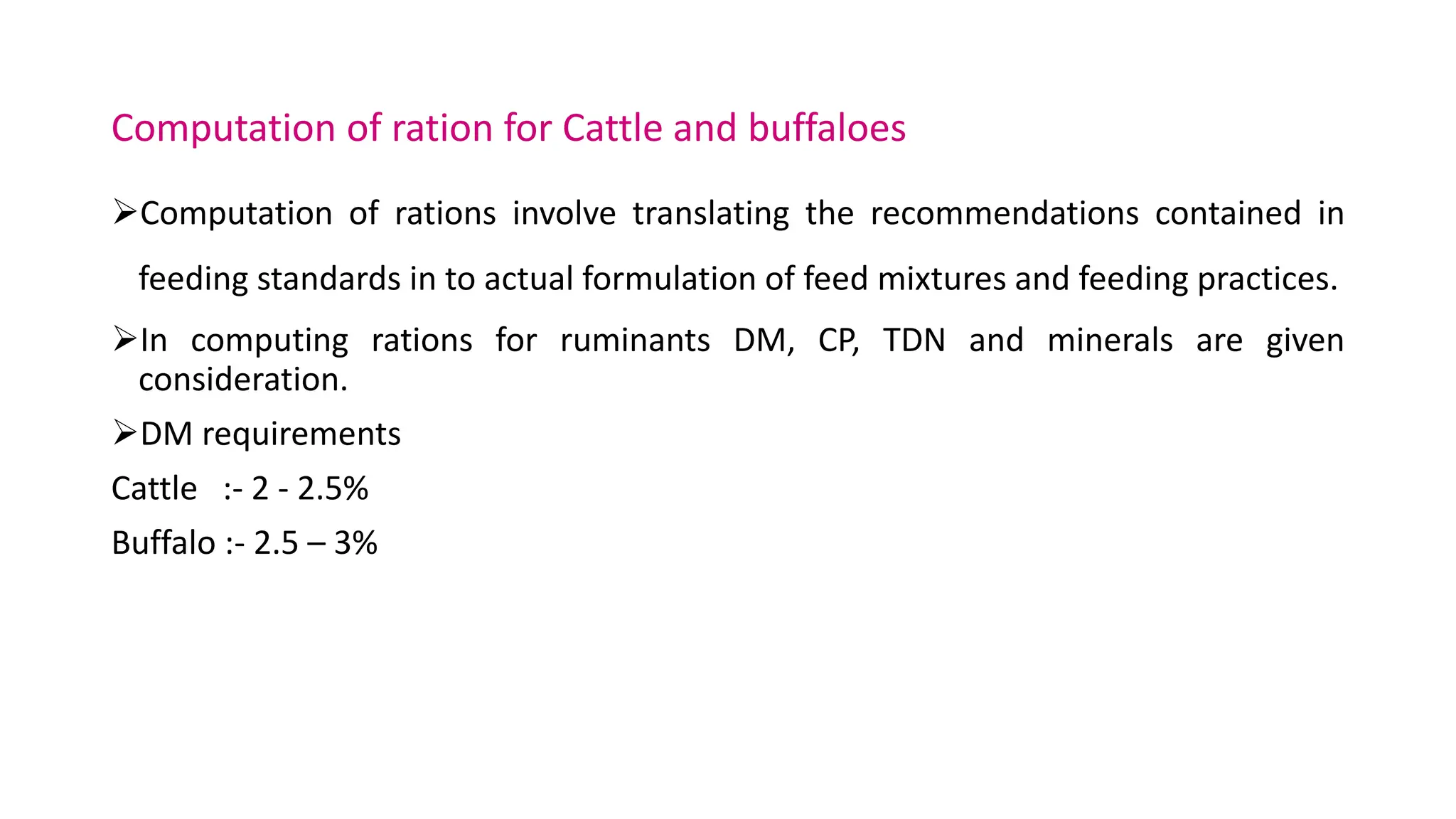
Computation of rations involve translating the recommendations contained in
feeding standards in to actual formulation of feed mixtures and feeding practices.
In computing rations for ruminants DM, CP, TDN and minerals are given
consideration.
DM requirements
Cattle :- 2 - 2.5%
Buffalo :- 2.5 – 3%
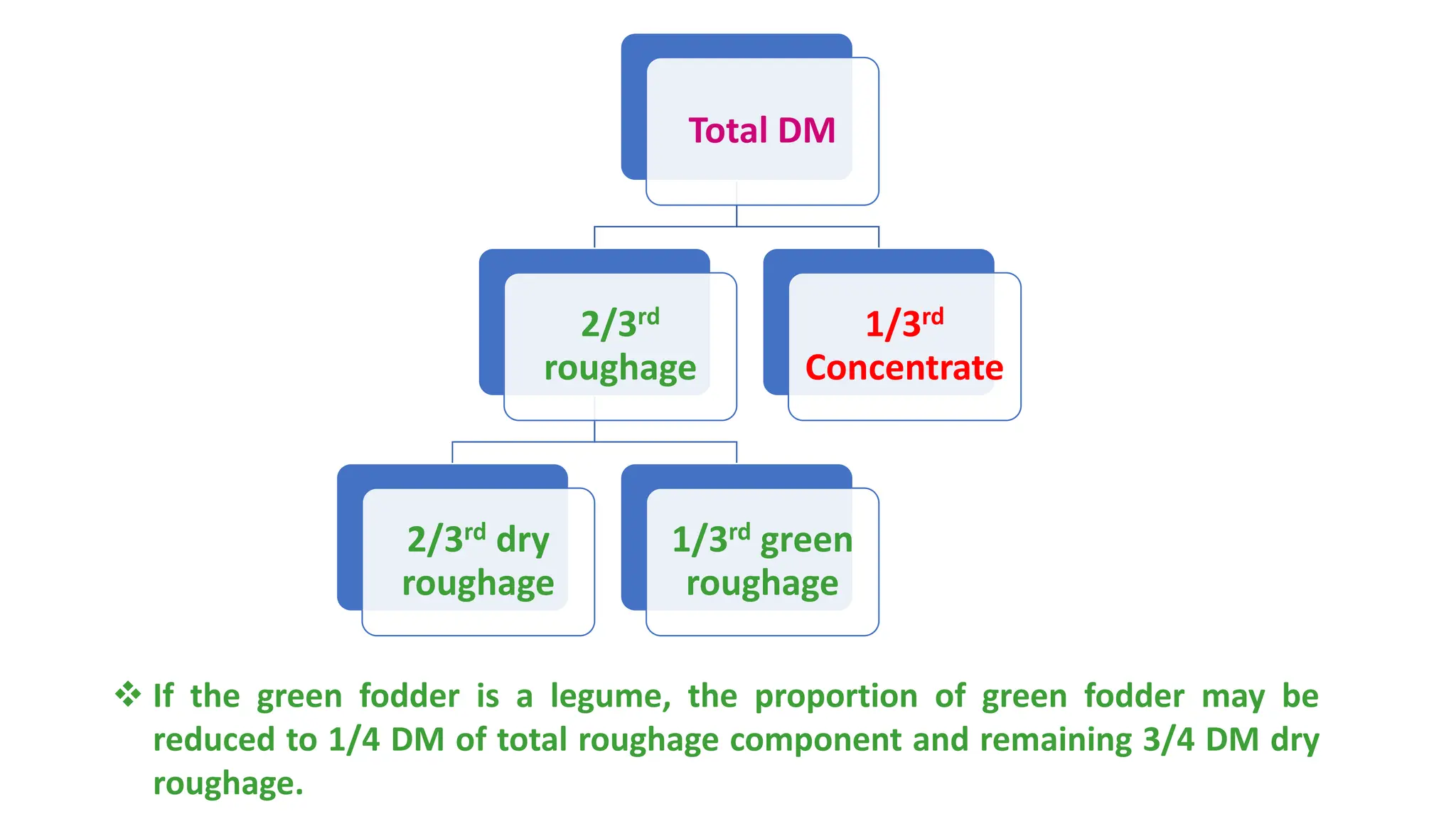
Total DM
2/3rd
roughage
2/3rd dry
roughage
1/3rd green
roughage
1/3rd
Concentrate
 If the green fodder is a legume, the proportion of green fodder may be
reduced to 1/4 DM of total roughage component and remaining 3/4 DM dry
roughage.
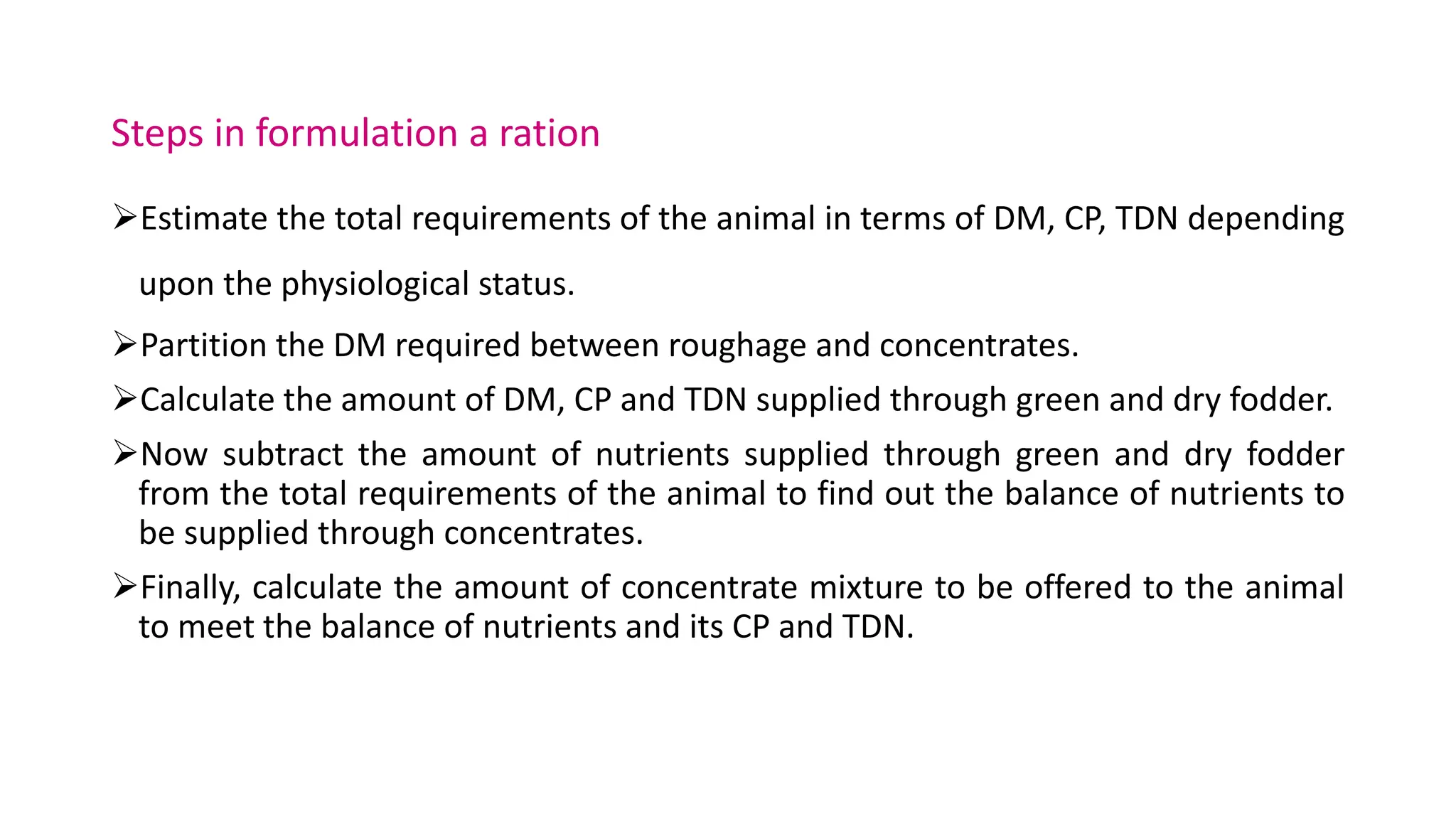
Steps in formulation a ration
Estimate the total requirements of the animal in terms of DM, CP, TDN depending
upon the physiological status.
Partition the DM required between roughage and concentrates.
Calculate the amount of DM, CP and TDN supplied through green and dry fodder.
Now subtract the amount of nutrients supplied through green and dry fodder
from the total requirements of the animal to find out the balance of nutrients to
be supplied through concentrates.
Finally, calculate the amount of concentrate mixture to be offered to the animal
to meet the balance of nutrients and its CP and TDN.
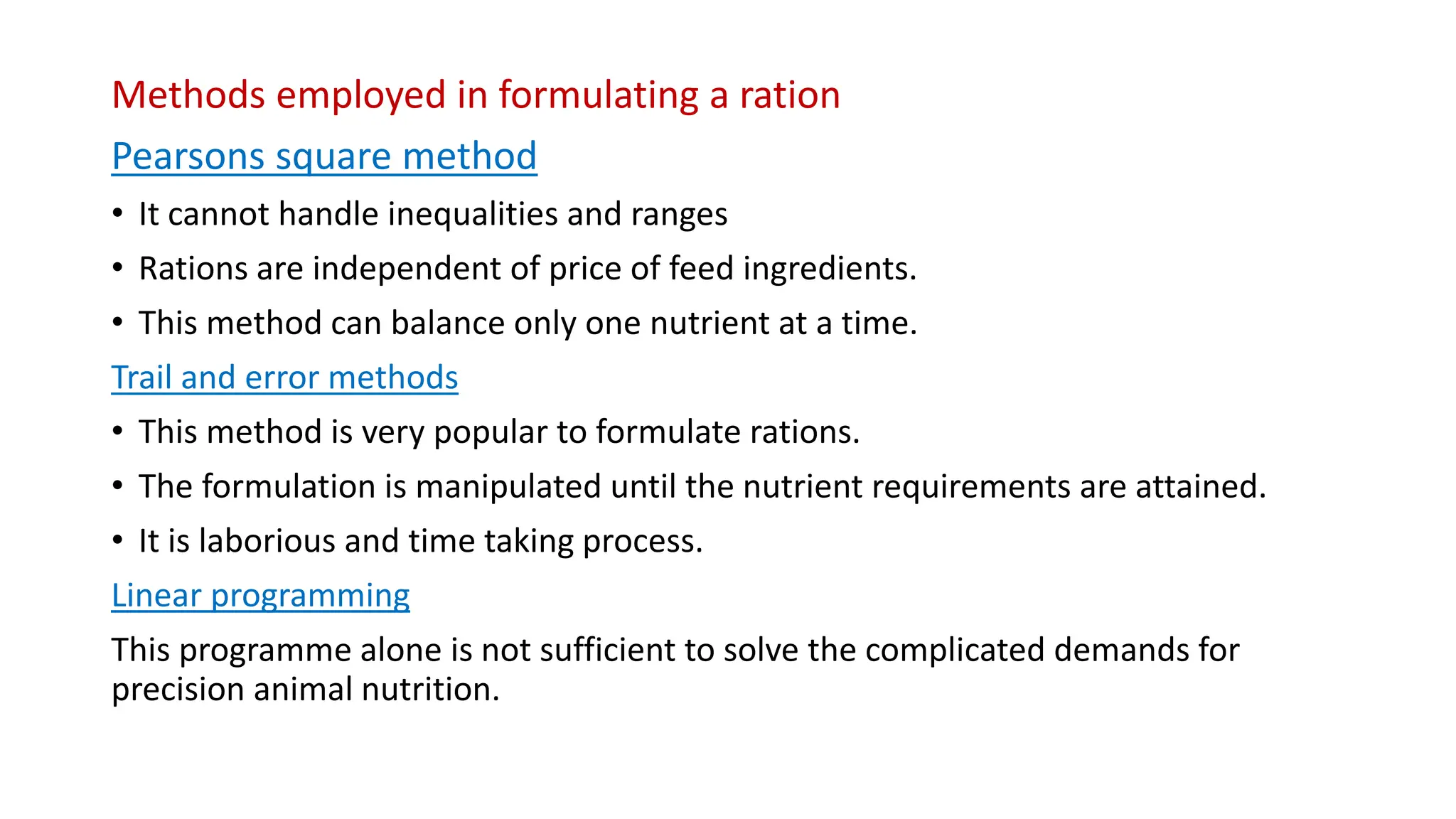
Methods employed in formulating a ration
Pearsons square method
• It cannot handle inequalities and ranges
• Rations are independent of price of feed ingredients.
• This method can balance only one nutrient at a time.
Trail and error methods
• This method is very popular to formulate rations.
• The formulation is manipulated until the nutrient requirements are attained.
• It is laborious and time taking process.
Linear programming
This programme alone is not sufficient to solve the complicated demands for
precision animal nutrition.
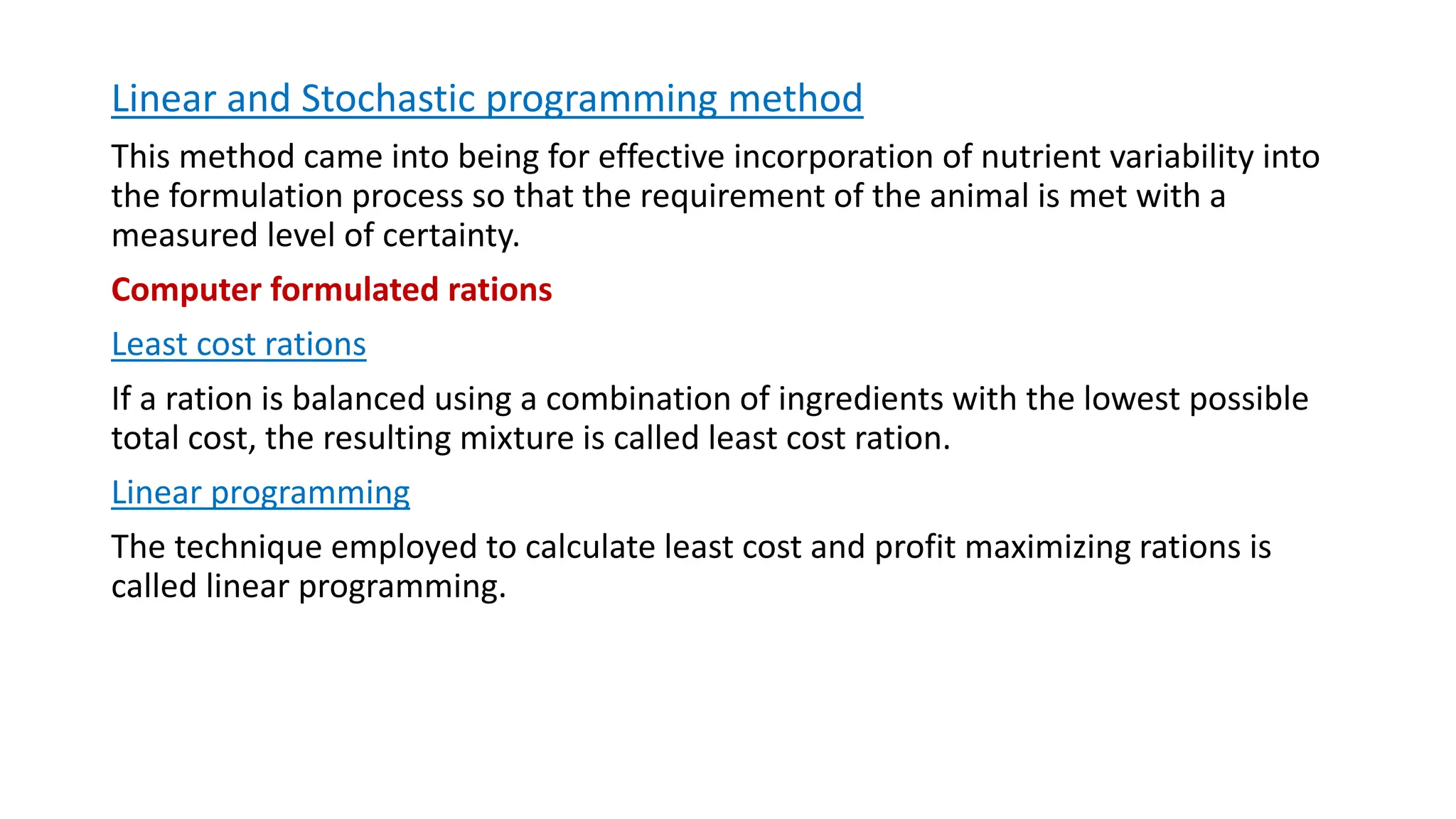
Linear and Stochastic programming method
This method came into being for effective incorporation of nutrient variability into
the formulation process so that the requirement of the animal is met with a
measured level of certainty.
Computer formulated rations
Least cost rations
If a ration is balanced using a combination of ingredients with the lowest possible
total cost, the resulting mixture is called least cost ration.
Linear programming
The technique employed to calculate least cost and profit maximizing rations is
called linear programming.
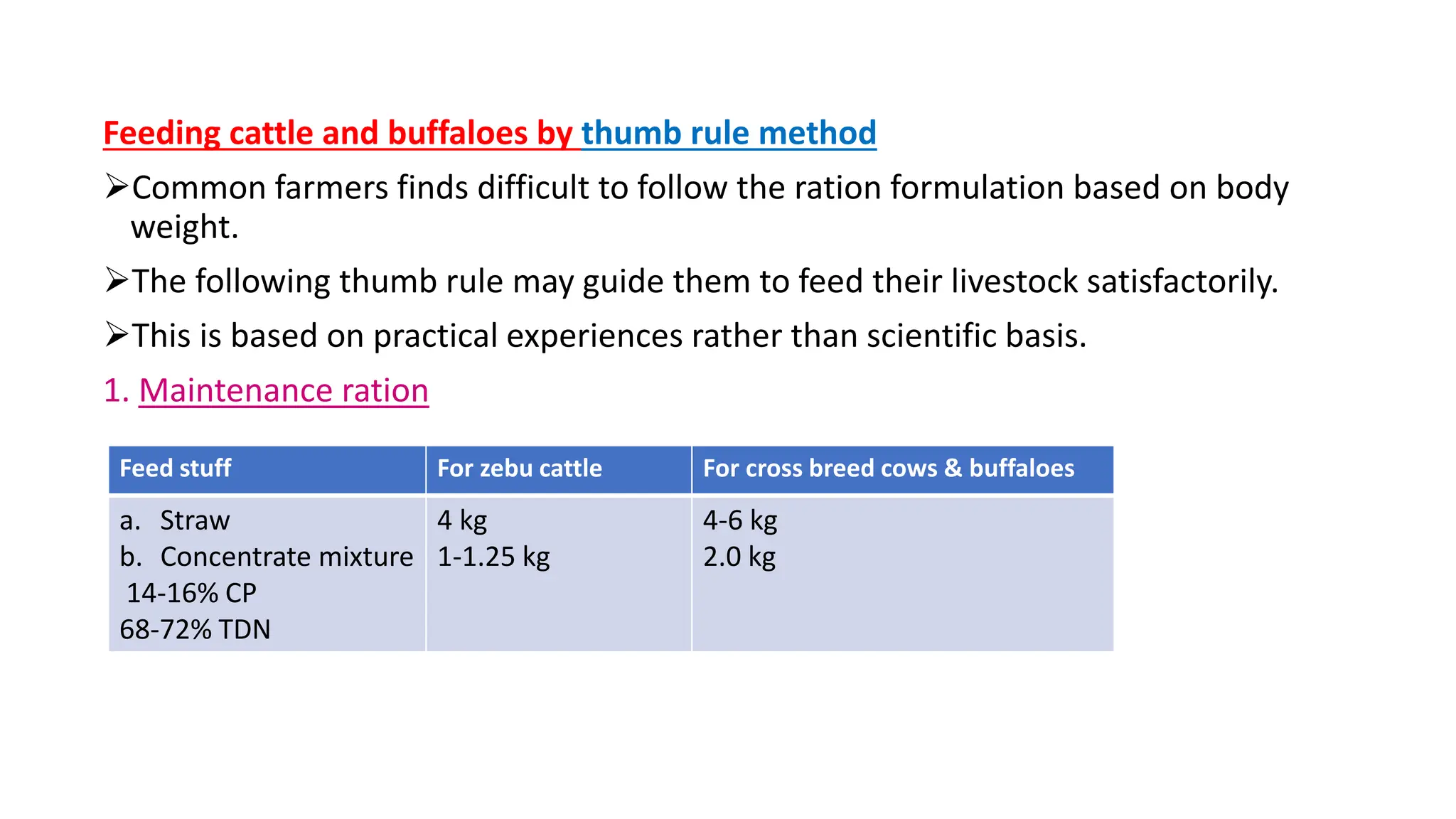
Feeding cattle and buffaloes by thumb rule method
Common farmers finds difficult to follow the ration formulation based on body
weight.
The following thumb rule may guide them to feed their livestock satisfactorily.
This is based on practical experiences rather than scientific basis.
1. Maintenance ration
Feed stuff For zebu cattle For cross breed cows & buffaloes
a. Straw
b. Concentrate mixture
14-16% CP
68-72% TDN
4 kg
1-1.25 kg
4-6 kg
2.0 kg
2. Extra allowances during pregnancy
Last trimester of pregnancy further quantity of 1.25kg for zebu cattle
1.75kg for crossbred cow/ buffalo
3. Extra allowances for milk production
Extra 1 kg concentrate required for every 2.5 kg of milk over and above the
maintenance requirement in case of zebu cattle & 2 kg of milk in case of buffaloes.
The concentrate mixture should have;
CP :- 20%
TDN :- 65%
Ca:- 0.5-0.7%
P:- 0.3-0.4%
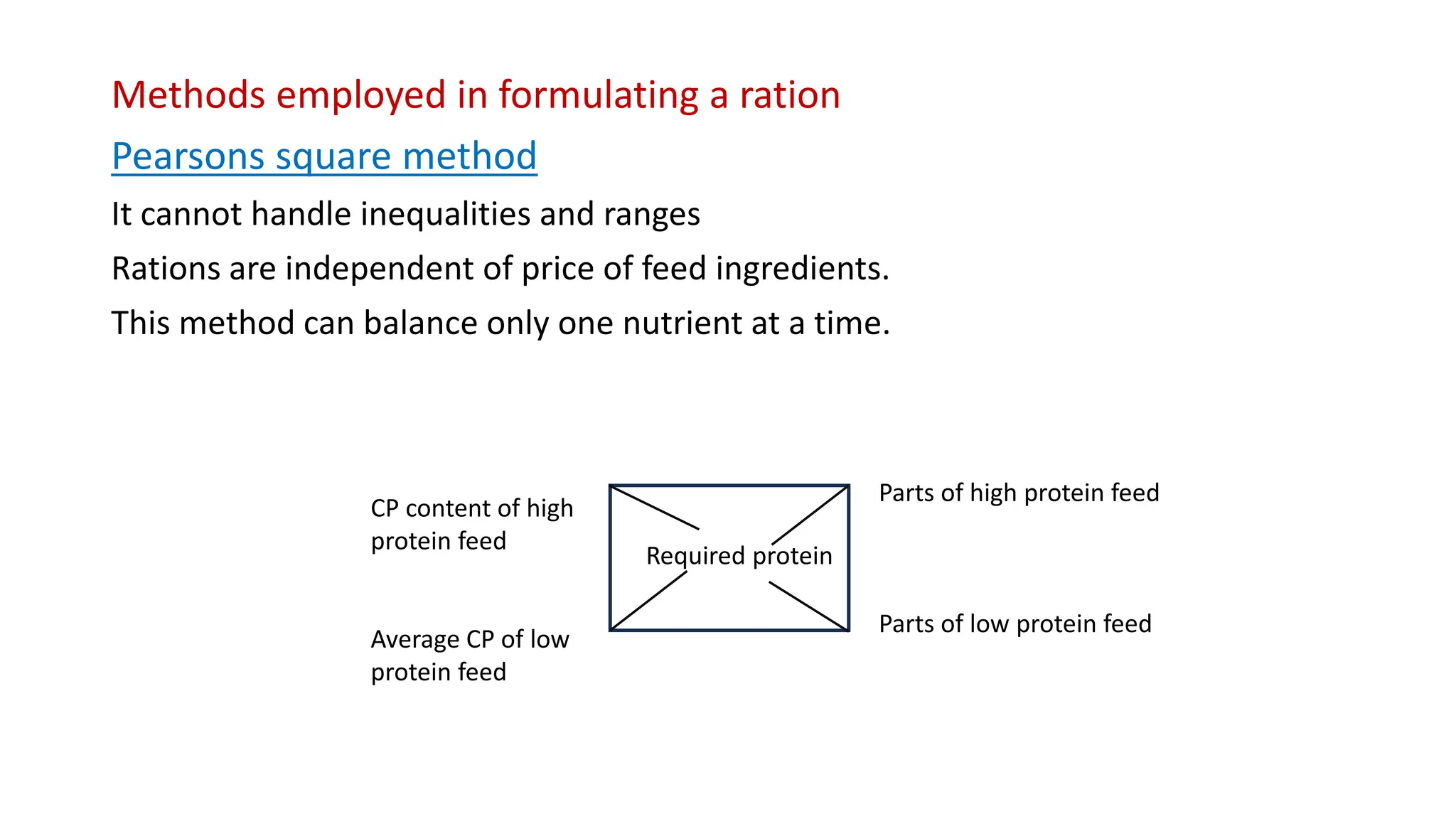
Methods employed in formulating a ration
Pearsons square method
It cannot handle inequalities and ranges
Rations are independent of price of feed ingredients.
This method can balance only one nutrient at a time.
CP content of high
protein feed
Average CP of low
protein feed
Required protein
Parts of high protein feed
Parts of low protein feed
• This is relatively simple and easy to follow. It satisfies only one nutrient requirement and uses
only two feed ingredients.
• The limitation however is that the level of nutrient being computed should be intermediate
between the nutrient concentration of the two feed ingredients being used.
• It is of greatest value when only two ingredients are to be mixed.
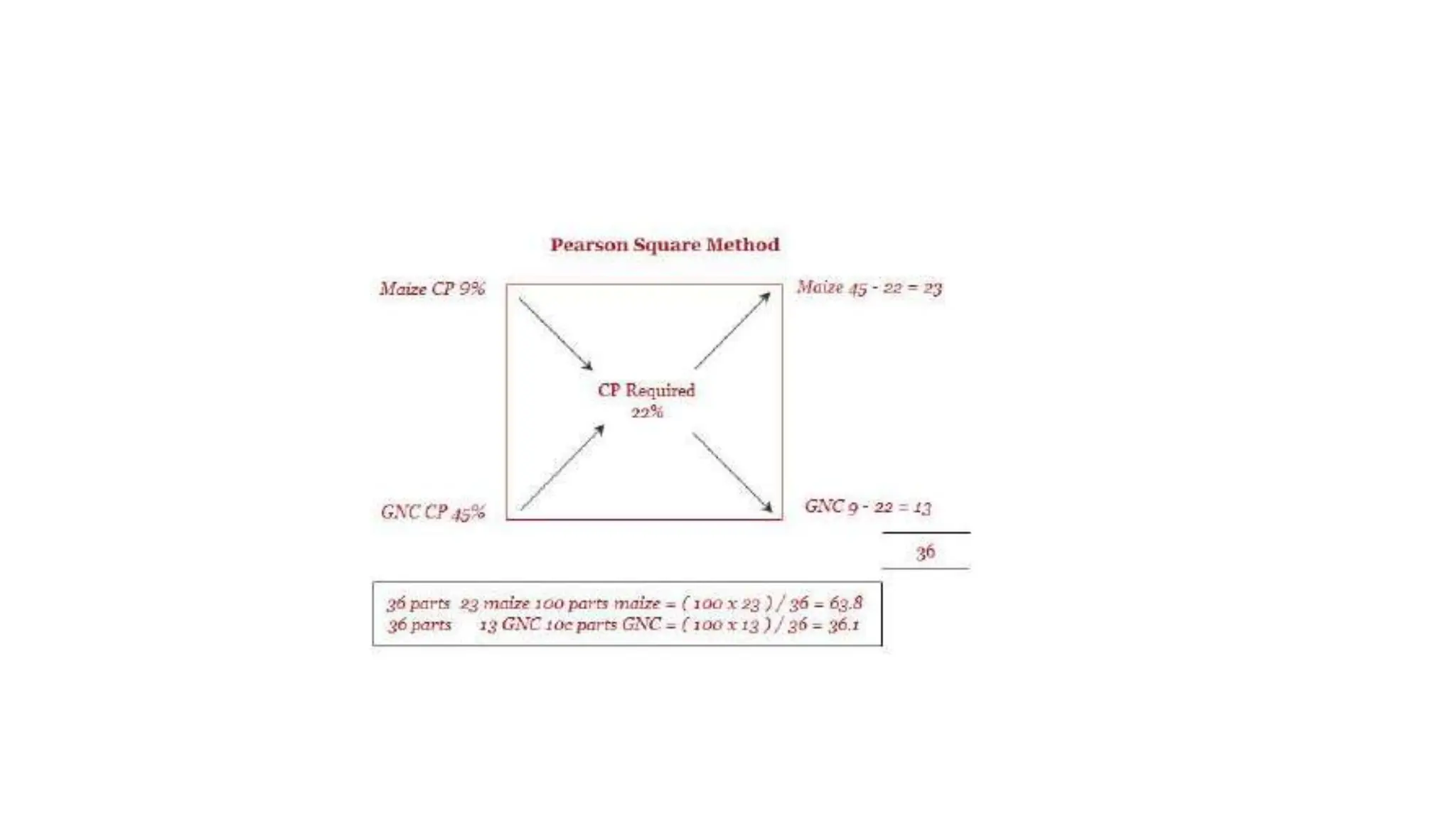
• The nutrient requirement is noted in the middle of the square this value in the middle of the
square must be intermediate between the two values that are used on the left side of the square
which are actually the nutrient content of the two ingredients that are to be used.
• For example, the 14 percent crude protein requirement has to be intermediate between the
soybean meal that has 45 percent crude protein or the maize that has 10 percent crude protein.
• Subtract the nutrient value from the nutritional requirement on the diagonal and arrive at a
numerical value and note it down on the right side of the square.
• Two sets of values will be got.
• By summing those parts and dividing by the total, you can determine the percent of the ration
that each ingredient should represent in order to provide a specific nutrient level.

Principles of computation of rations for ruminants

  • 1.
    General principles ofcomputation of rations for ruminants – Balanced ration and its characteristics. Steps in formulating the ration and Thumb rules of feeding in cattle and buffalo.
  • 2.
    Ration:- A rationis the feed offered for a given animal during a period of 24hrs. The feed may be given at a time or in proportions at intervals Balance ration:- A balanced ration is one that furnishes nutrients in such proportions and amounts that it will properly nourish a given animal for 24hr period. The required nutrients must be contained in the amount of dry matter, the animal is able to consume in the 24hr period. General principles of computation of rations for ruminants
  • 3.
    Desirable characteristics ofa Ration 1. The ration should have highly digestible feed ingredients. 2. The feed must be palatable. Free from musty and mould smell. 3. The ration should contain enough of mineral matter. 4. The ration should be fairly laxative. 5. The ration should be fairly bulky to satisfy the hunger. 6. Avoid sudden change in the diet. 7. Maintain regularity in feeding. 8. Ration should be properly prepared to render it more digestible and palatable. 9. Economy in labour and cost.
  • 4.
    Computation of rationfor Cattle and buffaloes Computation of rations involve translating the recommendations contained in feeding standards in to actual formulation of feed mixtures and feeding practices. In computing rations for ruminants DM, CP, TDN and minerals are given consideration. DM requirements Cattle :- 2 - 2.5% Buffalo :- 2.5 – 3%
  • 5.
    Total DM 2/3rd roughage 2/3rd dry roughage 1/3rdgreen roughage 1/3rd Concentrate  If the green fodder is a legume, the proportion of green fodder may be reduced to 1/4 DM of total roughage component and remaining 3/4 DM dry roughage.
  • 6.
    Steps in formulationa ration Estimate the total requirements of the animal in terms of DM, CP, TDN depending upon the physiological status. Partition the DM required between roughage and concentrates. Calculate the amount of DM, CP and TDN supplied through green and dry fodder. Now subtract the amount of nutrients supplied through green and dry fodder from the total requirements of the animal to find out the balance of nutrients to be supplied through concentrates. Finally, calculate the amount of concentrate mixture to be offered to the animal to meet the balance of nutrients and its CP and TDN.
  • 7.
    Methods employed informulating a ration Pearsons square method • It cannot handle inequalities and ranges • Rations are independent of price of feed ingredients. • This method can balance only one nutrient at a time. Trail and error methods • This method is very popular to formulate rations. • The formulation is manipulated until the nutrient requirements are attained. • It is laborious and time taking process. Linear programming This programme alone is not sufficient to solve the complicated demands for precision animal nutrition.
  • 8.
    Linear and Stochasticprogramming method This method came into being for effective incorporation of nutrient variability into the formulation process so that the requirement of the animal is met with a measured level of certainty. Computer formulated rations Least cost rations If a ration is balanced using a combination of ingredients with the lowest possible total cost, the resulting mixture is called least cost ration. Linear programming The technique employed to calculate least cost and profit maximizing rations is called linear programming.
  • 9.
    Feeding cattle andbuffaloes by thumb rule method Common farmers finds difficult to follow the ration formulation based on body weight. The following thumb rule may guide them to feed their livestock satisfactorily. This is based on practical experiences rather than scientific basis. 1. Maintenance ration Feed stuff For zebu cattle For cross breed cows & buffaloes a. Straw b. Concentrate mixture 14-16% CP 68-72% TDN 4 kg 1-1.25 kg 4-6 kg 2.0 kg
  • 10.
    2. Extra allowancesduring pregnancy Last trimester of pregnancy further quantity of 1.25kg for zebu cattle 1.75kg for crossbred cow/ buffalo 3. Extra allowances for milk production Extra 1 kg concentrate required for every 2.5 kg of milk over and above the maintenance requirement in case of zebu cattle & 2 kg of milk in case of buffaloes. The concentrate mixture should have; CP :- 20% TDN :- 65% Ca:- 0.5-0.7% P:- 0.3-0.4%
  • 11.
    Methods employed informulating a ration Pearsons square method It cannot handle inequalities and ranges Rations are independent of price of feed ingredients. This method can balance only one nutrient at a time. CP content of high protein feed Average CP of low protein feed Required protein Parts of high protein feed Parts of low protein feed
  • 13.
    • This isrelatively simple and easy to follow. It satisfies only one nutrient requirement and uses only two feed ingredients. • The limitation however is that the level of nutrient being computed should be intermediate between the nutrient concentration of the two feed ingredients being used. • It is of greatest value when only two ingredients are to be mixed. • The nutrient requirement is noted in the middle of the square this value in the middle of the square must be intermediate between the two values that are used on the left side of the square which are actually the nutrient content of the two ingredients that are to be used. • For example, the 14 percent crude protein requirement has to be intermediate between the soybean meal that has 45 percent crude protein or the maize that has 10 percent crude protein. • Subtract the nutrient value from the nutritional requirement on the diagonal and arrive at a numerical value and note it down on the right side of the square. • Two sets of values will be got. • By summing those parts and dividing by the total, you can determine the percent of the ration that each ingredient should represent in order to provide a specific nutrient level.