SKILL ASSESSMENT
Dr Amita Maurya
Controller of Examinations
SAGE University, Bhopal
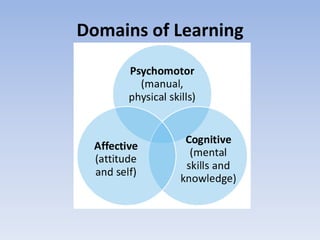
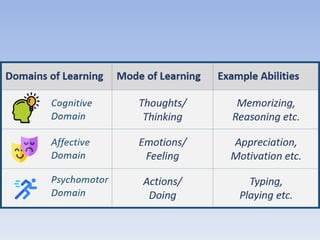
Domains of Learning
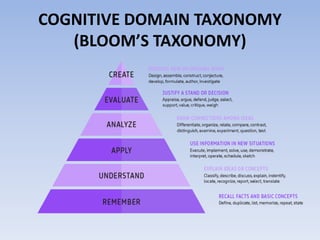
COGNITIVE DOMAIN TAXONOMY
(BLOOM’S TAXONOMY)
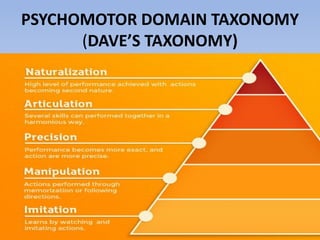
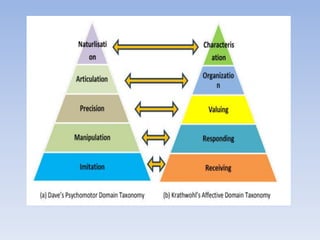
PSYCHOMOTOR DOMAIN TAXONOMY
(DAVE’S TAXONOMY)
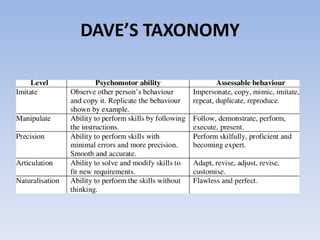
DAVE’S TAXONOMY
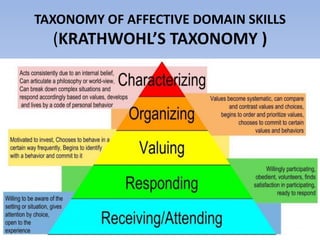
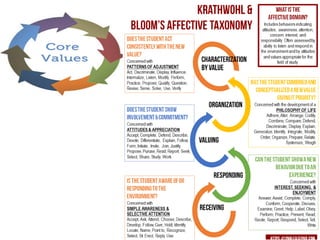
TAXONOMY OF AFFECTIVE DOMAIN SKILLS
(KRATHWOHL’S TAXONOMY )
ASSESSMENT TOOLS
• Checklists
• Rating Scales
• Rubrics
• Other
– Performance tests
– Portfolios
• Anecdotal Records / Course related learning portfolio
– Oral Tests
– Short Quizzes.
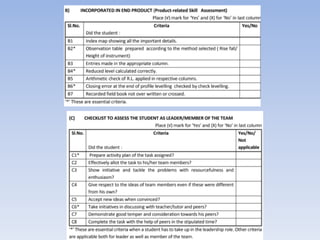
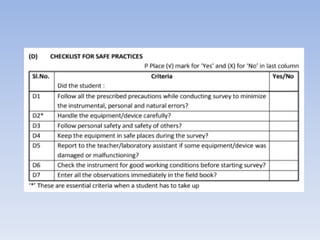
CHECKLISTS FOR ASSESSMENT
DESIGN TIPS FOR CHECKLISTS
• State the category and age range of target
population
• Decide if sequential order
• Formulate the criteria specifically
• There may be some critical/crucial sub-skills or
activities that could be starred in order
• Revise the checklist based on the feedback
Suggested Assessment Scheme
• PROCESS-RELATED SKILLS : 6 MARKS - 60%
– Handling of the instruments – 10%
– Identification of components/dial/scale -20%
– Measuring value using suitable instrument -20%
– Work team a team leader -10%
• PRODUCT-RELATED SKILLS: 4 MARKS - 40%
– Correct results obtained- 10%
– Interpretation of results – 10%
– Inferring the correct conclusions – 10%
– Organization and presentation of laboratory report – 5%
– Timely submission of laboratory report – 5%
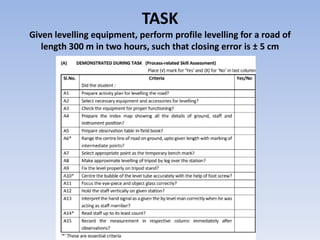
TASK
Given levelling equipment, perform profile levelling for a road of
length 300 m in two hours, such that closing error is ± 5 cm
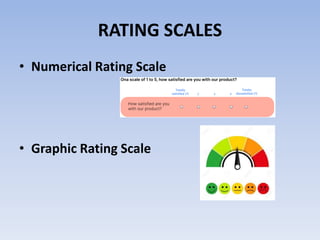
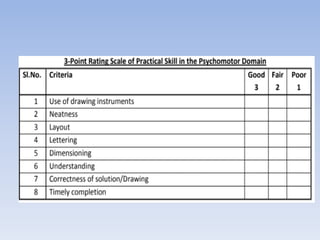
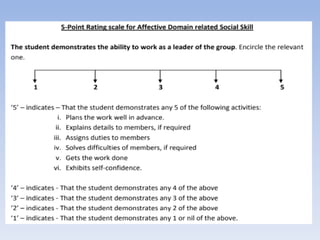
RATING SCALES
• Numerical Rating Scale
• Graphic Rating Scale
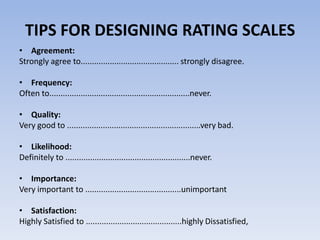
TIPS FOR DESIGNING RATING SCALES
• Agreement:
Strongly agree to............................................ strongly disagree.
• Frequency:
Often to...............................................................never.
• Quality:
Very good to ............................................................very bad.
• Likelihood:
Definitely to ........................................................never.
• Importance:
Very important to ...........................................unimportant
• Satisfaction:
Highly Satisfied to ...........................................highly Dissatisfied,
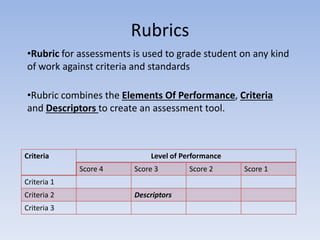
Rubrics
Criteria Level of Performance
Score 4 Score 3 Score 2 Score 1
Criteria 1
Criteria 2 Descriptors
Criteria 3
•Rubric for assessments is used to grade student on any kind
of work against criteria and standards
•Rubric combines the Elements Of Performance, Criteria
and Descriptors to create an assessment tool.
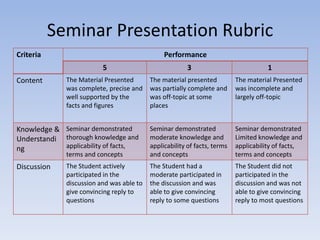
Seminar Presentation Rubric
Criteria Performance
5 3 1
Content The Material Presented
was complete, precise and
well supported by the
facts and figures
The material presented
was partially complete and
was off-topic at some
places
The material Presented
was incomplete and
largely off-topic
Knowledge &
Understandi
ng
Seminar demonstrated
thorough knowledge and
applicability of facts,
terms and concepts
Seminar demonstrated
moderate knowledge and
applicability of facts, terms
and concepts
Seminar demonstrated
Limited knowledge and
applicability of facts,
terms and concepts
Discussion The Student actively
participated in the
discussion and was able to
give convincing reply to
questions
The Student had a
moderate participated in
the discussion and was
able to give convincing
reply to some questions
The Student did not
participated in the
discussion and was not
able to give convincing
reply to most questions
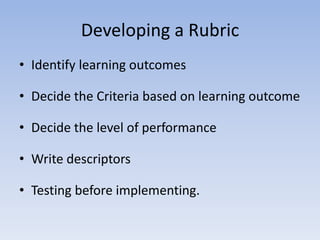
Developing a Rubric
• Identify learning outcomes
• Decide the Criteria based on learning outcome
• Decide the level of performance
• Write descriptors
• Testing before implementing.
Skill Assessment (Ideas and process).pdf

Skill Assessment (Ideas and process).pdf

  • 1.
    SKILL ASSESSMENT Dr AmitaMaurya Controller of Examinations SAGE University, Bhopal
  • 2.
  • 4.
  • 5.
  • 6.
  • 7.
    TAXONOMY OF AFFECTIVEDOMAIN SKILLS (KRATHWOHL’S TAXONOMY )
  • 10.
    ASSESSMENT TOOLS • Checklists •Rating Scales • Rubrics • Other – Performance tests – Portfolios • Anecdotal Records / Course related learning portfolio – Oral Tests – Short Quizzes.
  • 11.
    CHECKLISTS FOR ASSESSMENT DESIGNTIPS FOR CHECKLISTS • State the category and age range of target population • Decide if sequential order • Formulate the criteria specifically • There may be some critical/crucial sub-skills or activities that could be starred in order • Revise the checklist based on the feedback
  • 12.
    Suggested Assessment Scheme •PROCESS-RELATED SKILLS : 6 MARKS - 60% – Handling of the instruments – 10% – Identification of components/dial/scale -20% – Measuring value using suitable instrument -20% – Work team a team leader -10% • PRODUCT-RELATED SKILLS: 4 MARKS - 40% – Correct results obtained- 10% – Interpretation of results – 10% – Inferring the correct conclusions – 10% – Organization and presentation of laboratory report – 5% – Timely submission of laboratory report – 5%
  • 13.
    TASK Given levelling equipment,perform profile levelling for a road of length 300 m in two hours, such that closing error is ± 5 cm
  • 16.
    RATING SCALES • NumericalRating Scale • Graphic Rating Scale
  • 17.
    TIPS FOR DESIGNINGRATING SCALES • Agreement: Strongly agree to............................................ strongly disagree. • Frequency: Often to...............................................................never. • Quality: Very good to ............................................................very bad. • Likelihood: Definitely to ........................................................never. • Importance: Very important to ...........................................unimportant • Satisfaction: Highly Satisfied to ...........................................highly Dissatisfied,
  • 20.
    Rubrics Criteria Level ofPerformance Score 4 Score 3 Score 2 Score 1 Criteria 1 Criteria 2 Descriptors Criteria 3 •Rubric for assessments is used to grade student on any kind of work against criteria and standards •Rubric combines the Elements Of Performance, Criteria and Descriptors to create an assessment tool.
  • 21.
    Seminar Presentation Rubric CriteriaPerformance 5 3 1 Content The Material Presented was complete, precise and well supported by the facts and figures The material presented was partially complete and was off-topic at some places The material Presented was incomplete and largely off-topic Knowledge & Understandi ng Seminar demonstrated thorough knowledge and applicability of facts, terms and concepts Seminar demonstrated moderate knowledge and applicability of facts, terms and concepts Seminar demonstrated Limited knowledge and applicability of facts, terms and concepts Discussion The Student actively participated in the discussion and was able to give convincing reply to questions The Student had a moderate participated in the discussion and was able to give convincing reply to some questions The Student did not participated in the discussion and was not able to give convincing reply to most questions
  • 22.
    Developing a Rubric •Identify learning outcomes • Decide the Criteria based on learning outcome • Decide the level of performance • Write descriptors • Testing before implementing.