Early Islamand Modern Division632-661 CE
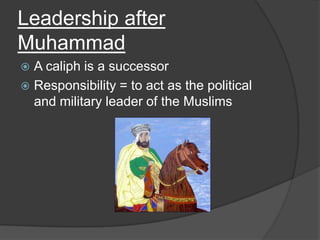
Leadership after MuhammadA caliph is a successorResponsibility = to act as the political and military leader of the Muslims
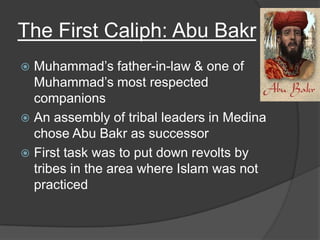
The First Caliph: Abu BakrMuhammad’s father-in-law & one of Muhammad’s most respected companionsAn assembly of tribal leaders in Medina chose Abu Bakr as successorFirst task was to put down revolts by tribes in the area where Islam was not practiced
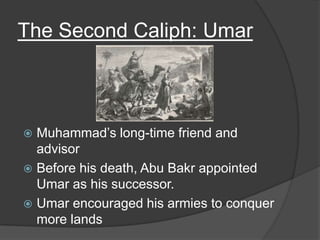
The Second Caliph: UmarMuhammad’s long-time friend and advisorBefore his death, Abu Bakr appointed Umar as his successor.Umar encouraged his armies to conquer more lands
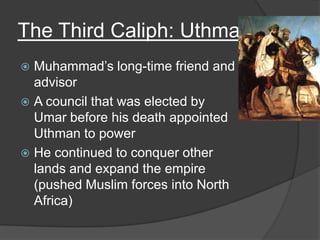
The Third Caliph: UthmanMuhammad’s long-time friend and advisorA council that was elected by Umar before his death appointed Uthman to powerHe continued to conquer other lands and expand the empire (pushed Muslim forces into North Africa)
The Fourth Caliph: Ali or Mu’awiya?the Islamic Empire grew so rapidly that many cultures and people had to come together to unifysome groups didn’t want toUthman was murdered by a group or unhappy people from Egypt
Ali was the natural choice as Uthman’ssuccesorHe participated in elections beforeHe belonged to Muhammad’s bloodlineMuhammad had trusted him alsoMu’awiyawas a relative of Uthmana popular governor in Syria
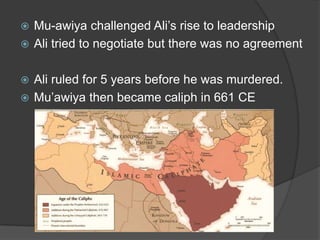
Mu-awiya challenged Ali’s rise to leadership
Ali tried to negotiate but there was no agreementAli ruled for 5 years before he was murdered. Mu’awiya then became caliph in 661 CE
Why did the Muslims divide in 2?BIG QUESTION: Who was Muhammad’s rightful successor? 			His descendents?				OR			Elected caliphs?
Shi’itesTranslates to “the party of Ali”Those who accept ONLY MEMBERS OF MUHAMMAD’S FAMILY as his successorsAli is given the title of Imam – meaning divinely guided as success“Imam” took on a strong sense of spiritual authority
SunnisThose who claim to follow the Sunna, or example of the prophet MuhammadThey accept the election of the first 4 caliphsThey do not accept the concept of “Imam” but instead believe that every individual has a relationship with God
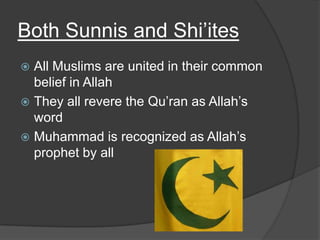
Both Sunnis and Shi’itesAll Muslims are united in their common belief in AllahThey all revere the Qu’ran as Allah’s wordMuhammad is recognized as Allah’s prophet by all

Early islam and modern division

  • 1.
    Early Islamand ModernDivision632-661 CE
  • 2.
    Leadership after MuhammadAcaliph is a successorResponsibility = to act as the political and military leader of the Muslims
  • 3.
    The First Caliph:Abu BakrMuhammad’s father-in-law & one of Muhammad’s most respected companionsAn assembly of tribal leaders in Medina chose Abu Bakr as successorFirst task was to put down revolts by tribes in the area where Islam was not practiced
  • 4.
    The Second Caliph:UmarMuhammad’s long-time friend and advisorBefore his death, Abu Bakr appointed Umar as his successor.Umar encouraged his armies to conquer more lands
  • 5.
    The Third Caliph:UthmanMuhammad’s long-time friend and advisorA council that was elected by Umar before his death appointed Uthman to powerHe continued to conquer other lands and expand the empire (pushed Muslim forces into North Africa)
  • 6.
    The Fourth Caliph:Ali or Mu’awiya?the Islamic Empire grew so rapidly that many cultures and people had to come together to unifysome groups didn’t want toUthman was murdered by a group or unhappy people from Egypt
  • 7.
    Ali was thenatural choice as Uthman’ssuccesorHe participated in elections beforeHe belonged to Muhammad’s bloodlineMuhammad had trusted him alsoMu’awiyawas a relative of Uthmana popular governor in Syria
  • 8.
    Mu-awiya challenged Ali’srise to leadership
  • 9.
    Ali tried tonegotiate but there was no agreementAli ruled for 5 years before he was murdered. Mu’awiya then became caliph in 661 CE
  • 10.
    Why did theMuslims divide in 2?BIG QUESTION: Who was Muhammad’s rightful successor? His descendents? OR Elected caliphs?
  • 11.
    Shi’itesTranslates to “theparty of Ali”Those who accept ONLY MEMBERS OF MUHAMMAD’S FAMILY as his successorsAli is given the title of Imam – meaning divinely guided as success“Imam” took on a strong sense of spiritual authority
  • 12.
    SunnisThose who claimto follow the Sunna, or example of the prophet MuhammadThey accept the election of the first 4 caliphsThey do not accept the concept of “Imam” but instead believe that every individual has a relationship with God
  • 13.
    Both Sunnis andShi’itesAll Muslims are united in their common belief in AllahThey all revere the Qu’ran as Allah’s wordMuhammad is recognized as Allah’s prophet by all