Mohammed and the Rise of Islam
 600’s A.D.
 loss of much of the Eastern Roman Empire
 to a new religious and political power
– Islam
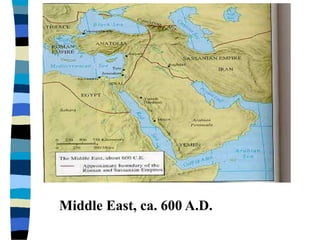
Middle East, ca. 600 A.D.
Islam
 Bedouin Arab named Mohammed
 born ca. 570 A.D.
 Merchant family, Hasimites
 Qurayshis tribe, who dominate Mecca
– controlling much of the religious pilgrim trade
 raised by relatives
-father and mother died by age six
-raised by an impoverished uncle
Mohammed
 formal education ?? We don’t know
– Normally only the Poets of the Tribes could
read and write
 commercial agent for a wealthy widow
– Khadijah
– supervising caravans from Mecca, north to
Jerusalem
– contact with both Jews and Christians
Mohammed, con’t
 He seems to have made an impression on his boss,
because of his reputed honesty
– married her and retired from commerce
– to devote himself to religion
– and to making society more fair and equitable
Mohammed, con’t
 monogamous until his wife died
 eventually married nine wives and had
assorted concubines
 last marriage at 53 to Aishah, daughter of a
friend
 wives: widows of friends or political marriages
• Women alone is such a world were very vulnerable
Origins of Mohammed’s
Teachings
 periods of unconsciousness are indicated:
explanations
– revelations from Allah by holy trances, spoken to by Gabriel
– epilepsy or a similar neurological disorder?
– mental illness or hallucinations ?
 Mohammed’s explanation:
– revelations from God
– Very unpleasant and painful for him
The Quran
 Record of revelations received during
visions
 Committed to writing c. 650 CE, compiled
(Muhammad dies 632)
– Under the third Caliph, Uthman ibn Affan
 Tradition of Muhammad’s life: hadith
Nature of Revelations
 diverse
 social, agricultural, medical, military,
astronomical, etc.
Historical Origins of His Ideas
 Arab polytheism
 Hanifism: a belief in one God traced to Abraham, by
tradition
 Judaism
 Christianity: Orthodox, Nestorian, Arianism
 Manichaeism: a mixture of Zoroastrianism,
Christianity, Judaism, and so forth
Beginning of His Ministry
 at about age 40, after a number of revelations
 began to preach publicly
 continued to receive revelations until death
– usually related to current problems or concerns
– Religious, political, social, economic
Early religious career
 not particularly successful
 threatened the social, political, and religious
structure, with his doctrine of social equity
 threatened the economic basis of Mecca as a center
of religious pilgrimage
 particularly the Black Rock
– sacred to the chief deity of the Arabs
 run out of town, or at least encouraged to leave
– Went to the desert with his family and lived for about a year
The Hijra
 flight from Mecca, to Yathrib (Medina)
-tradition: invited by the Jews of Medina
 622 A.D.
 beginning of the Islamic calendar
 forms the umma (community)
 welcomed, then resisted
 Mohammed becomes an absolute theocrat
Muhammad’s Return to Mecca
 Attack on Mecca, 630 -- jihad
 Conversion of Mecca to Islam
 Destruction of pagan sites, replaced with mosques
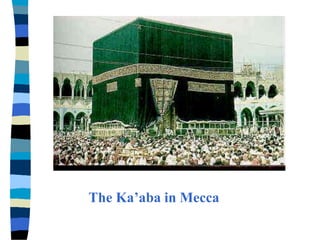
– Ka’aba preserved in honor of importance of Mecca
– Approved as pilgrimage site
Jihad
 holy war against Mecca
 ten year blockade
 a deal was made
The Deal
 Mecca preserved as a holy city and place of
pilgrimage
– to preserve the economic prosperity
 the Ka’aba preserved as the central shrine
– idols and icons destroyed
– story of its origins emphasized the role of
Abraham in its placement
– pilgrimage as an act of faith, at least once in your
life
The Ka’aba in Mecca
The Religion: the Koran (Qu’ran)
 the Koran (Qu’ran): contains much of Mohammed
recounting of Allah’s teachings
 written down by his followers after his death
– from notes and memories, on “stones and
parchments”
 Short: 114 chapters
– arranged from longest to the shortest
– not by subject or chronologically
– length is the criterion of order for the text
The Koran, con’t
 some “Old” and “New” Testaments stories
– but sometimes the story seems a bit different to
Jews and Christians
 parables and fables
 political polemic and prophecy
 “non-religious” subjects
– not dissimilar to Jewish and Christian scriptures in
some ways
Five Pillars of Islam
 uniqueness of God
– ‘There is no god, but God….’
 prayer five times a day
 observe the month of Ramadan
 give alms to the poor
 pilgrimage to Mecca
– If possible, once in your life
Additional teachings
 dietary laws
 no gambling or drinking
 no sexual irregularities, as defined by tradition and
custom
 no faulty weights or usury
 no infanticide
 elaborate rules concerning inheritance and property
 improvement in the status of women and children
Changing Status of Women
 Qu’ran improves status of women
– Outlawed female infanticide
– Brides, not husbands, claim dowries
 Yet male dominance preserved
– Patrilineal descent
– Polygamy permitted, Polyandry forbidden
– Veil adopted from ancient Mesopotamian practice
Similarities to Judaism and
Christianity
 monotheism (defined a bit differently)
 insistence on the responsibility of human beings
 final judgment and rewards
 angels and spirits
 practice of virtues: truthfulness, compassion, etc.
Differences
 an emphasis on compassion and mercy
 alms giving moderate
 heaven conceived a bit differently
 no priests or sacramental system
 easy conversion: the Shahadah
– ‘There is no God by Allah, and Mohammed is his prophet.’
Islamic Law: The Sharia
 Codification of Islamic law
 Based on Quran, hadith, logical schools
of analysis
 Extends beyond ritual law to all areas of
human activity
– This is the basis the idea of an “Islamic
republic” for instance
Expansion of Islam
 early victories
 backsliders (tribes) punished
– Apostasy = treason = death
 assaults on:
– the Byzantine (Roman) empire
– the Persian empire
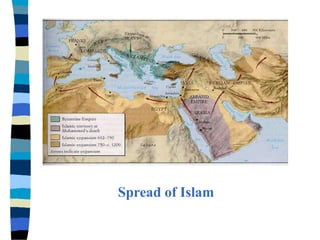
Spread of Islam
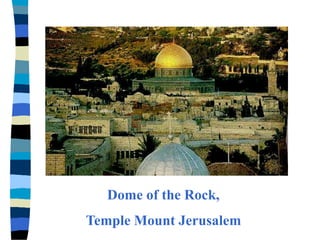
Dome of the Rock,
Temple Mount Jerusalem
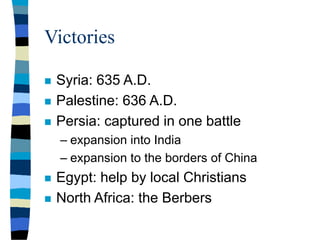
Victories
 Syria: 635 A.D.
 Palestine: 636 A.D.
 Persia: captured in one battle
– expansion into India
– expansion to the borders of China
 Egypt: help by local Christians
 North Africa: the Berbers
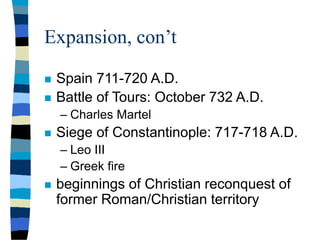
Expansion, con’t
 Spain 711-720 A.D.
 Battle of Tours: October 732 A.D.
– Charles Martel
 Siege of Constantinople: 717-718 A.D.
– Leo III
– Greek fire
 beginnings of Christian reconquest of
former Roman/Christian territory
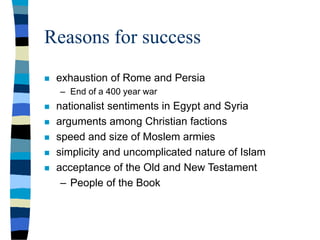
Reasons for success
 exhaustion of Rome and Persia
– End of a 400 year war
 nationalist sentiments in Egypt and Syria
 arguments among Christian factions
 speed and size of Moslem armies
 simplicity and uncomplicated nature of Islam
 acceptance of the Old and New Testament
– People of the Book
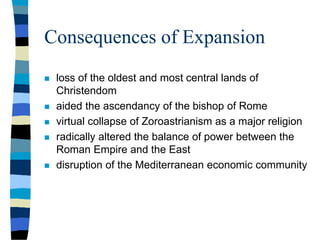
Consequences of Expansion
 loss of the oldest and most central lands of
Christendom
 aided the ascendancy of the bishop of Rome
 virtual collapse of Zoroastrianism as a major religion
 radically altered the balance of power between the
Roman Empire and the East
 disruption of the Mediterranean economic community
Early Problems
 Succession ?
– Mohammed had no surviving male children
– Daughter: Fatima
– Son-in-law: Ali, child of his uncle
 generated a permanent split in the
Islamic community
– Sunnis
– Shi’as
Sunnis
 considered themselves the “orthodox” followers of
Mohammed
 consider the Shi’as to be “dissenters”
 issue: who leads after Mohammed ??
 the Caliph (or “leader”)
 went successively to followers
-Abu Bakr, then Oman
-then Uthman and
The Shia
 Disagreements over selection of caliphs
 Ali passed over for Abu Bakr
 Served as caliph 656-661 CE, then assassinated
along with most of his followers
 Remaining followers organize separate party called
“Shia”
– Traditionalists: Sunni
Abu Bakr
 not particularly popular with the Muslim
community
 allowed raid, then invasions of
Byzantine and Persian territory
 subjugated any dissident elements or
tribes
 disposed of any “new prophets”
Success = strain
 success introduced luxury and change
– From original caliphs to the Umayyad caliphs
 new ideas and new ethnic groups
– with their own customs and heritage, to try to
assimilate
 rise of a sort of “revivalist element”
– Islam had strayed from its original path and purity
– Muslims were being led back to paganism
– caliphs were becoming idle, corrupt, tyrants
Uthman: the third Caliph
 murdered: warfare broke out
 Ali: cousin and son-in-law of Mohammed
 originally passed over as too young
 contested the succession
 Uthman supported by the Umayyad clan
– early enemies of Mohammed
– refused to accept Ali’s claims
Umayyeds
 successful in the war
 Ali assassinated in 661 A.D.
– by the Kharijites
 beginning of the Umayyed dynasty
Policy toward Conquered Peoples
 Favoritism of Arab military rulers causes
discontent
 Limited social mobility for non-Arab
Muslims
 Head tax (jizya) on non-Muslims
 Umayyad luxurious living causes further
decline in moral authority
Sunnis
 accepted the legitimacy of early caliphs
 “Sunni” : from an Arabic word
– “usage” or “custom”
– implies: “precedent”
Shi’as
 accepted Ali
 word means: “party”, “faction”,
“following”
Factions
 Sunni and Shi’as dominant
 originally political
– Eventually the differences became
dogmatic in emphasis
 Shi’as become a party of religious
dissent
Perceptions
 Sunni: conservative, in favor of the
“status quo”
– consensus is the guiding principle
 Shi’as: defenders of the oppressed,
critics of privilege and power
– obedience is required only as long as it can
be forced, and no longer
Umayyed empire
 Atlantic Ocean to India
 Syria: center of the Islamic World
 eventually displaced by the Abbasids
– an Arab family claiming decent from
Mohammed
The Abbasid Dynasty (750-1258
CE)
 Abu al-Abbas Sunni Arab, allied with Shia, non-Arab
Muslims
 Seizes control of Persia and Mesopotamia
 Defeats Umayyad army in 750
– Invited Umayyads to banquet, then massacred
them
– Only Spain remains Umayyad
– North Africa is disputed territory, ultimately
Fatamid
Nature of the Abbasid Dynasty
 Diverse nature of administration (i.e. not exclusively
Arab)
 Militarily competent, but not bent on imperial
expansion
 Dar al-Islam
 Growth through military activity of autonomous
Islamic forces
Nature of the Abbasid Dynasty
 Diverse nature of administration (i.e. not
exclusively Arab)
 Militarily competent, but not bent on
imperial expansion
 Dar al-Islam
 Growth through military activity of
autonomous Islamic forces
Caliph Harun al-Rashid (786-809
CE)
 High point of Abbasid dynasty
 Baghdad center of commerce
 Great cultural activity
Abbasid Decline
 Civil war between sons of Harun al-Rashid
 Provincial governers assert regional independence
 Dissenting sects, heretical movements
 Abbasid caliphs become puppets of Persian
nobility
 Later, Saljuq Turks influence, Sultan real power
behind the throne
Formation of an Islamic Cultural
Tradition
 Islamic values
– Uniformity of Islamic law in dar al-Islam
– Establishment of madrasas
– Importance of the Hajj
 Sufi missionaries
– Asceticism, mysticism
– Some tension with orthodox Islamic
theologians
– Wide popularity
Cultural influences on Islam
 Persia
– Adminstration and governance
– literature
 India
– Mathematics, science, medicine
• “Hindi” numbers
 Greece
– Philosophy, esp. Aristotle
– Greek medicine
Cultural Importance of Islam
 Development of these received
influences
 Distribution throughout the Muslim world
 Introduction and reintroduction of these
ideas to medieval Europe
– Through Spain
– Spanish Jews

Islam rise & spread.ppt

  • 1.
    Mohammed and theRise of Islam  600’s A.D.  loss of much of the Eastern Roman Empire  to a new religious and political power – Islam
  • 2.
  • 3.
    Islam  Bedouin Arabnamed Mohammed  born ca. 570 A.D.  Merchant family, Hasimites  Qurayshis tribe, who dominate Mecca – controlling much of the religious pilgrim trade  raised by relatives -father and mother died by age six -raised by an impoverished uncle
  • 4.
    Mohammed  formal education?? We don’t know – Normally only the Poets of the Tribes could read and write  commercial agent for a wealthy widow – Khadijah – supervising caravans from Mecca, north to Jerusalem – contact with both Jews and Christians
  • 5.
    Mohammed, con’t  Heseems to have made an impression on his boss, because of his reputed honesty – married her and retired from commerce – to devote himself to religion – and to making society more fair and equitable
  • 6.
    Mohammed, con’t  monogamousuntil his wife died  eventually married nine wives and had assorted concubines  last marriage at 53 to Aishah, daughter of a friend  wives: widows of friends or political marriages • Women alone is such a world were very vulnerable
  • 7.
    Origins of Mohammed’s Teachings periods of unconsciousness are indicated: explanations – revelations from Allah by holy trances, spoken to by Gabriel – epilepsy or a similar neurological disorder? – mental illness or hallucinations ?  Mohammed’s explanation: – revelations from God – Very unpleasant and painful for him
  • 8.
    The Quran  Recordof revelations received during visions  Committed to writing c. 650 CE, compiled (Muhammad dies 632) – Under the third Caliph, Uthman ibn Affan  Tradition of Muhammad’s life: hadith
  • 9.
    Nature of Revelations diverse  social, agricultural, medical, military, astronomical, etc.
  • 10.
    Historical Origins ofHis Ideas  Arab polytheism  Hanifism: a belief in one God traced to Abraham, by tradition  Judaism  Christianity: Orthodox, Nestorian, Arianism  Manichaeism: a mixture of Zoroastrianism, Christianity, Judaism, and so forth
  • 11.
    Beginning of HisMinistry  at about age 40, after a number of revelations  began to preach publicly  continued to receive revelations until death – usually related to current problems or concerns – Religious, political, social, economic
  • 12.
    Early religious career not particularly successful  threatened the social, political, and religious structure, with his doctrine of social equity  threatened the economic basis of Mecca as a center of religious pilgrimage  particularly the Black Rock – sacred to the chief deity of the Arabs  run out of town, or at least encouraged to leave – Went to the desert with his family and lived for about a year
  • 13.
    The Hijra  flightfrom Mecca, to Yathrib (Medina) -tradition: invited by the Jews of Medina  622 A.D.  beginning of the Islamic calendar  forms the umma (community)  welcomed, then resisted  Mohammed becomes an absolute theocrat
  • 14.
    Muhammad’s Return toMecca  Attack on Mecca, 630 -- jihad  Conversion of Mecca to Islam  Destruction of pagan sites, replaced with mosques – Ka’aba preserved in honor of importance of Mecca – Approved as pilgrimage site
  • 15.
    Jihad  holy waragainst Mecca  ten year blockade  a deal was made
  • 16.
    The Deal  Meccapreserved as a holy city and place of pilgrimage – to preserve the economic prosperity  the Ka’aba preserved as the central shrine – idols and icons destroyed – story of its origins emphasized the role of Abraham in its placement – pilgrimage as an act of faith, at least once in your life
  • 17.
  • 18.
    The Religion: theKoran (Qu’ran)  the Koran (Qu’ran): contains much of Mohammed recounting of Allah’s teachings  written down by his followers after his death – from notes and memories, on “stones and parchments”  Short: 114 chapters – arranged from longest to the shortest – not by subject or chronologically – length is the criterion of order for the text
  • 19.
    The Koran, con’t some “Old” and “New” Testaments stories – but sometimes the story seems a bit different to Jews and Christians  parables and fables  political polemic and prophecy  “non-religious” subjects – not dissimilar to Jewish and Christian scriptures in some ways
  • 20.
    Five Pillars ofIslam  uniqueness of God – ‘There is no god, but God….’  prayer five times a day  observe the month of Ramadan  give alms to the poor  pilgrimage to Mecca – If possible, once in your life
  • 21.
    Additional teachings  dietarylaws  no gambling or drinking  no sexual irregularities, as defined by tradition and custom  no faulty weights or usury  no infanticide  elaborate rules concerning inheritance and property  improvement in the status of women and children
  • 22.
    Changing Status ofWomen  Qu’ran improves status of women – Outlawed female infanticide – Brides, not husbands, claim dowries  Yet male dominance preserved – Patrilineal descent – Polygamy permitted, Polyandry forbidden – Veil adopted from ancient Mesopotamian practice
  • 23.
    Similarities to Judaismand Christianity  monotheism (defined a bit differently)  insistence on the responsibility of human beings  final judgment and rewards  angels and spirits  practice of virtues: truthfulness, compassion, etc.
  • 24.
    Differences  an emphasison compassion and mercy  alms giving moderate  heaven conceived a bit differently  no priests or sacramental system  easy conversion: the Shahadah – ‘There is no God by Allah, and Mohammed is his prophet.’
  • 25.
    Islamic Law: TheSharia  Codification of Islamic law  Based on Quran, hadith, logical schools of analysis  Extends beyond ritual law to all areas of human activity – This is the basis the idea of an “Islamic republic” for instance
  • 26.
    Expansion of Islam early victories  backsliders (tribes) punished – Apostasy = treason = death  assaults on: – the Byzantine (Roman) empire – the Persian empire
  • 27.
  • 28.
    Dome of theRock, Temple Mount Jerusalem
  • 29.
    Victories  Syria: 635A.D.  Palestine: 636 A.D.  Persia: captured in one battle – expansion into India – expansion to the borders of China  Egypt: help by local Christians  North Africa: the Berbers
  • 30.
    Expansion, con’t  Spain711-720 A.D.  Battle of Tours: October 732 A.D. – Charles Martel  Siege of Constantinople: 717-718 A.D. – Leo III – Greek fire  beginnings of Christian reconquest of former Roman/Christian territory
  • 31.
    Reasons for success exhaustion of Rome and Persia – End of a 400 year war  nationalist sentiments in Egypt and Syria  arguments among Christian factions  speed and size of Moslem armies  simplicity and uncomplicated nature of Islam  acceptance of the Old and New Testament – People of the Book
  • 32.
    Consequences of Expansion loss of the oldest and most central lands of Christendom  aided the ascendancy of the bishop of Rome  virtual collapse of Zoroastrianism as a major religion  radically altered the balance of power between the Roman Empire and the East  disruption of the Mediterranean economic community
  • 33.
    Early Problems  Succession? – Mohammed had no surviving male children – Daughter: Fatima – Son-in-law: Ali, child of his uncle  generated a permanent split in the Islamic community – Sunnis – Shi’as
  • 34.
    Sunnis  considered themselvesthe “orthodox” followers of Mohammed  consider the Shi’as to be “dissenters”  issue: who leads after Mohammed ??  the Caliph (or “leader”)  went successively to followers -Abu Bakr, then Oman -then Uthman and
  • 35.
    The Shia  Disagreementsover selection of caliphs  Ali passed over for Abu Bakr  Served as caliph 656-661 CE, then assassinated along with most of his followers  Remaining followers organize separate party called “Shia” – Traditionalists: Sunni
  • 36.
    Abu Bakr  notparticularly popular with the Muslim community  allowed raid, then invasions of Byzantine and Persian territory  subjugated any dissident elements or tribes  disposed of any “new prophets”
  • 37.
    Success = strain success introduced luxury and change – From original caliphs to the Umayyad caliphs  new ideas and new ethnic groups – with their own customs and heritage, to try to assimilate  rise of a sort of “revivalist element” – Islam had strayed from its original path and purity – Muslims were being led back to paganism – caliphs were becoming idle, corrupt, tyrants
  • 38.
    Uthman: the thirdCaliph  murdered: warfare broke out  Ali: cousin and son-in-law of Mohammed  originally passed over as too young  contested the succession  Uthman supported by the Umayyad clan – early enemies of Mohammed – refused to accept Ali’s claims
  • 39.
    Umayyeds  successful inthe war  Ali assassinated in 661 A.D. – by the Kharijites  beginning of the Umayyed dynasty
  • 40.
    Policy toward ConqueredPeoples  Favoritism of Arab military rulers causes discontent  Limited social mobility for non-Arab Muslims  Head tax (jizya) on non-Muslims  Umayyad luxurious living causes further decline in moral authority
  • 41.
    Sunnis  accepted thelegitimacy of early caliphs  “Sunni” : from an Arabic word – “usage” or “custom” – implies: “precedent”
  • 42.
    Shi’as  accepted Ali word means: “party”, “faction”, “following”
  • 43.
    Factions  Sunni andShi’as dominant  originally political – Eventually the differences became dogmatic in emphasis  Shi’as become a party of religious dissent
  • 44.
    Perceptions  Sunni: conservative,in favor of the “status quo” – consensus is the guiding principle  Shi’as: defenders of the oppressed, critics of privilege and power – obedience is required only as long as it can be forced, and no longer
  • 45.
    Umayyed empire  AtlanticOcean to India  Syria: center of the Islamic World  eventually displaced by the Abbasids – an Arab family claiming decent from Mohammed
  • 46.
    The Abbasid Dynasty(750-1258 CE)  Abu al-Abbas Sunni Arab, allied with Shia, non-Arab Muslims  Seizes control of Persia and Mesopotamia  Defeats Umayyad army in 750 – Invited Umayyads to banquet, then massacred them – Only Spain remains Umayyad – North Africa is disputed territory, ultimately Fatamid
  • 47.
    Nature of theAbbasid Dynasty  Diverse nature of administration (i.e. not exclusively Arab)  Militarily competent, but not bent on imperial expansion  Dar al-Islam  Growth through military activity of autonomous Islamic forces
  • 48.
    Nature of theAbbasid Dynasty  Diverse nature of administration (i.e. not exclusively Arab)  Militarily competent, but not bent on imperial expansion  Dar al-Islam  Growth through military activity of autonomous Islamic forces
  • 49.
    Caliph Harun al-Rashid(786-809 CE)  High point of Abbasid dynasty  Baghdad center of commerce  Great cultural activity
  • 50.
    Abbasid Decline  Civilwar between sons of Harun al-Rashid  Provincial governers assert regional independence  Dissenting sects, heretical movements  Abbasid caliphs become puppets of Persian nobility  Later, Saljuq Turks influence, Sultan real power behind the throne
  • 51.
    Formation of anIslamic Cultural Tradition  Islamic values – Uniformity of Islamic law in dar al-Islam – Establishment of madrasas – Importance of the Hajj  Sufi missionaries – Asceticism, mysticism – Some tension with orthodox Islamic theologians – Wide popularity
  • 52.
    Cultural influences onIslam  Persia – Adminstration and governance – literature  India – Mathematics, science, medicine • “Hindi” numbers  Greece – Philosophy, esp. Aristotle – Greek medicine
  • 53.
    Cultural Importance ofIslam  Development of these received influences  Distribution throughout the Muslim world  Introduction and reintroduction of these ideas to medieval Europe – Through Spain – Spanish Jews

Editor's Notes