Downloaded 40 times
![http://www.me.psu.edu/lamancusa/rapidpro/primer/chapter2.htm
1 Overview of Rapid Prototyping
The term rapid prototyping (RP) refers to a class of technologies that can automatically construct
physical models from Computer-Aided Design (CAD) data. These "three dimensional printers"
allow designers to quickly create tangible prototypes of their designs, rather than just two-
dimensional pictures. Such models have numerous uses. They make excellent visual aids for
communicating ideas with co-workers or customers. In addition, prototypes can be used for
design testing. For example, an aerospace engineer might mount a model airfoil in a wind tunnel
to measure lift and drag forces. Designers have always utilized prototypes; RP allows them to be
made faster and less expensively.
In addition to prototypes, RP techniques can also be used to make tooling (referred to as rapid
tooling) and even production-quality parts (rapid manufacturing). For small production runs and
complicated objects, rapid prototyping is often the best manufacturing process available. Of
course, "rapid" is a relative term. Most prototypes require from three to seventy-two hours to
build, depending on the size and complexity of the object. This may seem slow, but it is much
faster than the weeks or months required to make a prototype by traditional means such as
machining. These dramatic time savings allow manufacturers to bring products to market faster
and more cheaply. In 1994, Pratt & Whitney achieved "an order of magnitude [cost] reduction
[and] . . . time savings of 70 to 90 percent" by incorporating rapid prototyping into their
investment casting process. 5
At least six different rapid prototyping techniques are commercially available, each with unique
strengths. Because RP technologies are being increasingly used in non-prototyping applications,
the techniques are often collectively referred to as solid free-form fabrication, computer
automated manufacturing, or layered manufacturing. The latter term is particularly descriptive
of the manufacturing process used by all commercial techniques. A software package "slices" the
CAD model into a number of thin (~0.1 mm) layers, which are then built up one atop another.
Rapid prototyping is an "additive" process, combining layers of paper, wax, or plastic to create a
solid object. In contrast, most machining processes (milling, drilling, grinding, etc.) are
"subtractive" processes that remove material from a solid block. RP’s additive nature allows it to
create objects with complicated internal features that cannot be manufactured by other means.
Of course, rapid prototyping is not perfect. Part volume is generally limited to 0.125 cubic
meters or less, depending on the RP machine. Metal prototypes are difficult to make, though this
should change in the near future. For metal parts, large production runs, or simple objects,
conventional manufacturing techniques are usually more economical. These limitations aside,
rapid prototyping is a remarkable technology that is revolutionizing the manufacturing process.
2 The Basic Process](https://image.slidesharecdn.com/references2-120723020101-phpapp01-131002031444-phpapp01/85/rapid-prototyping-v1-1-320.jpg)
![http://www.me.psu.edu/lamancusa/rapidpro/primer/chapter2.htm
1 Overview of Rapid Prototyping
The term rapid prototyping (RP) refers to a class of technologies that can automatically construct
physical models from Computer-Aided Design (CAD) data. These "three dimensional printers"
allow designers to quickly create tangible prototypes of their designs, rather than just two-
dimensional pictures. Such models have numerous uses. They make excellent visual aids for
communicating ideas with co-workers or customers. In addition, prototypes can be used for
design testing. For example, an aerospace engineer might mount a model airfoil in a wind tunnel
to measure lift and drag forces. Designers have always utilized prototypes; RP allows them to be
made faster and less expensively.
In addition to prototypes, RP techniques can also be used to make tooling (referred to as rapid
tooling) and even production-quality parts (rapid manufacturing). For small production runs and
complicated objects, rapid prototyping is often the best manufacturing process available. Of
course, "rapid" is a relative term. Most prototypes require from three to seventy-two hours to
build, depending on the size and complexity of the object. This may seem slow, but it is much
faster than the weeks or months required to make a prototype by traditional means such as
machining. These dramatic time savings allow manufacturers to bring products to market faster
and more cheaply. In 1994, Pratt & Whitney achieved "an order of magnitude [cost] reduction
[and] . . . time savings of 70 to 90 percent" by incorporating rapid prototyping into their
investment casting process. 5
At least six different rapid prototyping techniques are commercially available, each with unique
strengths. Because RP technologies are being increasingly used in non-prototyping applications,
the techniques are often collectively referred to as solid free-form fabrication, computer
automated manufacturing, or layered manufacturing. The latter term is particularly descriptive
of the manufacturing process used by all commercial techniques. A software package "slices" the
CAD model into a number of thin (~0.1 mm) layers, which are then built up one atop another.
Rapid prototyping is an "additive" process, combining layers of paper, wax, or plastic to create a
solid object. In contrast, most machining processes (milling, drilling, grinding, etc.) are
"subtractive" processes that remove material from a solid block. RP’s additive nature allows it to
create objects with complicated internal features that cannot be manufactured by other means.
Of course, rapid prototyping is not perfect. Part volume is generally limited to 0.125 cubic
meters or less, depending on the RP machine. Metal prototypes are difficult to make, though this
should change in the near future. For metal parts, large production runs, or simple objects,
conventional manufacturing techniques are usually more economical. These limitations aside,
rapid prototyping is a remarkable technology that is revolutionizing the manufacturing process.
2 The Basic Process](https://image.slidesharecdn.com/references2-120723020101-phpapp01-131002031444-phpapp01/75/rapid-prototyping-v1-1-2048.jpg)
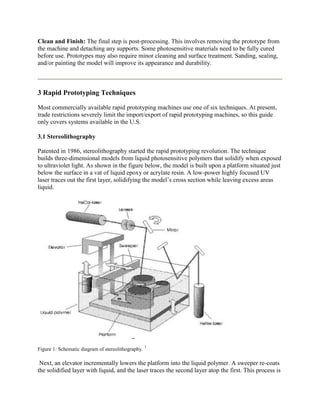
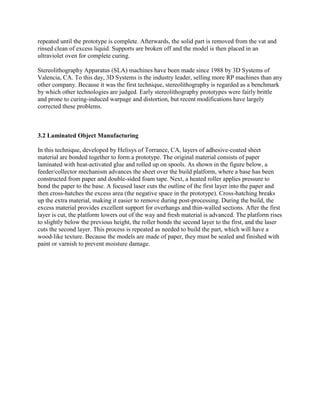
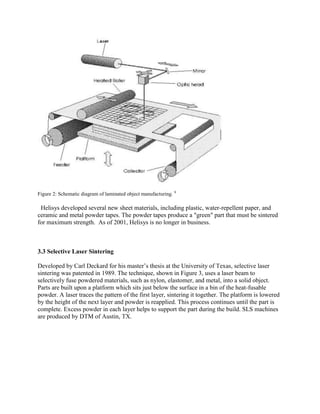
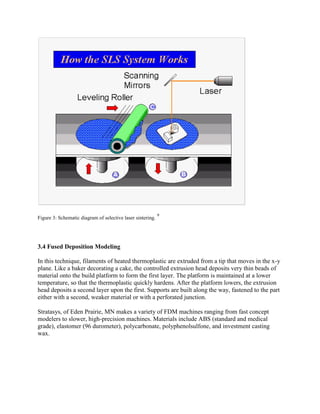
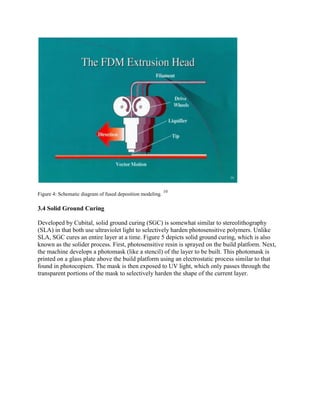
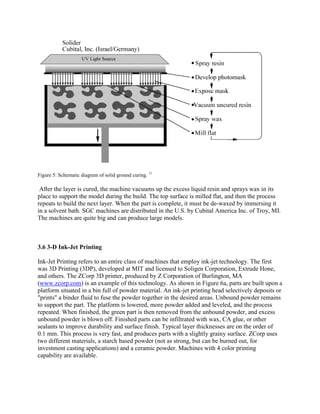
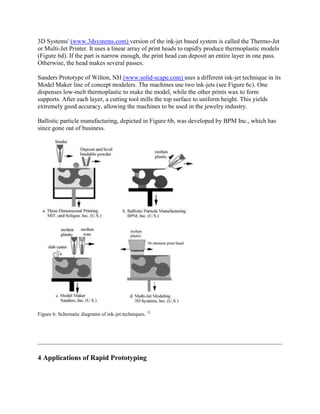

Rapid prototyping (RP) uses 3D printing technologies to automatically construct physical models from CAD data. This allows designers to quickly create prototypes rather than just 2D pictures. All RP techniques involve (1) creating a CAD file, (2) converting it to STL format, (3) slicing the STL file into thin layers, (4) constructing the model layer-by-layer, and (5) cleaning and finishing the prototype. The most common techniques are stereolithography, which solidifies liquid resin with UV light, and laminated object manufacturing, which bonds sheets of material like paper or metal powder. RP saves significant time and cost over traditional prototyping methods.


