
Md. Foyaz Ullah
CSE–38(evening)
Roll: 201411038150
Presented by:
Anowar Hossain
CSE-38(evening)
Roll: 201411038148
Bangladesh University
Outline
 Introduction
 History
 What is 3D Printing?
 General Principal
 How it’s work?
 Different method of 3D Printing
 Advantage
 Disadvantage
 Calculation
Introduction
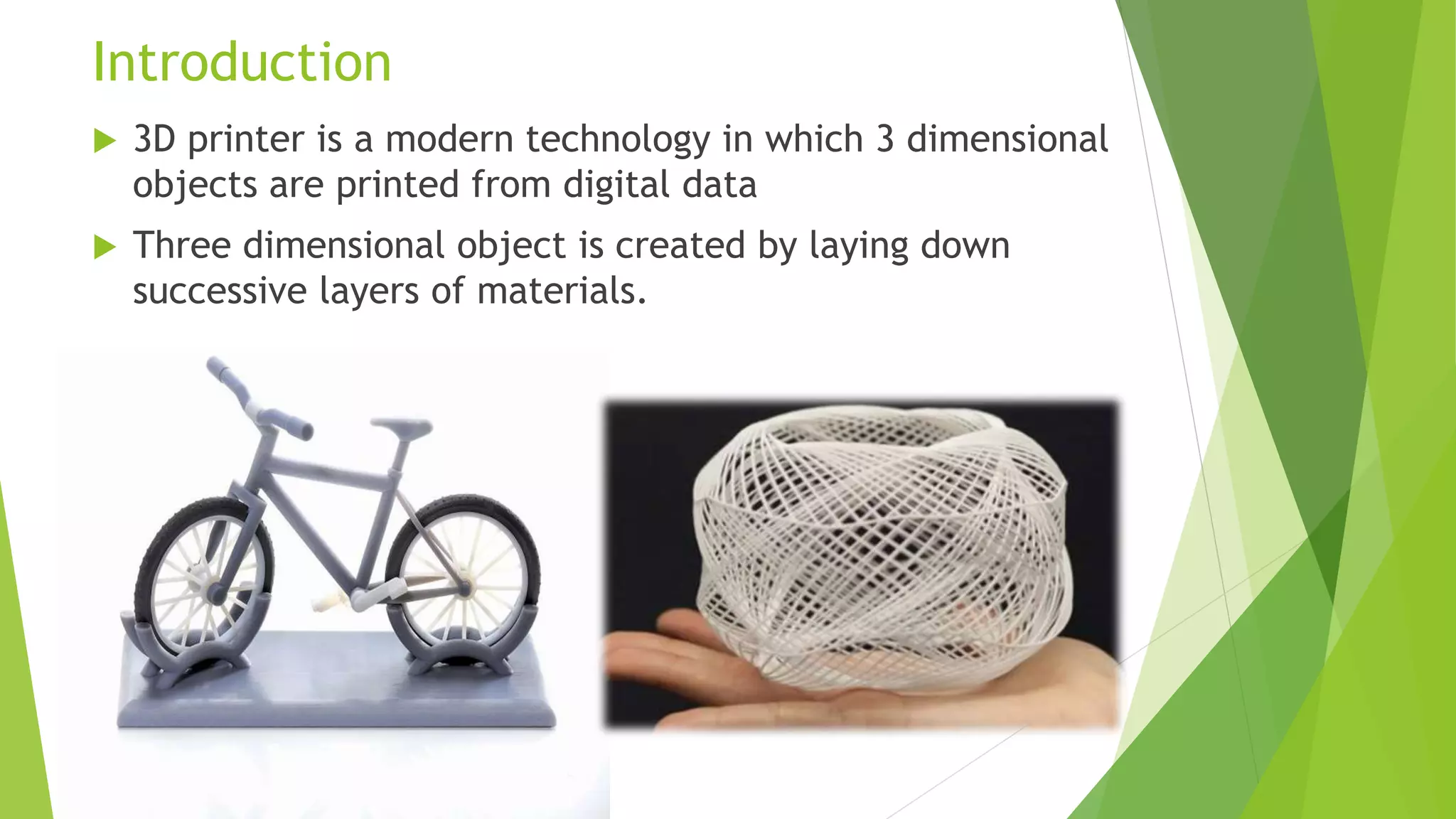
 3D printer is a modern technology in which 3 dimensional
objects are printed from digital data
 Three dimensional object is created by laying down
successive layers of materials.
History
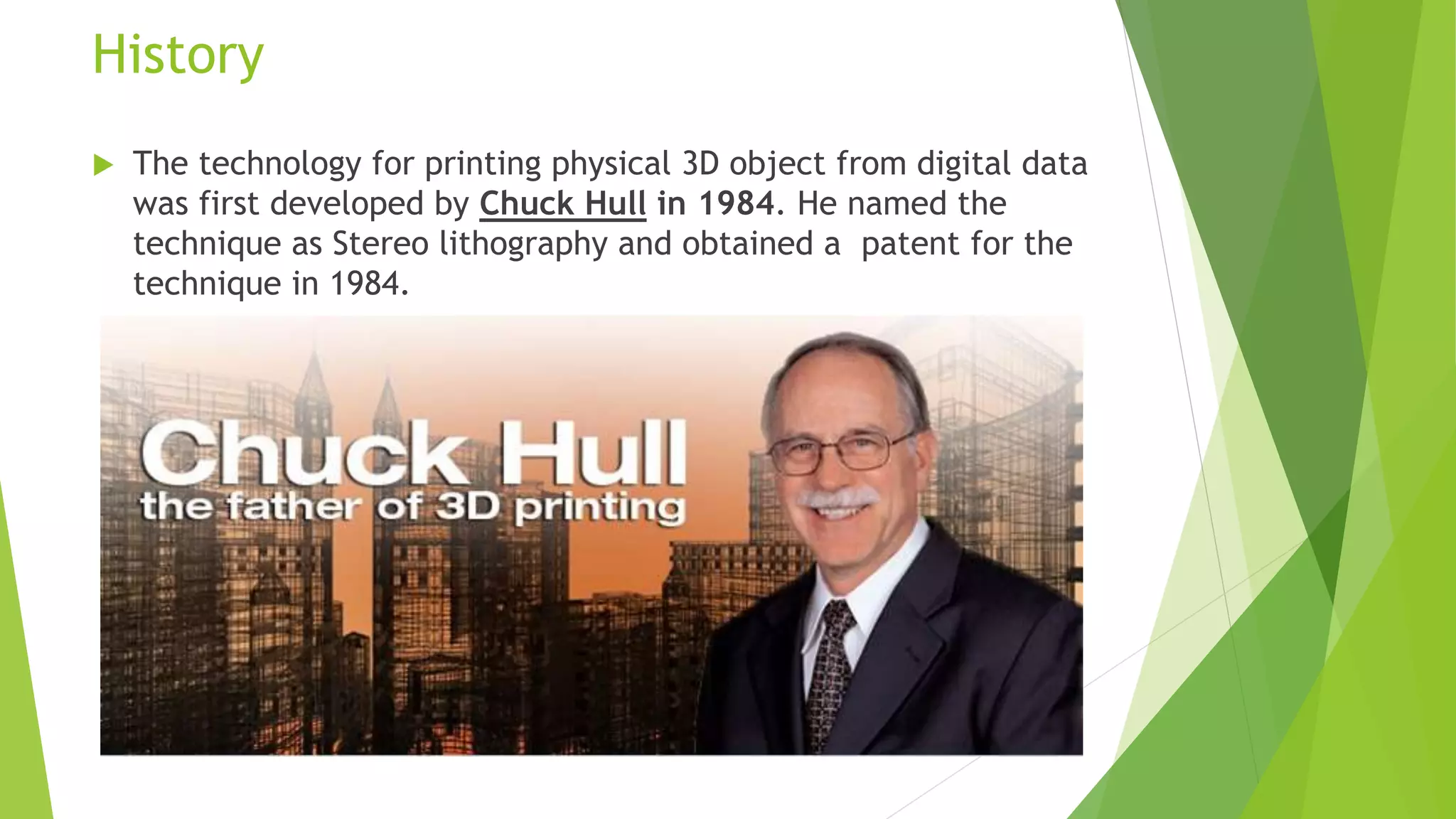
 The technology for printing physical 3D object from digital data
was first developed by Chuck Hull in 1984. He named the
technique as Stereo lithography and obtained a patent for the
technique in 1984.
What is 3D Printing?
 3D Printing is a form of additive manufacturing in which
components are fabricated in an additive fashion by adding
successive layers of materials together.
 It is also know as:
Rapid Prototyping
Additive manufacturing.
 3D printing or additive manufacturing is a process of making
three dimensional solid objects from a digital file. The creation
of a 3D printed object is achieved using additive processes. In
an additive process an object is created by laying down
successive layers of material until the entire object is created.
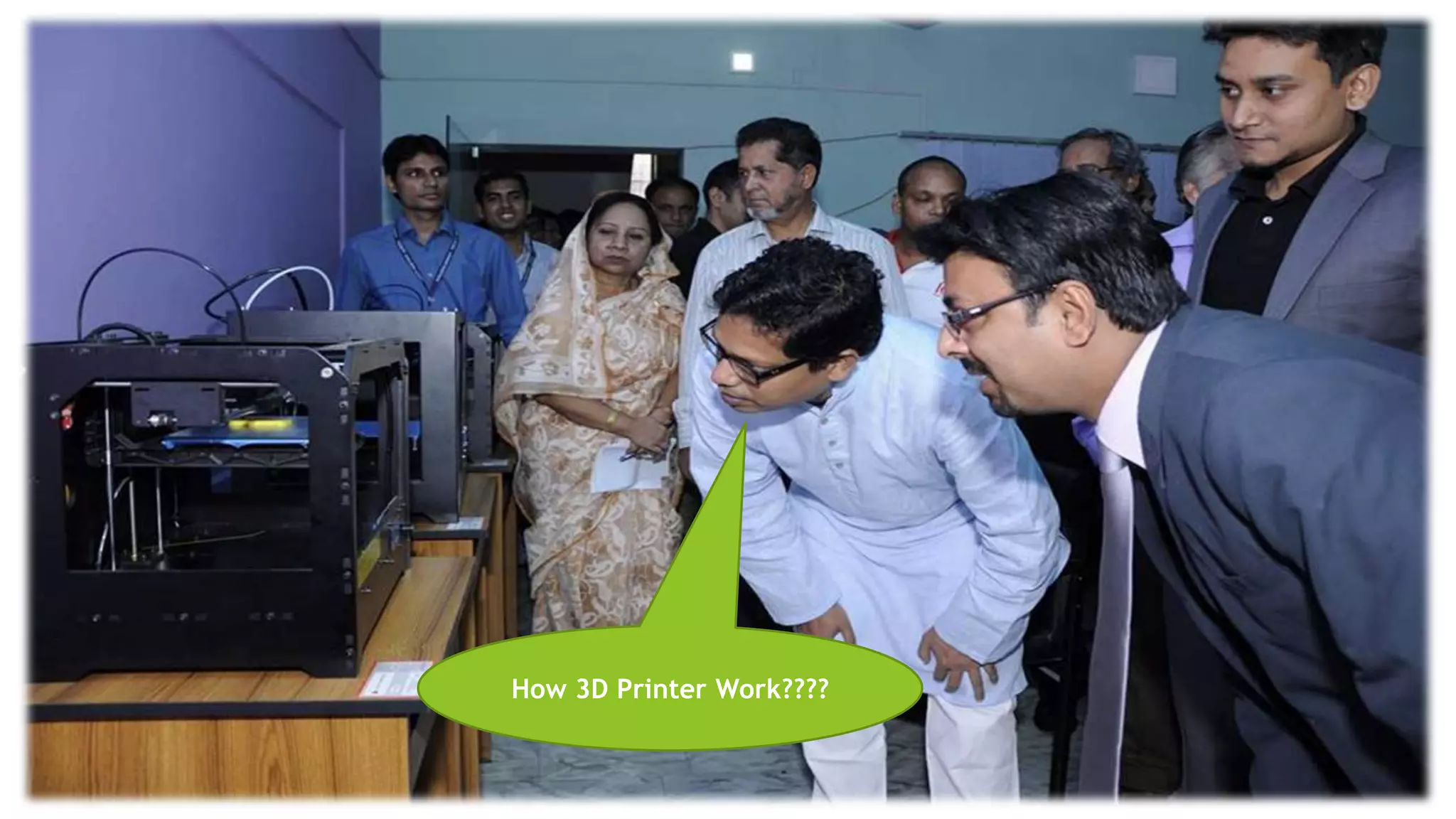
How 3D Printer Work????
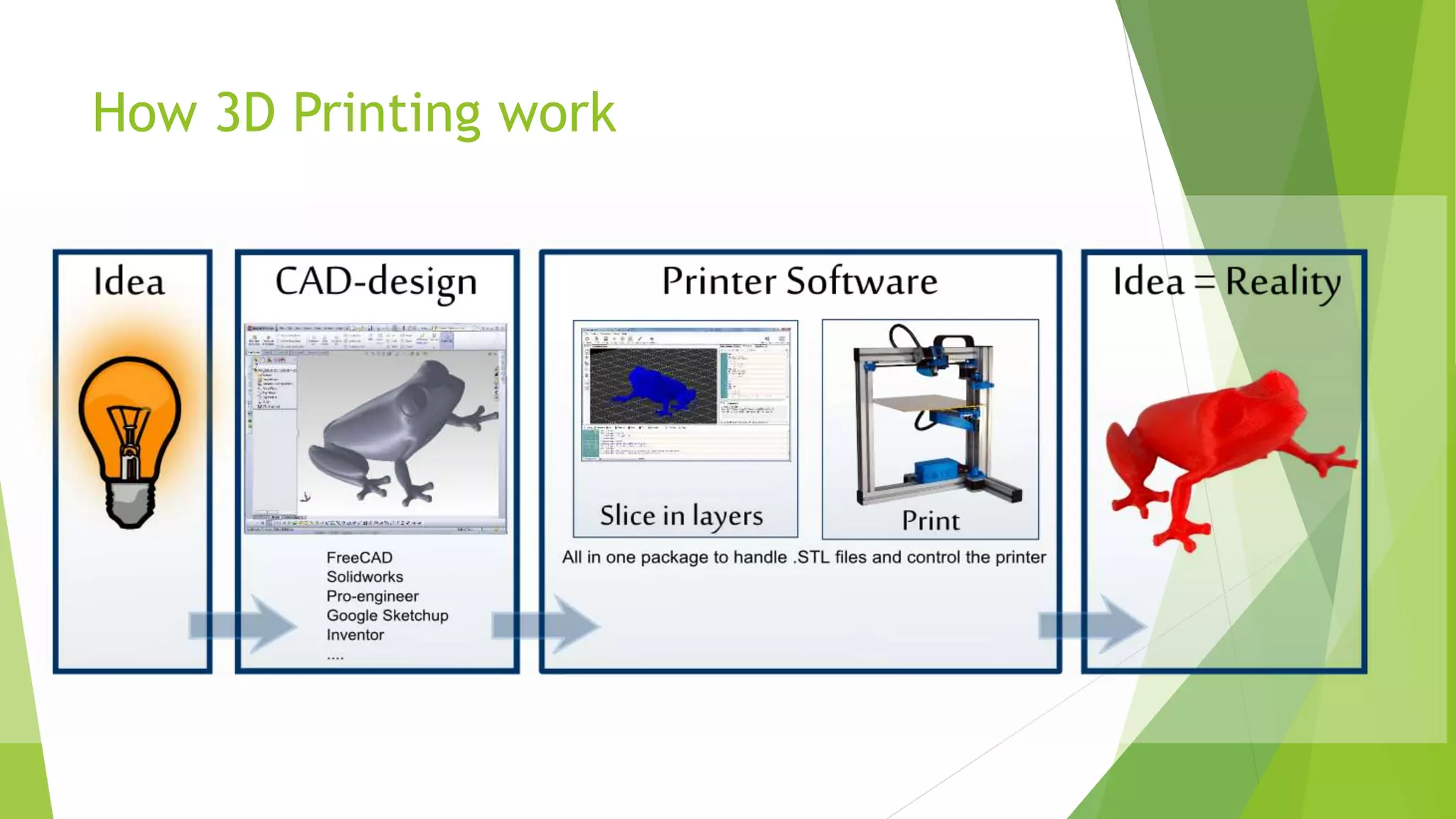
How 3D Printing work
1. A person created a of an item using a computer aided design
Software Program.
2. The CAD information is send the printer.
3. The Printer forms the item by depositing the materials in
layers, Starting from the bottom layers on to a platform. In
some cases light or lasers used to harden the materials.
How 3D Printing work
General Principles
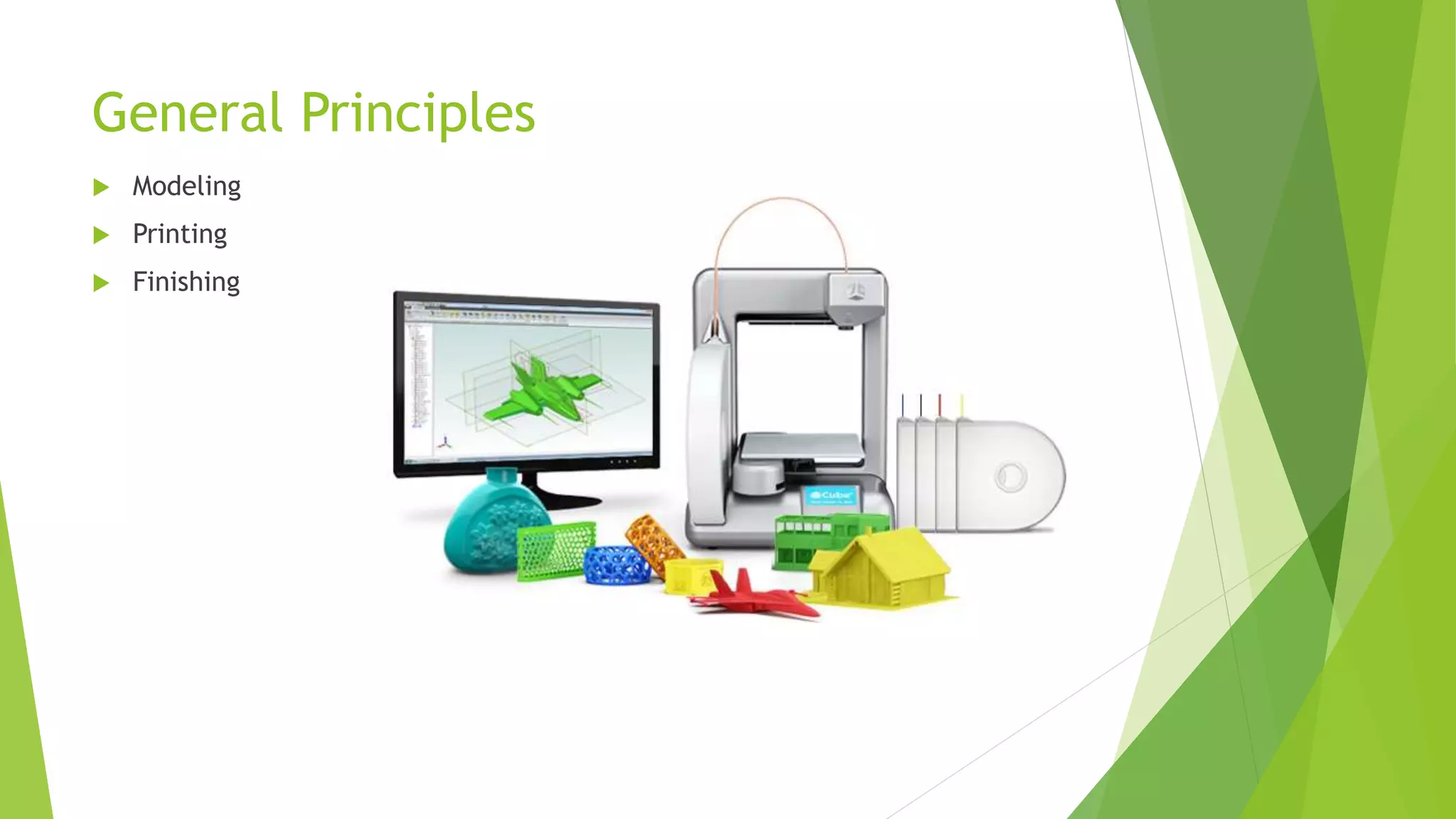
 Modeling
 Printing
 Finishing
Modeling
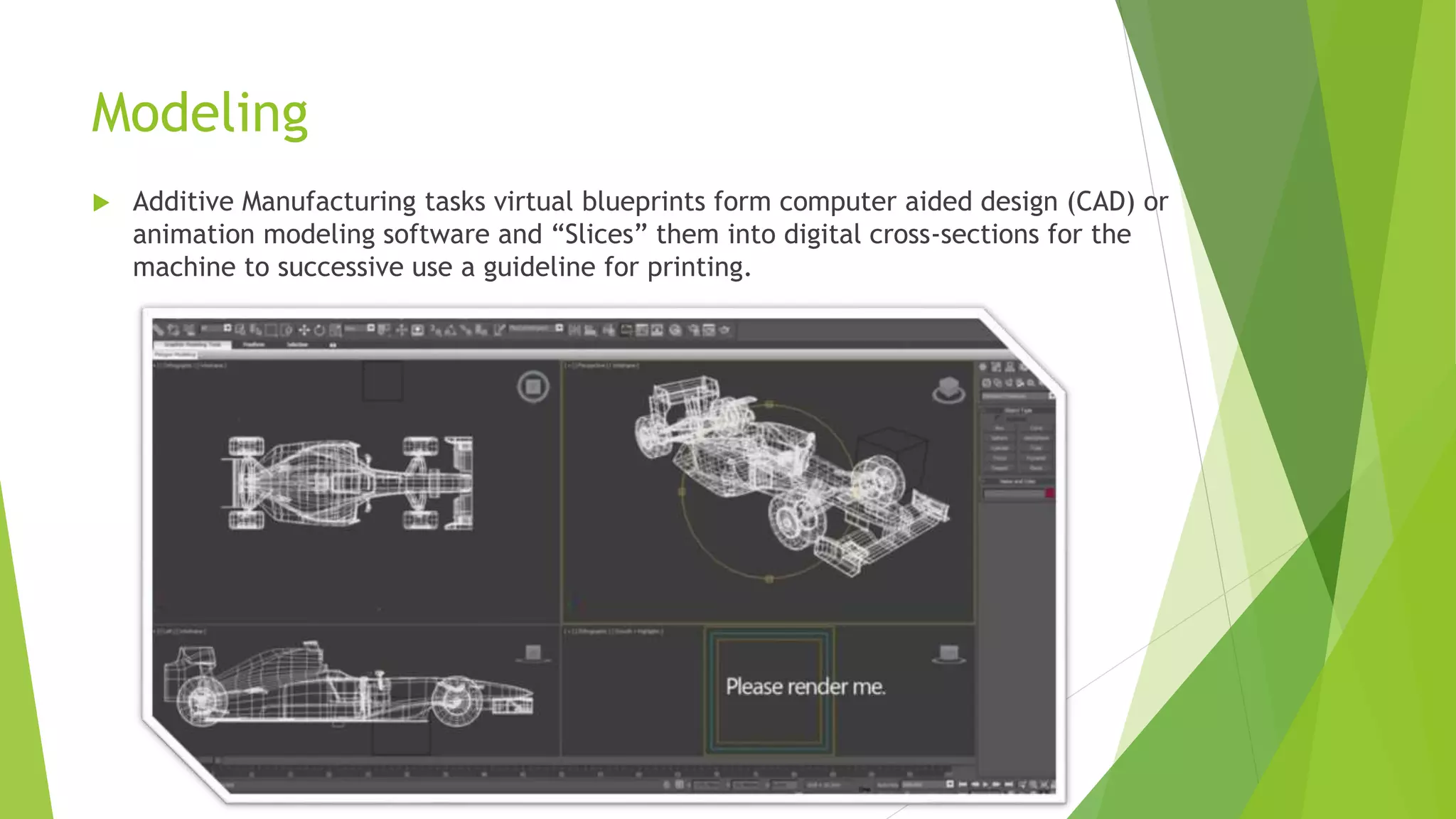
 Additive Manufacturing tasks virtual blueprints form computer aided design (CAD) or
animation modeling software and “Slices” them into digital cross-sections for the
machine to successive use a guideline for printing.
Printing
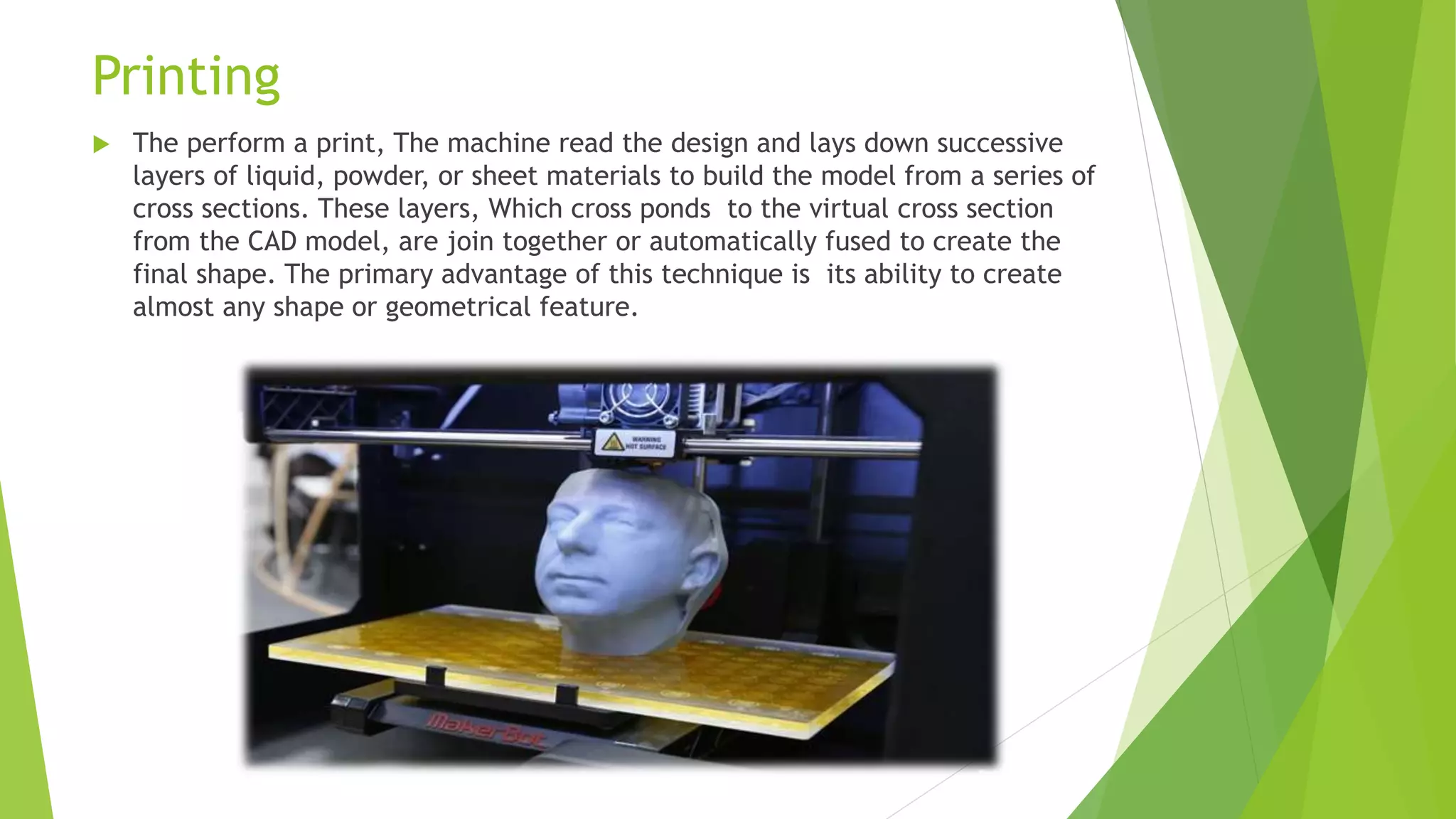
 The perform a print, The machine read the design and lays down successive
layers of liquid, powder, or sheet materials to build the model from a series of
cross sections. These layers, Which cross ponds to the virtual cross section
from the CAD model, are join together or automatically fused to create the
final shape. The primary advantage of this technique is its ability to create
almost any shape or geometrical feature.
Finishing
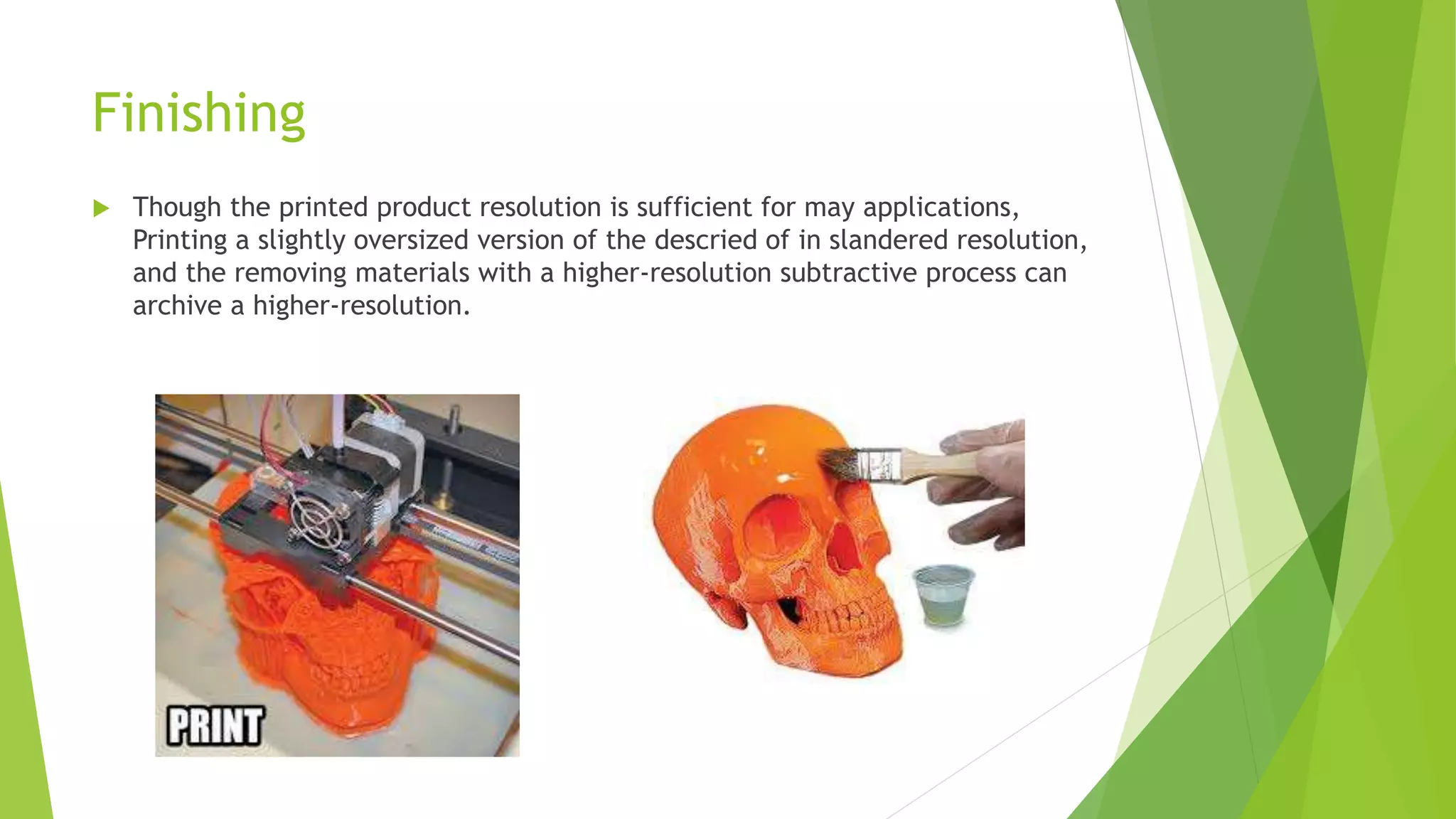
 Though the printed product resolution is sufficient for may applications,
Printing a slightly oversized version of the descried of in slandered resolution,
and the removing materials with a higher-resolution subtractive process can
archive a higher-resolution.
Different Methods
 Stereo lithography
 Selective laser sintering (SLS)
 Fused deposition modeling (FDM)
 Ink-Jet 3D Printing
Value proposition of 3D Printing
 Fabrication on demand
 Shorter Product development time due to rapid prototyping
 Less reliance on logistics
 Mass Customization
 Caters to each individual’s wants and needs instead of mass production and
consumption
Advantages
 Print movable parts
 Print Items in remote locations
 Ability to send items over internet and print out at home
 Plastic use is strong
Disadvantages
 No regulations on what can be made example weapons
 Kids could print out dangerous Items
 Provide advantages for criminals
 Counterfeiting
 Expansive
Conclusion
 Nothing communicates ideas faster than a three dimensional parts or model.
With a 3D printer you can bring CAD file and design ideas to life- right form
your desktop. Test form, Fit and function as and many design variations as
you like with functional parts.
3D Printer University-assignment

3D Printer University-assignment

  • 1.
    Md. Foyaz Ullah CSE–38(evening) Roll:201411038150 Presented by: Anowar Hossain CSE-38(evening) Roll: 201411038148 Bangladesh University
  • 2.
    Outline  Introduction  History What is 3D Printing?  General Principal  How it’s work?  Different method of 3D Printing  Advantage  Disadvantage  Calculation
  • 3.
    Introduction  3D printeris a modern technology in which 3 dimensional objects are printed from digital data  Three dimensional object is created by laying down successive layers of materials.
  • 4.
    History  The technologyfor printing physical 3D object from digital data was first developed by Chuck Hull in 1984. He named the technique as Stereo lithography and obtained a patent for the technique in 1984.
  • 5.
    What is 3DPrinting?  3D Printing is a form of additive manufacturing in which components are fabricated in an additive fashion by adding successive layers of materials together.  It is also know as: Rapid Prototyping Additive manufacturing.  3D printing or additive manufacturing is a process of making three dimensional solid objects from a digital file. The creation of a 3D printed object is achieved using additive processes. In an additive process an object is created by laying down successive layers of material until the entire object is created.
  • 6.
  • 7.
    How 3D Printingwork 1. A person created a of an item using a computer aided design Software Program. 2. The CAD information is send the printer. 3. The Printer forms the item by depositing the materials in layers, Starting from the bottom layers on to a platform. In some cases light or lasers used to harden the materials.
  • 8.
  • 9.
  • 10.
    Modeling  Additive Manufacturingtasks virtual blueprints form computer aided design (CAD) or animation modeling software and “Slices” them into digital cross-sections for the machine to successive use a guideline for printing.
  • 11.
    Printing  The performa print, The machine read the design and lays down successive layers of liquid, powder, or sheet materials to build the model from a series of cross sections. These layers, Which cross ponds to the virtual cross section from the CAD model, are join together or automatically fused to create the final shape. The primary advantage of this technique is its ability to create almost any shape or geometrical feature.
  • 12.
    Finishing  Though theprinted product resolution is sufficient for may applications, Printing a slightly oversized version of the descried of in slandered resolution, and the removing materials with a higher-resolution subtractive process can archive a higher-resolution.
  • 13.
    Different Methods  Stereolithography  Selective laser sintering (SLS)  Fused deposition modeling (FDM)  Ink-Jet 3D Printing
  • 14.
    Value proposition of3D Printing  Fabrication on demand  Shorter Product development time due to rapid prototyping  Less reliance on logistics  Mass Customization  Caters to each individual’s wants and needs instead of mass production and consumption
  • 15.
    Advantages  Print movableparts  Print Items in remote locations  Ability to send items over internet and print out at home  Plastic use is strong
  • 16.
    Disadvantages  No regulationson what can be made example weapons  Kids could print out dangerous Items  Provide advantages for criminals  Counterfeiting  Expansive
  • 18.
    Conclusion  Nothing communicatesideas faster than a three dimensional parts or model. With a 3D printer you can bring CAD file and design ideas to life- right form your desktop. Test form, Fit and function as and many design variations as you like with functional parts.