13/10/2024 1
JOURNAL CLUB
DR STEFI M S, 1STYEAR POST GRADUATE STUDENT
DR PRAVIN PISUDDE,ASSOCIATE PROFESSOR, DEPT OF COMMUNITY MEDICINE.
13/10/2024 2
UNDERSTANDING
BIBLIOMETRIC
PARAMETERS AND
ANALYSIS
13/10/2024 3
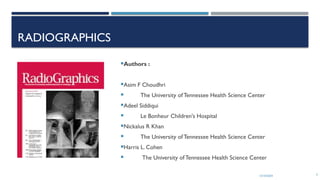
RADIOGRAPHICS
Authors :
Asim F Choudhri
 The University of Tennessee Health Science Center
Adeel Siddiqui
 Le Bonheur Children's Hospital
Nickalus R Khan
 The University of Tennessee Health Science Center
Harris L. Cohen
 The University of Tennessee Health Science Center
13/10/2024 4
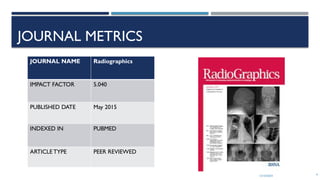
JOURNAL METRICS
JOURNAL NAME Radiographics
IMPACT FACTOR 5.040
PUBLISHED DATE May 2015
INDEXED IN PUBMED
ARTICLETYPE PEER REVIEWED
13/10/2024 5
LEARNING OBJECTIVES
 To learn about Journal Article Presentation
 Learn about bibliometric parameters.
 To learn about the uses of bibliometric parameters
 Understand each bibliometric parameters
13/10/2024 6
FRAMEWORK
 Introduction
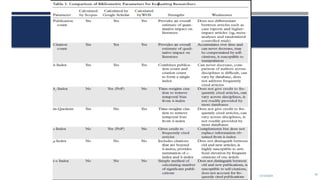
 Bibliometric parameters
 For authors
 For journals
 Databases
 Conclusion
 Critical review
 Take home message
13/10/2024 7
INTRODUCTION
 Quantitative measures
 Bibliometrics
 Qualitative measures
 Expert opinion.
 Peer review: feedback from other researchers who have reviewed the article before publication
 Content analysis: quality of the research, the clarity of the writing, the relevance to the field, and
other factors that are not necessarily numerical
13/10/2024 8
BIBLIOMETRICS
 Bibliometrics is a field that uses quantitative means to evaluate academic productivity
 Bibliometrics involves analysing and measuring the output and impact of publications,
researchers, institutions, and scientific fields using bibliographic parameters from databases
such as Web of Science, Scopus, or Google Scholar
13/10/2024 9
BIBLIOMETRIC PARAMETERS
 Evaluation of Authors
 Publication Count
 Citation Count
 h-Index
 m-Quotient
 hc-Index
 e-Index
 g-Index
 i-10 Index
13/10/2024 10
BIBLIOMETRIC PARAMETERS
 Evaluation of Journals
 Impact Factor
 Eigenfactor
 Article Influence Score
 SCImago Journal Rank
 Source-normalized Impact per Paper
13/10/2024 11
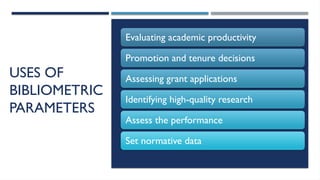
USES OF
BIBLIOMETRIC
PARAMETERS
Evaluating academic productivity
Promotion and tenure decisions
Assessing grant applications
Identifying high-quality research
Assess the performance
Set normative data
13/10/2024 12
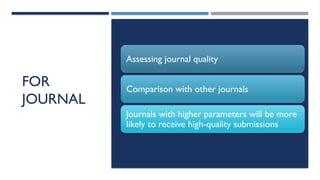
FOR
JOURNAL
Assessing journal quality
Comparison with other journals
Journals with higher parameters will be more
likely to receive high-quality submissions
13/10/2024 13
EVALUATION OF
AUTHORS
13/10/2024 14
PUBLICATION COUNT
 DEFINITION:
 Publication count refers to the number of publications that an individual or organization has
produced and made publicly available
 CALCULATION:
 ∑no. of publications
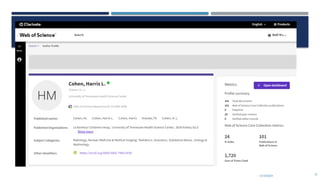
 Eg. Harris L. Cohen has a publication count of 101.
13/10/2024 15
PUBLICATION COUNT
 Advantages:
• Includes only peer-reviewed articles in indexed journals
• Book chapters not considered
• Case reports included, editorials and opinion pieces excluded
• Provides an overall quantitative estimate of the impact on literature
• Calculated by Scopus, google scholar, and web of science
13/10/2024 16
PUBLICATION COUNT
 Disadvantages:
• Does not consider authorship position or journal quality
• "Throwaway" journals counted equally with rigorous journals
• Does not distinguish between original ground-breaking research and less impactful articles such
as case reports
13/10/2024 17
CITATION COUNT
 Definition:
 Citation count refers to the number of times a particular scholarly work has been cited by
other published works
 Citation count measures the influence of an article on subsequent publications
 Calculation
 ∑citations
 Eg. Harris L. Cohen has citation count of 1720.
13/10/2024 18
CITATION COUNT
 Advantages:
 Provides an estimate of the qualitative impact on literature
 Calculated by Scopus, google scholar, and web of science
 Disadvantages:
 May not consider the impact of widely read but uncited articles
 Does not differentiate between positive and negative citations
 Self-citations by an author are counted, which may be appropriate or considered dishonest
13/10/2024 19
H-INDEX
 Definition:
 The h-index is a dimensionless number that represents an attempt to describe the quantity,
quality, or impact of a given author’s academic publications and is based on a set of the author’s
most frequently cited articles
 Attempts to quantify publication and citation counts in a single metric.
 Calculation:
 A given author has had h articles published, each of which has h or more citations
 Additional publications will not increase the h-index until and unless they are cited an
13/10/2024 20
H-INDEX ADVANTAGES
 Provides a measure of an author's impact on the scientific community
 The h-index is less prone to manipulation compared to publication or citation counts
 The stratification of academic rank is more reproducible on the basis of the h-index,
which can be used as a factor in academic promotions.
 Articles that have been cited less frequently are given less weight in the h-index
 H Index is best to measure to create normative data at different levels of academic rank
13/10/2024 21
H-INDEX DISADVANTAGES
 Incremental increases in the h-index become progressively more difficult
 Citations within the h-index do include self-citations
 Can never decrease
 comparison of authors across disciplines is difficult
 can vary by database
 does not address frequently cited articles
13/10/2024 22
M-QUOTIENT
 Definition:
 The m-Quotient or m-Index
 The m-quotient is a variant of the h-index and represents an author's h-index divided by the
number of years since their first publication
 It measures the average amount an author's h-index has increased per year over their
publishing career
 Calculation:
 H-index/years since the first publication
13/10/2024 23
M-QUOTIENT
 Advantages:
 The m-quotient can differentiate between two authors with similar h-indexes but different career lengths
 An h-index of 12 for an individual 10 years into their career may be considered more substantial than an h-
index of 12 for an individual 24 years into their career
 Disadvantages:
 It can be disadvantageous for individuals who started publishing early in their career.
 Does not give credit to frequently cited articles
 Can vary across disciplines
 Is not readily provided by most databases
13/10/2024 24
HC INDEX
 Definition:
 The contemporary index
 Multiplying the citation count for an article by four, then dividing by the number of years
since publication
 Calculation:
 Citation count*4/no years since the publication
13/10/2024 25
HC INDEX
 Advantages:
 Time-weights citation to remove temporal bias from h-index
 Older published articles are given less weight
 Emphasis is placed on more recent articles
 Disadvantages:
 Does not give credit to frequently cited articles
 Can vary across disciplines
 Is not readily provided by most databases
13/10/2024 26
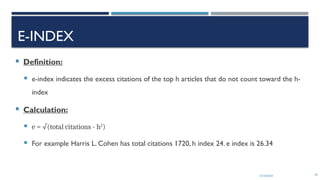
E-INDEX
 Definition:
 e-index indicates the excess citations of the top h articles that do not count toward the h-
index
 Calculation:
 e = √(total citations - h2
)
 For example Harris L. Cohen has total citations 1720, h index 24. e index is 26.34
13/10/2024 27
E-INDEX
 Advantages:
 Gives credit to frequently cited articles.
 Disadvantages:
 Complements but does not replace information obtained from h-index
13/10/2024 28
G-INDEX
 Definition:
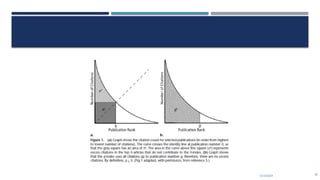
 Defined as a number such that the top g articles are cited an average of g times
 Calculation:
 " articles ranked in decreasing order of the number of citations that they received, the g-index
is the largest number such that the top g articles received at least g² citations."
13/10/2024 29
G-INDEX
 Advantages:
 Includes citations that are beyond h-index; provides a summation of e-index and h-index
 Disadvantages:
 Does not distinguish between old and new articles; is highly susceptible to artificial elevation by
frequent citations of one article
13/10/2024 30
13/10/2024 31
I-10 INDEX
 Definition:
 The i-10 index is the number of publications that have been cited 10 or more times
 An attempt to filter through unsubstantial work
 Calculation:
 ∑publications that have min 10 citations
13/10/2024 32
ADVANTAGES
 Advantages
 Simple method of calculating the number of significant publications
 Disadvantages
 Does not distinguish between old and new publications, is susceptible to self-citations, does not
account for frequently cited publications
13/10/2024 33
I-N INDEX
 Any i-n index could accordingly be calculated for any n, such as i-5(which may be more
helpful in evaluating more junior authors) or i-100 (which could be applied to compare
entire departments).
13/10/2024 34
13/10/2024 35
13/10/2024 36
13/10/2024 37
13/10/2024 38
EVALUATION OF
JOURNAL
13/10/2024 39
IMPACT FACTOR
 Definition:
 The impact factor was developed by Eugene Garfield and the Institute for Scientific Information
 The impact factor takes into account all indexed citations received by a given journal divided by
the number of “citable” articles published by a journal
 Calculation
 No. of citations in target window/ no. of articles published in the census period
 Target window: period of time in which citations are counted. (2yrs)
 Census period : time frame in which citable articles are counted.(1yr)
13/10/2024 40
IMPACT FACTOR
 Advantages
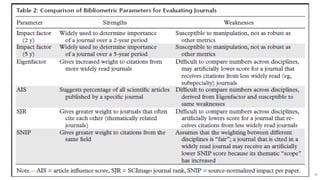
 Best used to compare different journals from the same scientific discipline
 Widely used to determine the importance of a journal
 Disadvantages
 Difficult to compare journals in different fields
 Can be manipulated by editorial policies, such as defining what constitutes a citable article
 One widely cited article can artificially inflate the impact factor, even if it is controversial or criticized
 Case reports are often cited infrequently, leading some journals to discontinue publishing them to maintain a
higher impact factor
13/10/2024 41
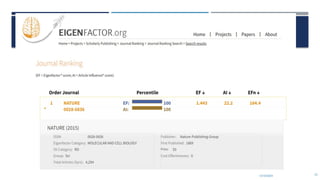
EIGENFACTOR
 Definition:
 The Eigenfactor was developed by researchers at the University of Washington and the
University of California.
 It gives greater weight to citations from more widely read journals and uses a 5-year target
window.
 Based on WOS database
 Calculation
 Mathematical algorithm
13/10/2024 42
ADVANTAGES
 The mathematical algorithm, used is much more robust and less subject to rapid
fluctuations or manipulation
 Gives increased weight to citations from more widely read journals by using the concept
of Eigenvector centrality
 On the Internet, a more highly trafficked website would receive a higher eigenvector
centrality score than a less highly trafficked website
 More credibility than the impact factor
13/10/2024 43
DISADVANTAGES
 Difficult to compare journals in different fields
 Complex calculation
 May be biased towards more established journals
 Slowly respond to changes
 Lack of transparency
13/10/2024 44
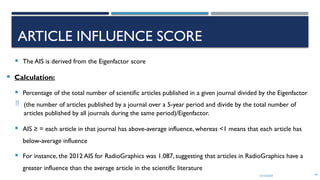
ARTICLE INFLUENCE SCORE
 The AIS is derived from the Eigenfactor score
 Calculation:
 Percentage of the total number of scientific articles published in a given journal divided by the Eigenfactor
 (the number of articles published by a journal over a 5-year period and divide by the total number of
articles published by all journals during the same period)/Eigenfactor.
 AIS ≥ = each article in that journal has above-average influence, whereas <1 means that each article has
below-average influence
 For instance, the 2012 AIS for RadioGraphics was 1.087, suggesting that articles in RadioGraphics have a
greater influence than the average article in the scientific literature
13/10/2024 45
ARTICLE INFLUENCE SCORE
 Advantages:
 Percentage of scientific articles published by a specific journal
 Disadvantages:
 Same weaknesses of Eigenfactor
13/10/2024 46
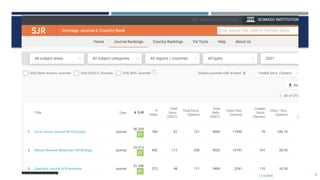
SCIMAGO JOURNAL RANK
 Definition:
 The SJR was developed by the SCImago Research Group at the University of Extremadura in Spain
 Based on the Scopus database
 SJR2 was introduced in 2012
 The SJR2 indicator was designed to weigh the citations according to the prestige of the citing journal.
 Takes into account the thematic relationship between the citing and cited journal.
 The more often that related journals cite a specific journal, the more prominence that journal is given in its
respective discipline
 Calculation: Algorithm
13/10/2024 47
SCIMAGO JOURNAL RANK
 Advantages:
 Gives greater weight to journals that often cite each other
 Disadvantages:
 Difficulty in comparing numbers across different disciplines since the citation practices and
publication patterns vary among fields
 The scores may be artificially lowered for journals that receive citations from less widely read
journals, even if the citing papers are from highly reputable sources
13/10/2024 48
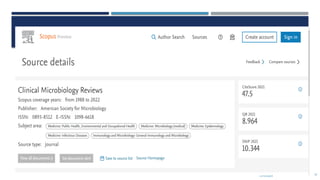
SOURCE-NORMALIZED IMPACT PER PAPER
 Definition:
 Source-normalized Impact per Paper was created by Professor Henk Moed at the University of Leiden,
the Netherlands
 SNIP gives greater weight to citations from the same scientific discipline
 Citations in fields that have fewer overall citations are given more weight
 Calculation:
 Journal's citation count per paper/ the citation potential in a given discipline
 Citation potential is calculated based on the average number of references per article in a given field,
which varies between disciplines
13/10/2024 49
SOURCE-NORMALIZED IMPACT PER PAPER
 Advantages:
 Gives greater weight to citations from the same field.
 Allows comparison of journals from different field.
 Disadvantages:
 Journal that is cited in a widely read journal may receive an artificially lower SNIP score
13/10/2024 50
13/10/2024 51
13/10/2024 52
13/10/2024 53
13/10/2024 54
DATABASES
13/10/2024 55
PUBMED
 It was created by the National Library of Medicine
 PubMed incorporates "published online ahead of print" articles, which are not available
on some other databases
 Confined to the biomedical and life sciences journal literature
 Very little citation analysis on PubMed
 MEDLINE is the most common source of material, although other databases are also
included
 Updated daily.
13/10/2024 56
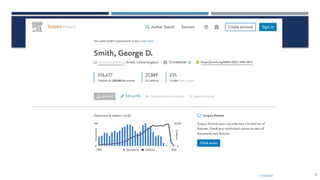
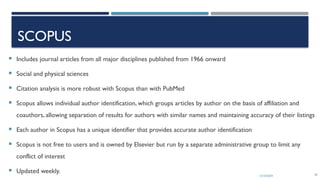
SCOPUS
 Includes journal articles from all major disciplines published from 1966 onward
 Social and physical sciences
 Citation analysis is more robust with Scopus than with PubMed
 Scopus allows individual author identification, which groups articles by author on the basis of affiliation and
coauthors, allowing separation of results for authors with similar names and maintaining accuracy of their listings
 Each author in Scopus has a unique identifier that provides accurate author identification
 Scopus is not free to users and is owned by Elsevier but run by a separate administrative group to limit any
conflict of interest
 Updated weekly.
13/10/2024 57
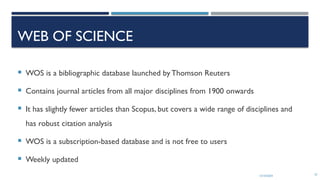
WEB OF SCIENCE
 WOS is a bibliographic database launched by Thomson Reuters
 Contains journal articles from all major disciplines from 1900 onwards
 It has slightly fewer articles than Scopus, but covers a wide range of disciplines and
has robust citation analysis
 WOS is a subscription-based database and is not free to users
 Weekly updated
13/10/2024 58
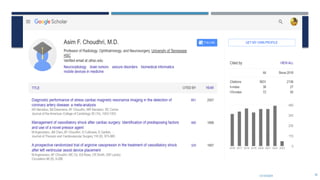
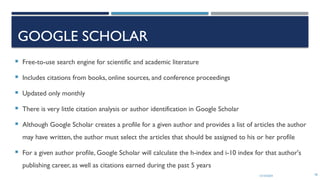
GOOGLE SCHOLAR
 Free-to-use search engine for scientific and academic literature
 Includes citations from books, online sources, and conference proceedings
 Updated only monthly
 There is very little citation analysis or author identification in Google Scholar
 Although Google Scholar creates a profile for a given author and provides a list of articles the author
may have written, the author must select the articles that should be assigned to his or her profile
 For a given author profile, Google Scholar will calculate the h-index and i-10 index for that author's
publishing career, as well as citations earned during the past 5 years
13/10/2024 59
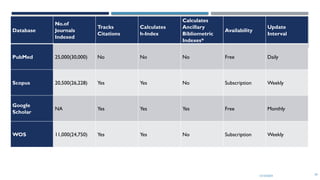
Database
No.of
Journals
Indexed
Tracks
Citations
Calculates
h-Index
Calculates
Ancillary
Bibliometric
Indexes*
Availability
Update
Interval
PubMed 25,000(30,000) No No No Free Daily
Scopus 20,500(26,228) Yes Yes No Subscription Weekly
Google
Scholar
NA Yes Yes Yes Free Monthly
WOS 11,000(24,750) Yes Yes No Subscription Weekly
13/10/2024 60
TOOLS
13/10/2024 61
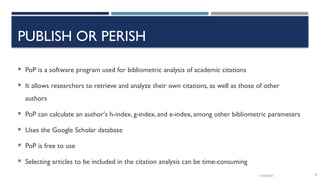
PUBLISH OR PERISH
 PoP is a software program used for bibliometric analysis of academic citations
 It allows researchers to retrieve and analyze their own citations, as well as those of other
authors
 PoP can calculate an author's h-index, g-index, and e-index, among other bibliometric parameters
 Uses the Google Scholar database
 PoP is free to use
 Selecting articles to be included in the citation analysis can be time-consuming
13/10/2024 62
CONSCLUSION
 Bibliometric parameters are used to summarize academic output of researchers and
journals
 New metrics are being developed due to limitations of existing tools
 It's important to understand the underlying theory and strengths and weaknesses of
bibliometric parameters before adopting them
 Academic productivity cannot be accurately reduced to a single number.
 Bibliometrics can be used to compare individuals with different publication histories and
those with similar publication totals but different bibliometric parameters
13/10/2024 63
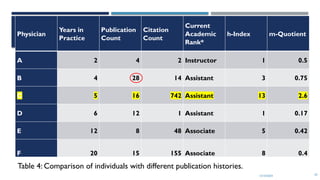
CONCLUSION
Physician
Years in
Practice
Publication
Count
Citation
Count
Current
Academic
Rank*
h-Index m-Quotient
A 2 4 2 Instructor 1 0.5
B 4 28 14 Assistant 3 0.75
C 5 16 742 Assistant 13 2.6
D 6 12 1 Assistant 1 0.17
E 12 8 48 Associate 5 0.42
F 20 15 155 Associate 8 0.4
Table 4: Comparison of individuals with different publication histories.
64
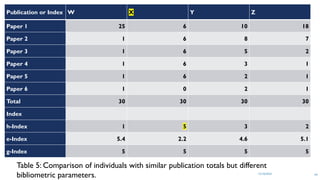
Publication or Index W X Y Z
Paper 1 25 6 10 18
Paper 2 1 6 8 7
Paper 3 1 6 5 2
Paper 4 1 6 3 1
Paper 5 1 6 2 1
Paper 6 1 0 2 1
Total 30 30 30 30
Index
h-Index 1 5 3 2
e-Index 5.4 2.2 4.6 5.1
g-Index 5 5 5 5
13/10/2024
Table 5: Comparison of individuals with similar publication totals but different
bibliometric parameters.
13/10/2024 65
CONSCLUSION
 Bibliometric parameters will have different values in different databases.
 H index is considered better index for comparing authors.
 Impact factor is most used index to compare journals.
13/10/2024 66
13/10/2024 67
13/10/2024 68
13/10/2024 69
CRITICAL REVIEW
13/10/2024 70
CRITICAL REVIEW- DISCUSSION
 Article emphasis more on bibliometric parameters as the tool to assess the academic
activity.
 Is research only tool for measuring academic activity?
 Bibliometric parameters are biased towards international journals
 Research published in local languages are restricted
13/10/2024 71
TAKE HOME MESSAGE
13/10/2024 72
TAKE HOME MESSAGE
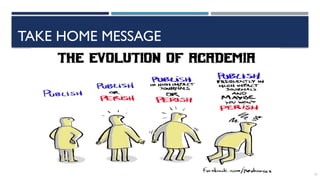
 Publish in high impact journals.
 Publish on relevant topics which will be cited more.
13/10/2024 73
REFERENCES
1. Choudhri AF, Siddiqui A, Khan NR, Cohen HL. Understanding Bibliometric Parameters and Analysis. RadioGraphics. 2015
May;35(3):736–46.
2. Allard RJ. Learning Resource Center: Measuring Your Research Impact: Author Impact [Internet]. [cited 2023 Mar 7].
Available from: https://usuhs.libguides.com/c.php?g=184957&p=2506307
3. Guerrero-Bote VP, Moya-Anegón F. A further step forward in measuring journals’ scientific prestige: The SJR2 indicator. J
Informetr. 2012 Oct;6(4):674–88.
4. Waltman L. A review of the literature on citation impact indicators. J Informetr. 2016 May;10(2):365–91.
13/10/2024 74
THANKYOU

Bibliographic parameters for authors and journals

  • 1.
    13/10/2024 1 JOURNAL CLUB DRSTEFI M S, 1STYEAR POST GRADUATE STUDENT DR PRAVIN PISUDDE,ASSOCIATE PROFESSOR, DEPT OF COMMUNITY MEDICINE.
  • 2.
  • 3.
    13/10/2024 3 RADIOGRAPHICS Authors : AsimF Choudhri  The University of Tennessee Health Science Center Adeel Siddiqui  Le Bonheur Children's Hospital Nickalus R Khan  The University of Tennessee Health Science Center Harris L. Cohen  The University of Tennessee Health Science Center
  • 4.
    13/10/2024 4 JOURNAL METRICS JOURNALNAME Radiographics IMPACT FACTOR 5.040 PUBLISHED DATE May 2015 INDEXED IN PUBMED ARTICLETYPE PEER REVIEWED
  • 5.
    13/10/2024 5 LEARNING OBJECTIVES To learn about Journal Article Presentation  Learn about bibliometric parameters.  To learn about the uses of bibliometric parameters  Understand each bibliometric parameters
  • 6.
    13/10/2024 6 FRAMEWORK  Introduction Bibliometric parameters  For authors  For journals  Databases  Conclusion  Critical review  Take home message
  • 7.
    13/10/2024 7 INTRODUCTION  Quantitativemeasures  Bibliometrics  Qualitative measures  Expert opinion.  Peer review: feedback from other researchers who have reviewed the article before publication  Content analysis: quality of the research, the clarity of the writing, the relevance to the field, and other factors that are not necessarily numerical
  • 8.
    13/10/2024 8 BIBLIOMETRICS  Bibliometricsis a field that uses quantitative means to evaluate academic productivity  Bibliometrics involves analysing and measuring the output and impact of publications, researchers, institutions, and scientific fields using bibliographic parameters from databases such as Web of Science, Scopus, or Google Scholar
  • 9.
    13/10/2024 9 BIBLIOMETRIC PARAMETERS Evaluation of Authors  Publication Count  Citation Count  h-Index  m-Quotient  hc-Index  e-Index  g-Index  i-10 Index
  • 10.
    13/10/2024 10 BIBLIOMETRIC PARAMETERS Evaluation of Journals  Impact Factor  Eigenfactor  Article Influence Score  SCImago Journal Rank  Source-normalized Impact per Paper
  • 11.
    13/10/2024 11 USES OF BIBLIOMETRIC PARAMETERS Evaluatingacademic productivity Promotion and tenure decisions Assessing grant applications Identifying high-quality research Assess the performance Set normative data
  • 12.
    13/10/2024 12 FOR JOURNAL Assessing journalquality Comparison with other journals Journals with higher parameters will be more likely to receive high-quality submissions
  • 13.
  • 14.
    13/10/2024 14 PUBLICATION COUNT DEFINITION:  Publication count refers to the number of publications that an individual or organization has produced and made publicly available  CALCULATION:  ∑no. of publications  Eg. Harris L. Cohen has a publication count of 101.
  • 15.
    13/10/2024 15 PUBLICATION COUNT Advantages: • Includes only peer-reviewed articles in indexed journals • Book chapters not considered • Case reports included, editorials and opinion pieces excluded • Provides an overall quantitative estimate of the impact on literature • Calculated by Scopus, google scholar, and web of science
  • 16.
    13/10/2024 16 PUBLICATION COUNT Disadvantages: • Does not consider authorship position or journal quality • "Throwaway" journals counted equally with rigorous journals • Does not distinguish between original ground-breaking research and less impactful articles such as case reports
  • 17.
    13/10/2024 17 CITATION COUNT Definition:  Citation count refers to the number of times a particular scholarly work has been cited by other published works  Citation count measures the influence of an article on subsequent publications  Calculation  ∑citations  Eg. Harris L. Cohen has citation count of 1720.
  • 18.
    13/10/2024 18 CITATION COUNT Advantages:  Provides an estimate of the qualitative impact on literature  Calculated by Scopus, google scholar, and web of science  Disadvantages:  May not consider the impact of widely read but uncited articles  Does not differentiate between positive and negative citations  Self-citations by an author are counted, which may be appropriate or considered dishonest
  • 19.
    13/10/2024 19 H-INDEX  Definition: The h-index is a dimensionless number that represents an attempt to describe the quantity, quality, or impact of a given author’s academic publications and is based on a set of the author’s most frequently cited articles  Attempts to quantify publication and citation counts in a single metric.  Calculation:  A given author has had h articles published, each of which has h or more citations  Additional publications will not increase the h-index until and unless they are cited an
  • 20.
    13/10/2024 20 H-INDEX ADVANTAGES Provides a measure of an author's impact on the scientific community  The h-index is less prone to manipulation compared to publication or citation counts  The stratification of academic rank is more reproducible on the basis of the h-index, which can be used as a factor in academic promotions.  Articles that have been cited less frequently are given less weight in the h-index  H Index is best to measure to create normative data at different levels of academic rank
  • 21.
    13/10/2024 21 H-INDEX DISADVANTAGES Incremental increases in the h-index become progressively more difficult  Citations within the h-index do include self-citations  Can never decrease  comparison of authors across disciplines is difficult  can vary by database  does not address frequently cited articles
  • 22.
    13/10/2024 22 M-QUOTIENT  Definition: The m-Quotient or m-Index  The m-quotient is a variant of the h-index and represents an author's h-index divided by the number of years since their first publication  It measures the average amount an author's h-index has increased per year over their publishing career  Calculation:  H-index/years since the first publication
  • 23.
    13/10/2024 23 M-QUOTIENT  Advantages: The m-quotient can differentiate between two authors with similar h-indexes but different career lengths  An h-index of 12 for an individual 10 years into their career may be considered more substantial than an h- index of 12 for an individual 24 years into their career  Disadvantages:  It can be disadvantageous for individuals who started publishing early in their career.  Does not give credit to frequently cited articles  Can vary across disciplines  Is not readily provided by most databases
  • 24.
    13/10/2024 24 HC INDEX Definition:  The contemporary index  Multiplying the citation count for an article by four, then dividing by the number of years since publication  Calculation:  Citation count*4/no years since the publication
  • 25.
    13/10/2024 25 HC INDEX Advantages:  Time-weights citation to remove temporal bias from h-index  Older published articles are given less weight  Emphasis is placed on more recent articles  Disadvantages:  Does not give credit to frequently cited articles  Can vary across disciplines  Is not readily provided by most databases
  • 26.
    13/10/2024 26 E-INDEX  Definition: e-index indicates the excess citations of the top h articles that do not count toward the h- index  Calculation:  e = √(total citations - h2 )  For example Harris L. Cohen has total citations 1720, h index 24. e index is 26.34
  • 27.
    13/10/2024 27 E-INDEX  Advantages: Gives credit to frequently cited articles.  Disadvantages:  Complements but does not replace information obtained from h-index
  • 28.
    13/10/2024 28 G-INDEX  Definition: Defined as a number such that the top g articles are cited an average of g times  Calculation:  " articles ranked in decreasing order of the number of citations that they received, the g-index is the largest number such that the top g articles received at least g² citations."
  • 29.
    13/10/2024 29 G-INDEX  Advantages: Includes citations that are beyond h-index; provides a summation of e-index and h-index  Disadvantages:  Does not distinguish between old and new articles; is highly susceptible to artificial elevation by frequent citations of one article
  • 30.
  • 31.
    13/10/2024 31 I-10 INDEX Definition:  The i-10 index is the number of publications that have been cited 10 or more times  An attempt to filter through unsubstantial work  Calculation:  ∑publications that have min 10 citations
  • 32.
    13/10/2024 32 ADVANTAGES  Advantages Simple method of calculating the number of significant publications  Disadvantages  Does not distinguish between old and new publications, is susceptible to self-citations, does not account for frequently cited publications
  • 33.
    13/10/2024 33 I-N INDEX Any i-n index could accordingly be calculated for any n, such as i-5(which may be more helpful in evaluating more junior authors) or i-100 (which could be applied to compare entire departments).
  • 34.
  • 35.
  • 36.
  • 37.
  • 38.
  • 39.
    13/10/2024 39 IMPACT FACTOR Definition:  The impact factor was developed by Eugene Garfield and the Institute for Scientific Information  The impact factor takes into account all indexed citations received by a given journal divided by the number of “citable” articles published by a journal  Calculation  No. of citations in target window/ no. of articles published in the census period  Target window: period of time in which citations are counted. (2yrs)  Census period : time frame in which citable articles are counted.(1yr)
  • 40.
    13/10/2024 40 IMPACT FACTOR Advantages  Best used to compare different journals from the same scientific discipline  Widely used to determine the importance of a journal  Disadvantages  Difficult to compare journals in different fields  Can be manipulated by editorial policies, such as defining what constitutes a citable article  One widely cited article can artificially inflate the impact factor, even if it is controversial or criticized  Case reports are often cited infrequently, leading some journals to discontinue publishing them to maintain a higher impact factor
  • 41.
    13/10/2024 41 EIGENFACTOR  Definition: The Eigenfactor was developed by researchers at the University of Washington and the University of California.  It gives greater weight to citations from more widely read journals and uses a 5-year target window.  Based on WOS database  Calculation  Mathematical algorithm
  • 42.
    13/10/2024 42 ADVANTAGES  Themathematical algorithm, used is much more robust and less subject to rapid fluctuations or manipulation  Gives increased weight to citations from more widely read journals by using the concept of Eigenvector centrality  On the Internet, a more highly trafficked website would receive a higher eigenvector centrality score than a less highly trafficked website  More credibility than the impact factor
  • 43.
    13/10/2024 43 DISADVANTAGES  Difficultto compare journals in different fields  Complex calculation  May be biased towards more established journals  Slowly respond to changes  Lack of transparency
  • 44.
    13/10/2024 44 ARTICLE INFLUENCESCORE  The AIS is derived from the Eigenfactor score  Calculation:  Percentage of the total number of scientific articles published in a given journal divided by the Eigenfactor  (the number of articles published by a journal over a 5-year period and divide by the total number of articles published by all journals during the same period)/Eigenfactor.  AIS ≥ = each article in that journal has above-average influence, whereas <1 means that each article has below-average influence  For instance, the 2012 AIS for RadioGraphics was 1.087, suggesting that articles in RadioGraphics have a greater influence than the average article in the scientific literature
  • 45.
    13/10/2024 45 ARTICLE INFLUENCESCORE  Advantages:  Percentage of scientific articles published by a specific journal  Disadvantages:  Same weaknesses of Eigenfactor
  • 46.
    13/10/2024 46 SCIMAGO JOURNALRANK  Definition:  The SJR was developed by the SCImago Research Group at the University of Extremadura in Spain  Based on the Scopus database  SJR2 was introduced in 2012  The SJR2 indicator was designed to weigh the citations according to the prestige of the citing journal.  Takes into account the thematic relationship between the citing and cited journal.  The more often that related journals cite a specific journal, the more prominence that journal is given in its respective discipline  Calculation: Algorithm
  • 47.
    13/10/2024 47 SCIMAGO JOURNALRANK  Advantages:  Gives greater weight to journals that often cite each other  Disadvantages:  Difficulty in comparing numbers across different disciplines since the citation practices and publication patterns vary among fields  The scores may be artificially lowered for journals that receive citations from less widely read journals, even if the citing papers are from highly reputable sources
  • 48.
    13/10/2024 48 SOURCE-NORMALIZED IMPACTPER PAPER  Definition:  Source-normalized Impact per Paper was created by Professor Henk Moed at the University of Leiden, the Netherlands  SNIP gives greater weight to citations from the same scientific discipline  Citations in fields that have fewer overall citations are given more weight  Calculation:  Journal's citation count per paper/ the citation potential in a given discipline  Citation potential is calculated based on the average number of references per article in a given field, which varies between disciplines
  • 49.
    13/10/2024 49 SOURCE-NORMALIZED IMPACTPER PAPER  Advantages:  Gives greater weight to citations from the same field.  Allows comparison of journals from different field.  Disadvantages:  Journal that is cited in a widely read journal may receive an artificially lower SNIP score
  • 50.
  • 51.
  • 52.
  • 53.
  • 54.
  • 55.
    13/10/2024 55 PUBMED  Itwas created by the National Library of Medicine  PubMed incorporates "published online ahead of print" articles, which are not available on some other databases  Confined to the biomedical and life sciences journal literature  Very little citation analysis on PubMed  MEDLINE is the most common source of material, although other databases are also included  Updated daily.
  • 56.
    13/10/2024 56 SCOPUS  Includesjournal articles from all major disciplines published from 1966 onward  Social and physical sciences  Citation analysis is more robust with Scopus than with PubMed  Scopus allows individual author identification, which groups articles by author on the basis of affiliation and coauthors, allowing separation of results for authors with similar names and maintaining accuracy of their listings  Each author in Scopus has a unique identifier that provides accurate author identification  Scopus is not free to users and is owned by Elsevier but run by a separate administrative group to limit any conflict of interest  Updated weekly.
  • 57.
    13/10/2024 57 WEB OFSCIENCE  WOS is a bibliographic database launched by Thomson Reuters  Contains journal articles from all major disciplines from 1900 onwards  It has slightly fewer articles than Scopus, but covers a wide range of disciplines and has robust citation analysis  WOS is a subscription-based database and is not free to users  Weekly updated
  • 58.
    13/10/2024 58 GOOGLE SCHOLAR Free-to-use search engine for scientific and academic literature  Includes citations from books, online sources, and conference proceedings  Updated only monthly  There is very little citation analysis or author identification in Google Scholar  Although Google Scholar creates a profile for a given author and provides a list of articles the author may have written, the author must select the articles that should be assigned to his or her profile  For a given author profile, Google Scholar will calculate the h-index and i-10 index for that author's publishing career, as well as citations earned during the past 5 years
  • 59.
    13/10/2024 59 Database No.of Journals Indexed Tracks Citations Calculates h-Index Calculates Ancillary Bibliometric Indexes* Availability Update Interval PubMed 25,000(30,000)No No No Free Daily Scopus 20,500(26,228) Yes Yes No Subscription Weekly Google Scholar NA Yes Yes Yes Free Monthly WOS 11,000(24,750) Yes Yes No Subscription Weekly
  • 60.
  • 61.
    13/10/2024 61 PUBLISH ORPERISH  PoP is a software program used for bibliometric analysis of academic citations  It allows researchers to retrieve and analyze their own citations, as well as those of other authors  PoP can calculate an author's h-index, g-index, and e-index, among other bibliometric parameters  Uses the Google Scholar database  PoP is free to use  Selecting articles to be included in the citation analysis can be time-consuming
  • 62.
    13/10/2024 62 CONSCLUSION  Bibliometricparameters are used to summarize academic output of researchers and journals  New metrics are being developed due to limitations of existing tools  It's important to understand the underlying theory and strengths and weaknesses of bibliometric parameters before adopting them  Academic productivity cannot be accurately reduced to a single number.  Bibliometrics can be used to compare individuals with different publication histories and those with similar publication totals but different bibliometric parameters
  • 63.
    13/10/2024 63 CONCLUSION Physician Years in Practice Publication Count Citation Count Current Academic Rank* h-Indexm-Quotient A 2 4 2 Instructor 1 0.5 B 4 28 14 Assistant 3 0.75 C 5 16 742 Assistant 13 2.6 D 6 12 1 Assistant 1 0.17 E 12 8 48 Associate 5 0.42 F 20 15 155 Associate 8 0.4 Table 4: Comparison of individuals with different publication histories.
  • 64.
    64 Publication or IndexW X Y Z Paper 1 25 6 10 18 Paper 2 1 6 8 7 Paper 3 1 6 5 2 Paper 4 1 6 3 1 Paper 5 1 6 2 1 Paper 6 1 0 2 1 Total 30 30 30 30 Index h-Index 1 5 3 2 e-Index 5.4 2.2 4.6 5.1 g-Index 5 5 5 5 13/10/2024 Table 5: Comparison of individuals with similar publication totals but different bibliometric parameters.
  • 65.
    13/10/2024 65 CONSCLUSION  Bibliometricparameters will have different values in different databases.  H index is considered better index for comparing authors.  Impact factor is most used index to compare journals.
  • 66.
  • 67.
  • 68.
  • 69.
  • 70.
    13/10/2024 70 CRITICAL REVIEW-DISCUSSION  Article emphasis more on bibliometric parameters as the tool to assess the academic activity.  Is research only tool for measuring academic activity?  Bibliometric parameters are biased towards international journals  Research published in local languages are restricted
  • 71.
  • 72.
    13/10/2024 72 TAKE HOMEMESSAGE  Publish in high impact journals.  Publish on relevant topics which will be cited more.
  • 73.
    13/10/2024 73 REFERENCES 1. ChoudhriAF, Siddiqui A, Khan NR, Cohen HL. Understanding Bibliometric Parameters and Analysis. RadioGraphics. 2015 May;35(3):736–46. 2. Allard RJ. Learning Resource Center: Measuring Your Research Impact: Author Impact [Internet]. [cited 2023 Mar 7]. Available from: https://usuhs.libguides.com/c.php?g=184957&p=2506307 3. Guerrero-Bote VP, Moya-Anegón F. A further step forward in measuring journals’ scientific prestige: The SJR2 indicator. J Informetr. 2012 Oct;6(4):674–88. 4. Waltman L. A review of the literature on citation impact indicators. J Informetr. 2016 May;10(2):365–91.

  • 74.

Editor's Notes

  • #7 For assessing research work, we have qualitative and quantitative methods. evaluating the article based on the
  • #11 For researcher..can be used by the department to assess the performance the faculties..each field of science will have different publication rates and citation behaviour so for specific fields there is need for normative data.
  • #19 For example Harris L. Cohen has H index of 24, meaning out of 101 articles he has 24 articles that have been atleast cited 24 times.
  • #22 If we imagine harris has started publishing in 2013, 10 years..m index= 24/10 = 2.4,
  • #24 for example comparing article published 1 yr ago and 4 yrs ago,
  • #39 For example impact factor of a journal in the year 2022 will be all the citations received in 2022 and 21 divided by no of citable articles in 2022.
  • #45 Difficult to compare journals in different fields Complex calculation May be biased towards more established journals Slowly respond to changes Lack of transparency
  • #46 Prestige of a journal is measure of its importance and standing in the academic community and as well as its reputation within the field.
  • #55 30,000
  • #56 Articles from social and …..
  • #63 compare individuals with different publication histories : Arranged in the order of years of practice..dr B has more no of articles.but is rarely cited.h index is 3..Dr C has articles which are cited more…
  • #64 Total no of publications is 30 for all the doctors. But the parameters are different.
  • #65 citation count and h-index calculated by Scopus lower than those calculated by Google scholar. Scopus will not include data before 1996.Google Scholar includes more sources for citations, including books and some online sources. Zipfs law: citations from the scientific community follows a logical pattern of mathematic progression regardless of the author and scientific community being evaluated.