Introduction to IPv6
Agenda
 IP Network Addressing
 Classful IP addressing
 Techniques to reduce address
shortage in IPv4
 Features of IPv6
 Header Comparisons
 Extension Headers
 Conclusions
IP Network Addressing
 INTERNET  world’s largest public
data network, doubling in size every nine
months
 IPv4, defines a 32-bit address - 232
(4,294,967,296) IPv4 addresses available
 The first problem is concerned with the
eventual depletion of the IP address
space.
 Traditional model of classful addressing
does not allow the address space to be
used to its maximum potential.
Classful Addressing
 When IP was first standardized in Sep
1981, each system attached to the IP
based Internet had to be assigned a
unique 32-bit address
 The 32-bit IP addressing scheme involves
a two level addressing hierarchy
Network Number/Prefix Host Number
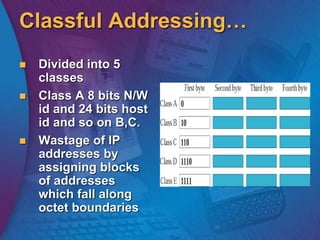
Classful Addressing…
 Divided into 5
classes
 Class A 8 bits N/W
id and 24 bits host
id and so on B,C.
 Wastage of IP
addresses by
assigning blocks
of addresses
which fall along
octet boundaries
Techniques to reduce
address shortage in IPv4
 Subnetting
 Classless Inter Domain Routing
(CIDR)
 Network Address Translation (NAT)
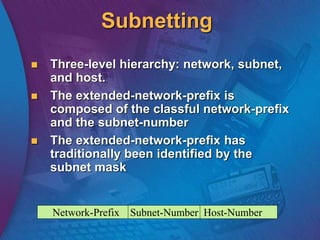
Subnetting
 Three-level hierarchy: network, subnet,
and host.
 The extended-network-prefix is
composed of the classful network-prefix
and the subnet-number
 The extended-network-prefix has
traditionally been identified by the
subnet mask
Network-Prefix Subnet-Number Host-Number
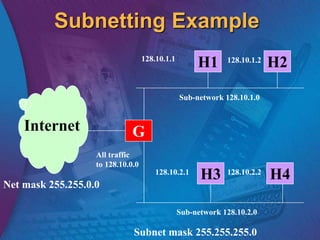
Subnetting Example
Internet G
H1 H2
H3 H4
Subnet mask 255.255.255.0
All traffic
to 128.10.0.0
128.10.1.1 128.10.1.2
128.10.2.1 128.10.2.2
Sub-network 128.10.1.0
Sub-network 128.10.2.0
Net mask 255.255.0.0
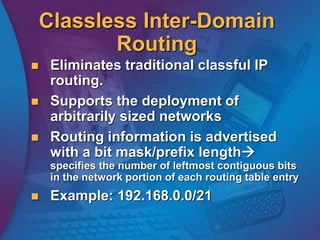
Classless Inter-Domain
Routing
 Eliminates traditional classful IP
routing.
 Supports the deployment of
arbitrarily sized networks
 Routing information is advertised
with a bit mask/prefix length
specifies the number of leftmost contiguous bits
in the network portion of each routing table entry
 Example: 192.168.0.0/21
CIDR Table Entry…
 Extract the destination IP address.
 Boolean AND the IP address with the
subnet mask for each entry in the
routing table.
 The answer you get after ANDing is
checked with the base address entry
corresponding to the subnet mask
entry with which the destination
entry was Boolean ANDed.
 If a match is obtained the packet is
forwarded to the router with the
corresponding base address
Network Address
Translation
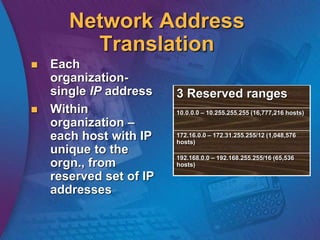
 Each
organization-
single IP address
 Within
organization –
each host with IP
unique to the
orgn., from
reserved set of IP
addresses
3 Reserved ranges
10.0.0.0 – 10.255.255.255 (16,777,216 hosts)
172.16.0.0 – 172.31.255.255/12 (1,048,576
hosts)
192.168.0.0 – 192.168.255.255/16 (65,536
hosts)
NAT Example
Source
Computer
Source
Computer's
IP Address
Source
Computer's
Port
NAT Router's
IP Address
NAT Router's
Assigned
Port Number
A 10.0.0.1 400 24.2.249.4 1
B 10.0.0.2 50 24.2.249.4 2
C 10.0.0.3 3750 24.2.249.4 3
D 10.0.0.4 206 24.2.249.4 4
10.0.0.4
10.0.0.1
B
C
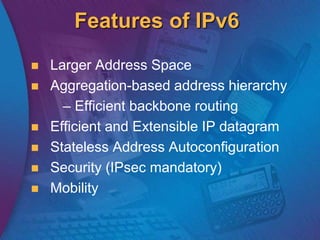
Features of IPv6
 Larger Address Space
 Aggregation-based address hierarchy
– Efficient backbone routing
 Efficient and Extensible IP datagram
 Stateless Address Autoconfiguration
 Security (IPsec mandatory)
 Mobility
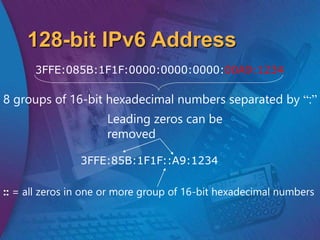
128-bit IPv6 Address
3FFE:085B:1F1F:0000:0000:0000:00A9:1234
8 groups of 16-bit hexadecimal numbers separated by “:”
3FFE:85B:1F1F::A9:1234
:: = all zeros in one or more group of 16-bit hexadecimal numbers
Leading zeros can be
removed
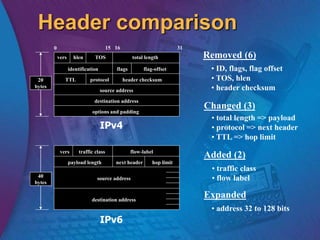
40
bytes
20
bytes
IPv4
IPv6
0 15 16 31
vers hlen TOS total length
identification flags flag-offset
TTL protocol header checksum
source address
destination address
options and padding
vers traffic class flow-label
payload length next header hop limit
source address
destination address
Removed (6)
• ID, flags, flag offset
• TOS, hlen
• header checksum
Changed (3)
Added (2)
Expanded
• total length => payload
• protocol => next header
• TTL => hop limit
• traffic class
• flow label
• address 32 to 128 bits
Header comparison
Major Improvements of
IPv6 Header
 No option field: Replaced by
extension header. Result in a fixed
length, 40-byte IP header.
 No header checksum: Result in fast
processing.
 No fragmentation at intermediate
nodes: Result in fast IP forwarding.
Extension Headers
 Routing – Extended routing, like IPv4
loose list of routers to visit
 Fragmentation – Fragmentation and
reassembly
 Authentication – Integrity and
authentication, security
 Encapsulation – Confidentiality
 Hop-by-Hop Option – Special options that
require hop-by-hop processing
 Destination Options – Optional
information to be examined by the
destination node
Stateless Address
Autoconfiguration
 3 ways to configure network
interfaces: Manually, Stateful,
Stateless
 IPSAA IPv6 addr. Separated into 2
2 parts: network and interface id.
 Link- local addresses: prefix FE80::0
+ interface identifier (EUI-64 format)
 Obtain network id through Router
solicitation (RS)
Conclusion
 IPv6 is NEW …
– built on the experiences learned from IPv4
– new features
– large address space
– new efficient header
– autoconfiguration
 … and OLD
– still IP
– build on a solid base
– started in 1995, a lot of implementations
and tests done

IPV6.ppt

  • 1.
  • 2.
    Agenda  IP NetworkAddressing  Classful IP addressing  Techniques to reduce address shortage in IPv4  Features of IPv6  Header Comparisons  Extension Headers  Conclusions
  • 3.
    IP Network Addressing INTERNET  world’s largest public data network, doubling in size every nine months  IPv4, defines a 32-bit address - 232 (4,294,967,296) IPv4 addresses available  The first problem is concerned with the eventual depletion of the IP address space.  Traditional model of classful addressing does not allow the address space to be used to its maximum potential.
  • 4.
    Classful Addressing  WhenIP was first standardized in Sep 1981, each system attached to the IP based Internet had to be assigned a unique 32-bit address  The 32-bit IP addressing scheme involves a two level addressing hierarchy Network Number/Prefix Host Number
  • 5.
    Classful Addressing…  Dividedinto 5 classes  Class A 8 bits N/W id and 24 bits host id and so on B,C.  Wastage of IP addresses by assigning blocks of addresses which fall along octet boundaries
  • 6.
    Techniques to reduce addressshortage in IPv4  Subnetting  Classless Inter Domain Routing (CIDR)  Network Address Translation (NAT)
  • 7.
    Subnetting  Three-level hierarchy:network, subnet, and host.  The extended-network-prefix is composed of the classful network-prefix and the subnet-number  The extended-network-prefix has traditionally been identified by the subnet mask Network-Prefix Subnet-Number Host-Number
  • 8.
    Subnetting Example Internet G H1H2 H3 H4 Subnet mask 255.255.255.0 All traffic to 128.10.0.0 128.10.1.1 128.10.1.2 128.10.2.1 128.10.2.2 Sub-network 128.10.1.0 Sub-network 128.10.2.0 Net mask 255.255.0.0
  • 9.
    Classless Inter-Domain Routing  Eliminatestraditional classful IP routing.  Supports the deployment of arbitrarily sized networks  Routing information is advertised with a bit mask/prefix length specifies the number of leftmost contiguous bits in the network portion of each routing table entry  Example: 192.168.0.0/21
  • 10.
    CIDR Table Entry… Extract the destination IP address.  Boolean AND the IP address with the subnet mask for each entry in the routing table.  The answer you get after ANDing is checked with the base address entry corresponding to the subnet mask entry with which the destination entry was Boolean ANDed.  If a match is obtained the packet is forwarded to the router with the corresponding base address
  • 11.
    Network Address Translation  Each organization- singleIP address  Within organization – each host with IP unique to the orgn., from reserved set of IP addresses 3 Reserved ranges 10.0.0.0 – 10.255.255.255 (16,777,216 hosts) 172.16.0.0 – 172.31.255.255/12 (1,048,576 hosts) 192.168.0.0 – 192.168.255.255/16 (65,536 hosts)
  • 12.
    NAT Example Source Computer Source Computer's IP Address Source Computer's Port NATRouter's IP Address NAT Router's Assigned Port Number A 10.0.0.1 400 24.2.249.4 1 B 10.0.0.2 50 24.2.249.4 2 C 10.0.0.3 3750 24.2.249.4 3 D 10.0.0.4 206 24.2.249.4 4 10.0.0.4 10.0.0.1 B C
  • 13.
    Features of IPv6 Larger Address Space  Aggregation-based address hierarchy – Efficient backbone routing  Efficient and Extensible IP datagram  Stateless Address Autoconfiguration  Security (IPsec mandatory)  Mobility
  • 14.
    128-bit IPv6 Address 3FFE:085B:1F1F:0000:0000:0000:00A9:1234 8groups of 16-bit hexadecimal numbers separated by “:” 3FFE:85B:1F1F::A9:1234 :: = all zeros in one or more group of 16-bit hexadecimal numbers Leading zeros can be removed
  • 15.
    40 bytes 20 bytes IPv4 IPv6 0 15 1631 vers hlen TOS total length identification flags flag-offset TTL protocol header checksum source address destination address options and padding vers traffic class flow-label payload length next header hop limit source address destination address Removed (6) • ID, flags, flag offset • TOS, hlen • header checksum Changed (3) Added (2) Expanded • total length => payload • protocol => next header • TTL => hop limit • traffic class • flow label • address 32 to 128 bits Header comparison
  • 16.
    Major Improvements of IPv6Header  No option field: Replaced by extension header. Result in a fixed length, 40-byte IP header.  No header checksum: Result in fast processing.  No fragmentation at intermediate nodes: Result in fast IP forwarding.
  • 17.
    Extension Headers  Routing– Extended routing, like IPv4 loose list of routers to visit  Fragmentation – Fragmentation and reassembly  Authentication – Integrity and authentication, security  Encapsulation – Confidentiality  Hop-by-Hop Option – Special options that require hop-by-hop processing  Destination Options – Optional information to be examined by the destination node
  • 18.
    Stateless Address Autoconfiguration  3ways to configure network interfaces: Manually, Stateful, Stateless  IPSAA IPv6 addr. Separated into 2 2 parts: network and interface id.  Link- local addresses: prefix FE80::0 + interface identifier (EUI-64 format)  Obtain network id through Router solicitation (RS)
  • 19.
    Conclusion  IPv6 isNEW … – built on the experiences learned from IPv4 – new features – large address space – new efficient header – autoconfiguration  … and OLD – still IP – build on a solid base – started in 1995, a lot of implementations and tests done