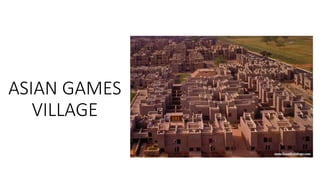
ASIAN GAMES
VILLAGE
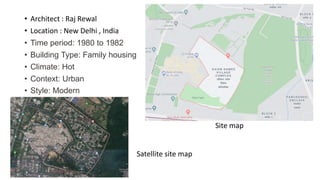
• Architect : Raj Rewal
• Location : New Delhi , India
• Time period: 1980 to 1982
• Building Type: Family housing
• Climate: Hot
• Context: Urban
• Style: Modern
Site map
Satellite site map
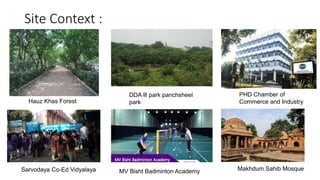
Site Context :
Hauz Khas Forest
DDA lll park panchsheel
park
PHD Chamber of
Commerce and Industry
Sarvodaya Co-Ed Vidyalaya MV Bisht Badminton Academy Makhdum Sahib Mosque
Introduction :
• Asian games village located in institutional zone new delhi.
• Asian games village was constructed on a 35 acre site.
• Initially, the complex, had 700 housing unite out of which 200 were
individual houses and 500 were apartments which varied from two to four
storey structures.
• Density is 28 units per hectare.
• Four types of house .(a,b,c,d)
CONCEPT :-
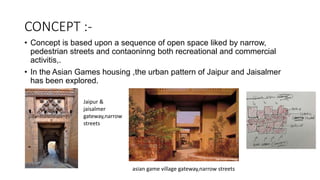
• Concept is based upon a sequence of open space liked by narrow,
pedestrian streets and contaoninng both recreational and commercial
activitis,.
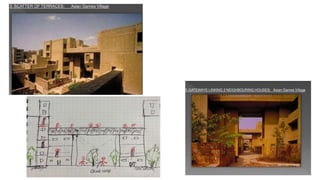
• In the Asian Games housing ,the urban pattern of Jaipur and Jaisalmer
has been explored.
asian game village gateway,narrow streets
Jaipur &
jaisalmer
gateway,narrow
streets
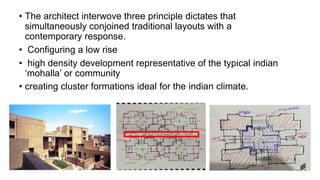
• The architect interwove three principle dictates that
simultaneously conjoined traditional layouts with a
contemporary response.
• Configuring a low rise
• high density development representative of the typical indian
‘mohalla’ or community
• creating cluster formations ideal for the indian climate.
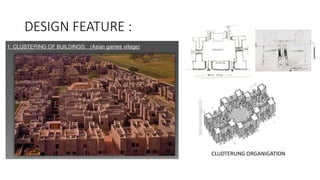
DESIGN FEATURE :
CLUDTERUNG ORGANIGATION
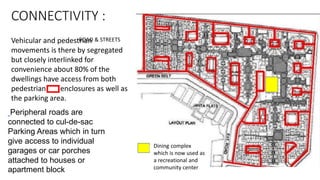
CONNECTIVITY :
ROAD & STREETSVehicular and pedestrian
movements is there by segregated
but closely interlinked for
convenience about 80% of the
dwellings have access from both
pedestrian enclosures as well as
the parking area.
Dining complex
which is now used as
a recreational and
community center
Peripheral roads are
connected to cul-de-sac
Parking Areas which in turn
give access to individual
garages or car porches
attached to houses or
apartment block
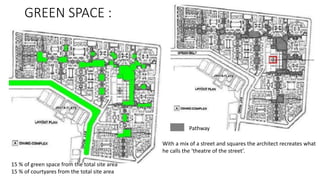
GREEN SPACE :
Pathway
15 % of green space from the total site area
15 % of courtyares from the total site area
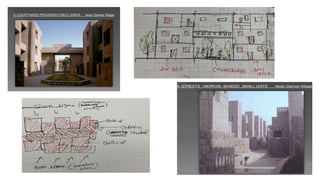
With a mix of a street and squares the architect recreates what
he calls the ‘theatre of the street’.
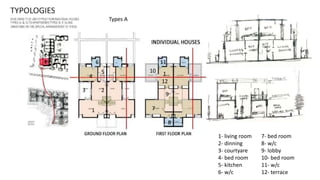
1
3
4
2
6
5
7
8
9
110
11
12
1- living room
2- dinning
3- courtyare
4- bed room
5- kitchen
6- w/c
7- bed room
8- w/c
9- lobby
10- bed room
11- w/c
12- terrace
Types A
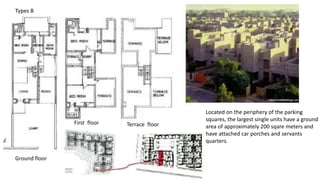
Types B
Ground floor
First floor Terrace floor
Located on the periphery of the parking
squares, the largest single units have a ground
area of approximately 200 sqare meters and
have attached car porches and servants
quarters.
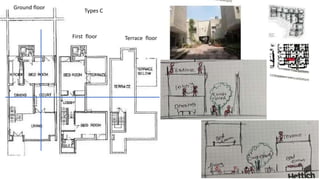
Ground floor
First floor Terrace floor
Types C
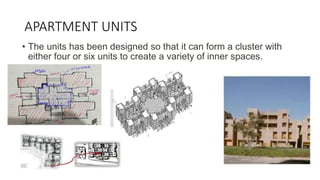
APARTMENT UNITS
• The units has been designed so that it can form a cluster with
either four or six units to create a variety of inner spaces.
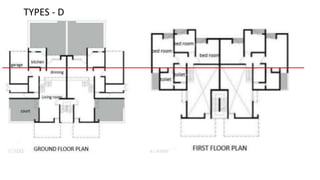
TYPES - D
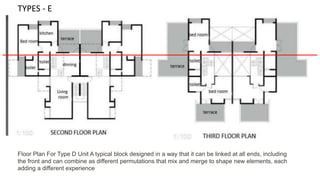
TYPES - E
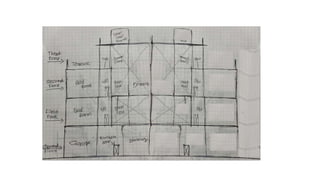
Floor Plan For Type D Unit A typical block designed in a way that it can be linked at all ends, including
the front and can combine as different permutations that mix and merge to shape new elements, each
adding a different experience
THANK YOU
NAME : LAD NIHAL
EN NO : 17SA02AR022
P.P SAVANI UNIVERSITY

Asian games village

  • 1.
  • 2.
    • Architect :Raj Rewal • Location : New Delhi , India • Time period: 1980 to 1982 • Building Type: Family housing • Climate: Hot • Context: Urban • Style: Modern Site map Satellite site map
  • 3.
    Site Context : HauzKhas Forest DDA lll park panchsheel park PHD Chamber of Commerce and Industry Sarvodaya Co-Ed Vidyalaya MV Bisht Badminton Academy Makhdum Sahib Mosque
  • 4.
    Introduction : • Asiangames village located in institutional zone new delhi. • Asian games village was constructed on a 35 acre site. • Initially, the complex, had 700 housing unite out of which 200 were individual houses and 500 were apartments which varied from two to four storey structures. • Density is 28 units per hectare. • Four types of house .(a,b,c,d)
  • 5.
    CONCEPT :- • Conceptis based upon a sequence of open space liked by narrow, pedestrian streets and contaoninng both recreational and commercial activitis,. • In the Asian Games housing ,the urban pattern of Jaipur and Jaisalmer has been explored. asian game village gateway,narrow streets Jaipur & jaisalmer gateway,narrow streets
  • 6.
    • The architectinterwove three principle dictates that simultaneously conjoined traditional layouts with a contemporary response. • Configuring a low rise • high density development representative of the typical indian ‘mohalla’ or community • creating cluster formations ideal for the indian climate.
  • 7.
  • 10.
    CONNECTIVITY : ROAD &STREETSVehicular and pedestrian movements is there by segregated but closely interlinked for convenience about 80% of the dwellings have access from both pedestrian enclosures as well as the parking area. Dining complex which is now used as a recreational and community center Peripheral roads are connected to cul-de-sac Parking Areas which in turn give access to individual garages or car porches attached to houses or apartment block
  • 11.
    GREEN SPACE : Pathway 15% of green space from the total site area 15 % of courtyares from the total site area With a mix of a street and squares the architect recreates what he calls the ‘theatre of the street’.
  • 12.
    1 3 4 2 6 5 7 8 9 110 11 12 1- living room 2-dinning 3- courtyare 4- bed room 5- kitchen 6- w/c 7- bed room 8- w/c 9- lobby 10- bed room 11- w/c 12- terrace Types A
  • 13.
    Types B Ground floor Firstfloor Terrace floor Located on the periphery of the parking squares, the largest single units have a ground area of approximately 200 sqare meters and have attached car porches and servants quarters.
  • 14.
    Ground floor First floorTerrace floor Types C
  • 15.
    APARTMENT UNITS • Theunits has been designed so that it can form a cluster with either four or six units to create a variety of inner spaces.
  • 16.
  • 17.
    TYPES - E FloorPlan For Type D Unit A typical block designed in a way that it can be linked at all ends, including the front and can combine as different permutations that mix and merge to shape new elements, each adding a different experience
  • 19.
    THANK YOU NAME :LAD NIHAL EN NO : 17SA02AR022 P.P SAVANI UNIVERSITY