GOVERNMENT ENGINEERING
COLLEGE AJMER
PRESENTATION ON INDUSTRIAL TRAINING AT
DRM AJMER
SUBMITTED BY: SUBMITTED TO:
MAHENDRA BISHNOI DEPT. OF ECE
15EEAEC049
Indian Railways carry more than 25 million
passengers every day, more than the entire
population of Australia.
With over 1.4 million
employees, Indian Railways is
the world's 7th largest
employer.
The full track length of Indian
Railways can circle the
equator one-and-a-half times.
BRIEF INTRODUCTION
• The first train in India ran on 16 th April 1853
from Bombay to Thane.
• The mascot of Indian Railways is Bholu - the guard
elephant.
1. Northern Railway --Delhi
2. North Eastern Railway -- Gorakhpur
3. Northeast Frontier Railway-- Guwahati
4. Eastern Railway -- Kolkata
5. South Eastern Railway -- Kolkata
6. South Central Railway --Secunderabad
7. Southern Railway -- Chennai
8. Central Railway -- Mumbai
9. Western Railway -- Mumbai
10. South Western Railway -- Hubballi
11. North Western Railway --Jaipur
12. West Central Railway -- Jabalpur
13. North Central Railway -- Allahabad
14. South East Central Railway -- Bilaspur
15. East Coast Railway -- Bhubaneswar
16. East Central Railway -- Hajipur
DEPARTMENTS IN IR
1. Engineering Department
2.Mechanical Engineering & Power (Transportation)
Department
3.Electrical Engineering Department
4.Signal & Telecommunication Engineering Department
5. Operating and Traffic (Transportation) Department
6.Commercial Department
7.Medical Department
8.Safety Department
9.Stores Department
10. Accounts Department
11.Personnel Department
12.Security Department
13. Managing Department
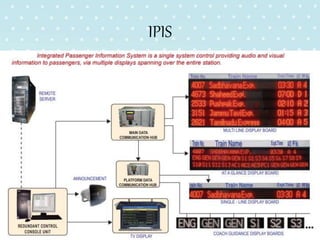
IPIS
signalling
• SIGNALLING IN RAILWAYS –
• Signalling is the mechanism by which the station master conveys information to the
loco driver to stop , go with caution or proceed.
• There are two types of signalling :-
1. Time travel method
2. Space interval method
• Colour Light Signalling
• Advantages of this are:
1. Night and day aspects are same so no confusion to driver
2. Visibility can be available for longer ranges , so it is easier for the driver to apply
brakes on time if needed.
3. The signals are placed on driver’s eye level.
4. No mechanical transmission and no moving parts.
1. Signals
2. Track circuits
3. Points
4. Slots
signalsTrack circuits
Points
A slot is an element of yard which has dual control i.e. an element
of yard that can be operated by two or more means .
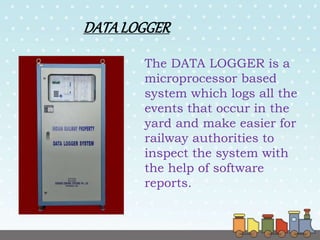
DATALOGGER
The DATA LOGGER is a
microprocessor based
system which logs all the
events that occur in the
yard and make easier for
railway authorities to
inspect the system with
the help of software
reports.
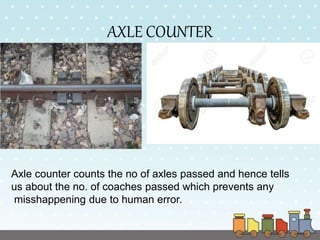
AXLE COUNTER
Axle counter counts the no of axles passed and hence tells
us about the no. of coaches passed which prevents any
misshappening due to human error.
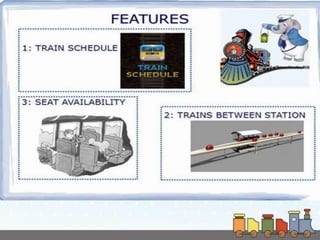
1) schedule
2)Trains b/w stations
3)resevation
Mobile applications
Electronic exchange
• Ajmer Division exchange consists of three main
exchanges
• 1.First is having a capacity of 128 lines. It is based
on C-DOT technology
• 2.Second one has the capacity of 1200 lines and is
based on OKI technology
• 3.Third one has the capacity of 60 lines. It is a
MKT (Multi Key telephone exchange).
Slc(subscribe line card) there are 10 slc cards
Each card contains 10 linesC-dot ecxhange less than
100 lines
RAX Control processor (RCP)
This card uses 65C02 Micro Processor and has 12K
RAM, 48K EPROM & 16K EEPROM
memories.
The main functions RCP are Call processing,
Administration and Maintenance.
railnet
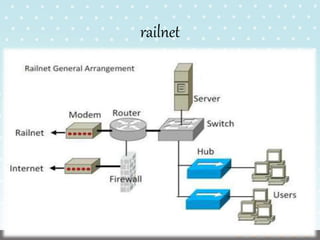
The whole railways is connection through
copper cable and optical fibre cables. These
cables run underground all along the railway
lines all over India.
The underground cables are 6quad cables
or in other words they have total of 24 wires
in one cable.
The end

Railway Industrial Training

  • 1.
    GOVERNMENT ENGINEERING COLLEGE AJMER PRESENTATIONON INDUSTRIAL TRAINING AT DRM AJMER SUBMITTED BY: SUBMITTED TO: MAHENDRA BISHNOI DEPT. OF ECE 15EEAEC049
  • 2.
    Indian Railways carrymore than 25 million passengers every day, more than the entire population of Australia. With over 1.4 million employees, Indian Railways is the world's 7th largest employer. The full track length of Indian Railways can circle the equator one-and-a-half times.
  • 3.
    BRIEF INTRODUCTION • Thefirst train in India ran on 16 th April 1853 from Bombay to Thane. • The mascot of Indian Railways is Bholu - the guard elephant.
  • 4.
    1. Northern Railway--Delhi 2. North Eastern Railway -- Gorakhpur 3. Northeast Frontier Railway-- Guwahati 4. Eastern Railway -- Kolkata 5. South Eastern Railway -- Kolkata 6. South Central Railway --Secunderabad 7. Southern Railway -- Chennai 8. Central Railway -- Mumbai 9. Western Railway -- Mumbai 10. South Western Railway -- Hubballi 11. North Western Railway --Jaipur 12. West Central Railway -- Jabalpur 13. North Central Railway -- Allahabad 14. South East Central Railway -- Bilaspur 15. East Coast Railway -- Bhubaneswar 16. East Central Railway -- Hajipur
  • 5.
    DEPARTMENTS IN IR 1.Engineering Department 2.Mechanical Engineering & Power (Transportation) Department 3.Electrical Engineering Department 4.Signal & Telecommunication Engineering Department 5. Operating and Traffic (Transportation) Department 6.Commercial Department 7.Medical Department 8.Safety Department 9.Stores Department 10. Accounts Department 11.Personnel Department 12.Security Department 13. Managing Department
  • 6.
  • 9.
    signalling • SIGNALLING INRAILWAYS – • Signalling is the mechanism by which the station master conveys information to the loco driver to stop , go with caution or proceed. • There are two types of signalling :- 1. Time travel method 2. Space interval method • Colour Light Signalling • Advantages of this are: 1. Night and day aspects are same so no confusion to driver 2. Visibility can be available for longer ranges , so it is easier for the driver to apply brakes on time if needed. 3. The signals are placed on driver’s eye level. 4. No mechanical transmission and no moving parts.
  • 10.
    1. Signals 2. Trackcircuits 3. Points 4. Slots signalsTrack circuits
  • 11.
    Points A slot isan element of yard which has dual control i.e. an element of yard that can be operated by two or more means .
  • 12.
    DATALOGGER The DATA LOGGERis a microprocessor based system which logs all the events that occur in the yard and make easier for railway authorities to inspect the system with the help of software reports.
  • 14.
    AXLE COUNTER Axle countercounts the no of axles passed and hence tells us about the no. of coaches passed which prevents any misshappening due to human error.
  • 18.
  • 19.
  • 20.
  • 21.
  • 22.
    Electronic exchange • AjmerDivision exchange consists of three main exchanges • 1.First is having a capacity of 128 lines. It is based on C-DOT technology • 2.Second one has the capacity of 1200 lines and is based on OKI technology • 3.Third one has the capacity of 60 lines. It is a MKT (Multi Key telephone exchange).
  • 23.
    Slc(subscribe line card)there are 10 slc cards Each card contains 10 linesC-dot ecxhange less than 100 lines
  • 24.
    RAX Control processor(RCP) This card uses 65C02 Micro Processor and has 12K RAM, 48K EPROM & 16K EEPROM memories. The main functions RCP are Call processing, Administration and Maintenance.
  • 25.
  • 27.
    The whole railwaysis connection through copper cable and optical fibre cables. These cables run underground all along the railway lines all over India. The underground cables are 6quad cables or in other words they have total of 24 wires in one cable.
  • 28.