RADIOLOGICAL
ANATOMY OF BILIARY
SYSTEM
BY DR NISHANT RAJ
POST GRADUATE RESIDENT
DMIMS, WARDHA
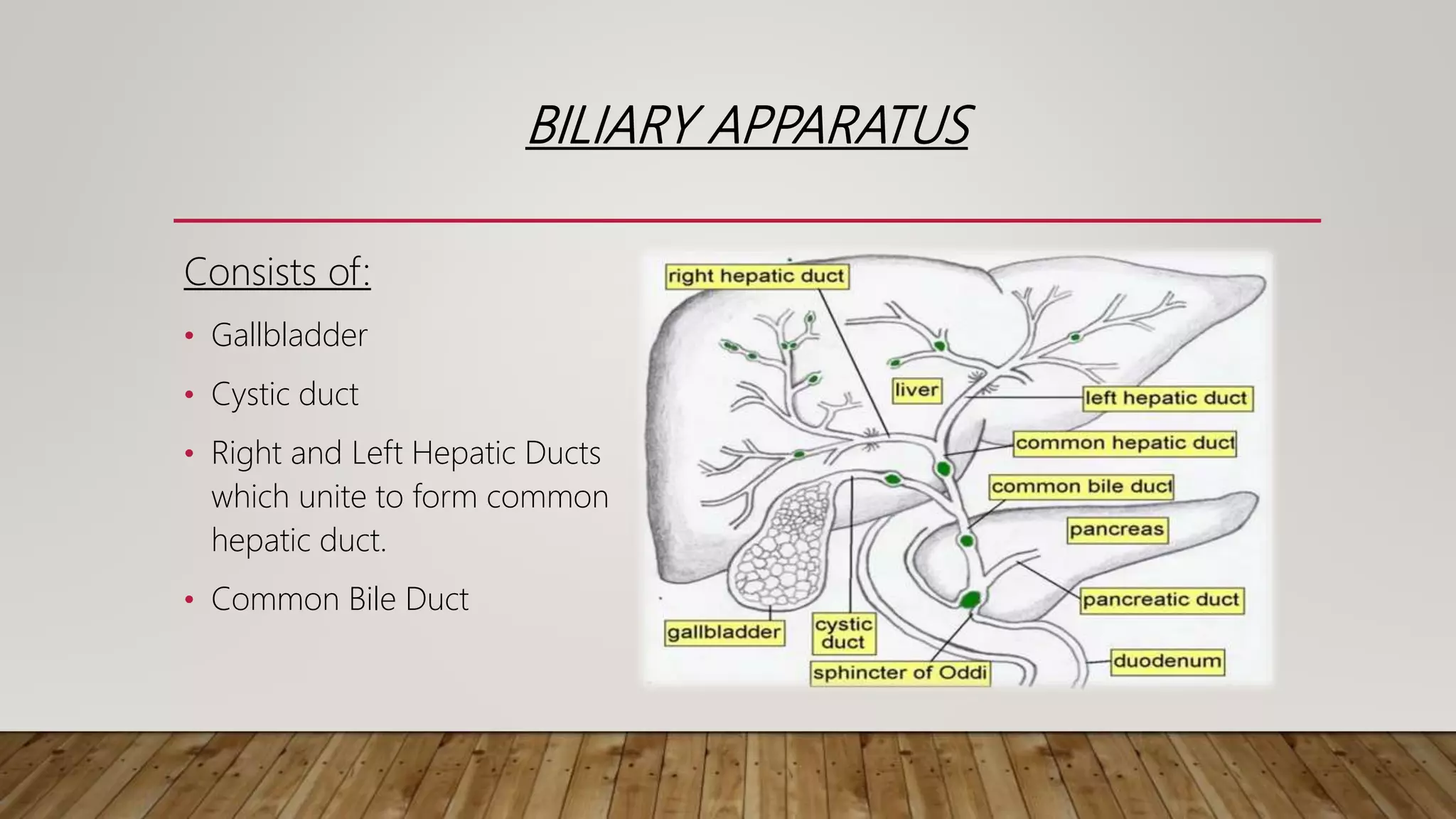
BILIARY APPARATUS
Consists of:
• Gallbladder
• Cystic duct
• Right and Left Hepatic Ducts
which unite to form common
hepatic duct.
• Common Bile Duct
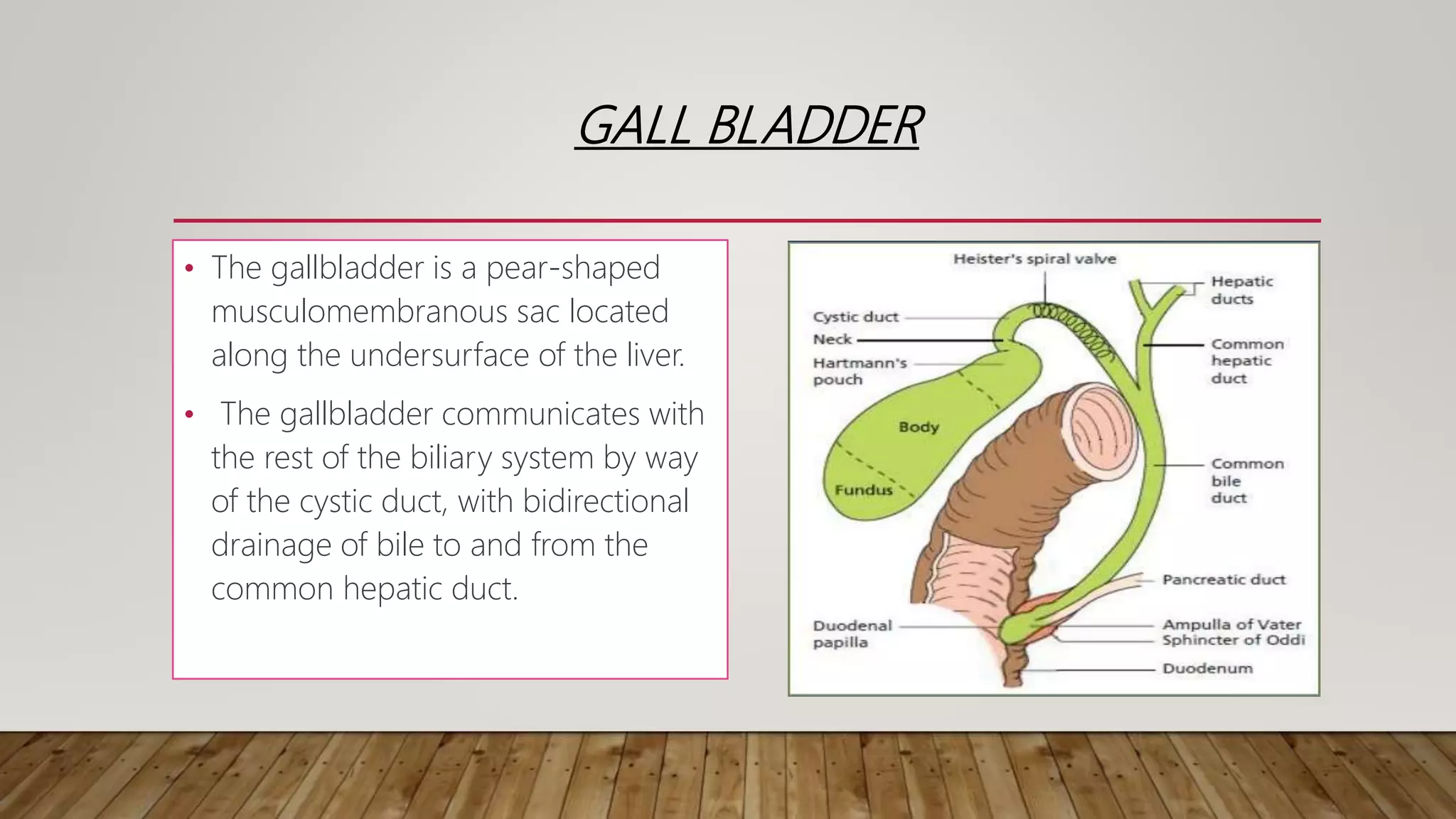
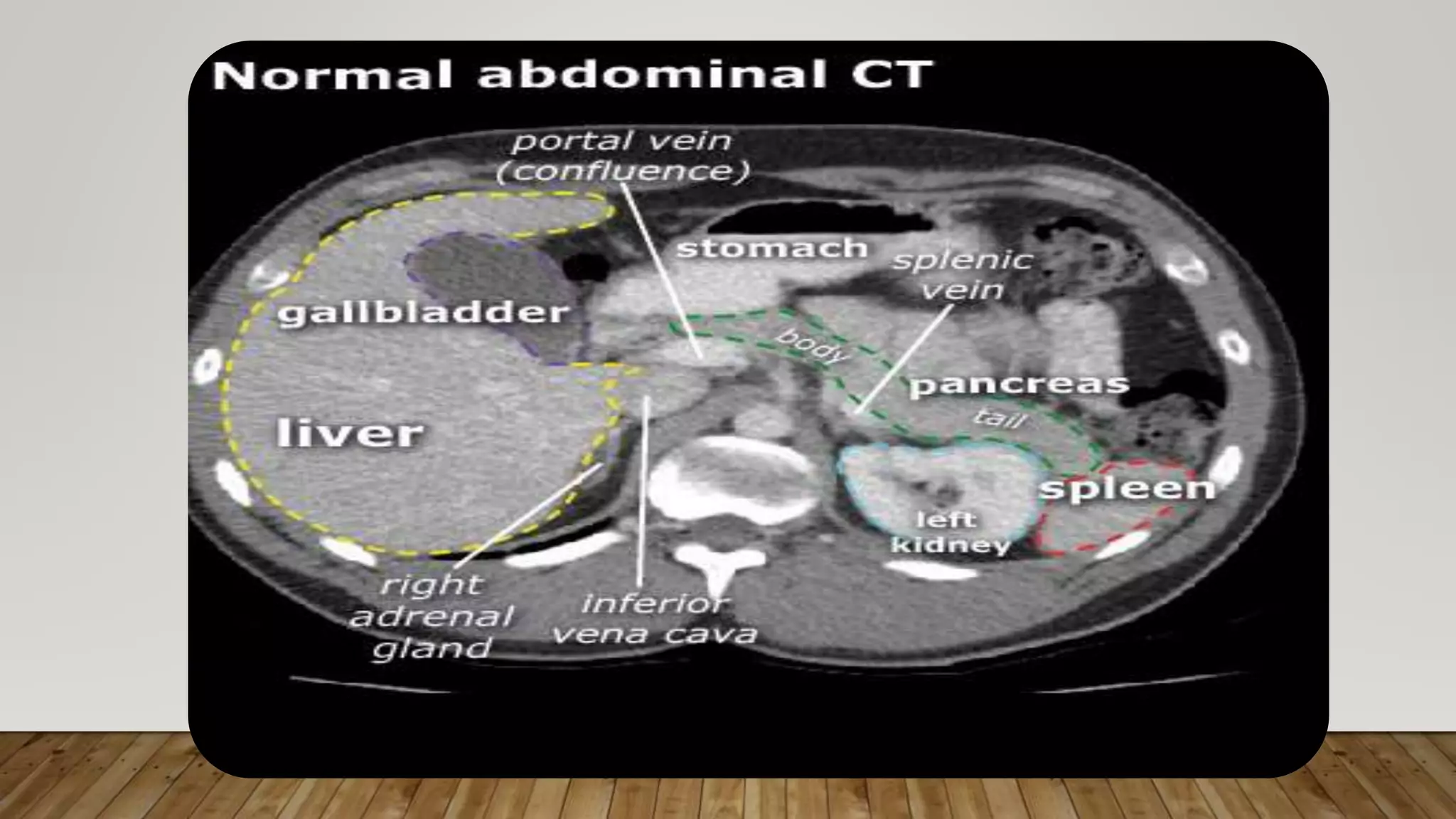
GALL BLADDER
• The gallbladder is a pear-shaped
musculomembranous sac located
along the undersurface of the liver.
• The gallbladder communicates with
the rest of the biliary system by way
of the cystic duct, with bidirectional
drainage of bile to and from the
common hepatic duct.
• Arterial: Cystic
Artery
• Venous: Cystic
Vein---Portal Vein.
BLOOD SUPPLY OF GALLBLADDER
• Parasympathetic is by pre-
ganglionic fibres from the vagus
nerve.
• Sympathetic is from post-ganglionic
fibres of coeliac plexus.
NERVE SUPPLY OF GALLBLADDER
LYMPHATICS OF GALLBLADDER
• Cholecysto-retropancreatic: following common duct inferiorly to a retroportal node
posterior to pancreatic head (primary pathway)
• Cholecysto-celiac: via hepatoduodenal ligament to celiac nodes
• Cholecysto-mesenteric: anterior to portal vein to superior mesenteric root nodes
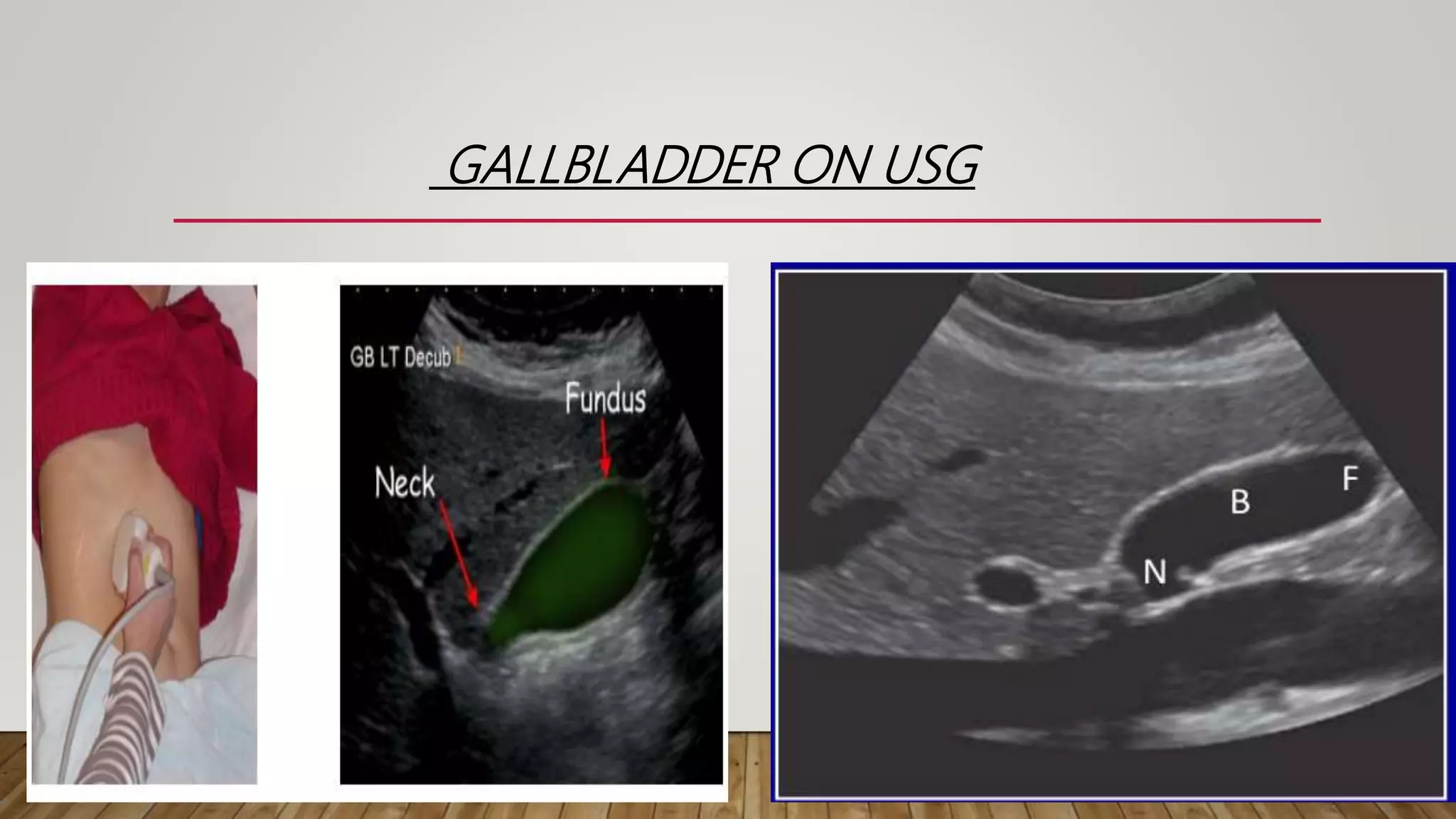
GALLBLADDER ON USG
GALLBLADDER ON USG
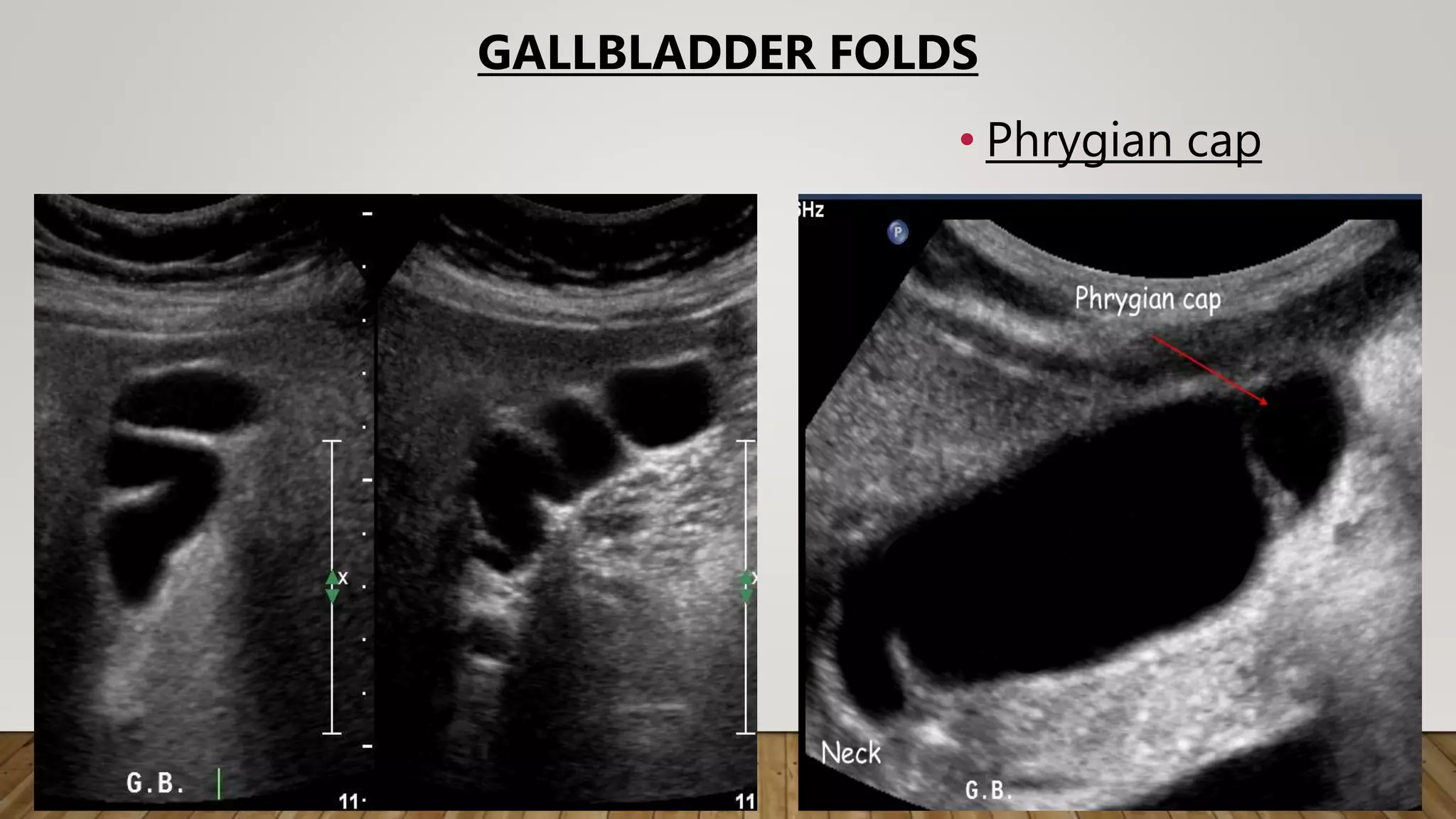
• Phrygian cap
GALLBLADDER FOLDS
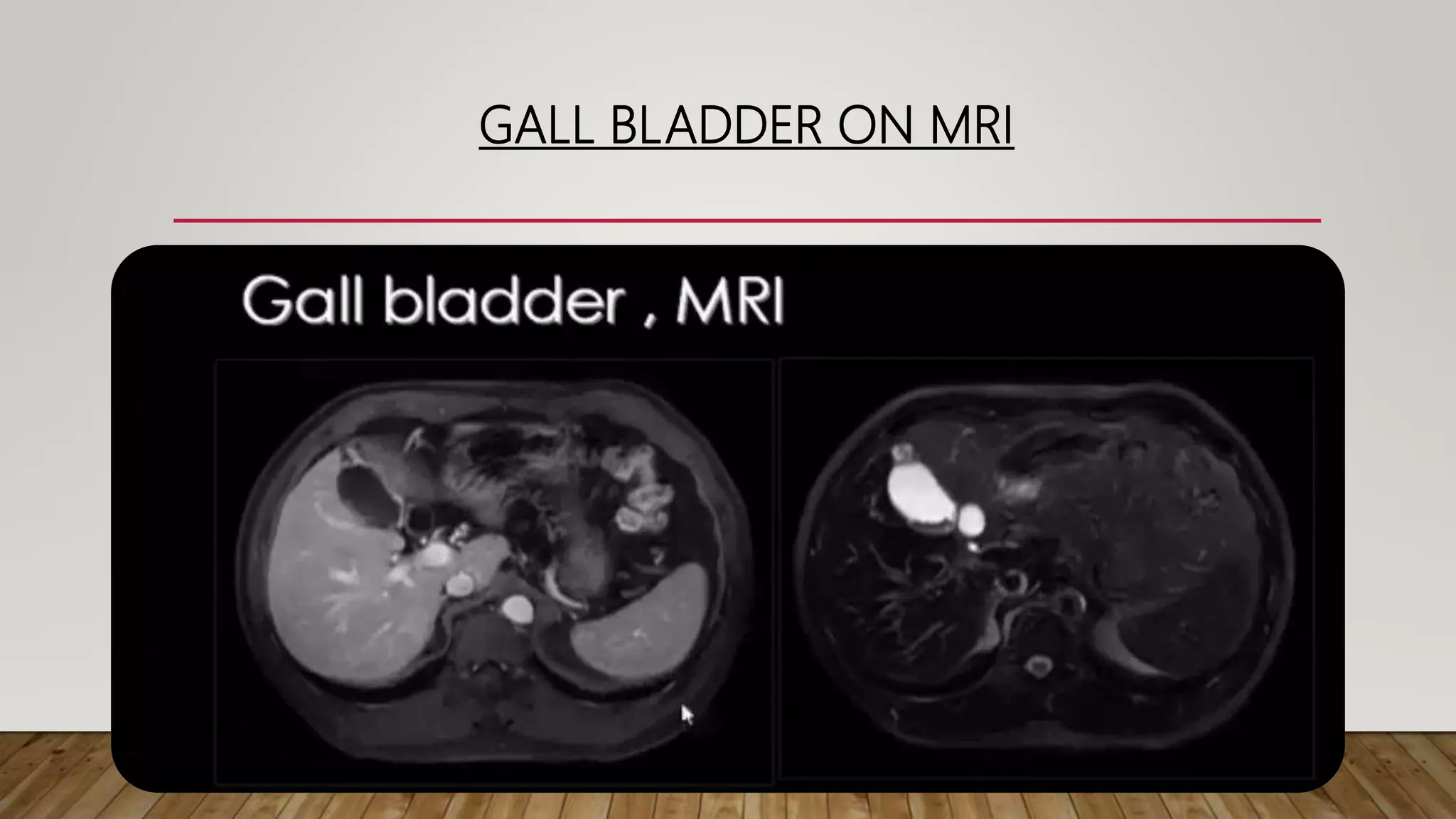
GALL BLADDER ON MRI
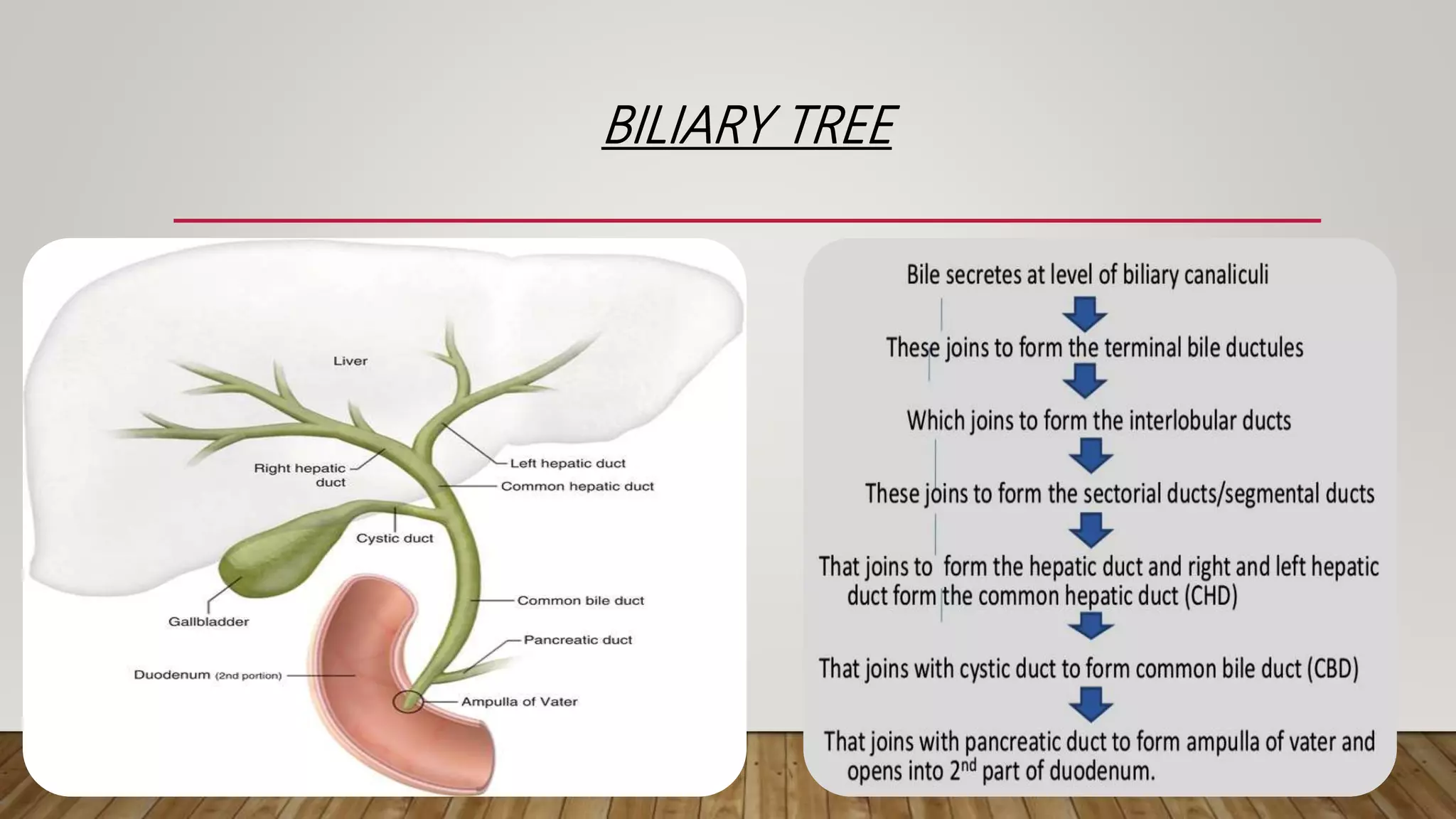
BILIARY TREE
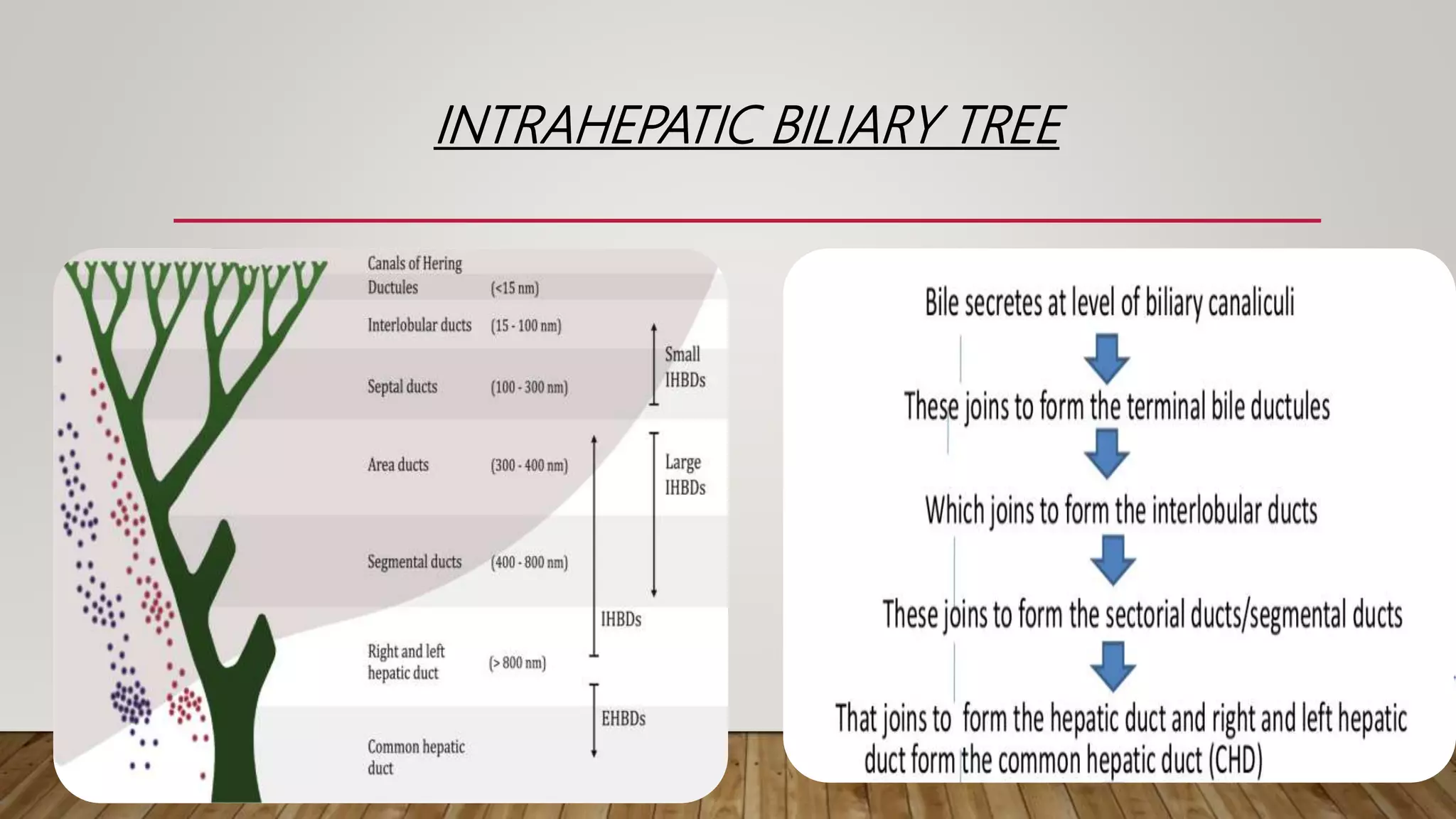
INTRAHEPATIC BILIARY TREE
SEGMENTAL ANATOMY OF LIVER
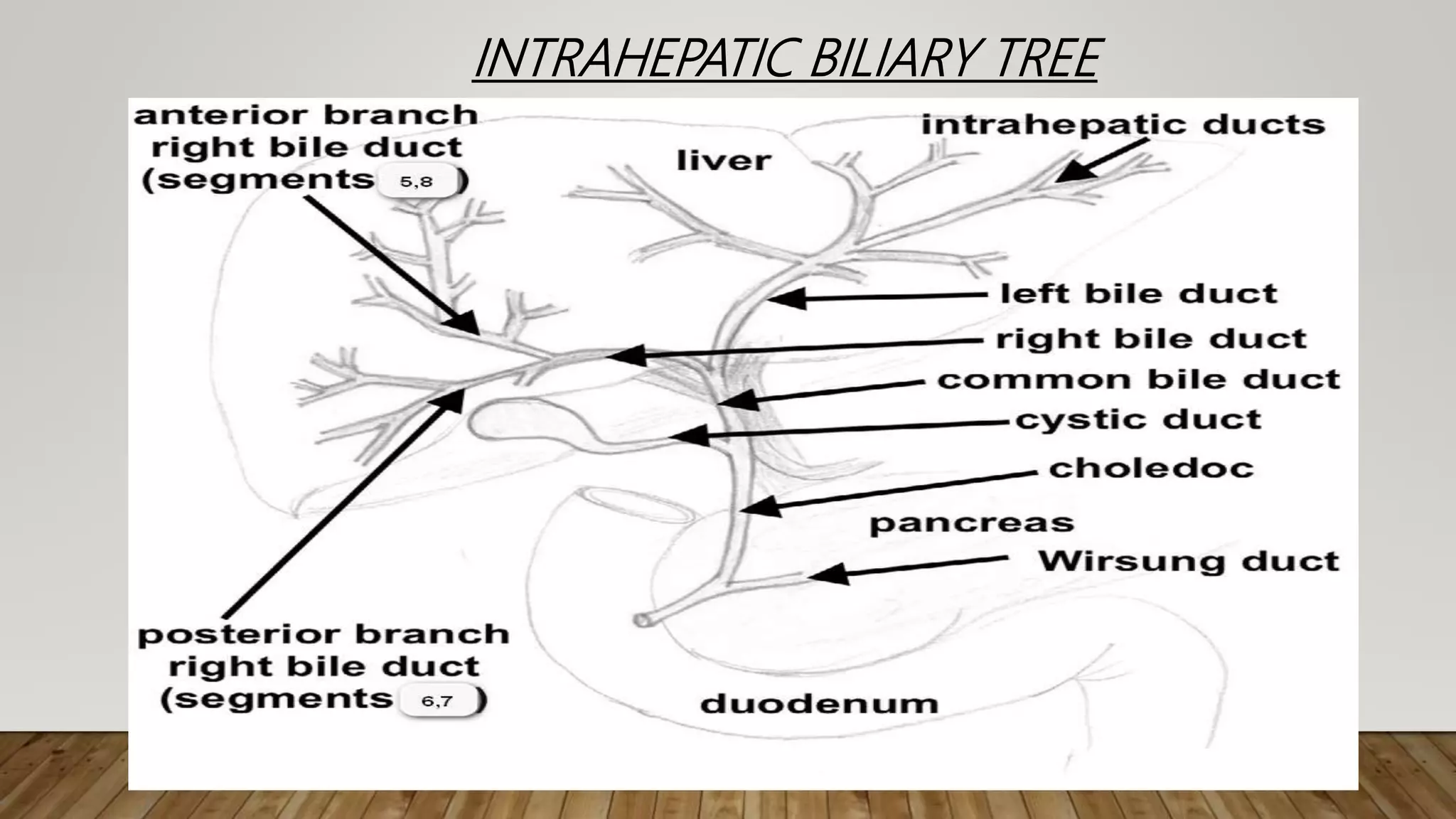
INTRAHEPATIC BILIARY TREE
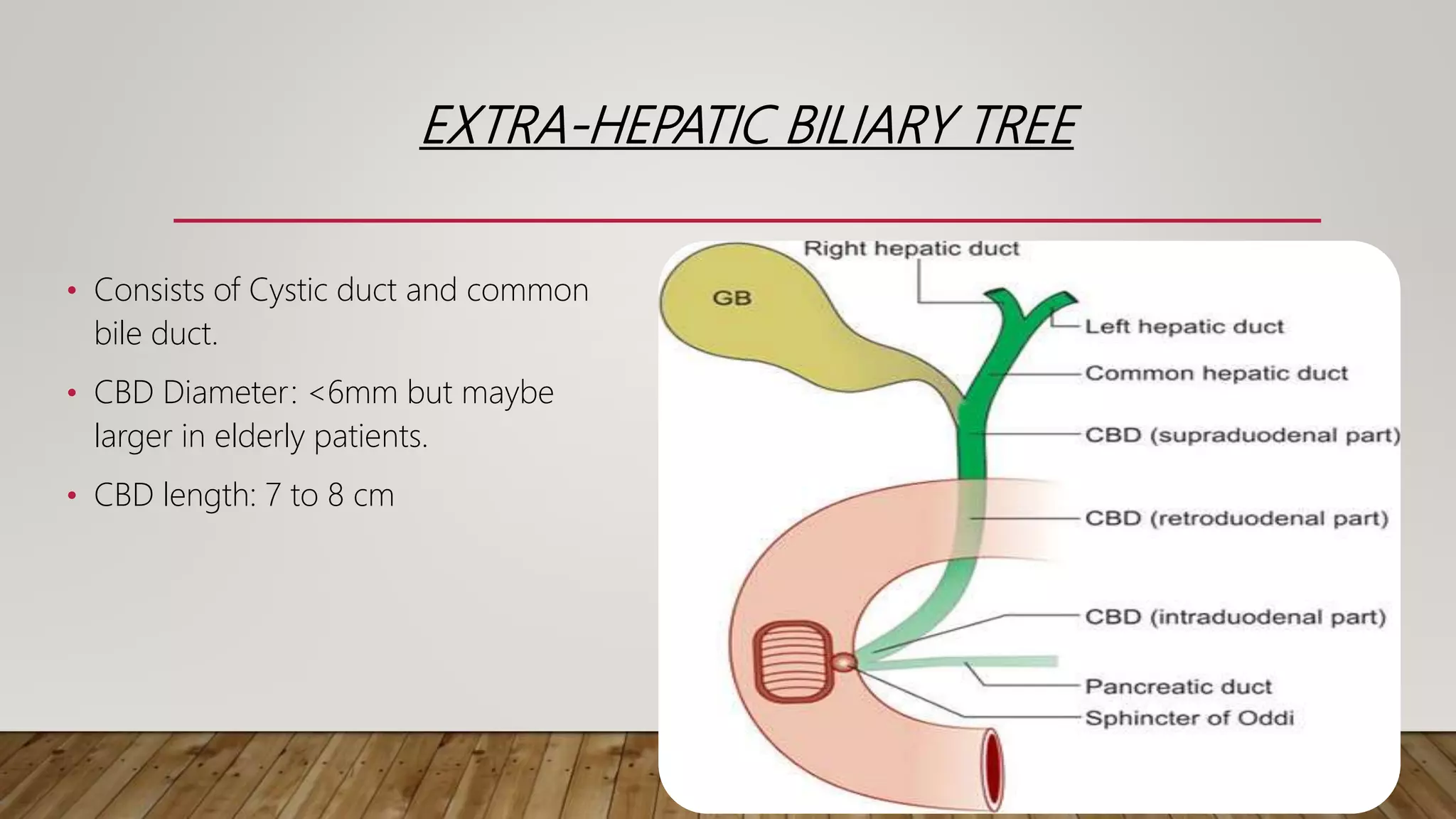
EXTRA-HEPATIC BILIARY TREE
• Consists of Cystic duct and common
bile duct.
• CBD Diameter: <6mm but maybe
larger in elderly patients.
• CBD length: 7 to 8 cm
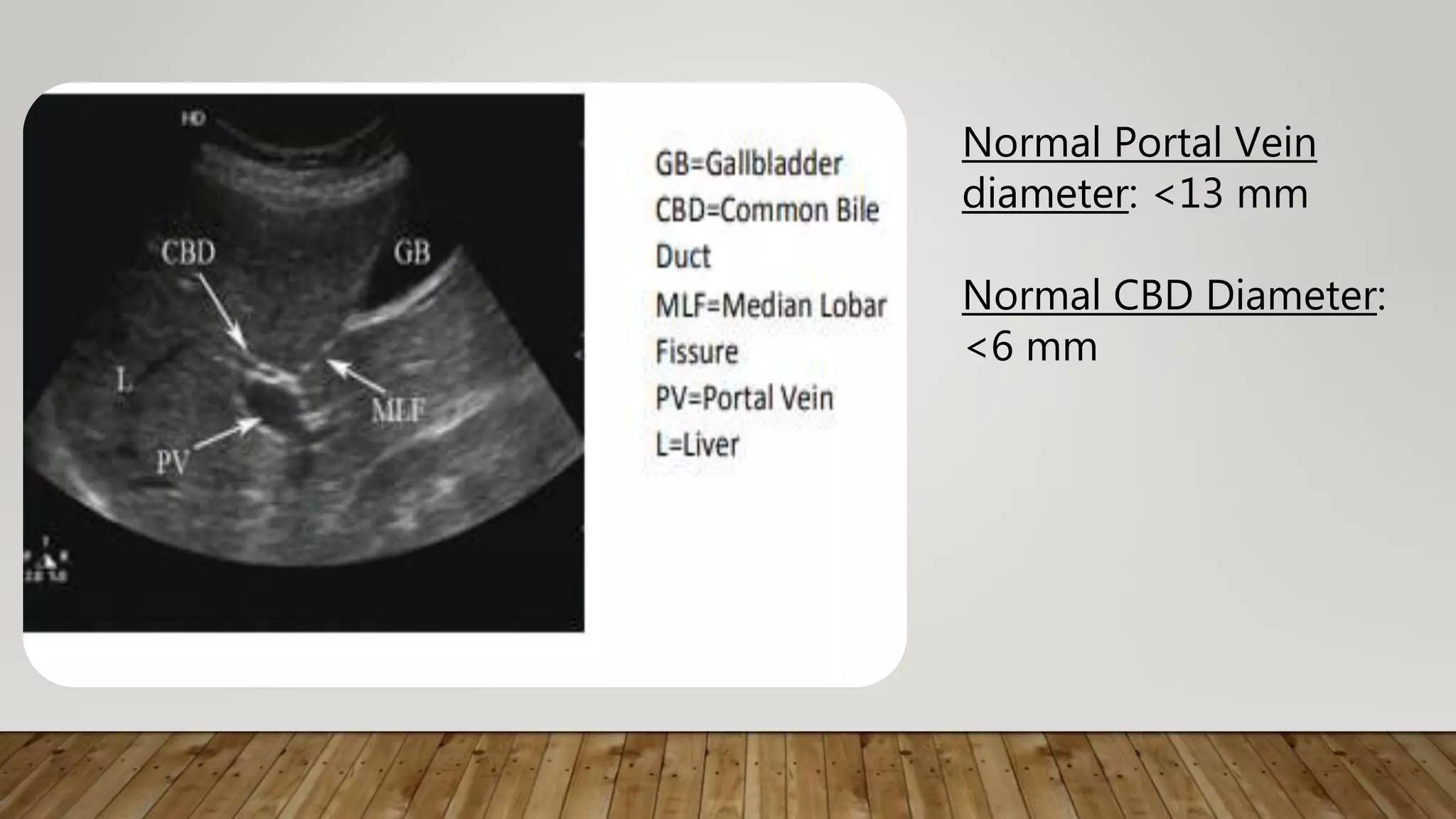
PORTAL TRIAD ON USG
TRANSVERSE VIEW
Normal Portal Vein
diameter: <13 mm
Normal CBD Diameter:
<6 mm
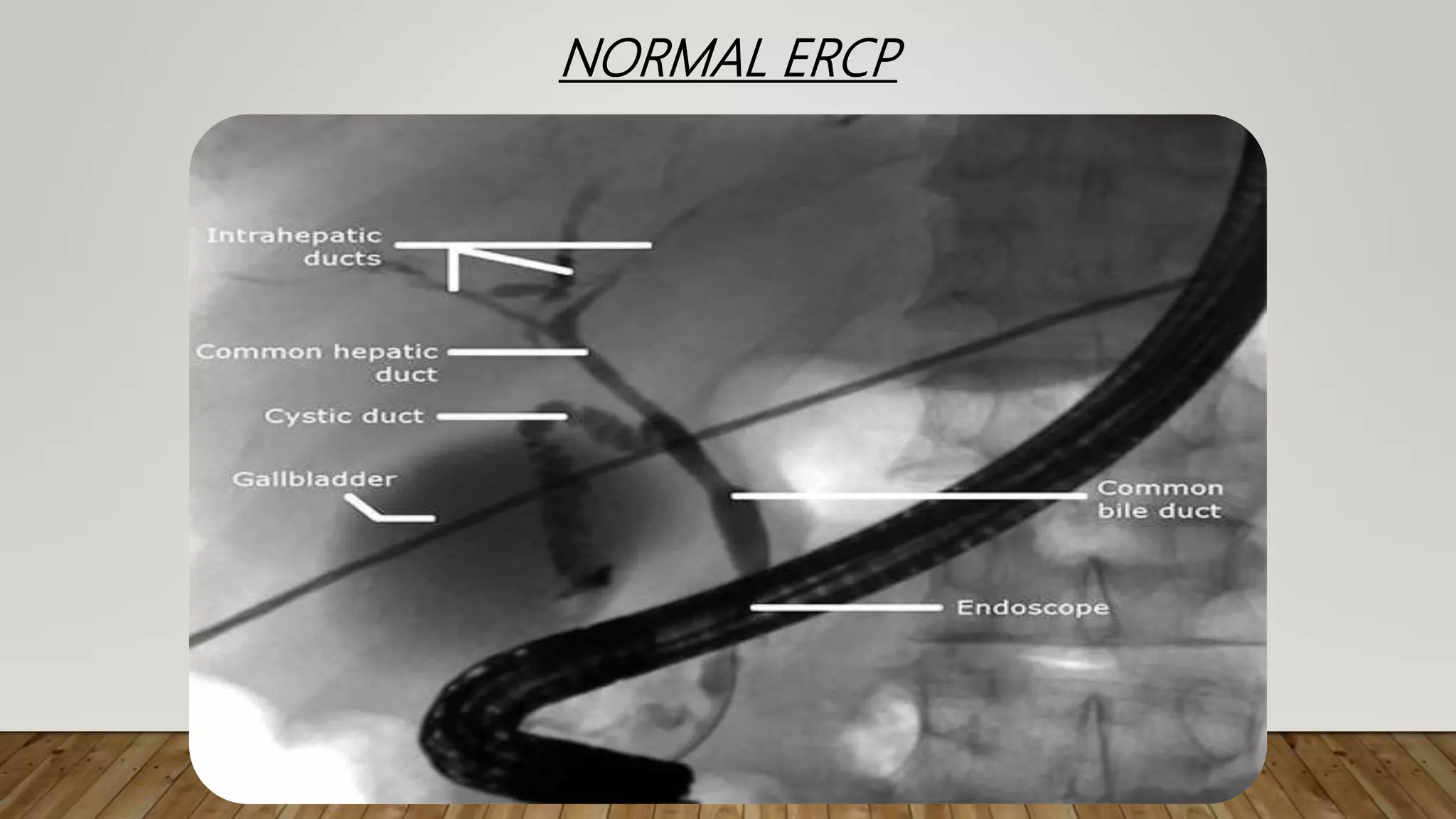
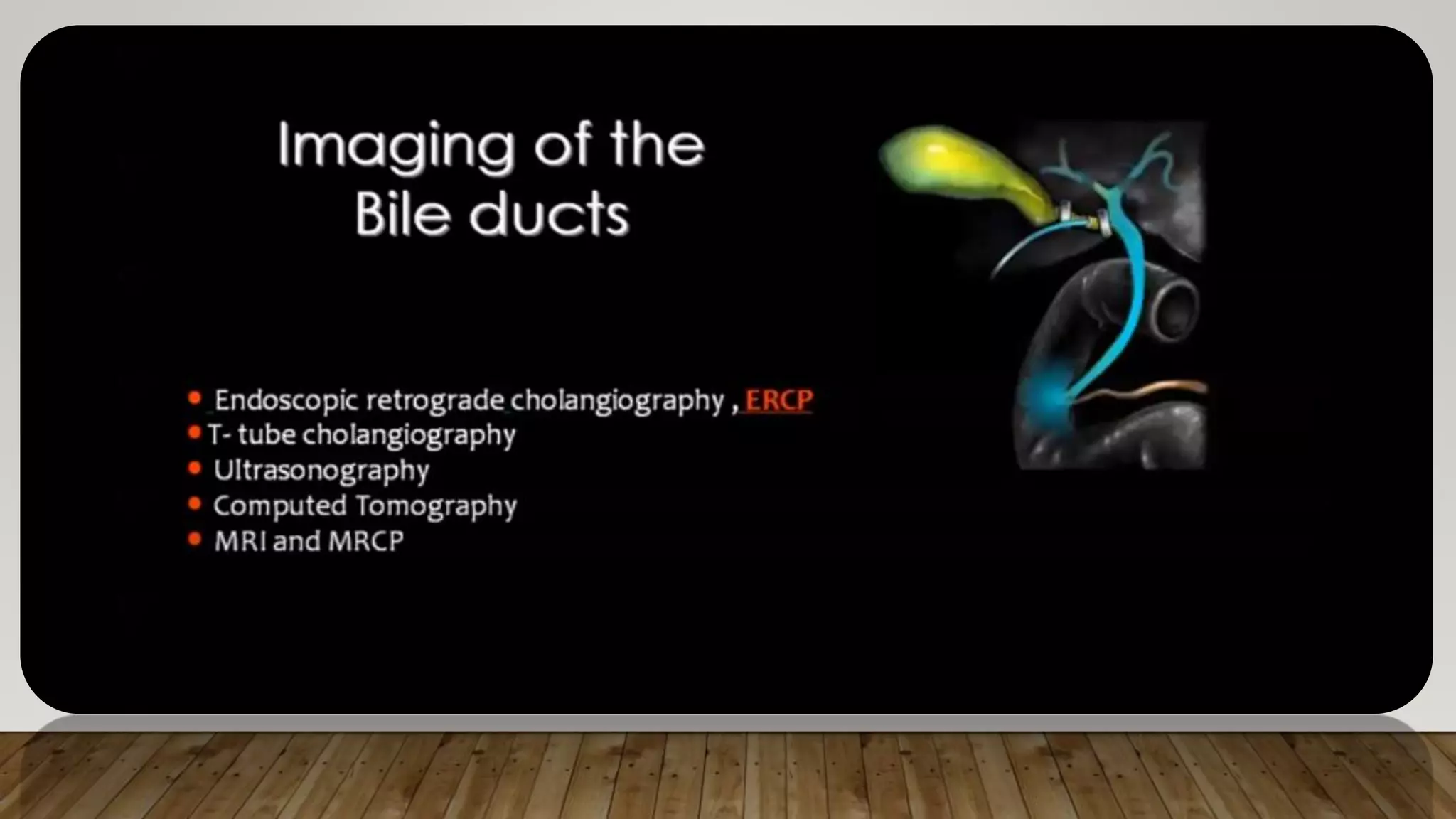
ENDOSCOPIC RETROGRADE CHOLANGIO-
PANCREATICOGRAPHY [ERCP]
NORMAL ERCP
CT CHOLANGIOGRAPHY
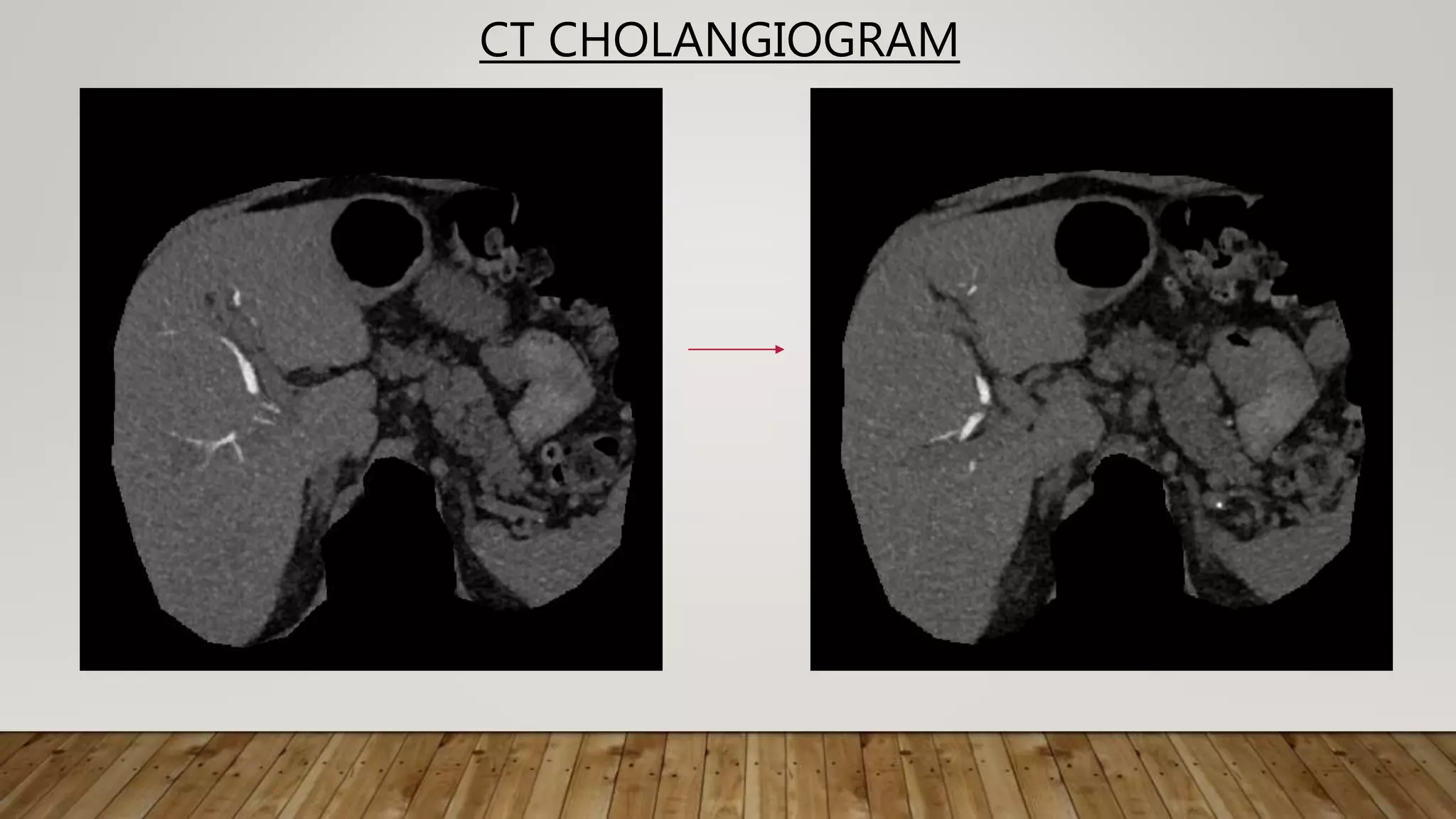
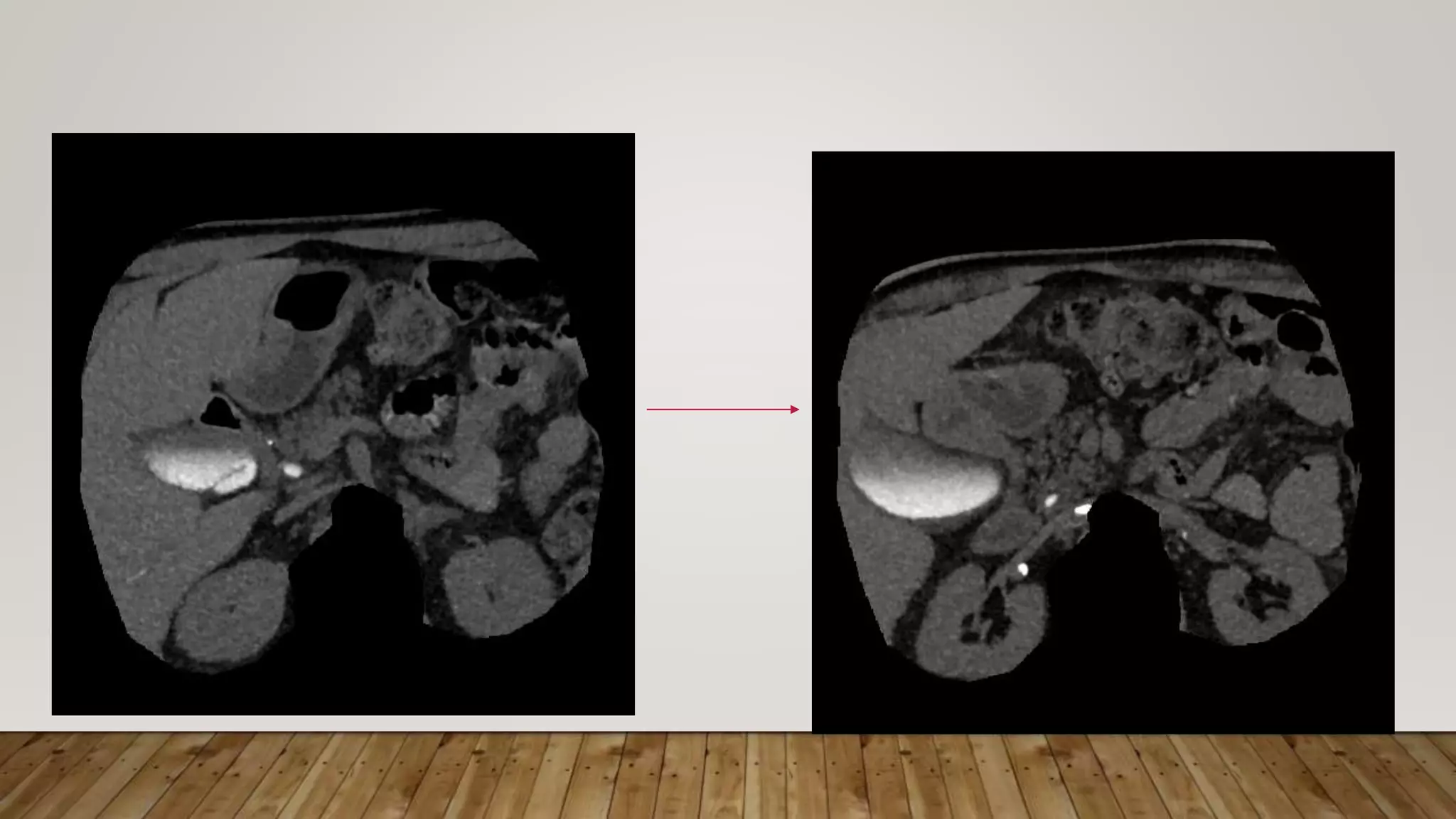
• CT cholangiography is a technique of imaging the biliary tree with the usage of
hepatobiliary excreted contrast.
• CT cholangiography may be performed with either intravenous or oral
cholangiographic contrast agents both of which outline the biliary tree with
positive contrast.
CT CHOLANGIOGRAM
MAGNETIC RESONANCE CHOLANGIO-
PANCRETICOGRAPHY[MRCP]
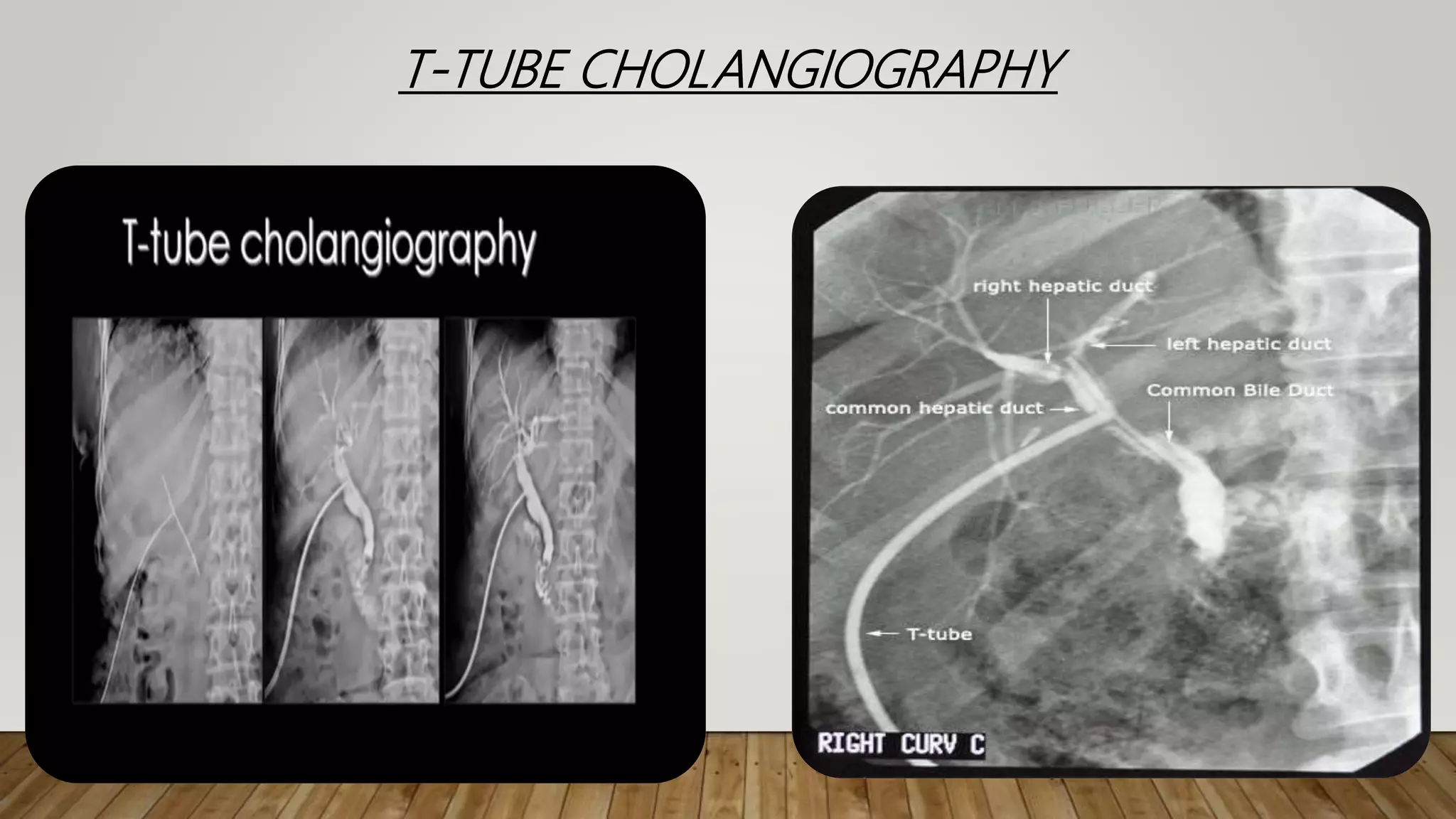
T-TUBE CHOLANGIOGRAPHY
THANK YOU

Radiological anatomy of biliary system

Editor's Notes

  • #9 Wall Thickness <3mm
  • #10 Normal Gall-Bladder Wall Thickness: <3mm Normal Gall Bladder length: 7-12cm Transverse diameter of Gall Bladder: 3-4 cm
  • #17 Right Hepatic Duct branches into right posterior hepatic duct which drains posterior segments VI and VII and right anterior hepatic duct which drains anterior segments V and VIII. Segmental tributaries draining segments II to IV are form left hepatic duct.
  • #18 Supraduodenal portion: About 2.5 cm long, running in the free edge of the lesser omentum. Retroduodenal portion. Infraduodenal portion lies in a groove, but at times in a tunnel, on the posterior surface of the pancreas. Intraduodenal portion passes obliquely through the wall of the second part of the duodenum, where it is surrounded by the sphincter of Oddi, and terminates by opening on the summit of the ampulla of Vater.
  • #20 Short Axis(Transverse View) Mickey Mouse View CBD is anterior to the Portal vein and doesn’t take up any flow on doppler.
  • #21 Portal Vein can be identified by hyperechoic walls surrounding the vein. This is due to presence of connective tissue around the portal vein.
  • #22 Endoscopic retrograde cholangiopancreatography (ERCP) is a diagnostic and interventional procedure technique using both endoscopy and fluoroscopy for examination and intervention of the biliary tree and pancreatic ducts. It involves passing an endoscope to the descending duodenum and subsequently cannulating the ampulla of vater, after which contrast can be injected outlining the biliary tree and various procedures can be performed. 
  • #25 Axial CT Cholangiogram: Cranial to Caudal.
  • #28 Magnetic resonance cholangiopancreatography (MRCP) is a non-invasive imaging technique to visualize the intra and extrahepatic biliary tree and pancreatic ductal system. MRCP is performed on a 1.5 T or superior MRI system, using a phased-array body coil. All protocols obtain heavily T2-weighted sequences
  • #29 A T-tube cholangiogram is a fluoroscopic procedure in which contrast medium is injected through a T-tube into the patient's biliary tree. The T-tube is most commonly inserted during a cholecystectomy operation when there is a possibility of residual gall stones within the biliary tree. This technique has been largely superseded by MRCP and ERCP. Typically a T-shaped tube is left in the common bile duct at the time of surgery (e.g. cholecystectomy) and allows for exploration of the common bile duct (choledochotomy) and retrieval of common bile duct stones. At a later date (usually approximately 10 days), imaging of the biliary tree (cholangiogram) is performed via the tube.