RADIOGRAPHIC FILM
RADIOGRAPHIC FILM
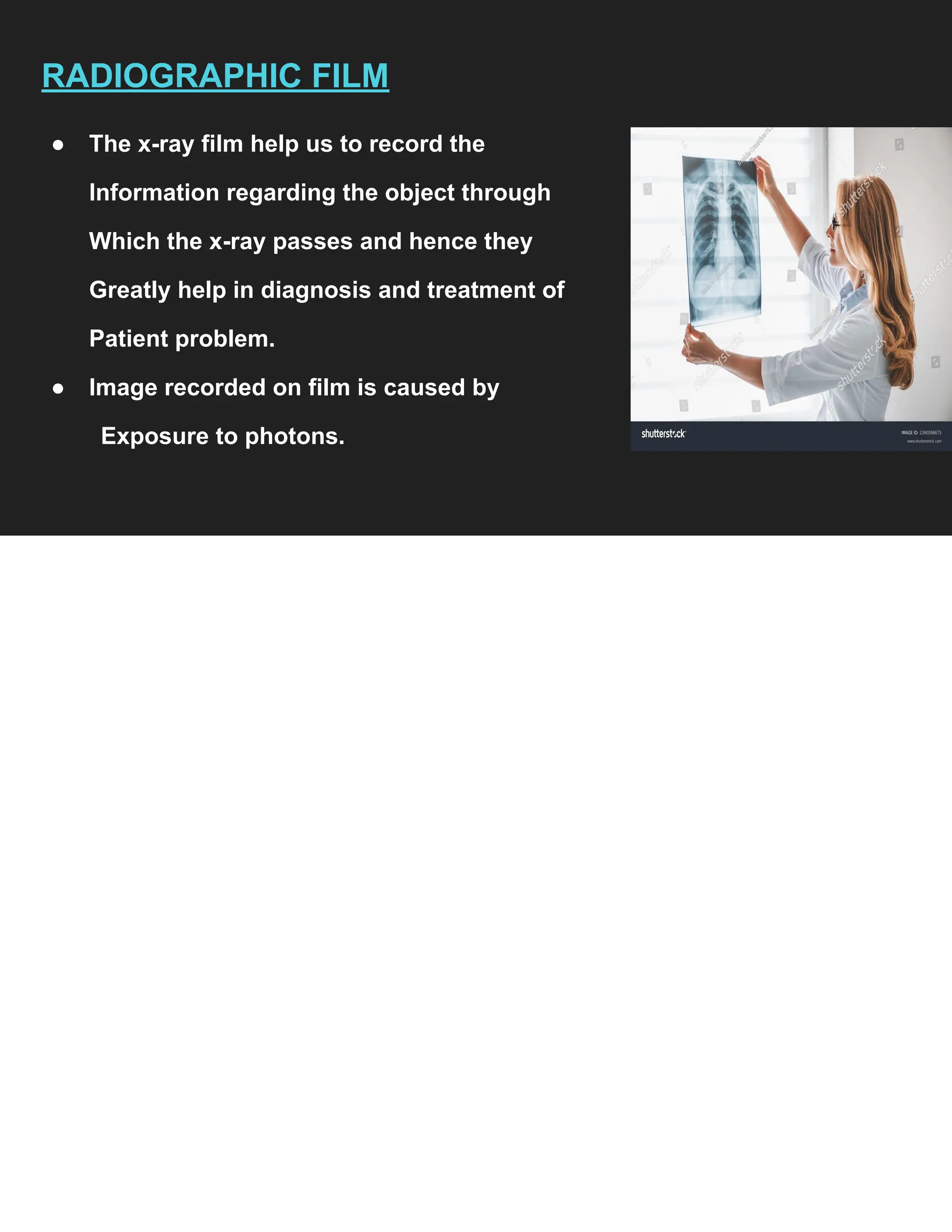
● The x-ray film help us to record the
Information regarding the object through
Which the x-ray passes and hence they
Greatly help in diagnosis and treatment of
Patient problem.
● Image recorded on film is caused by
Exposure to photons.
FILM CONSTRUCTION
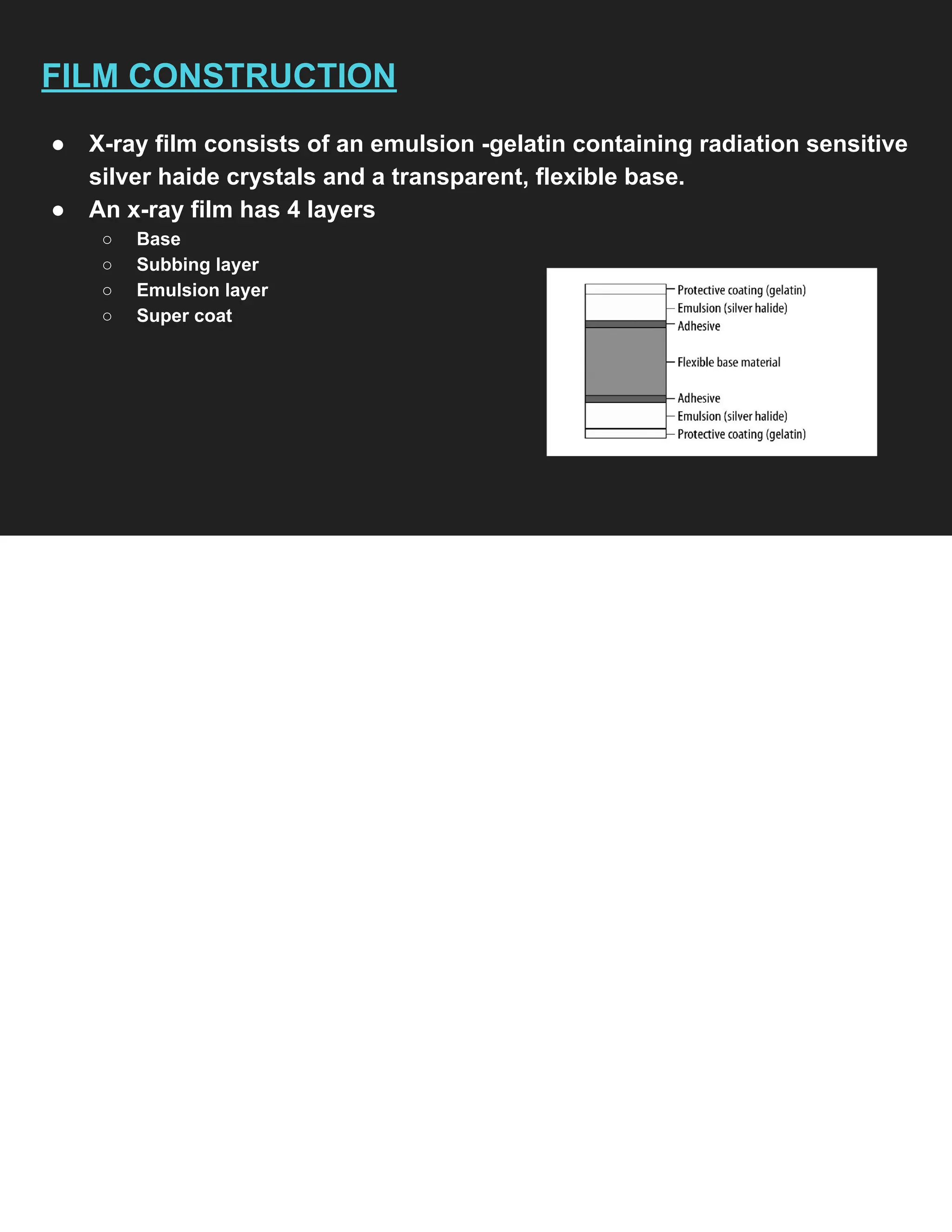
● X-ray film consists of an emulsion -gelatin containing radiation sensitive
silver haide crystals and a transparent, flexible base.
● An x-ray film has 4 layers
○ Base
○ Subbing layer
○ Emulsion layer
○ Super coat
FILM BASE
● A film base is a transparent,
flexible,and tough substrate
that supports the film
emulsion.
● Earlier , cellulose triacetate
was used.
● Nowadays,polyster made
from polyethylene
terephthalate resin is used.
FUNCTION OF
FILM BASE
● Provide support to the
emulsion layer
● To transmit light so, that an
image can be viewed.
Characteristics
of film base
● Transparent
● Strong
● Flexible
● Uniform in thickness
● Dimensionally stable
● Impermeable to water and
processing solution
● Non flammable
● Chemically inactive
● Uniform in colour
● Sheet film :0.18mm
● Flurographic roll film:0.08mm
Thickness of
base
SUBBING
LAYER
● It is present between base and the
emulsion layer.
● It is made by the mixture of gelatin
soln
and solvent of film base.
Subbing layer is required due to:
● To prevent any separation of the
emulsion layer from the base during
processing.
EMULSION
LAYER
● the emulsion layer contains
light-sensitive compounds
that capture images when
exposed to light.
● The sensitive emulsion
consist of silver halide
crystals suspended in
gelatin.
● Duplitized x-ray film
:emulsion is coated on both
sides of the base.
SUPERCOAT
● This is a thin layer of clear
gelatin,which is applied to
the emulsion.
It has 2 prime function
● To protect the sensitive
emulsion from the effects of
light pressure or abrasion
which might occur during
use.
● To provide suitable surface
characteristics.
Non-curl
backing
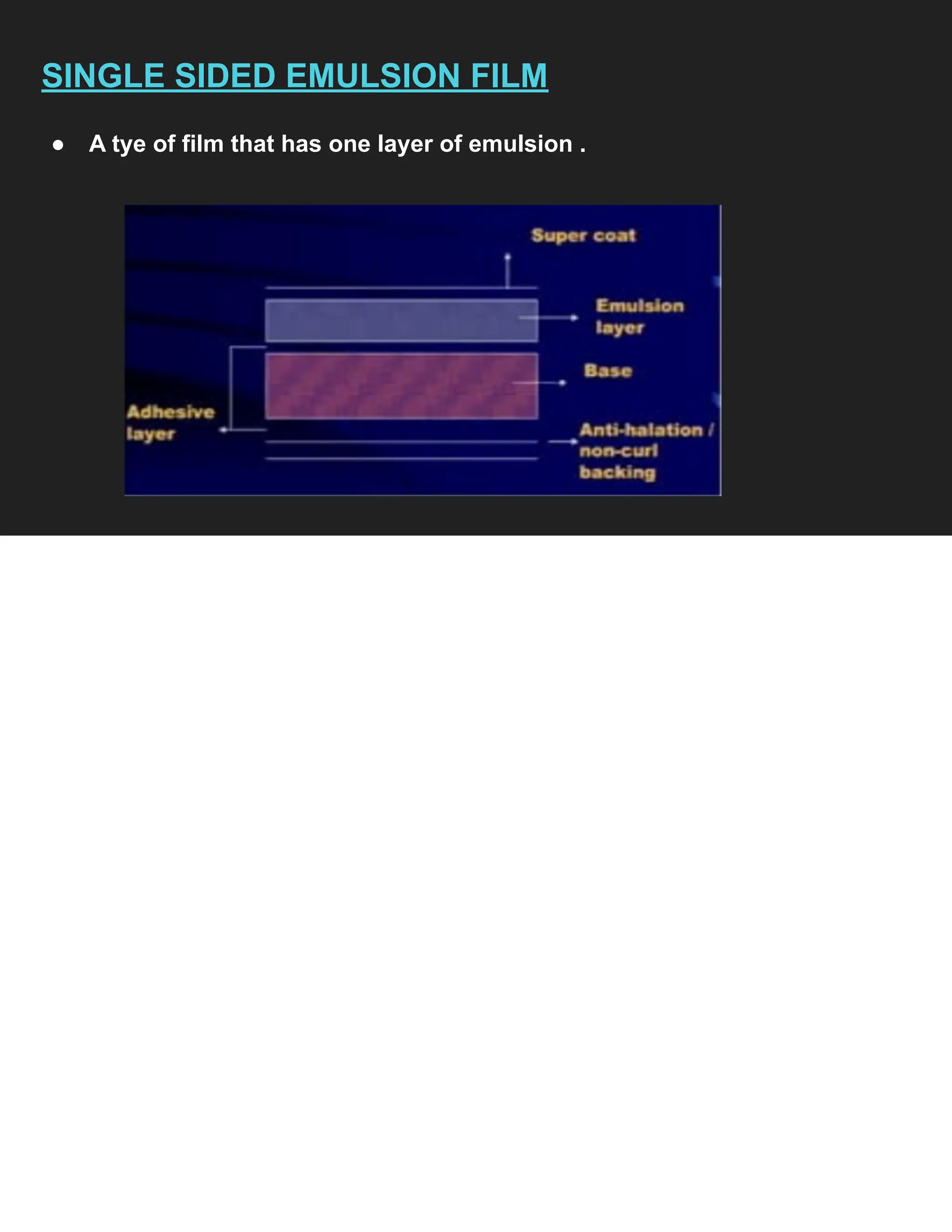
● Present in single -sided emulsion film
only.
● Because the film emulsion layer swell
during processing the film as a whole
will have tendency to curl .
● In order to prevent the curling
tendency with single sided emulsion
film,the emulsion layer is balanced by
coating the base on the opposite
side.
ANTI-HALATION
LAYER
● When the image is formed by
light,some of the light incident on
the film will pass through the
emulsion layer and reach the
base.
● Depending on the angle at which
the light strike the film,it may
either passout of the base /air-
interface at the back of the film or
totally reflected back towards the
emulsion.
● Such reflected light will produce a
diffuse image or ‘HALO’ around
the proper image.
● This phenomenon is known as
‘HALATION’ .
TYPES OF FILM
SINGLE SIDED EMULSION FILM
● A tye of film that has one layer of emulsion .
SINGLE SIDED
EMULSION FILM 1. Screen type film
2. Photoflurographic film
SCREEN TYPE
FILM
● Most commonly used.
● Sensitive to blue light emitted
by intensifying screen and
direct action of x-rays
● Film used in conjunction with a
cassette fitted with single
intensifying screen
APPLICATION
● Mammography
● Capable of demonstrating
microcalcification in soft
tissues.
Some
flurographic film
Line film: 16mm and 35mm
Roll film :70mm and 105mm
Cut film : 100mm
DUPLITIZED EMULSION FILM
Non - screen type film
● Intra oral dental film
● Kidney surgery film
● Radiation monitoring film
Screen type film
● Used with intensifying screen
SINGLE
EMULSION FILM
● Screen type film
● Photoflurographic film
● Cathode ray tube
photography
● Duplication film
● Substraction film
● Laser imaging film
DUPLITIZED
FILM
● Direct -exposure type film
● Intra oral dental film
● Kidney -surgery film
● Radiation monitoring film
DIRECT EXPOSURE TYPE FILM
● Also known as envelope wrapped or non -screen film because of its exposure
to x rays only.
● Each film is individually wrapped in paper and mounted with a stiff and for
support inside a moisture - resistant paper envelope.
● On-screen film are used because of their superior resolution compared to
screen film system.
INTRA ORAL DENTAL FILMS
TYPES:
● PERIAPICAL : 31×41mm (for single or groups of teeth)
● OCCLUSAL :57×76mm (for imaging mandibles or maxilae)
The wrapping of dental envelope package includes:
● The lead -foil insert act as an attenuation of back scattered radiation arising
from the intra oral structure.
● The outer water- proof packets protects the film from the moisture and the
paper insert provide some protection from pressure.
KIDNEY SURGERY FILM
● It is designed to enable a radiographic exposure of the kidney to be
made extra-abdominally during surgery for the removal of renal stones
● The shape of the film facilitates easy placement of the kidney and renal
vessels.
● Each packet contains 2- films on with fast emulsion and other with flow.
SCREEN TYPE FILM
● These film are used in conjunction with pairs of intensifying screens.
● The latent image being produced mainly by light emission from the
screen phosphurs.
● A wide range of different manufactural film are available:
BLUE SENSITIVE (Monochromatic)
GREEN SENSITIVE (orthochromatic)
SINGLE SIDED
EMULSION FILM ● Screen type film
● Photoflurographic film
Screen type film
● Film used in conjunction with a cassette fitted with a single intensifying
screen.
● Capable of demonstrating microcalcification in soft tissues.
APPLICATION
● Mammography
Photoflurographic film
● These are film used to record the image produced at:
The output phospher of an image intensifier tube
The fluroscent screen of a camera system such as miniature
radiography of the chest.
All film has a single emulsion and an anti halation layer. The
emulsion are orthochromatic.
Uses of single emulsion film
● Used in ultrasound, CT,MRI, Nuclear medicine and digital subtraction
Image
● Films are used in conjunction with CRT
● Emulsion are orthochromatic of medium to high contrast
● Sizes commonly used are 10”
×8” and14”×11”
POLOROID FILM
● Mainly used in recording ultrasound scan images.
● Poloroid film pack comprises of a positive and negative sheet
● The photographic sheets are connected by a paper linkage
● After exposure the paper tab is pulled,so bringing the exposed surface
of a negative sheet into close with a positive sheet.

RADIOGRAPHIC FILM, types, uses, application

  • 1.
  • 2.
    RADIOGRAPHIC FILM ● Thex-ray film help us to record the Information regarding the object through Which the x-ray passes and hence they Greatly help in diagnosis and treatment of Patient problem. ● Image recorded on film is caused by Exposure to photons.
  • 3.
    FILM CONSTRUCTION ● X-rayfilm consists of an emulsion -gelatin containing radiation sensitive silver haide crystals and a transparent, flexible base. ● An x-ray film has 4 layers ○ Base ○ Subbing layer ○ Emulsion layer ○ Super coat
  • 4.
    FILM BASE ● Afilm base is a transparent, flexible,and tough substrate that supports the film emulsion. ● Earlier , cellulose triacetate was used. ● Nowadays,polyster made from polyethylene terephthalate resin is used.
  • 5.
    FUNCTION OF FILM BASE ●Provide support to the emulsion layer ● To transmit light so, that an image can be viewed.
  • 6.
    Characteristics of film base ●Transparent ● Strong ● Flexible ● Uniform in thickness ● Dimensionally stable ● Impermeable to water and processing solution ● Non flammable ● Chemically inactive ● Uniform in colour
  • 7.
    ● Sheet film:0.18mm ● Flurographic roll film:0.08mm Thickness of base
  • 8.
    SUBBING LAYER ● It ispresent between base and the emulsion layer. ● It is made by the mixture of gelatin soln and solvent of film base. Subbing layer is required due to: ● To prevent any separation of the emulsion layer from the base during processing.
  • 9.
    EMULSION LAYER ● the emulsionlayer contains light-sensitive compounds that capture images when exposed to light. ● The sensitive emulsion consist of silver halide crystals suspended in gelatin. ● Duplitized x-ray film :emulsion is coated on both sides of the base.
  • 10.
    SUPERCOAT ● This isa thin layer of clear gelatin,which is applied to the emulsion. It has 2 prime function ● To protect the sensitive emulsion from the effects of light pressure or abrasion which might occur during use. ● To provide suitable surface characteristics.
  • 11.
    Non-curl backing ● Present insingle -sided emulsion film only. ● Because the film emulsion layer swell during processing the film as a whole will have tendency to curl . ● In order to prevent the curling tendency with single sided emulsion film,the emulsion layer is balanced by coating the base on the opposite side.
  • 12.
    ANTI-HALATION LAYER ● When theimage is formed by light,some of the light incident on the film will pass through the emulsion layer and reach the base. ● Depending on the angle at which the light strike the film,it may either passout of the base /air- interface at the back of the film or totally reflected back towards the emulsion. ● Such reflected light will produce a diffuse image or ‘HALO’ around the proper image. ● This phenomenon is known as ‘HALATION’ .
  • 13.
  • 14.
    SINGLE SIDED EMULSIONFILM ● A tye of film that has one layer of emulsion .
  • 15.
    SINGLE SIDED EMULSION FILM1. Screen type film 2. Photoflurographic film
  • 16.
    SCREEN TYPE FILM ● Mostcommonly used. ● Sensitive to blue light emitted by intensifying screen and direct action of x-rays ● Film used in conjunction with a cassette fitted with single intensifying screen
  • 17.
    APPLICATION ● Mammography ● Capableof demonstrating microcalcification in soft tissues.
  • 18.
    Some flurographic film Line film:16mm and 35mm Roll film :70mm and 105mm Cut film : 100mm
  • 19.
    DUPLITIZED EMULSION FILM Non- screen type film ● Intra oral dental film ● Kidney surgery film ● Radiation monitoring film Screen type film ● Used with intensifying screen
  • 20.
    SINGLE EMULSION FILM ● Screentype film ● Photoflurographic film ● Cathode ray tube photography ● Duplication film ● Substraction film ● Laser imaging film
  • 21.
    DUPLITIZED FILM ● Direct -exposuretype film ● Intra oral dental film ● Kidney -surgery film ● Radiation monitoring film
  • 22.
    DIRECT EXPOSURE TYPEFILM ● Also known as envelope wrapped or non -screen film because of its exposure to x rays only. ● Each film is individually wrapped in paper and mounted with a stiff and for support inside a moisture - resistant paper envelope. ● On-screen film are used because of their superior resolution compared to screen film system.
  • 23.
    INTRA ORAL DENTALFILMS TYPES: ● PERIAPICAL : 31×41mm (for single or groups of teeth) ● OCCLUSAL :57×76mm (for imaging mandibles or maxilae) The wrapping of dental envelope package includes: ● The lead -foil insert act as an attenuation of back scattered radiation arising from the intra oral structure. ● The outer water- proof packets protects the film from the moisture and the paper insert provide some protection from pressure.
  • 24.
    KIDNEY SURGERY FILM ●It is designed to enable a radiographic exposure of the kidney to be made extra-abdominally during surgery for the removal of renal stones ● The shape of the film facilitates easy placement of the kidney and renal vessels. ● Each packet contains 2- films on with fast emulsion and other with flow.
  • 25.
    SCREEN TYPE FILM ●These film are used in conjunction with pairs of intensifying screens. ● The latent image being produced mainly by light emission from the screen phosphurs.
  • 26.
    ● A widerange of different manufactural film are available: BLUE SENSITIVE (Monochromatic) GREEN SENSITIVE (orthochromatic)
  • 27.
    SINGLE SIDED EMULSION FILM● Screen type film ● Photoflurographic film
  • 28.
    Screen type film ●Film used in conjunction with a cassette fitted with a single intensifying screen. ● Capable of demonstrating microcalcification in soft tissues. APPLICATION ● Mammography
  • 29.
    Photoflurographic film ● Theseare film used to record the image produced at: The output phospher of an image intensifier tube The fluroscent screen of a camera system such as miniature radiography of the chest. All film has a single emulsion and an anti halation layer. The emulsion are orthochromatic.
  • 30.
    Uses of singleemulsion film ● Used in ultrasound, CT,MRI, Nuclear medicine and digital subtraction Image ● Films are used in conjunction with CRT ● Emulsion are orthochromatic of medium to high contrast ● Sizes commonly used are 10” ×8” and14”×11”
  • 31.
    POLOROID FILM ● Mainlyused in recording ultrasound scan images. ● Poloroid film pack comprises of a positive and negative sheet ● The photographic sheets are connected by a paper linkage ● After exposure the paper tab is pulled,so bringing the exposed surface of a negative sheet into close with a positive sheet.