
Presented By -
Pooja Singh
Prabeen Singh
Pratyush Devrani
Mubashir Hassan
Mukesh Tiwari
BBA Sec- B IVth Term
Introduction about Banking
Traditional Banking System
Functions of Banking Industry
Objectives of Banking Industry
Services offered by Banking Industry
Conclusion
References
“A bank is a financial institution and a financial
intermediary that accepts deposits and channels those
deposits into lending activities, either directly or
through capital market. A bank connects customers
with capital deficits to customers with capital
surpluses.”
 Section 5 (b) of the Banking Regulation Act 1949
defines “Banking” as
 “Accepting for the purpose of lending and
investment, deposits of money from the public
 repayable on demand or otherwise
 and withdrawable by cheque, draft, order or
otherwise”
Basic Introduction:
In traditional banking system, a customer can open any bank
account in banks, take the facility of saving his money by
depositing money in local bank. He can withdraw his money
through check, counter payment and through bank draft. He
can meet the bank manager and ask his problem. He can
take the physical help for getting loan from bank.
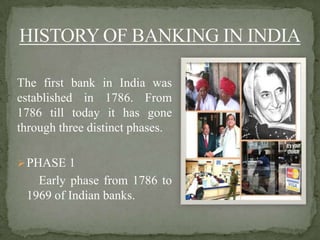
The first bank in India was
established in 1786. From
1786 till today it has gone
through three distinct phases.
PHASE 1
Early phase from 1786 to
1969 of Indian banks.
PHASE 2
Nationalization of Indian Banks and up to 1991 prior
to Indian banking sector Reforms.
PHASE 3
New phase of Indian Banking system with the
advent of Indian Financial & Banking Sector
Reforms after 1991.
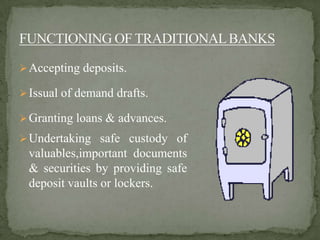
Accepting deposits.
Issual of demand drafts.
Granting loans & advances.
Undertaking safe custody of
valuables,important documents
& securities by providing safe
deposit vaults or lockers.
 Documentation is maintained
through ledgers only.
 Minimum balance for opening
an account was more during this
period.
 Credits were granted at very
high rate of interest.
 Token system for withdrawal of
cash from the account.
 Possibility of human errors .
 Time constraint.
 Customer relationship was limited.
 Over draft was not available.
 Processing fees was charged for all the transactions .
 Passing of cheques was delayed.
 Limited use of technology.
 The main functions of banks are accepting deposit and lending
loans:
Accepting Deposits
1. Fixed deposits - These deposits mature after a considerable
long period like 1 year or more than that the rate of interest is
fixed the amount deposited cannot be withdrawn before
maturity date.
2. Current A/C deposit - These are mainly maintain by business
community to facilitate frequent transaction with big amounts.
Generally no rate of interest or very low rate of interest is paid
on this account.
3. Savings bank A/C - It is kind of demand deposits
which is generally kept by the people for the sake of
safety. These facility is given for small saver and
normally a small rate of interest is paid.
4. Recurring deposit A/C - In case of recurring deposit
the fixed amount is deposited in a bank every month
for a fixed period of time.
Lending loans
1. Call loans - These loan are called back at any time.
Normally, this loans are taken by bill brokers or stock
brokers.
2. Short term loans - These are sanctioned for a period
up to 1 year.
3. Medium term loans - These are sanctioned for the
period varying between 1 and 5 years.
 Credit Creation
 Wealth Function
 Liquidity Function
 Payment Function
 Risk Protection Function
 Transferring Money From One Place To Another
To maintain higher profitability by maintaining
circular and efficient flow of amount of money
deposited by the customers and the lenders.
To lower transaction costs, lower information
costs, create liquidity, and to diversify people's money
in a way they could not do on their own.
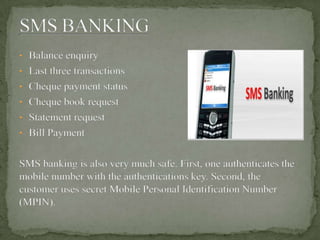
A mobile hand set with a connection is the only
instrument needed to make a gateway to your banking
transaction, the latest innovation of technology.
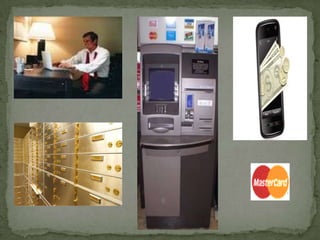
Mobile Banking, SMS Banking, Net Banking and
ATMs are the major services by
the banks in India.
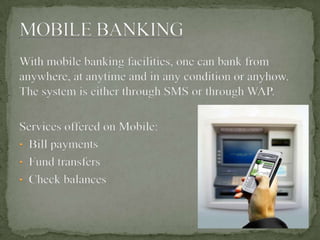
With mobile banking facilities, one can bank from
anywhere, at anytime and in any condition or anyhow.
The system is either through SMS or through WAP.
Services offered on Mobile:
• Bill payments
• Fund transfers
• Check balances
• Balance enquiry
• Last three transactions
• Cheque payment status
• Cheque book request
• Statement request
• Bill Payment
SMS banking is also very much safe. First, one authenticates the
mobile number with the authentications key. Second, the
customer uses secret Mobile Personal Identification Number
(MPIN).
Online banking/Internet banking/E-banking allows
customers of a financial institution to conduct
financial transactions on a secure website operated by
the institution, which can be
a retail or virtual bank, credit union or building
society.
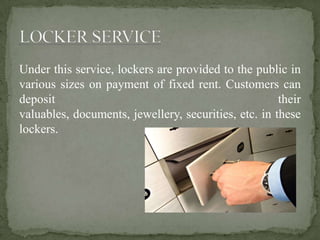
Under this service, lockers are provided to the public in
various sizes on payment of fixed rent. Customers can
deposit their
valuables, documents, jewellery, securities, etc. in these
lockers.
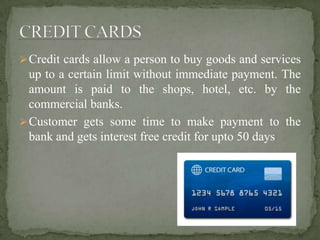
Credit cards allow a person to buy goods and services
up to a certain limit without immediate payment. The
amount is paid to the shops, hotel, etc. by the
commercial banks.
Customer gets some time to make payment to the
bank and gets interest free credit for upto 50 days
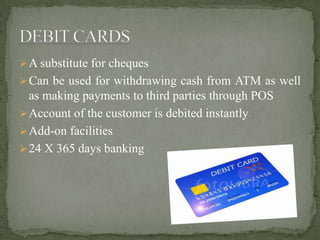
A substitute for cheques
Can be used for withdrawing cash from ATM as well
as making payments to third parties through POS
Account of the customer is debited instantly
Add-on facilities
24 X 365 days banking
“The reforms to the old Banking system with
the advent of technology has bought in a
dramatic change in its functioning and has
increased customer relationship.”
Technology in Indian Banking[Commercial
Banking].
Traditional Banking System in India.
Trend & progress of Banking in India, RBI
2006
Google search.
www.antiphishing.com
Indian finanacial Market

Indian finanacial Market

  • 1.
    Presented By - PoojaSingh Prabeen Singh Pratyush Devrani Mubashir Hassan Mukesh Tiwari BBA Sec- B IVth Term
  • 2.
    Introduction about Banking TraditionalBanking System Functions of Banking Industry Objectives of Banking Industry Services offered by Banking Industry Conclusion References
  • 3.
    “A bank isa financial institution and a financial intermediary that accepts deposits and channels those deposits into lending activities, either directly or through capital market. A bank connects customers with capital deficits to customers with capital surpluses.”
  • 4.
     Section 5(b) of the Banking Regulation Act 1949 defines “Banking” as  “Accepting for the purpose of lending and investment, deposits of money from the public  repayable on demand or otherwise  and withdrawable by cheque, draft, order or otherwise”
  • 5.
    Basic Introduction: In traditionalbanking system, a customer can open any bank account in banks, take the facility of saving his money by depositing money in local bank. He can withdraw his money through check, counter payment and through bank draft. He can meet the bank manager and ask his problem. He can take the physical help for getting loan from bank.
  • 6.
    The first bankin India was established in 1786. From 1786 till today it has gone through three distinct phases. PHASE 1 Early phase from 1786 to 1969 of Indian banks.
  • 7.
    PHASE 2 Nationalization ofIndian Banks and up to 1991 prior to Indian banking sector Reforms. PHASE 3 New phase of Indian Banking system with the advent of Indian Financial & Banking Sector Reforms after 1991.
  • 8.
    Accepting deposits. Issual ofdemand drafts. Granting loans & advances. Undertaking safe custody of valuables,important documents & securities by providing safe deposit vaults or lockers.
  • 9.
     Documentation ismaintained through ledgers only.  Minimum balance for opening an account was more during this period.  Credits were granted at very high rate of interest.  Token system for withdrawal of cash from the account.
  • 10.
     Possibility ofhuman errors .  Time constraint.  Customer relationship was limited.  Over draft was not available.  Processing fees was charged for all the transactions .  Passing of cheques was delayed.  Limited use of technology.
  • 12.
     The mainfunctions of banks are accepting deposit and lending loans: Accepting Deposits 1. Fixed deposits - These deposits mature after a considerable long period like 1 year or more than that the rate of interest is fixed the amount deposited cannot be withdrawn before maturity date. 2. Current A/C deposit - These are mainly maintain by business community to facilitate frequent transaction with big amounts. Generally no rate of interest or very low rate of interest is paid on this account.
  • 13.
    3. Savings bankA/C - It is kind of demand deposits which is generally kept by the people for the sake of safety. These facility is given for small saver and normally a small rate of interest is paid. 4. Recurring deposit A/C - In case of recurring deposit the fixed amount is deposited in a bank every month for a fixed period of time.
  • 14.
    Lending loans 1. Callloans - These loan are called back at any time. Normally, this loans are taken by bill brokers or stock brokers. 2. Short term loans - These are sanctioned for a period up to 1 year. 3. Medium term loans - These are sanctioned for the period varying between 1 and 5 years.
  • 15.
     Credit Creation Wealth Function  Liquidity Function  Payment Function  Risk Protection Function  Transferring Money From One Place To Another
  • 16.
    To maintain higherprofitability by maintaining circular and efficient flow of amount of money deposited by the customers and the lenders. To lower transaction costs, lower information costs, create liquidity, and to diversify people's money in a way they could not do on their own.
  • 19.
    A mobile handset with a connection is the only instrument needed to make a gateway to your banking transaction, the latest innovation of technology. Mobile Banking, SMS Banking, Net Banking and ATMs are the major services by the banks in India.
  • 20.
    With mobile bankingfacilities, one can bank from anywhere, at anytime and in any condition or anyhow. The system is either through SMS or through WAP. Services offered on Mobile: • Bill payments • Fund transfers • Check balances
  • 21.
    • Balance enquiry •Last three transactions • Cheque payment status • Cheque book request • Statement request • Bill Payment SMS banking is also very much safe. First, one authenticates the mobile number with the authentications key. Second, the customer uses secret Mobile Personal Identification Number (MPIN).
  • 22.
    Online banking/Internet banking/E-bankingallows customers of a financial institution to conduct financial transactions on a secure website operated by the institution, which can be a retail or virtual bank, credit union or building society.
  • 23.
    Under this service,lockers are provided to the public in various sizes on payment of fixed rent. Customers can deposit their valuables, documents, jewellery, securities, etc. in these lockers.
  • 24.
    Credit cards allowa person to buy goods and services up to a certain limit without immediate payment. The amount is paid to the shops, hotel, etc. by the commercial banks. Customer gets some time to make payment to the bank and gets interest free credit for upto 50 days
  • 25.
    A substitute forcheques Can be used for withdrawing cash from ATM as well as making payments to third parties through POS Account of the customer is debited instantly Add-on facilities 24 X 365 days banking
  • 26.
    “The reforms tothe old Banking system with the advent of technology has bought in a dramatic change in its functioning and has increased customer relationship.”
  • 27.
    Technology in IndianBanking[Commercial Banking]. Traditional Banking System in India. Trend & progress of Banking in India, RBI 2006 Google search. www.antiphishing.com

Editor's Notes

  • #7 The General Bank of India was established in 1786. Then came the Bank of Hindustan and Bengal Bank. The East India company established Bank of Bengal (1809), Bank of Bombay (1840), Bank of Madras (1843) and these banks called as Presidency Bank. These three banks were amalgamated in 1920 and named as the Imperial Bank of India, which was started as the as the private shareholder bank mostly European shareholder .In 1865 Allahabad Bank was established and first time exclusively by Indians, Punjab National Bank Ltd was setup in 1894 with headquarter in Lahore. Between 1906 to 1913 many banks were established namely Canara bank, Central bank, Bank of India, Bank of Baroda, Indian Bank, Bank of Mysore were established. There were approximately 1100 banks mostly small was established.To streamline the banks and to gain control over the banks Govt. of India came up with The Banking Companies Act in 1949 which was later changed to Banking Regulation Act 1949.
  • #8 PHASE2Govt. took some major steps to bring reforms in the Indian banking sector after independence. In 1955, it nationalized The Imperial Bank of India with extensive banking facilities on a large scale especially in rural and Semi-urban areas. It form SBI to act as the principal agent of RBI.In 1969 late Prime Minister Mrs. Indira Gandhi nationalized 14 commercial banks.PHASE2 (CONT……)In 1980 seven more banks were nationalized which brings around 80% banks under the control of Govt. Govt. took the following steps:-1949: Enactment of Banking Regulation Act1955: Nationalization of SBI1959: Nationalization of SBI Subsidiaries1961: Insurance cover extended to deposits1969:Nationalization of 14 commercial banks1971:Creation of credit guarantee corporation1975:Creation of Regional Rural Banks (RRB)1980:Nationalization of banks with deposits over 200 crorePHASE3This phase brought many more facilities in the banking sector. In 1991, under the chairmanship of Mr. M Narasimham, a committee was set up which work for the liberalization of banks in IndiaDuring this country is flooded with the Foreign banks and ATMs. Phone Baking and Net banking was introduced.