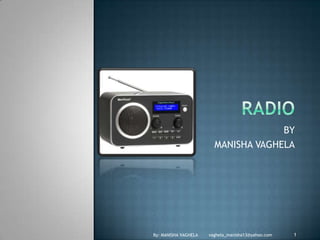
BY
                        MANISHA VAGHELA


By: MANISHA VAGHELA   vaghela_manisha13@yahoo.com   1
• A combination of a number of discoveries of electro
  magnetic waves, radio waves, the wireless telegraph and
  the triode amplifier valve by scientists and technicians from
  different countries gave rise to the development of wireless
  telegraphy and later to radio broadcasting.
• WWI prompted the industrialization of wireless telegraphy.
  In US the radio created a communication environment in
  which amateurs could operate freely.
• Radio Broadcasting needed the mass production of receivers
  and marketing for it to be commercially viable. WWI
  military requirements facilitated this.
• Earliest radio transmission in 1915 were by universities to
  disseminate news.


                        By: MANISHA VAGHELA   vaghela_manisha13@yahoo.com   2
• First radio stations were set up in Pittsburg, New York and
  Chicago in 1920s to broadcast election news, sporting events and
  even opera performances.
• By mid 1923 as many as 450 stations sprouted across US

• In Europe, public service oriented broadcasting supported by
  taxes or license fees rather than advertising oriented
  commercial broadcasting found widespread favour.
• Thus as CBS Columbia Broadcasting Station and NBC National
  Broadcasting Stations in the US were established as private
  stations, the British Government took the initiative to set up
  BBC in 1920 as an autonomous public service corporation.


               By: MANISHA VAGHELA   vaghela_manisha13@yahoo.com   3
Development of Radio in India


•   Broadcasting was introduced in India by amateur radio
    clubs in Calcutta, Bombay, Madras and Lahore.
•   Before the clubs launched their ventures, several
    experimental broadcasts were conducted in Bombay and
    other cities.
•   The Times of India records that a broadcast was
    transmitted from the roof of it’s building on August 20,
    1921.
•   By the mid-1930s, there were around 20 amateur radio
    operators in India
•   Amateur radio operators played an important part in
    the Indian independence movement with the
    establishment of illegal pro-independence radio stations
    in the 1940s.


                        By: MANISHA VAGHELA   vaghela_manisha13@yahoo.com   4
•   The three decades after India's independence saw only
    slow growth in the numbers of operators until the
    then Prime Minister of India and amateur radio
    operator, Rajiv Gandhi, waived the import duty on
    wireless equipment in 1984.
•   Since then, numbers have picked up, and as of 2007,
    there were more than 16,000 operators in the country.
•   Amateur radio operators have played a vital role during
    disasters and national emergencies such as earthquakes,
    tsunamis, cyclones, floods, and bomb blasts, by providing
    voluntary emergency communications in the affected
    areas.


                  By: MANISHA VAGHELA   vaghela_manisha13@yahoo.com   5
All India Radio


•   All India Radio (AIR), officially known since 1956
    as Akashvani is the radio broadcaster of India and a
    division of Prasar Bharati. Established in 1936, it is the sister
    service of Prasar Bharati's Doordarshan, the national
    television broadcaster. All India Radio is one of the largest
    radio networks in the world.
•   In British India, broadcasting began in June 1923 with
    programmes by the Radio Club of Bombay and other radio
    clubs.
•   According to an agreement of 1926, the private Indian
    Broadcasting Company (IBC) was authorized to operate two
    radio stations; the Bombay station began on 23 July 1927,
    and the Calcutta station followed on 26 August 1927.


                           By: MANISHA VAGHELA   vaghela_manisha13@yahoo.com   6
•   On 1 March 1930, however, the company went into liquidation.
•   The government took over the broadcasting facilities,
    beginning the Indian State Broadcasting Service (ISBS) on 1
    April 1930 (on an experimental basis for two years, and
    permanently in May 1932). On 8 June 1936 the ISBS was
    renamed All India Radio.
•   When India became independent in 1947 the AIR network had
    only six stations (in Delhi, Bombay, Calcutta, Madras, Lucknow,
    and Tiruchi); the total number of radio sets at that time was
    about 275,000.
•   On 3 October 1957 the Vividh Bharati Service was launched, to
    compete with Radio Ceylon.
•   Television broadcasting began in Delhi in 1959 as part of AIR,
    but was split off from the radio network as Doordarshan on 1
    April 1976.
•   FM broadcasting began on 23 July 1977 in Madras, and was
    expanded during the 1990s.


                          By: MANISHA VAGHELA   vaghela_manisha13@yahoo.com   7
AIR Services
 Vividh Bharati
 Prasar Bharati
 Regional Services:
The headquarters of the Regional Deputy Directors General are
located at Delhi and Chandigarh (NR), Lucknow and Bhopal
(CR), Guwahati (NER), Kolkata (ER), Mumbai and Ahmedabad
(WR), Chennai and Bangaluru (SR).


                        By: MANISHA VAGHELA   vaghela_manisha13@yahoo.com   8
 External Services:The external services of All India Radio
  broadcast in 27 languages to countries outside India.
  The first broadcasts were in Pushto, beamed to
  Afghanistan and the North-West Frontier Province. Soon
  broadcasts began in other languages including Dari,
  Persian, Arabic, English, Burmese, Japanese, Chinese,
  Malay and French. The external services broadcast in 16
  foreign and 11 Indian languages, with a total program
  output of 70¼ hours per day on medium- and shortwave.
 News-On-Phone Service:All India Radio launched news-
  on-phone service on 25 February 1998 in New Delhi; it
  now has service in Chennai, Mumbai, Hyderabad, Indore,
  Patna and Bangalore. The service is accessible through
  STD, ISD and local calls
 Direct-To-Home Service:Direct-to-home (DTH) service is
  offered on 21 channels via Insat.
 FM


                      By: MANISHA VAGHELA   vaghela_manisha13@yahoo.com   9
AIR Programmes
 News Bulletins
 NewsReels
 Documentaries/Radio features
 Radio Plays
 Radio Talks
 Music Programmes
 Movie trailers
 Quizzes


                 By: MANISHA VAGHELA   vaghela_manisha13@yahoo.com   10
Vividh Bharati
The Vividh Bharati Service of All India Radio was
conceptualized to combat Radio Ceylon in 1957.
Within no time it proved to be a popular channel of
every household. Vividh Bharati radio channel was
launched on October 3, 1957. The service provides
entertainment for nearly 15 to 17 hours a day.
Vividh Bharati is one of the best-known services of
AIR. Its name roughly translates as "Multi-Indian
Service", and it is also known as the Commercial
Broadcasting Service (CBS).
It is the most commercially-accessible of the AIR
networks and is popular in Mumbai and other large
cities.


                       By: MANISHA VAGHELA   vaghela_manisha13@yahoo.com   11
Vividh Bharati offers a wide range of programmes including
news, film music and comedy programs.
It operates on different medium wave-band frequencies for
each city.
40 Vividh Bharati stations across the country down-linked
these programmes through captive earth stations provided
at each of these AIR stations.
These 40 Vividh Bharati stations are known as Commercial
Broadcasting Service Stations and are located at all major
and commercially vibrant cities covering 97% of the Indian
population.

Some programs broadcast on Vividh Bharati are:

Hawa-mahal: Radio plays based on novels and plays


                By: MANISHA VAGHELA   vaghela_manisha13@yahoo.com   12
Prasar Bharati


• Prasar Bharati is India's largest public broadcaster. It is an
  autonomous body set up by an Act of Parliament and
  comprises Doordarshan television network and All India
  Radio which were earlier media units of the Ministry of
  Information and Broadcasting, Government of India.
• Prasar Bharati was established on November 23, 1997 following a
  demand that the government owned broadcasters in India should
  be given autonomy like those in many other countries. The
  Parliament of India passed an Act to grant this autonomy in 1990,
  but it was not enacted until September 15, 1997.


                         By: MANISHA VAGHELA   vaghela_manisha13@yahoo.com   13
Functions and Objectives
It shall be the primary duty of the Corporation to organise and
conduct public broadcasting services to inform, educate and
entertain the public and to ensure a balanced development of
broadcasting on radio and television.


                  By: MANISHA VAGHELA   vaghela_manisha13@yahoo.com   14
By: MANISHA VAGHELA   vaghela_manisha13@yahoo.com   15

Radio

  • 1.
    BY MANISHA VAGHELA By: MANISHA VAGHELA vaghela_manisha13@yahoo.com 1
  • 2.
    • A combinationof a number of discoveries of electro magnetic waves, radio waves, the wireless telegraph and the triode amplifier valve by scientists and technicians from different countries gave rise to the development of wireless telegraphy and later to radio broadcasting. • WWI prompted the industrialization of wireless telegraphy. In US the radio created a communication environment in which amateurs could operate freely. • Radio Broadcasting needed the mass production of receivers and marketing for it to be commercially viable. WWI military requirements facilitated this. • Earliest radio transmission in 1915 were by universities to disseminate news. By: MANISHA VAGHELA vaghela_manisha13@yahoo.com 2
  • 3.
    • First radiostations were set up in Pittsburg, New York and Chicago in 1920s to broadcast election news, sporting events and even opera performances. • By mid 1923 as many as 450 stations sprouted across US • In Europe, public service oriented broadcasting supported by taxes or license fees rather than advertising oriented commercial broadcasting found widespread favour. • Thus as CBS Columbia Broadcasting Station and NBC National Broadcasting Stations in the US were established as private stations, the British Government took the initiative to set up BBC in 1920 as an autonomous public service corporation. By: MANISHA VAGHELA vaghela_manisha13@yahoo.com 3
  • 4.
    Development of Radioin India • Broadcasting was introduced in India by amateur radio clubs in Calcutta, Bombay, Madras and Lahore. • Before the clubs launched their ventures, several experimental broadcasts were conducted in Bombay and other cities. • The Times of India records that a broadcast was transmitted from the roof of it’s building on August 20, 1921. • By the mid-1930s, there were around 20 amateur radio operators in India • Amateur radio operators played an important part in the Indian independence movement with the establishment of illegal pro-independence radio stations in the 1940s. By: MANISHA VAGHELA vaghela_manisha13@yahoo.com 4
  • 5.
    The three decades after India's independence saw only slow growth in the numbers of operators until the then Prime Minister of India and amateur radio operator, Rajiv Gandhi, waived the import duty on wireless equipment in 1984. • Since then, numbers have picked up, and as of 2007, there were more than 16,000 operators in the country. • Amateur radio operators have played a vital role during disasters and national emergencies such as earthquakes, tsunamis, cyclones, floods, and bomb blasts, by providing voluntary emergency communications in the affected areas. By: MANISHA VAGHELA vaghela_manisha13@yahoo.com 5
  • 6.
    All India Radio • All India Radio (AIR), officially known since 1956 as Akashvani is the radio broadcaster of India and a division of Prasar Bharati. Established in 1936, it is the sister service of Prasar Bharati's Doordarshan, the national television broadcaster. All India Radio is one of the largest radio networks in the world. • In British India, broadcasting began in June 1923 with programmes by the Radio Club of Bombay and other radio clubs. • According to an agreement of 1926, the private Indian Broadcasting Company (IBC) was authorized to operate two radio stations; the Bombay station began on 23 July 1927, and the Calcutta station followed on 26 August 1927. By: MANISHA VAGHELA vaghela_manisha13@yahoo.com 6
  • 7.
    On 1 March 1930, however, the company went into liquidation. • The government took over the broadcasting facilities, beginning the Indian State Broadcasting Service (ISBS) on 1 April 1930 (on an experimental basis for two years, and permanently in May 1932). On 8 June 1936 the ISBS was renamed All India Radio. • When India became independent in 1947 the AIR network had only six stations (in Delhi, Bombay, Calcutta, Madras, Lucknow, and Tiruchi); the total number of radio sets at that time was about 275,000. • On 3 October 1957 the Vividh Bharati Service was launched, to compete with Radio Ceylon. • Television broadcasting began in Delhi in 1959 as part of AIR, but was split off from the radio network as Doordarshan on 1 April 1976. • FM broadcasting began on 23 July 1977 in Madras, and was expanded during the 1990s. By: MANISHA VAGHELA vaghela_manisha13@yahoo.com 7
  • 8.
    AIR Services  VividhBharati  Prasar Bharati  Regional Services: The headquarters of the Regional Deputy Directors General are located at Delhi and Chandigarh (NR), Lucknow and Bhopal (CR), Guwahati (NER), Kolkata (ER), Mumbai and Ahmedabad (WR), Chennai and Bangaluru (SR). By: MANISHA VAGHELA vaghela_manisha13@yahoo.com 8
  • 9.
     External Services:Theexternal services of All India Radio broadcast in 27 languages to countries outside India. The first broadcasts were in Pushto, beamed to Afghanistan and the North-West Frontier Province. Soon broadcasts began in other languages including Dari, Persian, Arabic, English, Burmese, Japanese, Chinese, Malay and French. The external services broadcast in 16 foreign and 11 Indian languages, with a total program output of 70¼ hours per day on medium- and shortwave.  News-On-Phone Service:All India Radio launched news- on-phone service on 25 February 1998 in New Delhi; it now has service in Chennai, Mumbai, Hyderabad, Indore, Patna and Bangalore. The service is accessible through STD, ISD and local calls  Direct-To-Home Service:Direct-to-home (DTH) service is offered on 21 channels via Insat.  FM By: MANISHA VAGHELA vaghela_manisha13@yahoo.com 9
  • 10.
    AIR Programmes  NewsBulletins  NewsReels  Documentaries/Radio features  Radio Plays  Radio Talks  Music Programmes  Movie trailers  Quizzes By: MANISHA VAGHELA vaghela_manisha13@yahoo.com 10
  • 11.
    Vividh Bharati The VividhBharati Service of All India Radio was conceptualized to combat Radio Ceylon in 1957. Within no time it proved to be a popular channel of every household. Vividh Bharati radio channel was launched on October 3, 1957. The service provides entertainment for nearly 15 to 17 hours a day. Vividh Bharati is one of the best-known services of AIR. Its name roughly translates as "Multi-Indian Service", and it is also known as the Commercial Broadcasting Service (CBS). It is the most commercially-accessible of the AIR networks and is popular in Mumbai and other large cities. By: MANISHA VAGHELA vaghela_manisha13@yahoo.com 11
  • 12.
    Vividh Bharati offersa wide range of programmes including news, film music and comedy programs. It operates on different medium wave-band frequencies for each city. 40 Vividh Bharati stations across the country down-linked these programmes through captive earth stations provided at each of these AIR stations. These 40 Vividh Bharati stations are known as Commercial Broadcasting Service Stations and are located at all major and commercially vibrant cities covering 97% of the Indian population. Some programs broadcast on Vividh Bharati are: Hawa-mahal: Radio plays based on novels and plays By: MANISHA VAGHELA vaghela_manisha13@yahoo.com 12
  • 13.
    Prasar Bharati • PrasarBharati is India's largest public broadcaster. It is an autonomous body set up by an Act of Parliament and comprises Doordarshan television network and All India Radio which were earlier media units of the Ministry of Information and Broadcasting, Government of India. • Prasar Bharati was established on November 23, 1997 following a demand that the government owned broadcasters in India should be given autonomy like those in many other countries. The Parliament of India passed an Act to grant this autonomy in 1990, but it was not enacted until September 15, 1997. By: MANISHA VAGHELA vaghela_manisha13@yahoo.com 13
  • 14.
    Functions and Objectives Itshall be the primary duty of the Corporation to organise and conduct public broadcasting services to inform, educate and entertain the public and to ensure a balanced development of broadcasting on radio and television. By: MANISHA VAGHELA vaghela_manisha13@yahoo.com 14
  • 15.
    By: MANISHA VAGHELA vaghela_manisha13@yahoo.com 15