RADIO
The future is air borne.
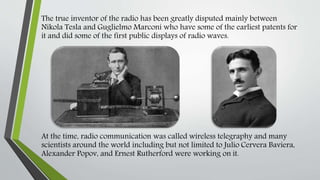
The true inventor of the radio has been greatly disputed mainly between
Nikola Tesla and Guglielmo Marconi who have some of the earliest patents for
it and did some of the first public displays of radio waves.
At the time, radio communication was called wireless telegraphy and many
scientists around the world including but not limited to Julio Cervera Baviera,
Alexander Popov, and Ernest Rutherford were working on it.
History of Radio in India
• Radio Broadcasting was pioneered in India by the Madras Presidency Club
Radio in 1924. The Club worked a broadcasting service for three years, but
owing to financial difficulties gave it up in 1927.
• In the same year (1927) some enterprising businessmen in Bombay started
the Indian Broadcasting Company with stations at Bombay and Calcutta.
This company failed in 1930, in 1932 the Government of India took over
broadcasting. A separate department known as Indian Broadcasting Service
was opened.
• The Service was later designated 'All India Radio' (AIR) and was placed
under a separate Ministry - the Ministry of Information and Broadcasting.
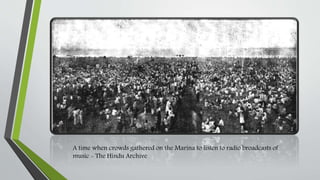
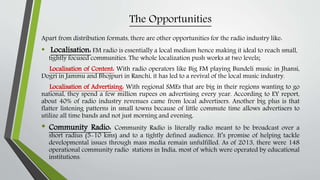
A time when crowds gathered on the Marina to listen to radio broadcasts of
music - The Hindu Archive
All India Radio
• Officially known since 1956 as Ākāshvāṇī (literally, "Voice from the
Sky"), is the national public radio broadcaster of India. All India Radio is
one of the largest radio networks in the world and is headquartered at the
Akashvani Bhavan in New Delhi.
• The word ‘Akashvani’ was coined by M. V. Gopalaswamy after setting up
the nation’s first private radio station in his residence, "Vittal Vihar"
(about 200 yards from AIR’s current location in Mysore) in 1936.
‘Akashvani’ seemed to be an appropriate name for a radio broadcaster
and was later adopted as All India Radio's on-air name after
independence.
• AIR’s home service comprises 414 stations today located across the
country, reaching nearly 92% of the country’s area and 99.19 % of the
total population. AIR originates programming in 23 languages and 146
dialects.
FM Broadcasting in India
Phase One
• Until 1993, All India Radio or AIR, a government undertaking, was the only radio
broadcaster in India. The government then took the initiative to privatize the radio
broadcasting sector. It sold airtime blocks on its FM channels in Indore, Hyderabad,
Mumbai, Delhi, Kolkata, Vizag and Goa to private operators, who developed their
own program content. The Times Group operated its brand, Times FM, till June
1998. After that, the government decided not to renew contracts given to private
operators.
• In 2000, the government announced the auction of 108 FM frequencies across
India.
• Radio City Bangalore, started on July 3, 2001, is India's first private FM radio
station. It launched with presenters such as Rohit Barker, Darius Sunawala, Jonzie
Kurian and Suresh Venkat.
• Companies were allowed to own and run radio stations by paying license fees to
the government every year. Phase One saw 21 private radio stations being
operational in 12 cities.
Phase Two
• Second Phase auctions in the year 2005 witnessed 237 frequencies being sold out
of about 338 that were offered.
• Reliance and South Asia FM (Sun group) bid for most of the 91 cities, although they
were allowed only 15% of the total allocated frequencies. Between them, they have
had to surrender over 40 licenses.
• Phase Two saw 248 stations broadcasting across 91 cities.
• News is not permitted on private FM. Nationally, many of the current FM players,
including the Times of India, Hindustan Times, Mid-Day, and BBC are essentially
newspaper chains or media, and they are making a strong pitch for news on FM.
Private FM stations are allowed to rebroadcast news from All India Radio, as long as
they do so without any changes or additions. The Supreme Court of India on 17
October 2013 issued a public interest litigation to the Centre requesting that the
rules should be changed to allow FM stations to broadcast news reports.
Phase Three• E-Auction of the first batch of private FM radio phase III channels comprising of two stages
– the Channel Allocation stage and the Frequency Allocation Stage, was completed on 9th
September 2015.
• A noteworthy feature of the auction was that out of 15 channels in J&K and NE states, 12
channels got provisional winners with the city of Guwahati getting provisional winning
price more than 10 times its reserve price.
• The ministry had notified the list of successful bidders of the first batch on September 16,
comprising details of 14 successful bidders for 91 channels in 54 cities along with winning
prices and selected frequency spots.
• The government estimates an overall bounty of around Rs 5,000 crore from the phase III
auctions. These include Rs 1,150 crore from the 97 frequencies under the first batch of
phase III auctions, another estimated Rs 1,900-2,000 crore through migration of 266
frequencies to phase III from phase II, and an estimated Rs 2,000-2,300 crore from licence
fees.
• HT Media and Entertainment Network India (ENIL) were the biggest spenders with both
spending close to Rs. 340 crore and focusing mainly on metros like Delhi, Bangalore and
Mumbai. Reliance Broadcast Network added 14 new stations to it’s existing 45 station
network.
The Working of the Radio Industry
Costs
The costs for the starting up of a radio station in India include;
• License Fees: Phase Three policy states that the License fee will be determined as 4%
of Gross Revenue (GR) or 2.5% of bid price for a city, whichever is higher. Acc. to
the EY 2012 report, license fees formed 5-8% of the total costs of a radio station.
• Set-up costs: Average investment to set up a radio station is Rs. 15 to 25 million for
smaller stations and Rs. 40 to 50 million for a metro or big city station. These costs
normally includes transmission, studio and office equipment, premises and
networking infrastructure.
• Operating costs: Acc. to EY report, key elements of operating cost are payroll (30-
40%), marketing (10-20%), music royalty (2-3%), overheads and utilities (20% of
costs).
The Economics
The Economics
Main sources of revenue are;
• Advertising and Sponsorship: This is the main revenue stream for radio
companies with national and local advertising on radio in India split close to
60:40.
• Subscription: Satellite radios depend on subscriptions as a main source of
revenue. However, audiences of most media have their fill of free content
before feeling the need to pay for content. Radio in India is far from
reaching there though.
Revenues
The Metrics
• AIR began by selling time, through sponsorship and spots, when it was set
up as a private company in 1927. The government disallowed advertising in
1934 only to be re-introduced in ‘67 on the recommendation of the Chanda
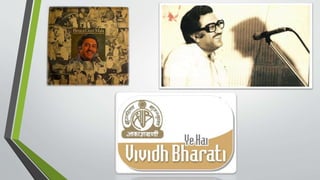
Committee. This saw an acceptance of commercials on ‘Vividh Bharati’
which made Rs. 1.9 million that year from ad revenues and the amount kept
rising.
• Prime time on radio in the 80’s was classified as Category One ( 8-9 am and
7-8 pm). If an advertiser wanted a fixed time on Category One, there was a
premium of 25%. This is in contrast to today’s average utilization of
advertising time on FM which is between 65-75%.
The Buying and Selling
Dynamics
The Buying and Selling Dynamics
With the rise in the number of radio channels, advertising on it is bound to
change in two ways.
• As the no. of channels grow, there will be a need for focused advertising. For
example, a Smirnoff Vodka advertisement is better fit in the evening when
people dive back home rather than when they commute to work. Or, hard
rock listeners are more likely to buy jeans. Therefore, advertisers could
utilize specific channels and time bands.
• Cross-media buys is the second potential change that radio could force.
With companies like BCCL that owns TOI and Radio Mirchi, ‘combos’ like a
good deal in Mumbai Mirror also gets you spots on Mirchi at attractive
rates. Also, buyers can combine TV from companies like Sun TV and their
radio stations.
The
Changes
The Buying and Selling Dynamics
• AIR: The radio company has an in-house Audience Research Unit that
conducts research on listening habits using interviews, panel studies and
other tools to determine numbers on listenership and patterns. It was the
only source of information on radio listenership since 1937 until NRS came
along in the 80’s. Under pressure from advertisers, AIR evolved the system
for measuring ratings of radio programs – Radio Programme Listenership
(RPL) ratings.
• Indian Listenership Track or Wave: The ILT is a syndicated radio study
conducted by MRUC in partnership with ACNielsen ORG-MARG. It is based
on Yesterday Listenership (YDL) data in Mumbai and Delhi. However, no ILT
research has been released since 2006.
The
Measures
The Measures
• Adex India: A division of TAM Media Research’s Radio, Adex looks at
advertising patterns – volume, value, etc. – on radio.
• Radio Audience Measurement (RAM): Radio Audience Measurement is a
rating metric that was introduced by TAM. It’s a diary-based method that
started with three cities in 2007 and now covers 13. It measures listenership
on radio across phones, car radios and others and most studies have focused
on listenership according to demographics, city, advertiser or station.
The Regulations
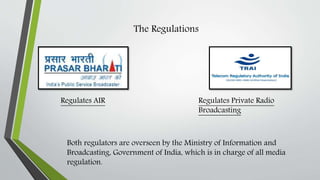
Regulates AIR Regulates Private Radio
Broadcasting
Both regulators are overseen by the Ministry of Information and
Broadcasting, Government of India, which is in charge of all media
regulation.
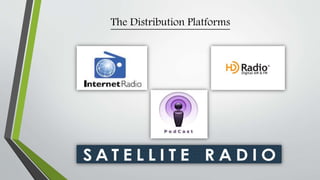
The Distribution Platforms
The Genres
• Spoken Word:
The spoken word format includes Announcements, Radio Talk, Radio
Interviews, Radio Discussions, Radio Documentaries/Features, Radio Drama,
Running Commentaries, Radio Magazines and News.
• Music
• Sound Effects/Jingles
The Trends
• Increasing Social Media Presence: Radio stations like Mirchi, Red and City
are taking to social media to highlight the entertainment quotient for
listeners and also to have direct interaction with them by posting content
like videos and pictures of celebrities visiting the studio, posts pertaining to
polls, contests, etc.
• Content Differentiation: Stations have been increasingly focusing on
differentiation strategies to break away from routine and to increase
listenership. Music based shows with celebrities like ‘Sitaron Ka Jawaniyaan’
with Ameen Sayani on Radio City and Non-Music Based Content like Radio
Mirchi Kolkata’s radio plays adapted from classic Bengali stories and novels
are two main attempts at content differentiation by radio stations.
The Brand Building Measures
• Social Causes/Issue Based: Radio has always been one of the primary vehicles
for Public Service announcements pertaining to Health, Environment, Safety,
etc. with many stations tying up with NGO’s and Companies undertake
social initiatives and community building exercises.
• Event Based: Radio companies have been engaged in event based marketing.
Sports is one of the primary areas of focus to boost brand visibility and
relevance with the emergence of IPL, ISL and Kabbadi Leagues. Last year, we
saw Mirchi tied up with Marathons and City continuing it’s partnership
with the Mumbai Indians.
• Entertainment Awards: The big players are investing on their own awards
shows to reach out to the TV audience and have a cross-platform
experience. This is not only an integral part of marketing but also an
investment in building own properties and enhancing their brand.
The Opportunities
Apart from distribution formats, there are other opportunities for the radio industry like:
• Localisation: FM radio is essentially a local medium hence making it ideal to reach small,
tightly focused communities. The whole localization push works at two levels;
Localisation of Content: With radio operators like Big FM playing Bundeli music in Jhansi,
Dogri in Jammu and Bhojpuri in Ranchi, it has led to a revival of the local music industry.
Localisation of Advertising: With regional SMEs that are big in their regions wanting to go
national, they spend a few million rupees on advertising every year. According to EY report,
about 40% of radio industry revenues came from local advertisers. Another big plus is that
flatter listening patterns in small towns because of little commute time allows advertisers to
utilize all time bands and not just morning and evening.
• Community Radio: Community Radio is literally radio meant to be broadcast over a
short radius (5-10 kms) and to a tightly defined audience. It’s promise of helping tackle
developmental issues through mass media remain unfulfilled. As of 2013, there were 148
operational community radio stations in India, most of which were operated by educational
institutions.
The Challenges
• Increased penetration of digital platforms: The rise of digital media has
made it difficult for terrestrial radio stations to stay relevant among younger
tech savvy listeners. The shift from terrestrial to digital is inevitable and it is
to bring more clarity to two aspects that traditional radio failed to provide,
i.e; measurability and targeting. Although the big players have created
online channels or apps, the threat from YouTube and services like Saavn
and Gaana are looming large.
• Measurability: Advertisers and Sponsors are increasingly shifting their focus
on analytics and consumer data to justify their ROI. Some operators have
unsubscribed from RAM and IRS while others are employing their own set
of surveys and methodologies through external agencies to provide data to
advertisers. However, it still doesn’t provide the framework in what can be
viewed as the industry’s ‘currency’ and the importance of a universally
accepted metric cannot be stressed upon more since the incorporation of
metrics has always increased the advertisement spend in Radio.
Statistics and Figures
Size of the Radio Industry
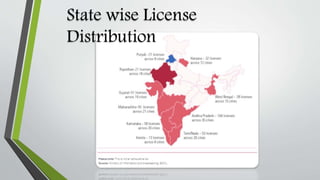
State wise License
Distribution
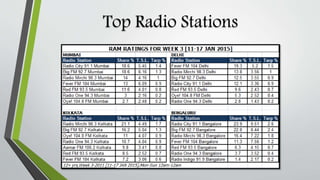
Top Radio Stations
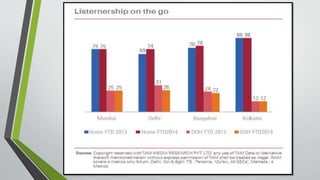
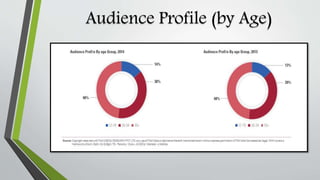
Audience Profile (by Age)
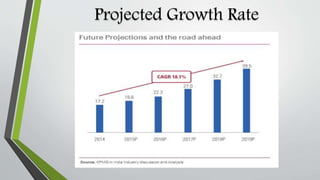
Projected Growth Rate
A Presentation By
Kevin Thomas

The Indian Radio Industry

  • 1.
  • 3.
    The true inventorof the radio has been greatly disputed mainly between Nikola Tesla and Guglielmo Marconi who have some of the earliest patents for it and did some of the first public displays of radio waves. At the time, radio communication was called wireless telegraphy and many scientists around the world including but not limited to Julio Cervera Baviera, Alexander Popov, and Ernest Rutherford were working on it.
  • 4.
    History of Radioin India • Radio Broadcasting was pioneered in India by the Madras Presidency Club Radio in 1924. The Club worked a broadcasting service for three years, but owing to financial difficulties gave it up in 1927. • In the same year (1927) some enterprising businessmen in Bombay started the Indian Broadcasting Company with stations at Bombay and Calcutta. This company failed in 1930, in 1932 the Government of India took over broadcasting. A separate department known as Indian Broadcasting Service was opened. • The Service was later designated 'All India Radio' (AIR) and was placed under a separate Ministry - the Ministry of Information and Broadcasting.
  • 5.
    A time whencrowds gathered on the Marina to listen to radio broadcasts of music - The Hindu Archive
  • 6.
  • 7.
    • Officially knownsince 1956 as Ākāshvāṇī (literally, "Voice from the Sky"), is the national public radio broadcaster of India. All India Radio is one of the largest radio networks in the world and is headquartered at the Akashvani Bhavan in New Delhi. • The word ‘Akashvani’ was coined by M. V. Gopalaswamy after setting up the nation’s first private radio station in his residence, "Vittal Vihar" (about 200 yards from AIR’s current location in Mysore) in 1936. ‘Akashvani’ seemed to be an appropriate name for a radio broadcaster and was later adopted as All India Radio's on-air name after independence. • AIR’s home service comprises 414 stations today located across the country, reaching nearly 92% of the country’s area and 99.19 % of the total population. AIR originates programming in 23 languages and 146 dialects.
  • 9.
  • 10.
    Phase One • Until1993, All India Radio or AIR, a government undertaking, was the only radio broadcaster in India. The government then took the initiative to privatize the radio broadcasting sector. It sold airtime blocks on its FM channels in Indore, Hyderabad, Mumbai, Delhi, Kolkata, Vizag and Goa to private operators, who developed their own program content. The Times Group operated its brand, Times FM, till June 1998. After that, the government decided not to renew contracts given to private operators. • In 2000, the government announced the auction of 108 FM frequencies across India. • Radio City Bangalore, started on July 3, 2001, is India's first private FM radio station. It launched with presenters such as Rohit Barker, Darius Sunawala, Jonzie Kurian and Suresh Venkat. • Companies were allowed to own and run radio stations by paying license fees to the government every year. Phase One saw 21 private radio stations being operational in 12 cities.
  • 11.
    Phase Two • SecondPhase auctions in the year 2005 witnessed 237 frequencies being sold out of about 338 that were offered. • Reliance and South Asia FM (Sun group) bid for most of the 91 cities, although they were allowed only 15% of the total allocated frequencies. Between them, they have had to surrender over 40 licenses. • Phase Two saw 248 stations broadcasting across 91 cities. • News is not permitted on private FM. Nationally, many of the current FM players, including the Times of India, Hindustan Times, Mid-Day, and BBC are essentially newspaper chains or media, and they are making a strong pitch for news on FM. Private FM stations are allowed to rebroadcast news from All India Radio, as long as they do so without any changes or additions. The Supreme Court of India on 17 October 2013 issued a public interest litigation to the Centre requesting that the rules should be changed to allow FM stations to broadcast news reports.
  • 12.
    Phase Three• E-Auctionof the first batch of private FM radio phase III channels comprising of two stages – the Channel Allocation stage and the Frequency Allocation Stage, was completed on 9th September 2015. • A noteworthy feature of the auction was that out of 15 channels in J&K and NE states, 12 channels got provisional winners with the city of Guwahati getting provisional winning price more than 10 times its reserve price. • The ministry had notified the list of successful bidders of the first batch on September 16, comprising details of 14 successful bidders for 91 channels in 54 cities along with winning prices and selected frequency spots. • The government estimates an overall bounty of around Rs 5,000 crore from the phase III auctions. These include Rs 1,150 crore from the 97 frequencies under the first batch of phase III auctions, another estimated Rs 1,900-2,000 crore through migration of 266 frequencies to phase III from phase II, and an estimated Rs 2,000-2,300 crore from licence fees. • HT Media and Entertainment Network India (ENIL) were the biggest spenders with both spending close to Rs. 340 crore and focusing mainly on metros like Delhi, Bangalore and Mumbai. Reliance Broadcast Network added 14 new stations to it’s existing 45 station network.
  • 13.
    The Working ofthe Radio Industry Costs The costs for the starting up of a radio station in India include; • License Fees: Phase Three policy states that the License fee will be determined as 4% of Gross Revenue (GR) or 2.5% of bid price for a city, whichever is higher. Acc. to the EY 2012 report, license fees formed 5-8% of the total costs of a radio station. • Set-up costs: Average investment to set up a radio station is Rs. 15 to 25 million for smaller stations and Rs. 40 to 50 million for a metro or big city station. These costs normally includes transmission, studio and office equipment, premises and networking infrastructure. • Operating costs: Acc. to EY report, key elements of operating cost are payroll (30- 40%), marketing (10-20%), music royalty (2-3%), overheads and utilities (20% of costs). The Economics
  • 14.
    The Economics Main sourcesof revenue are; • Advertising and Sponsorship: This is the main revenue stream for radio companies with national and local advertising on radio in India split close to 60:40. • Subscription: Satellite radios depend on subscriptions as a main source of revenue. However, audiences of most media have their fill of free content before feeling the need to pay for content. Radio in India is far from reaching there though. Revenues
  • 15.
    The Metrics • AIRbegan by selling time, through sponsorship and spots, when it was set up as a private company in 1927. The government disallowed advertising in 1934 only to be re-introduced in ‘67 on the recommendation of the Chanda Committee. This saw an acceptance of commercials on ‘Vividh Bharati’ which made Rs. 1.9 million that year from ad revenues and the amount kept rising. • Prime time on radio in the 80’s was classified as Category One ( 8-9 am and 7-8 pm). If an advertiser wanted a fixed time on Category One, there was a premium of 25%. This is in contrast to today’s average utilization of advertising time on FM which is between 65-75%. The Buying and Selling Dynamics
  • 16.
    The Buying andSelling Dynamics With the rise in the number of radio channels, advertising on it is bound to change in two ways. • As the no. of channels grow, there will be a need for focused advertising. For example, a Smirnoff Vodka advertisement is better fit in the evening when people dive back home rather than when they commute to work. Or, hard rock listeners are more likely to buy jeans. Therefore, advertisers could utilize specific channels and time bands. • Cross-media buys is the second potential change that radio could force. With companies like BCCL that owns TOI and Radio Mirchi, ‘combos’ like a good deal in Mumbai Mirror also gets you spots on Mirchi at attractive rates. Also, buyers can combine TV from companies like Sun TV and their radio stations. The Changes
  • 18.
    The Buying andSelling Dynamics • AIR: The radio company has an in-house Audience Research Unit that conducts research on listening habits using interviews, panel studies and other tools to determine numbers on listenership and patterns. It was the only source of information on radio listenership since 1937 until NRS came along in the 80’s. Under pressure from advertisers, AIR evolved the system for measuring ratings of radio programs – Radio Programme Listenership (RPL) ratings. • Indian Listenership Track or Wave: The ILT is a syndicated radio study conducted by MRUC in partnership with ACNielsen ORG-MARG. It is based on Yesterday Listenership (YDL) data in Mumbai and Delhi. However, no ILT research has been released since 2006. The Measures
  • 19.
    The Measures • AdexIndia: A division of TAM Media Research’s Radio, Adex looks at advertising patterns – volume, value, etc. – on radio. • Radio Audience Measurement (RAM): Radio Audience Measurement is a rating metric that was introduced by TAM. It’s a diary-based method that started with three cities in 2007 and now covers 13. It measures listenership on radio across phones, car radios and others and most studies have focused on listenership according to demographics, city, advertiser or station.
  • 20.
    The Regulations Regulates AIRRegulates Private Radio Broadcasting Both regulators are overseen by the Ministry of Information and Broadcasting, Government of India, which is in charge of all media regulation.
  • 21.
  • 22.
    The Genres • SpokenWord: The spoken word format includes Announcements, Radio Talk, Radio Interviews, Radio Discussions, Radio Documentaries/Features, Radio Drama, Running Commentaries, Radio Magazines and News. • Music • Sound Effects/Jingles
  • 23.
    The Trends • IncreasingSocial Media Presence: Radio stations like Mirchi, Red and City are taking to social media to highlight the entertainment quotient for listeners and also to have direct interaction with them by posting content like videos and pictures of celebrities visiting the studio, posts pertaining to polls, contests, etc. • Content Differentiation: Stations have been increasingly focusing on differentiation strategies to break away from routine and to increase listenership. Music based shows with celebrities like ‘Sitaron Ka Jawaniyaan’ with Ameen Sayani on Radio City and Non-Music Based Content like Radio Mirchi Kolkata’s radio plays adapted from classic Bengali stories and novels are two main attempts at content differentiation by radio stations.
  • 25.
    The Brand BuildingMeasures • Social Causes/Issue Based: Radio has always been one of the primary vehicles for Public Service announcements pertaining to Health, Environment, Safety, etc. with many stations tying up with NGO’s and Companies undertake social initiatives and community building exercises. • Event Based: Radio companies have been engaged in event based marketing. Sports is one of the primary areas of focus to boost brand visibility and relevance with the emergence of IPL, ISL and Kabbadi Leagues. Last year, we saw Mirchi tied up with Marathons and City continuing it’s partnership with the Mumbai Indians. • Entertainment Awards: The big players are investing on their own awards shows to reach out to the TV audience and have a cross-platform experience. This is not only an integral part of marketing but also an investment in building own properties and enhancing their brand.
  • 26.
    The Opportunities Apart fromdistribution formats, there are other opportunities for the radio industry like: • Localisation: FM radio is essentially a local medium hence making it ideal to reach small, tightly focused communities. The whole localization push works at two levels; Localisation of Content: With radio operators like Big FM playing Bundeli music in Jhansi, Dogri in Jammu and Bhojpuri in Ranchi, it has led to a revival of the local music industry. Localisation of Advertising: With regional SMEs that are big in their regions wanting to go national, they spend a few million rupees on advertising every year. According to EY report, about 40% of radio industry revenues came from local advertisers. Another big plus is that flatter listening patterns in small towns because of little commute time allows advertisers to utilize all time bands and not just morning and evening. • Community Radio: Community Radio is literally radio meant to be broadcast over a short radius (5-10 kms) and to a tightly defined audience. It’s promise of helping tackle developmental issues through mass media remain unfulfilled. As of 2013, there were 148 operational community radio stations in India, most of which were operated by educational institutions.
  • 27.
    The Challenges • Increasedpenetration of digital platforms: The rise of digital media has made it difficult for terrestrial radio stations to stay relevant among younger tech savvy listeners. The shift from terrestrial to digital is inevitable and it is to bring more clarity to two aspects that traditional radio failed to provide, i.e; measurability and targeting. Although the big players have created online channels or apps, the threat from YouTube and services like Saavn and Gaana are looming large. • Measurability: Advertisers and Sponsors are increasingly shifting their focus on analytics and consumer data to justify their ROI. Some operators have unsubscribed from RAM and IRS while others are employing their own set of surveys and methodologies through external agencies to provide data to advertisers. However, it still doesn’t provide the framework in what can be viewed as the industry’s ‘currency’ and the importance of a universally accepted metric cannot be stressed upon more since the incorporation of metrics has always increased the advertisement spend in Radio.

  • 28.
  • 29.
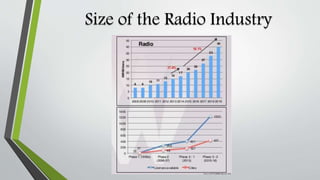
    Size of theRadio Industry
  • 30.
  • 31.
  • 34.
  • 35.
  • 37.

Editor's Notes

  • #5 On May 16, 1924, the Madras Presidency Radio Club (MPRC) transmitted the country’s first radio broadcasting programme from Ripon Buildings. The objective of the club, led by C.V. Krishnaswami Chetti, a Manchester-trained electrical engineer of the Madras Corporation, was to stimulate interest and foster the study of radio communications in the Presidency. For Chetti, the radio held the keys to propelling the country out of the ‘pocket of darkness’ it was then wedged in. The club wasted no time in laying the groundwork to establish the broadcasting service. The first batch of wireless sets was procured from the British Marconi Telegraph Wireless Company. Their agents conducted sessions, demonstrating how to use the sets, for members of the club. On 1st Line Beach, a series of receiving sets were displayed for sale to encourage curiosity in the new medium. The club’s station began regular broadcasts by July, from Halloways Garden in Egmore. The club offered its members practical training on manipulating the apparatus, opportunities to attend lectures by experts like W.H. Calway, as well as exclusive access to important radio journals.
  • #6 Twice every week, after 5.30 p.m., the beaches of Marina, Santhome and the High Court would resound with the reverb of amplified radio broadcasts of music, and 10-minute lectures. Radio was to be used as an integral element in classroom teaching as well, with indoor radio receivers being fixed in Corporation schools. Nine years later, in June, All India Radio established its station in Madras, taking over the service. The radio wave, as it were, had already made a sweep in the Presidency.