Rationalising radicals It is not usual to leave a expression with surds or radicals in the denominator.  Rationalising  a radical expression is “removing” the radical in the denominator.  We are going to do this in 3 different cases:
Rationalising radicals Case 1 : The radical in the denominator is a square root. For example: We multiply the numerator and the denominator by that square root. In the example:
Rationalising radicals Case 1 :
Rationalising radicals Case 1 : Try this exercise now:
Rationalising radicals Case 2 : The radical in the denominator is not a square root. For example:
Rationalising radicals Case 2 : The radical in the denominator is not a square root. For example: This a little tricky to solve. We multiply the numerator and the denominator by a power of the radical: the “necessary” power to remove the radical. In the example:
Rationalising radicals Case 2 :
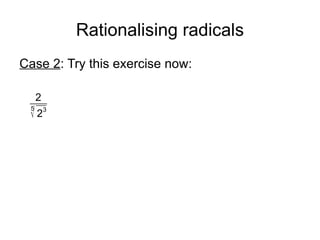
Rationalising radicals Case 2 : Try this exercise now:
Rationalising radicals Case 3 : The denominator is a sum or subtraction with square roots. For example:
Rationalising radicals Case 3 : The denominator is a sum or subtraction with square roots. For example: We multiply the numerator and denominator by the same expression in the denominator but changing the sign.
Rationalising radicals Case 3 :
Rationalising radicals Case 3 : Try this one now:
Rationalising radicals New term!!!  Conjugate radicals We can say that in the last 2 examples, we multiplied both the numerator and the denominator by the  conjugate  of the denominator.

Rationalising radicals