QUALITY ASSURANCE IN IMMOBILIZATION
                  AND
PATIENT POSITIONING FOR RADIATION THERAPY


RAJIV GANDHI CANCER INSTITUTE &
RESEARCH CENTRE- DELHI


    Akhil Chaudhary , Vishvendra Gaur                ,
   R.S.Bedi , S. Mitra , S.N.Sinha ,G.S.Wadhawan ,
THE CLINICAL AIM OF
RADIOTHERAPY…
 To maximize the “therapeutic index” by:
• Delivering lethal doses of radiation to
  cancerous cells (so increasing chances of
  survival) ,while
• Sparing normal tissue (so reducing side-
  effects and increasing quality of life)
 This is achieved by precisely shaping and
  directing the radiation beams based on
  information from medical images.
WHAT IS PATIENT POSITIONING?

   a reproducible localization of the patient with
    the use of a device onto which a patient lays
    a specific part of their anatomy

   designed to guide the patient into the original
    simulation position for radiation beam
    administration.
WHAT IS
PATIENT IMMOBILIZATION?
   A reproducible localization of the patient with a device into
    which the patient is locked, to aid in the restriction of
    anatomical movement
   Why use positioning and immobilization
    devices?
•   Increase target accuracy
•   Easy to use
•   Quick to setup
•   Comfortable for patient
•   Durable enough to withstand an entire course of treatment
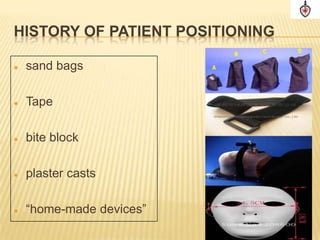
HISTORY OF PATIENT POSITIONING

   sand bags

   Tape

   bite block

   plaster casts

   “home-made devices”
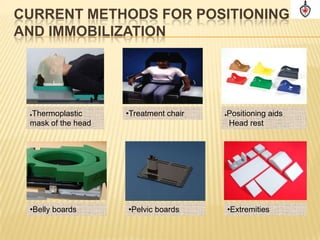
CURRENT METHODS FOR POSITIONING
AND IMMOBILIZATION


 Thermoplastic
                   •Treatment chair      Positioning aids
 mask of the head                          Head rest


 •Belly boards      •Pelvic boards         •Extremities
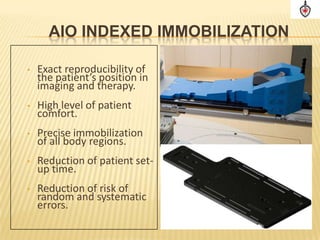
AIO INDEXED IMMOBILIZATION

•   Exact reproducibility of
    the patient’s position in
    imaging and therapy.
•   High level of patient
    comfort.
•   Precise immobilization
    of all body regions.
•   Reduction of patient set-
    up time.
•   Reduction of risk of
    random and systematic
    errors.
CONSIDERATIONS
FOR SELECTING A DEVICE
 Cost

• Value for money.

 Convenience

• If its not convenient it will just gather dust on the
  shelf.
 Accuracy

• The identical position must be reproduced day to
  day.
CONSIDERATIONS
FOR SELECTING A DEVICE
   Speed
•   Minimal time should be required to get the device
    ready for patient use.
   Compatibility
   devices should be constructed of
   radio-translucent materials to avoid image artifact
    or anatomical obstructions
   Attenuation
•   Beam integrity must be maintained.
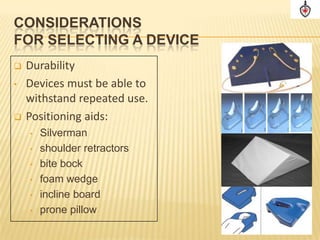
CONSIDERATIONS
FOR SELECTING A DEVICE
   Durability
•   Devices must be able to
    withstand repeated use.
   Positioning aids:
    •   Silverman
    •   shoulder retractors
    •   bite bock
    •   foam wedge
    •   incline board
    •   prone pillow
BENEFITS OF POSITIONING AIDS
   work with positioning devices to increase
    stability, comfort and reproducibility.


LIMITATIONS OF POSITIONING AIDS:
•   During immobilization, patients still have freedom of
    movement.
TEN SYSTEMS
   skeletal system        Verbal statements to
   circulatory system       immobilize patients:
                              Please do not move.
   digestive system
                              Don’t wiggle, now.
   respiratory system        Lay heavy, become as one
   urinary system             with the table.
   reproductive system       Be placid, man.
   nervous system
   muscular system
   endocrine system
   integumentary system
PATIENT POSITIONING, FIXATION AND
REPRODUCIBILITY OF SETUP

   Whether you are doing conventional radiotherapy, 3D
    conformal or IMRT treatments – accurate, reproducible
    positioning and rigid fixation are important factors for precise
    dose delivery to the treatment portals.
   Thermoplastic shells offers a reliable method for accurate
    positioning and immobilization.
   There are three essential components required for making
    these shells:
•   (i) Base plate: made up of acrylic material or carbon fibre.
    Available for head and neck cases, chest, pelvic regions.
•   (ii) Neck supports: foam type poly urethane material or silver
    man standard supports.
•    (iii) Thermoplastic masks.
ABDOMEN / PELVIS POSITIONING AND
FIXATION
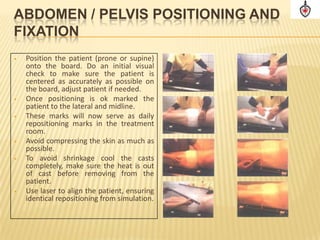
•   Position the patient (prone or supine)
    onto the board. Do an initial visual
    check to make sure the patient is
    centered as accurately as possible on
    the board, adjust patient if needed.
•   Once positioning is ok marked the
    patient to the lateral and midline.
•   These marks will now serve as daily
    repositioning marks in the treatment
    room.
•   Avoid compressing the skin as much as
    possible.
•   To avoid shrinkage cool the casts
    completely, make sure the heat is out
    of cast before removing from the
    patient.
•   Use laser to align the patient, ensuring
    identical repositioning from simulation.
BENEFITS OF THERMOPLASTIC MASKS

   Economical

   Disposable

   can re-use PVC frame (with re-loadable systems)

   markers can be placed on the mask rather than the
    patient.

   reproducible positioning is achieved.
CHALLENGES OF
THE HIP AND PELVIS REGION

   cylindrical shape of this anatomical region
   rotation of the body axis
   cast fabrication is technique sensitive
   choosing supine or prone positioning
LIMITATIONS OF THERMOPLASTIC
  IMMOBILIZATION
   thermoplastic sheets are expensive
   technique sensitive application requires hands-on
    training by vendor
   must have a large water bath.
ERRORS

   Localization Error:
       results from the failure to appreciate the full extent of
        the disease or to design adequate treatment fields
   Immobilization Error:
       occurs as a result of displacement of the treatment
        fields relative to the intended treatment volume.
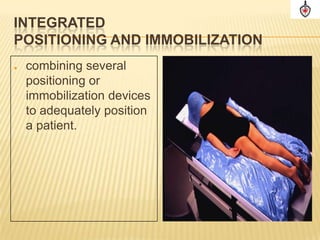
INTEGRATED
POSITIONING AND IMMOBILIZATION
   combining several
    positioning or
    immobilization devices
    to adequately position
    a patient.
VAC-LOK

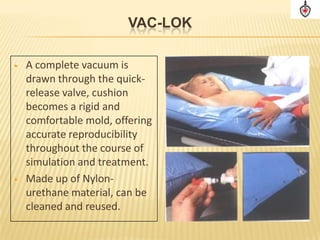
•   A complete vacuum is
    drawn through the quick-
    release valve, cushion
    becomes a rigid and

    comfortable mold, offering
    accurate reproducibility
    throughout the course of
    simulation and treatment.
•   Made up of Nylon-
    urethane material, can be
    cleaned and reused.
BENEFITS    OF VAC-LOK         LIMITATIONS     OF VAC-LOK

   cost-effective                 vacuum or wall suction is
   re-usable                       required
   quick to set up                storage space is required
   full range of sizes            may puncture or develop
   longevity is dependent on       leaks
    care and use.                  can not “cut-away” into the
                                    cushion.


                         VAC-LOK
LASERS

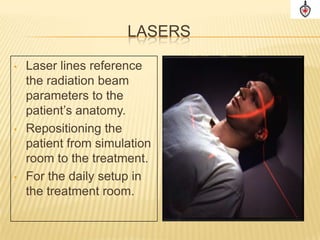
•   Laser lines reference
    the radiation beam
    parameters to the
    patient’s anatomy.
•   Repositioning the
    patient from simulation
    room to the treatment.
•   For the daily setup in
    the treatment room.
INDEXED IMMOBILIZATION™

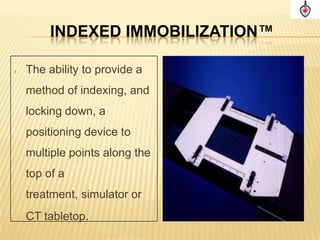
   The ability to provide a
    method of indexing, and
    locking down, a
    positioning device to
    multiple points along the
    top of a
    treatment, simulator or
    CT tabletop.
FEATURES OF
INDEXED IMMOBILIZATION
   close tolerance repositioning

   improved target accuracy

   increased patient through-put

   quick and accurate patient set-up

   reliable repeatability

   maximized clinical efficiency
BENEFITS OF
INDEXED IMMOBILIZATION
   same spatial reference between simulation and treatment

   same spatial reference between treatments

   standardization of the spatial relationship for all couches and
    treatment tables in the department, including CT couches

   improved target accuracy

   reduced patient set-up time resulting in increased patient through-
    put.
QUALITY ASSURANCE ACHIEVEMENT

   comfortable to minimize movement
   reproducible for the treatment plan
   Portal Identification.
   CONSISTENCY:
•   Consistency in patient positioning and
    immobilization from treatment planning to
    simulation, and from simulation to treatment must
    be maintained.
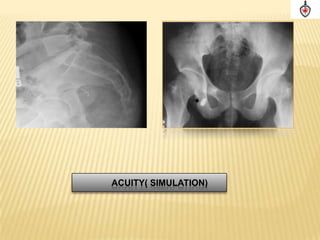
ACUITY( SIMULATION)
RESULTS
   prescription of target dose

   physical dosimetry of the beam

   planning of individual treatment

   precision of daily dose delivery
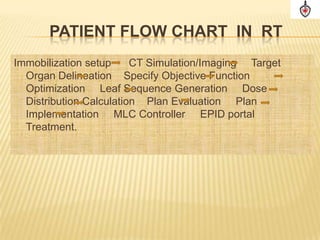
PATIENT FLOW CHART IN RT
Immobilization setup     CT Simulation/Imaging Target
  Organ Delineation Specify Objective Function
  Optimization Leaf Sequence Generation Dose
  Distribution Calculation Plan Evaluation Plan
  Implementation MLC Controller EPID portal
  Treatment.
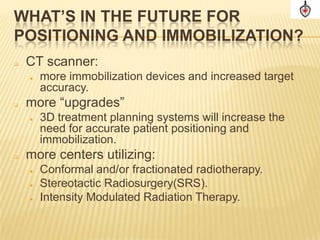
WHAT’S IN THE FUTURE FOR
POSITIONING AND IMMOBILIZATION?
   CT scanner:
       more immobilization devices and increased target
        accuracy.
   more “upgrades”
       3D treatment planning systems will increase the
        need for accurate patient positioning and
        immobilization.
   more centers utilizing:
       Conformal and/or fractionated radiotherapy.
       Stereotactic Radiosurgery(SRS).
       Intensity Modulated Radiation Therapy.
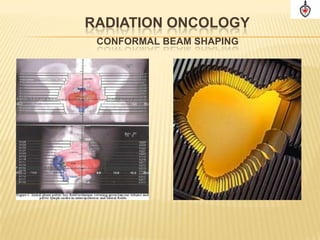
RADIATION ONCOLOGY
 CONFORMAL BEAM SHAPING
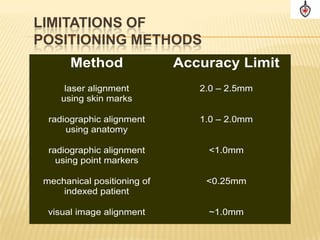
LIMITATIONS OF
POSITIONING METHODS
       Method                Accuracy Limit
      laser alignment           2.0 – 2.5mm
     using skin marks

  radiographic alignment        1.0 – 2.0mm
      using anatomy

  radiographic alignment         <1.0mm
    using point markers

 mechanical positioning of       <0.25mm
     indexed patient

  visual image alignment         ~1.0mm
CONCLUSION
   Currently most IMRT/3D-CRT/stereotactic
    radiotherapy, approaches have increased the time
    and efforts required by radiation oncologists
    ,medical physicist , dosimetrist and radiation
    therapy technologist In precise delivery of radiation
    dose .
   Actually in radiation therapy execution in hands of
    radiotherapy technologists resulting –
•   Safety of normal organs
•   Proper coverage of target volume
•   Precise delivery of dose
•   Decreased toxicity in grade and size
•   Improved overall survival and quality of life
CONT….
•   Immobilization improves : the reproducibility of
  patient positioning during conventional/Conformal/IMRT
  Radiation therapy.
• Purpose : to determine the magnitude of patient
  positioning errors and to assess the impact of
  immobilization on these errors.
•   The record of 22 patients , in our department whose
    immobilization was prepared in open environment (Mould
    room) were compared with rigid immobilization prepared in
    closed environment (simulator room) and it was observed
    there is 2 to 5 mm shift in open Vs closed environment
    setup.
CONT….

•   Portal films of patients: treated at both facilities
    were subsequently review and deviation each portal
    from the simulation film was determined.
•   Simulation-to-Treatment variability &
    Treatment-to-Treatment variability: was 2-
    5mm along the patient treated with open vs closed
    immobilization.
CONT….

•   The use of immobilization devices significantly
    reduces errors in patient positioning , potentially
    permitting the use of smaller treatment volumes.
•   Immobilization should be a component of
    conformal radiation therapy programs for
    cervix carcinoma to achieve the integrity of
    treatment plan.
Immobilization in Radiotherapy-Quality assurance

Immobilization in Radiotherapy-Quality assurance

  • 1.
    QUALITY ASSURANCE INIMMOBILIZATION AND PATIENT POSITIONING FOR RADIATION THERAPY RAJIV GANDHI CANCER INSTITUTE & RESEARCH CENTRE- DELHI Akhil Chaudhary , Vishvendra Gaur , R.S.Bedi , S. Mitra , S.N.Sinha ,G.S.Wadhawan ,
  • 2.
    THE CLINICAL AIMOF RADIOTHERAPY…  To maximize the “therapeutic index” by: • Delivering lethal doses of radiation to cancerous cells (so increasing chances of survival) ,while • Sparing normal tissue (so reducing side- effects and increasing quality of life)  This is achieved by precisely shaping and directing the radiation beams based on information from medical images.
  • 3.
    WHAT IS PATIENTPOSITIONING?  a reproducible localization of the patient with the use of a device onto which a patient lays a specific part of their anatomy  designed to guide the patient into the original simulation position for radiation beam administration.
  • 4.
    WHAT IS PATIENT IMMOBILIZATION?  A reproducible localization of the patient with a device into which the patient is locked, to aid in the restriction of anatomical movement  Why use positioning and immobilization devices? • Increase target accuracy • Easy to use • Quick to setup • Comfortable for patient • Durable enough to withstand an entire course of treatment
  • 5.
    HISTORY OF PATIENTPOSITIONING  sand bags  Tape  bite block  plaster casts  “home-made devices”
  • 6.
    CURRENT METHODS FORPOSITIONING AND IMMOBILIZATION Thermoplastic  •Treatment chair  Positioning aids mask of the head Head rest •Belly boards •Pelvic boards •Extremities
  • 7.
    AIO INDEXED IMMOBILIZATION • Exact reproducibility of the patient’s position in imaging and therapy. • High level of patient comfort. • Precise immobilization of all body regions. • Reduction of patient set- up time. • Reduction of risk of random and systematic errors.
  • 8.
    CONSIDERATIONS FOR SELECTING ADEVICE  Cost • Value for money.  Convenience • If its not convenient it will just gather dust on the shelf.  Accuracy • The identical position must be reproduced day to day.
  • 9.
    CONSIDERATIONS FOR SELECTING ADEVICE  Speed • Minimal time should be required to get the device ready for patient use.  Compatibility  devices should be constructed of  radio-translucent materials to avoid image artifact or anatomical obstructions  Attenuation • Beam integrity must be maintained.
  • 10.
    CONSIDERATIONS FOR SELECTING ADEVICE  Durability • Devices must be able to withstand repeated use.  Positioning aids: • Silverman • shoulder retractors • bite bock • foam wedge • incline board • prone pillow
  • 11.
    BENEFITS OF POSITIONINGAIDS  work with positioning devices to increase stability, comfort and reproducibility. LIMITATIONS OF POSITIONING AIDS: • During immobilization, patients still have freedom of movement.
  • 12.
    TEN SYSTEMS  skeletal system Verbal statements to  circulatory system immobilize patients:  Please do not move.  digestive system  Don’t wiggle, now.  respiratory system  Lay heavy, become as one  urinary system with the table.  reproductive system  Be placid, man.  nervous system  muscular system  endocrine system  integumentary system
  • 13.
    PATIENT POSITIONING, FIXATIONAND REPRODUCIBILITY OF SETUP  Whether you are doing conventional radiotherapy, 3D conformal or IMRT treatments – accurate, reproducible positioning and rigid fixation are important factors for precise dose delivery to the treatment portals.  Thermoplastic shells offers a reliable method for accurate positioning and immobilization.  There are three essential components required for making these shells: • (i) Base plate: made up of acrylic material or carbon fibre. Available for head and neck cases, chest, pelvic regions. • (ii) Neck supports: foam type poly urethane material or silver man standard supports. • (iii) Thermoplastic masks.
  • 14.
    ABDOMEN / PELVISPOSITIONING AND FIXATION • Position the patient (prone or supine) onto the board. Do an initial visual check to make sure the patient is centered as accurately as possible on the board, adjust patient if needed. • Once positioning is ok marked the patient to the lateral and midline. • These marks will now serve as daily repositioning marks in the treatment room. • Avoid compressing the skin as much as possible. • To avoid shrinkage cool the casts completely, make sure the heat is out of cast before removing from the patient. • Use laser to align the patient, ensuring identical repositioning from simulation.
  • 15.
    BENEFITS OF THERMOPLASTICMASKS  Economical  Disposable  can re-use PVC frame (with re-loadable systems)  markers can be placed on the mask rather than the patient.  reproducible positioning is achieved.
  • 16.
    CHALLENGES OF THE HIPAND PELVIS REGION  cylindrical shape of this anatomical region  rotation of the body axis  cast fabrication is technique sensitive  choosing supine or prone positioning LIMITATIONS OF THERMOPLASTIC IMMOBILIZATION  thermoplastic sheets are expensive  technique sensitive application requires hands-on training by vendor  must have a large water bath.
  • 17.
    ERRORS  Localization Error:  results from the failure to appreciate the full extent of the disease or to design adequate treatment fields  Immobilization Error:  occurs as a result of displacement of the treatment fields relative to the intended treatment volume.
  • 18.
    INTEGRATED POSITIONING AND IMMOBILIZATION  combining several positioning or immobilization devices to adequately position a patient.
  • 19.
    VAC-LOK • A complete vacuum is drawn through the quick- release valve, cushion becomes a rigid and comfortable mold, offering accurate reproducibility throughout the course of simulation and treatment. • Made up of Nylon- urethane material, can be cleaned and reused.
  • 20.
    BENEFITS OF VAC-LOK LIMITATIONS OF VAC-LOK  cost-effective  vacuum or wall suction is  re-usable required  quick to set up  storage space is required  full range of sizes  may puncture or develop  longevity is dependent on leaks care and use.  can not “cut-away” into the cushion. VAC-LOK
  • 21.
    LASERS • Laser lines reference the radiation beam parameters to the patient’s anatomy. • Repositioning the patient from simulation room to the treatment. • For the daily setup in the treatment room.
  • 22.
    INDEXED IMMOBILIZATION™  The ability to provide a method of indexing, and locking down, a positioning device to multiple points along the top of a treatment, simulator or CT tabletop.
  • 23.
    FEATURES OF INDEXED IMMOBILIZATION  close tolerance repositioning  improved target accuracy  increased patient through-put  quick and accurate patient set-up  reliable repeatability  maximized clinical efficiency
  • 24.
    BENEFITS OF INDEXED IMMOBILIZATION  same spatial reference between simulation and treatment  same spatial reference between treatments  standardization of the spatial relationship for all couches and treatment tables in the department, including CT couches  improved target accuracy  reduced patient set-up time resulting in increased patient through- put.
  • 25.
    QUALITY ASSURANCE ACHIEVEMENT  comfortable to minimize movement  reproducible for the treatment plan  Portal Identification.  CONSISTENCY: • Consistency in patient positioning and immobilization from treatment planning to simulation, and from simulation to treatment must be maintained.
  • 26.
  • 27.
    RESULTS  prescription of target dose  physical dosimetry of the beam  planning of individual treatment  precision of daily dose delivery
  • 28.
    PATIENT FLOW CHARTIN RT Immobilization setup CT Simulation/Imaging Target Organ Delineation Specify Objective Function Optimization Leaf Sequence Generation Dose Distribution Calculation Plan Evaluation Plan Implementation MLC Controller EPID portal Treatment.
  • 29.
    WHAT’S IN THEFUTURE FOR POSITIONING AND IMMOBILIZATION?  CT scanner:  more immobilization devices and increased target accuracy.  more “upgrades”  3D treatment planning systems will increase the need for accurate patient positioning and immobilization.  more centers utilizing:  Conformal and/or fractionated radiotherapy.  Stereotactic Radiosurgery(SRS).  Intensity Modulated Radiation Therapy.
  • 30.
  • 31.
    LIMITATIONS OF POSITIONING METHODS Method Accuracy Limit laser alignment 2.0 – 2.5mm using skin marks radiographic alignment 1.0 – 2.0mm using anatomy radiographic alignment <1.0mm using point markers mechanical positioning of <0.25mm indexed patient visual image alignment ~1.0mm
  • 32.
    CONCLUSION  Currently most IMRT/3D-CRT/stereotactic radiotherapy, approaches have increased the time and efforts required by radiation oncologists ,medical physicist , dosimetrist and radiation therapy technologist In precise delivery of radiation dose .  Actually in radiation therapy execution in hands of radiotherapy technologists resulting – • Safety of normal organs • Proper coverage of target volume • Precise delivery of dose • Decreased toxicity in grade and size • Improved overall survival and quality of life
  • 33.
    CONT…. • Immobilization improves : the reproducibility of patient positioning during conventional/Conformal/IMRT Radiation therapy. • Purpose : to determine the magnitude of patient positioning errors and to assess the impact of immobilization on these errors. • The record of 22 patients , in our department whose immobilization was prepared in open environment (Mould room) were compared with rigid immobilization prepared in closed environment (simulator room) and it was observed there is 2 to 5 mm shift in open Vs closed environment setup.
  • 34.
    CONT…. • Portal films of patients: treated at both facilities were subsequently review and deviation each portal from the simulation film was determined. • Simulation-to-Treatment variability & Treatment-to-Treatment variability: was 2- 5mm along the patient treated with open vs closed immobilization.
  • 35.
    CONT…. • The use of immobilization devices significantly reduces errors in patient positioning , potentially permitting the use of smaller treatment volumes. • Immobilization should be a component of conformal radiation therapy programs for cervix carcinoma to achieve the integrity of treatment plan.