Diseases of Bean
HPP 5311
Diseases of vegetables, ornamentals
and spice crops.
Anthracnose
• The disease is more severe in temperate and subtropical
mountaneous regions of the world with cool and wet climate.
• Colletotrichum lindemuthianum
Symptoms
• All the above ground parts are affected at any stage of crop
growth. However, the characteristic symptoms appear on
pods.
• On cotyledons spots are sunken dark brown or black with pink
spore mass.
• Seedling infection results in collapse of seedling.
• Spots on leaves appear on lower side and are black. Later
these may also appear on upper surface. When the infection
is severe, the affected plants wither off.
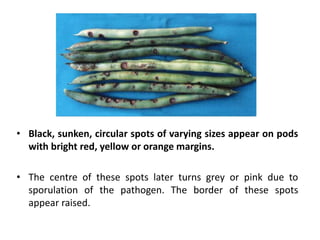
• Black, sunken, circular spots of varying sizes appear on pods
with bright red, yellow or orange margins.
• The centre of these spots later turns grey or pink due to
sporulation of the pathogen. The border of these spots
appear raised.
Pathogen
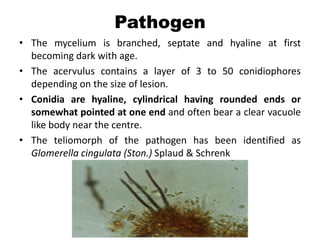
• The mycelium is branched, septate and hyaline at first
becoming dark with age.
• The acervulus contains a layer of 3 to 50 conidiophores
depending on the size of lesion.
• Conidia are hyaline, cylindrical having rounded ends or
somewhat pointed at one end and often bear a clear vacuole
like body near the centre.
• The teliomorph of the pathogen has been identified as
Glomerella cingulata (Ston.) Splaud & Schrenk
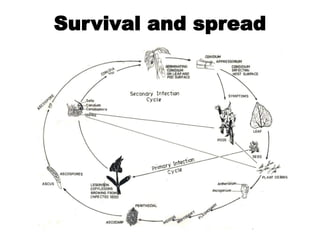
Survival and spread
Management
• Follow 2-3 years of crop rotation with non-leguminous crops.
• Use disease free seed and treat them with carbendazim or
benomyl (0.2%).
• Resistant cutivars/ lines like KRC 1, KRC 17, EC 42960 and EC
57080 have been identified as resistant to this pathogen.
• In field, the spread of the disease can be limited by
application of fungicides like mancozeb (0.25%) or
combination of mancozeb (0.25%) and carbendazim (0.05%)
or tricyclazole (0.03%) and repeat at 10 -14 days interval.
Rust
• Uromyces fabae
Symptoms
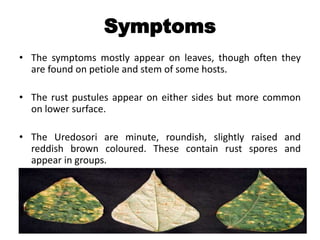
• The symptoms mostly appear on leaves, though often they
are found on petiole and stem of some hosts.
• The rust pustules appear on either sides but more common
on lower surface.
• The Uredosori are minute, roundish, slightly raised and
reddish brown coloured. These contain rust spores and
appear in groups.
• Later in the season with the formation of teliospores, the sori
turn dark brown or black.
• Diseased leaves may wither or fall off under severe infection
Pathogen
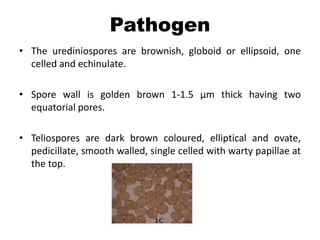
• The urediniospores are brownish, globoid or ellipsoid, one
celled and echinulate.
• Spore wall is golden brown 1-1.5 μm thick having two
equatorial pores.
• Teliospores are dark brown coloured, elliptical and ovate,
pedicillate, smooth walled, single celled with warty papillae at
the top.
Disease cycle and epidemiology
• P.I: Survives through teliospores in cooler regions and on
collateral hosts
• S.I: Wind borne Uredospores
• Host range: French beans, green gram, black gram and
cowpea.
• Areas having high humidity and temperature upto 24⁰C are
most suitable for disease development.
• Urediniospores germinate optimally at 15-24⁰C while for
teliospores germination, 10-15⁰C is optimum.
Management
• Collect and destroy the infected plant debris.
• Follow long crop rotations.
• With the initiation of the disease, spray the crop with
mancozeb (0.25%) or hexaconazole (0.1%) or difenoconazole
(0.05%) or combination of mancozeb (0.25%) and
hexaconazole (0.05%) and repeat at 10 days interval.
Yellow mosaic
• Bean Yellow Mosaic Virus, Mungbean yellow virus or
Phaseolus virus-2 (ss DNA virus)
Symptoms
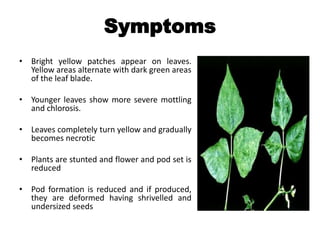
• Bright yellow patches appear on leaves.
Yellow areas alternate with dark green areas
of the leaf blade.
• Younger leaves show more severe mottling
and chlorosis.
• Leaves completely turn yellow and gradually
becomes necrotic
• Plants are stunted and flower and pod set is
reduced
• Pod formation is reduced and if produced,
they are deformed having shrivelled and
undersized seeds
Survival and spread
• P.I: Collateral hosts
• S.I: Whitefly, Bemisia tabaci
• Not transmitted by sap, seed and pollen
• Host range: French bean, Soybean, Red gram, Xanthium
strumarum, Eclipta alba, etc.
Management
• Remove collateral hosts and destroy
• Use resistant varieties
• Spray metasystox@0.1% for vector control

Diseases of Beans

  • 1.
    Diseases of Bean HPP5311 Diseases of vegetables, ornamentals and spice crops.
  • 2.
    Anthracnose • The diseaseis more severe in temperate and subtropical mountaneous regions of the world with cool and wet climate. • Colletotrichum lindemuthianum
  • 3.
    Symptoms • All theabove ground parts are affected at any stage of crop growth. However, the characteristic symptoms appear on pods. • On cotyledons spots are sunken dark brown or black with pink spore mass. • Seedling infection results in collapse of seedling. • Spots on leaves appear on lower side and are black. Later these may also appear on upper surface. When the infection is severe, the affected plants wither off.
  • 4.
    • Black, sunken,circular spots of varying sizes appear on pods with bright red, yellow or orange margins. • The centre of these spots later turns grey or pink due to sporulation of the pathogen. The border of these spots appear raised.
  • 5.
    Pathogen • The myceliumis branched, septate and hyaline at first becoming dark with age. • The acervulus contains a layer of 3 to 50 conidiophores depending on the size of lesion. • Conidia are hyaline, cylindrical having rounded ends or somewhat pointed at one end and often bear a clear vacuole like body near the centre. • The teliomorph of the pathogen has been identified as Glomerella cingulata (Ston.) Splaud & Schrenk
  • 6.
  • 7.
    Management • Follow 2-3years of crop rotation with non-leguminous crops. • Use disease free seed and treat them with carbendazim or benomyl (0.2%). • Resistant cutivars/ lines like KRC 1, KRC 17, EC 42960 and EC 57080 have been identified as resistant to this pathogen. • In field, the spread of the disease can be limited by application of fungicides like mancozeb (0.25%) or combination of mancozeb (0.25%) and carbendazim (0.05%) or tricyclazole (0.03%) and repeat at 10 -14 days interval.
  • 8.
  • 9.
    Symptoms • The symptomsmostly appear on leaves, though often they are found on petiole and stem of some hosts. • The rust pustules appear on either sides but more common on lower surface. • The Uredosori are minute, roundish, slightly raised and reddish brown coloured. These contain rust spores and appear in groups.
  • 10.
    • Later inthe season with the formation of teliospores, the sori turn dark brown or black. • Diseased leaves may wither or fall off under severe infection
  • 11.
    Pathogen • The urediniosporesare brownish, globoid or ellipsoid, one celled and echinulate. • Spore wall is golden brown 1-1.5 μm thick having two equatorial pores. • Teliospores are dark brown coloured, elliptical and ovate, pedicillate, smooth walled, single celled with warty papillae at the top.
  • 12.
    Disease cycle andepidemiology • P.I: Survives through teliospores in cooler regions and on collateral hosts • S.I: Wind borne Uredospores • Host range: French beans, green gram, black gram and cowpea. • Areas having high humidity and temperature upto 24⁰C are most suitable for disease development. • Urediniospores germinate optimally at 15-24⁰C while for teliospores germination, 10-15⁰C is optimum.
  • 13.
    Management • Collect anddestroy the infected plant debris. • Follow long crop rotations. • With the initiation of the disease, spray the crop with mancozeb (0.25%) or hexaconazole (0.1%) or difenoconazole (0.05%) or combination of mancozeb (0.25%) and hexaconazole (0.05%) and repeat at 10 days interval.
  • 14.
    Yellow mosaic • BeanYellow Mosaic Virus, Mungbean yellow virus or Phaseolus virus-2 (ss DNA virus)
  • 15.
    Symptoms • Bright yellowpatches appear on leaves. Yellow areas alternate with dark green areas of the leaf blade. • Younger leaves show more severe mottling and chlorosis. • Leaves completely turn yellow and gradually becomes necrotic • Plants are stunted and flower and pod set is reduced • Pod formation is reduced and if produced, they are deformed having shrivelled and undersized seeds
  • 16.
    Survival and spread •P.I: Collateral hosts • S.I: Whitefly, Bemisia tabaci • Not transmitted by sap, seed and pollen • Host range: French bean, Soybean, Red gram, Xanthium strumarum, Eclipta alba, etc.
  • 17.
    Management • Remove collateralhosts and destroy • Use resistant varieties • Spray metasystox@0.1% for vector control