IDENTIFICATION OF PHYSIOLOGICAL
DISORDERS IN PLANTS AND THEIR
CONTROL
By:
GHULAM MURTAZA
Department of Soil And Environmental
Sciences, UCA, University of Sargodha
What are plants
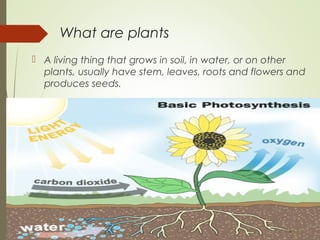
 A living thing that grows in soil, in water, or on other
plants, usually have stem, leaves, roots and flowers and
produces seeds.
Plants
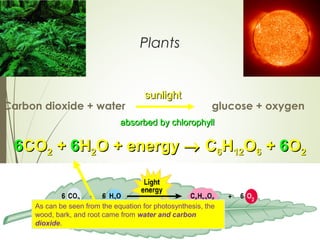
Carbon dioxide + water glucose + oxygen
sunlightsunlight
absorbed by chlorophyllabsorbed by chlorophyll
66COCO22 ++ 66HH22O + energyO + energy →→ CC66HH1212OO66 ++ 66OO22
As can be seen from the equation for photosynthesis, the
wood, bark, and root came from water and carbon
dioxide.
Physiological Disorder in Plants
Physiological disorders of plants are those problems
resulting from the influence of environmental and cultural
factors on plant growth.
The main causes are:
 Nutrient deficiencies
 Excess fertilizer
 Low temperature or frost
 High temperature,
 Lack of light
 Overwatering and
 Underwatering
 High concentration of CO2
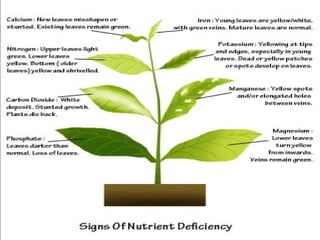
Nutrient and physiological disorders
 Nutrients are the chemical elements required for plant
growth.
 Macro-nutrients –N, P, K, Ca, Mg and S. Macro-nutrients
constitute the main elements that a plant requires for its
basic functioning.
 Micro-nutrients – Fe, Cu, Zn, Mn, Mo and B. These
elements are termed ‘minor’ because plants need them
in only very small amounts; however, they are essential for
normal growth.
 Lack of plant nutrients, or the presence of nutrients at
levels toxic may lead to physiological disorders in plants.
 The plant exhibits disease-like symptoms; therefore
nutrient disorders are sometimes mistaken for a disease.
 These disorders can be cured by applying the
recommended doses of fertilizers.
Blossom end rot
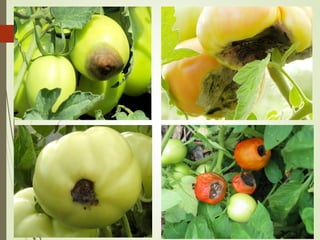
 Physiological disorder in tomatoes and peppers.
  Tissue typically at the blossom end turns brown and then
black, and becomes sunken and leathery. 
 It occurs when amount of calcium being moved into
fruit is insufficient to support growth.
 Although there is no cure for blossom end rot once the
symptoms begin to appear, the obvious
recommendation is that fruiting crops should never be
allowed to have dry roots.
Bitter pit in Apples
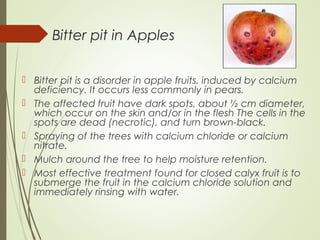
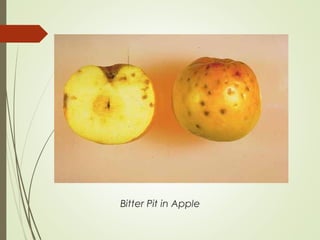
 Bitter pit is a disorder in apple fruits, induced by calcium
deficiency. It occurs less commonly in pears.
 The affected fruit have dark spots, about ½ cm diameter,
which occur on the skin and/or in the flesh The cells in the
spots are dead (necrotic), and turn brown-black.
 Spraying of the trees with calcium chloride or calcium
nitrate.
 Mulch around the tree to help moisture retention.
 Most effective treatment found for closed calyx fruit is to
submerge the fruit in the calcium chloride solution and
immediately rinsing with water.
Bitter Pit in Apple
Excess fertilizer
 When fertilizers are present at too high levels, roots are
scorched and are unable to provide nutrients for the other
parts of the plant, often resulting in the plant's death.
 Manganese toxicity – Yellowing of margins of older leaves;
poor root development
 Chloride toxicity – Caused by saline water and soil
conditions.
 Ammonium toxicity “jelly butt” – Poor emergence followed
by wilting and death of seedlings; browning of the central
root tissue
 Careful consideration of the appropriate frequency and
amounts of fertilizer will prevent this situation.
Low temperatures
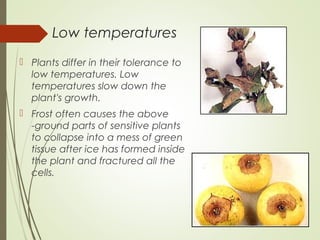
 Plants differ in their tolerance to
low temperatures. Low
temperatures slow down the
plant's growth.
 Frost often causes the above
-ground parts of sensitive plants
to collapse into a mess of green
tissue after ice has formed inside
the plant and fractured all the
cells.
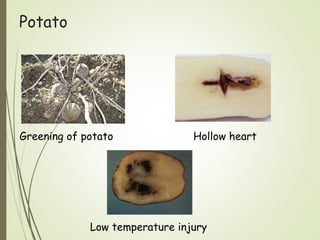
Potato
Greening of potato Hollow heart
Low temperature injury
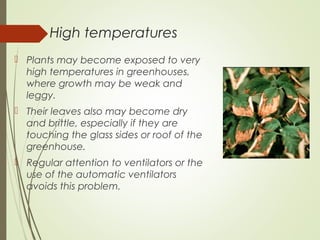
High temperatures
 Plants may become exposed to very
high temperatures in greenhouses,
where growth may be weak and
leggy.
 Their leaves also may become dry
and brittle, especially if they are
touching the glass sides or roof of the
greenhouse.
 Regular attention to ventilators or the
use of the automatic ventilators
avoids this problem.
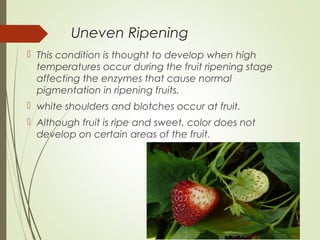
Uneven Ripening
 This condition is thought to develop when high
temperatures occur during the fruit ripening stage
affecting the enzymes that cause normal
pigmentation in ripening fruits.
 white shoulders and blotches occur at fruit.
 Although fruit is ripe and sweet, color does not
develop on certain areas of the fruit.
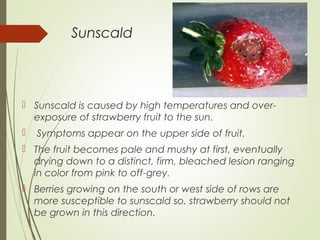
Sunscald
 Sunscald is caused by high temperatures and over-
exposure of strawberry fruit to the sun.
 Symptoms appear on the upper side of fruit.
 The fruit becomes pale and mushy at first, eventually
drying down to a distinct, firm, bleached lesion ranging
in color from pink to off-grey.
 Berries growing on the south or west side of rows are
more susceptible to sunscald so, strawberry should not
be grown in this direction.
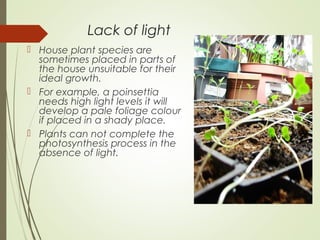
Lack of light
 House plant species are
sometimes placed in parts of
the house unsuitable for their
ideal growth.
 For example, a poinsettia
needs high light levels it will
develop a pale foliage colour
if placed in a shady place.
 Plants can not complete the
photosynthesis process in the
absence of light.
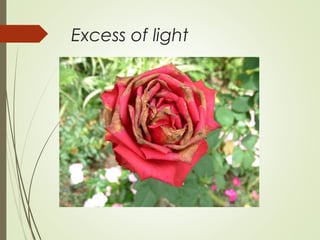
Excess of light
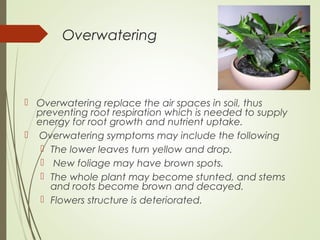
Overwatering
 Overwatering replace the air spaces in soil, thus
preventing root respiration which is needed to supply
energy for root growth and nutrient uptake.
 Overwatering symptoms may include the following
 The lower leaves turn yellow and drop.
 New foliage may have brown spots.
 The whole plant may become stunted, and stems
and roots become brown and decayed.
 Flowers structure is deteriorated.
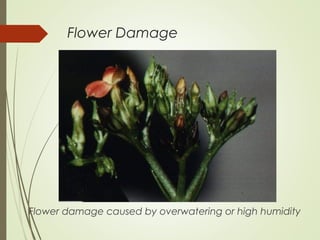
Flower Damage
Flower damage caused by overwatering or high humidity
Oedema
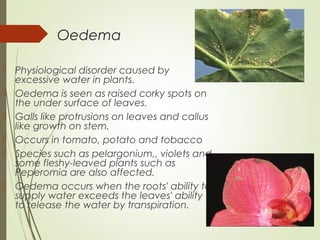
 Physiological disorder caused by
excessive water in plants.
 Oedema is seen as raised corky spots on
the under surface of leaves.
 Galls like protrusions on leaves and callus
like growth on stem.
 Occurs in tomato, potato and tobacco
 Species such as pelargonium,, violets and
some fleshy-leaved plants such as
Peperomia are also affected.
 Oedema occurs when the roots' ability to
supply water exceeds the leaves' ability
to release the water by transpiration.
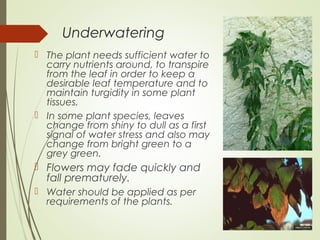
Underwatering
 The plant needs sufficient water to
carry nutrients around, to transpire
from the leaf in order to keep a
desirable leaf temperature and to
maintain turgidity in some plant
tissues.
 In some plant species, leaves
change from shiny to dull as a first
signal of water stress and also may
change from bright green to a
grey green.
 Flowers may fade quickly and
fall prematurely.
 Water should be applied as per
requirements of the plants.
High Concentration of CO2
 High concentration of carbon dioxide is generally
beneficial for growth and provide maximum benefit
between 0.1 and 0.2 Kpa (1.000-2000ppm).
 Yet with certain species enrichment with 0.1kpa can
be injurious.
 Photosynthetic activity reduces when CO2
concentration exceeds optimal level so plants may
turn yellow.
 Plants which are sensitive to higher levels of CO2
should not be grown in closed environments.
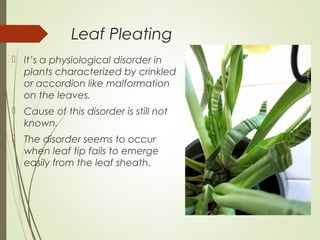
Leaf Pleating
 It’s a physiological disorder in
plants characterized by crinkled
or accordion like malformation
on the leaves.
 Cause of this disorder is still not
known.
 The disorder seems to occur
when leaf tip fails to emerge
easily from the leaf sheath.
Recommendations
 Recommended doses of fertilizers should be
applied.
 Water should be applied according to the
requirements of the plants.
 Plants should be grown at appropriate places
where sufficient light is available to carry out
photosynthesis process.
 Continuous exposure to light may cause
physiological disorders in plants so it should be
avoided.
identification of physiological disoreder in plants by Ghulam murtaza UOS