Compile by SF naqvi
Quinine
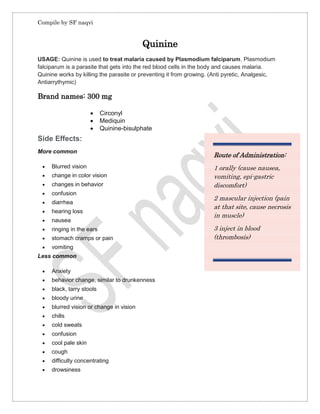
USAGE: Quinine is used to treat malaria caused by Plasmodium falciparum. Plasmodium
falciparum is a parasite that gets into the red blood cells in the body and causes malaria.
Quinine works by killing the parasite or preventing it from growing. (Anti pyretic, Analgesic,
Antiarrythymic)
Brand names: 300 mg
 Circonyl
 Mediquin
 Quinine-bisulphate
Side Effects:
More common
 Blurred vision
 change in color vision
 changes in behavior
 confusion
 diarrhea
 hearing loss
 nausea
 ringing in the ears
 stomach cramps or pain
 vomiting
Less common
 Anxiety
 behavior change, similar to drunkenness
 black, tarry stools
 bloody urine
 blurred vision or change in vision
 chills
 cold sweats
 confusion
 cool pale skin
 cough
 difficulty concentrating
 drowsiness
Route of Administration:
1 orally (cause nausea,
vomiting, epi-gastric
discomfort)
2 mascular injection (pain
at that site, cause necrosis
in muscle)
3 inject in blood
(thrombosis)
Compile by SF naqvi
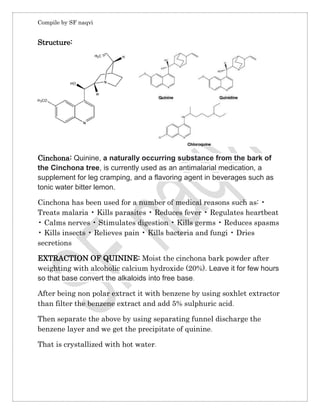
Structure:
Cinchona: Quinine, a naturally occurring substance from the bark of
the Cinchona tree, is currently used as an antimalarial medication, a
supplement for leg cramping, and a flavoring agent in beverages such as
tonic water bitter lemon.
Cinchona has been used for a number of medical reasons such as: •
Treats malaria • Kills parasites • Reduces fever • Regulates heartbeat
• Calms nerves • Stimulates digestion • Kills germs • Reduces spasms
• Kills insects • Relieves pain • Kills bacteria and fungi • Dries
secretions
EXTRACTION OF QUININE: Moist the cinchona bark powder after
weighting with alcoholic calcium hydroxide (20%). Leave it for few hours
so that base convert the alkaloids into free base.
After being non polar extract it with benzene by using soxhlet extractor
than filter the benzene extract and add 5% sulphuric acid.
Then separate the above by using separating funnel discharge the
benzene layer and we get the precipitate of quinine.
That is crystallized with hot water.
Compile by SF naqvi
SYNTHESIS OF QUININE:
d-quinotoxine is also prepared by claisen condensation of isoquinoline
Structure Elucidation/determination:
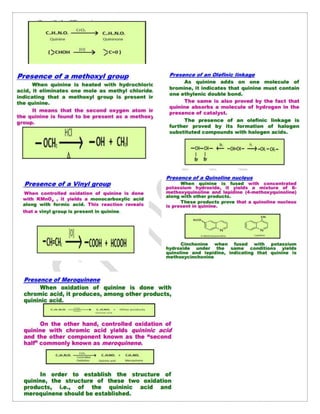
Presence of two tertiary N atoms: As quinine quinine adds on two moles of methyliodide to
form a diquaternary salt, it is a ditertiary base.
C20H24N2O2 + 2CH3I C20H24N2O2.2CH3I
Presence of a secondary alcoholic group: As quinine forms a monoacetate and
amonobenzoate, it means that quinine must contain one –OH group. However, this is a
secondary alcoholic group which is shown by the fact that quinine on oxidation gives a
ketone,quininone.
Compile by SF naqvi
Compile by SF naqvi
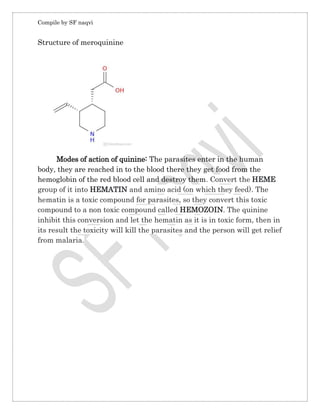
Structure of meroquinine
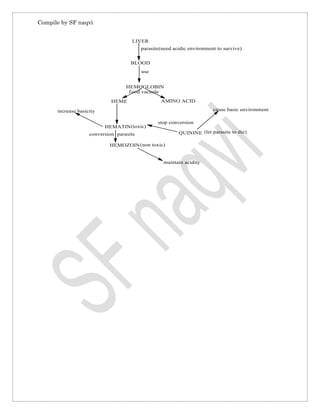
Modes of action of quinine: The parasites enter in the human
body, they are reached in to the blood there they get food from the
hemoglobin of the red blood cell and destroy them. Convert the HEME
group of it into HEMATIN and amino acid (on which they feed). The
hematin is a toxic compound for parasites, so they convert this toxic
compound to a non toxic compound called HEMOZOIN. The quinine
inhibit this conversion and let the hematin as it is in toxic form, then in
its result the toxicity will kill the parasites and the person will get relief
from malaria.
Compile by SF naqvi

Quinine.docx

  • 1.
    Compile by SFnaqvi Quinine USAGE: Quinine is used to treat malaria caused by Plasmodium falciparum. Plasmodium falciparum is a parasite that gets into the red blood cells in the body and causes malaria. Quinine works by killing the parasite or preventing it from growing. (Anti pyretic, Analgesic, Antiarrythymic) Brand names: 300 mg  Circonyl  Mediquin  Quinine-bisulphate Side Effects: More common  Blurred vision  change in color vision  changes in behavior  confusion  diarrhea  hearing loss  nausea  ringing in the ears  stomach cramps or pain  vomiting Less common  Anxiety  behavior change, similar to drunkenness  black, tarry stools  bloody urine  blurred vision or change in vision  chills  cold sweats  confusion  cool pale skin  cough  difficulty concentrating  drowsiness Route of Administration: 1 orally (cause nausea, vomiting, epi-gastric discomfort) 2 mascular injection (pain at that site, cause necrosis in muscle) 3 inject in blood (thrombosis)
  • 2.
    Compile by SFnaqvi Structure: Cinchona: Quinine, a naturally occurring substance from the bark of the Cinchona tree, is currently used as an antimalarial medication, a supplement for leg cramping, and a flavoring agent in beverages such as tonic water bitter lemon. Cinchona has been used for a number of medical reasons such as: • Treats malaria • Kills parasites • Reduces fever • Regulates heartbeat • Calms nerves • Stimulates digestion • Kills germs • Reduces spasms • Kills insects • Relieves pain • Kills bacteria and fungi • Dries secretions EXTRACTION OF QUININE: Moist the cinchona bark powder after weighting with alcoholic calcium hydroxide (20%). Leave it for few hours so that base convert the alkaloids into free base. After being non polar extract it with benzene by using soxhlet extractor than filter the benzene extract and add 5% sulphuric acid. Then separate the above by using separating funnel discharge the benzene layer and we get the precipitate of quinine. That is crystallized with hot water.
  • 3.
    Compile by SFnaqvi SYNTHESIS OF QUININE: d-quinotoxine is also prepared by claisen condensation of isoquinoline Structure Elucidation/determination: Presence of two tertiary N atoms: As quinine quinine adds on two moles of methyliodide to form a diquaternary salt, it is a ditertiary base. C20H24N2O2 + 2CH3I C20H24N2O2.2CH3I Presence of a secondary alcoholic group: As quinine forms a monoacetate and amonobenzoate, it means that quinine must contain one –OH group. However, this is a secondary alcoholic group which is shown by the fact that quinine on oxidation gives a ketone,quininone.
  • 4.
  • 5.
    Compile by SFnaqvi Structure of meroquinine Modes of action of quinine: The parasites enter in the human body, they are reached in to the blood there they get food from the hemoglobin of the red blood cell and destroy them. Convert the HEME group of it into HEMATIN and amino acid (on which they feed). The hematin is a toxic compound for parasites, so they convert this toxic compound to a non toxic compound called HEMOZOIN. The quinine inhibit this conversion and let the hematin as it is in toxic form, then in its result the toxicity will kill the parasites and the person will get relief from malaria.
  • 6.