Introduction
to Green
Chemistry
By Sameen Fatima
Roll No. 908529
Semester 6th (M)
2019-2023
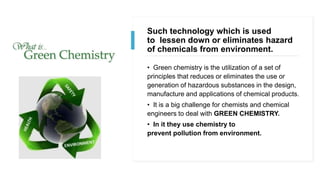
Such technology which is used
to lessen down or eliminates hazard
of chemicals from environment.
• Green chemistry is the utilization of a set of
principles that reduces or eliminates the use or
generation of hazardous substances in the design,
manufacture and applications of chemical products.
• It is a big challenge for chemists and chemical
engineers to deal with GREEN CHEMISTRY.
• In it they use chemistry to
prevent pollution from environment.
• The remediation technology of
pollution from environment
meets the definition of green
chemistry.
• In this century the human
population, industrialization,
energy crisis, environmental
pollution are the
major concerns of green
chemistry on this Earth. To
resolves these issues we need
to apply 12 principles of green
chemistry.
Concept of green chemistry
• Firstly introduced in USA in 1990s.
• In 1991 OPPT(office of pollution prevention and toxics)
started a research grant program called "Alternative
Synthetic Pathways for Pollution Prevention"
• This program expanded in 1993 and renamed as
Green chemistry. As a result of this program the EPA
(environmental protection agency) led this program.
• In Europe several activities related to green chemistry
was started in 1998.
• Then in UK Royal society of Chemistry has
established the Green Chemistry Network (GCN) who
started a new journal that was called Green chemistry.
Who did introduce Green
Chemistry?
• Paul Anastas and John C. Warner co-authored the groundbreaking book, Green
Chemistry: Theory and Practice in 1998. The 12 Principles of Green Chemistry outlined
within this work declared a philosophy that motivated academic and industrial scientists at
the time and continues to guide the green chemistry movement.
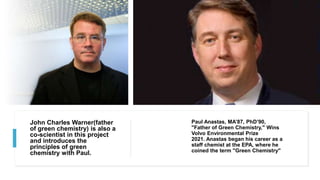
John Charles Warner(father
of green chemistry) is also a
co-scientist in this project
and introduces the
principles of green
chemistry with Paul.
Paul Anastas, MA’87, PhD’90,
"Father of Green Chemistry," Wins
Volvo Environmental Prize
2021. Anastas began his career as a
staff chemist at the EPA, where he
coined the term "Green Chemistry"
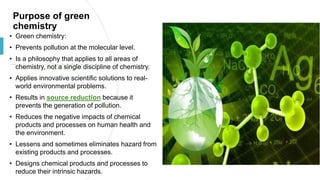
Purpose of green
chemistry
• Green chemistry:
• Prevents pollution at the molecular level.
• Is a philosophy that applies to all areas of
chemistry, not a single discipline of chemistry.
• Applies innovative scientific solutions to real-
world environmental problems.
• Results in source reduction because it
prevents the generation of pollution.
• Reduces the negative impacts of chemical
products and processes on human health and
the environment.
• Lessens and sometimes eliminates hazard from
existing products and processes.
• Designs chemical products and processes to
reduce their intrinsic hazards.
Sustainable Chemistry
• Green chemistry, also termed as sustainable chemistry is that branch of chemical
sciences that emphasizes on design of chemical processes and products that minimize
generation of hazardous chemical substances.
• Sustainable chemistry is a scientific concept that seeks to improve the efficiency with
which natural resources are used to meet human needs for chemical products and
services.
• Majorly Sustainable chemistry is the maintenance and continuation of a technological
development. And we can achieve this sustainable development by adapting the
12 principles of green chemistry.
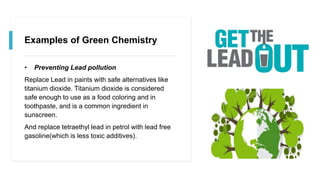
Examples of Green Chemistry
• Preventing Lead pollution
Replace Lead in paints with safe alternatives like
titanium dioxide. Titanium dioxide is considered
safe enough to use as a food coloring and in
toothpaste, and is a common ingredient in
sunscreen.
And replace tetraethyl lead in petrol with lead free
gasoline(which is less toxic additives).
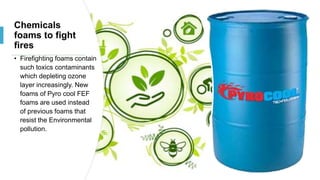
Chemicals
foams to fight
fires
• Firefighting foams contain
such toxics contaminants
which depleting ozone
layer increasingly. New
foams of Pyro cool FEF
foams are used instead
of previous foams that
resist the Environmental
pollution.
Chemicals for dry
cleaning
• Perchloroethylene ("Perc") is mostly
used in dry cleaning of clothes. It is
a cancer causing chemical
moreover its disposal cans
contaminate water underground.
• Instead of it if liquid CO2 is used
with wetting agent then it will act as
an excellent environment
friendly solvent.
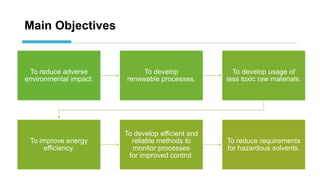
Main Objectives
To reduce adverse
environmental impact.
To develop
renewable processes.
To develop usage of
less toxic raw materials.
To improve energy
efficiency.
To develop efficient and
reliable methods to
monitor processes
for improved control.
To reduce requirements
for hazardous solvents.
How green chemistry differs from
cleaning up pollution.
• Green chemistry reduces pollution at its source by
minimizing or eliminating the hazards of chemical
feedstocks, reagents, solvents, and products.
• This is unlike cleaning up pollution (also called
remediation), which involves treating waste streams
(end-of-the-pipe treatment) or cleanup of
environmental spills and other releases.
Remediation may include separating hazardous
chemicals from other materials, then treating them
so they are no longer hazardous or concentrating
them for safe disposal. Most remediation activities
do not involve green chemistry. Remediation
removes hazardous materials from the
environment; on the other hand, green chemistry
keeps the hazardous materials out of the
environment in the first place.
• If a technology reduces or
eliminates the hazardous chemicals
used to clean up environmental
contaminants, this technology
would qualify as a green chemistry
technology. One example is
replacing a hazardous
sorbent [chemical] used to capture
mercury from the air for safe
disposal with an effective, but
nonhazardous sorbent. Using the
nonhazardous sorbent means that
the hazardous sorbent is never
manufactured and so
the remediation technology meets
the definition of green chemistry.
 Green Chemistry.pptx

Green Chemistry.pptx

  • 1.
    Introduction to Green Chemistry By SameenFatima Roll No. 908529 Semester 6th (M) 2019-2023
  • 2.
    Such technology whichis used to lessen down or eliminates hazard of chemicals from environment. • Green chemistry is the utilization of a set of principles that reduces or eliminates the use or generation of hazardous substances in the design, manufacture and applications of chemical products. • It is a big challenge for chemists and chemical engineers to deal with GREEN CHEMISTRY. • In it they use chemistry to prevent pollution from environment.
  • 3.
    • The remediationtechnology of pollution from environment meets the definition of green chemistry. • In this century the human population, industrialization, energy crisis, environmental pollution are the major concerns of green chemistry on this Earth. To resolves these issues we need to apply 12 principles of green chemistry.
  • 4.
    Concept of greenchemistry • Firstly introduced in USA in 1990s. • In 1991 OPPT(office of pollution prevention and toxics) started a research grant program called "Alternative Synthetic Pathways for Pollution Prevention" • This program expanded in 1993 and renamed as Green chemistry. As a result of this program the EPA (environmental protection agency) led this program. • In Europe several activities related to green chemistry was started in 1998. • Then in UK Royal society of Chemistry has established the Green Chemistry Network (GCN) who started a new journal that was called Green chemistry.
  • 5.
    Who did introduceGreen Chemistry? • Paul Anastas and John C. Warner co-authored the groundbreaking book, Green Chemistry: Theory and Practice in 1998. The 12 Principles of Green Chemistry outlined within this work declared a philosophy that motivated academic and industrial scientists at the time and continues to guide the green chemistry movement.
  • 6.
    John Charles Warner(father ofgreen chemistry) is also a co-scientist in this project and introduces the principles of green chemistry with Paul. Paul Anastas, MA’87, PhD’90, "Father of Green Chemistry," Wins Volvo Environmental Prize 2021. Anastas began his career as a staff chemist at the EPA, where he coined the term "Green Chemistry"
  • 7.
    Purpose of green chemistry •Green chemistry: • Prevents pollution at the molecular level. • Is a philosophy that applies to all areas of chemistry, not a single discipline of chemistry. • Applies innovative scientific solutions to real- world environmental problems. • Results in source reduction because it prevents the generation of pollution. • Reduces the negative impacts of chemical products and processes on human health and the environment. • Lessens and sometimes eliminates hazard from existing products and processes. • Designs chemical products and processes to reduce their intrinsic hazards.
  • 8.
    Sustainable Chemistry • Greenchemistry, also termed as sustainable chemistry is that branch of chemical sciences that emphasizes on design of chemical processes and products that minimize generation of hazardous chemical substances. • Sustainable chemistry is a scientific concept that seeks to improve the efficiency with which natural resources are used to meet human needs for chemical products and services. • Majorly Sustainable chemistry is the maintenance and continuation of a technological development. And we can achieve this sustainable development by adapting the 12 principles of green chemistry.
  • 9.
    Examples of GreenChemistry • Preventing Lead pollution Replace Lead in paints with safe alternatives like titanium dioxide. Titanium dioxide is considered safe enough to use as a food coloring and in toothpaste, and is a common ingredient in sunscreen. And replace tetraethyl lead in petrol with lead free gasoline(which is less toxic additives).
  • 10.
    Chemicals foams to fight fires •Firefighting foams contain such toxics contaminants which depleting ozone layer increasingly. New foams of Pyro cool FEF foams are used instead of previous foams that resist the Environmental pollution.
  • 11.
    Chemicals for dry cleaning •Perchloroethylene ("Perc") is mostly used in dry cleaning of clothes. It is a cancer causing chemical moreover its disposal cans contaminate water underground. • Instead of it if liquid CO2 is used with wetting agent then it will act as an excellent environment friendly solvent.
  • 12.
    Main Objectives To reduceadverse environmental impact. To develop renewable processes. To develop usage of less toxic raw materials. To improve energy efficiency. To develop efficient and reliable methods to monitor processes for improved control. To reduce requirements for hazardous solvents.
  • 13.
    How green chemistrydiffers from cleaning up pollution. • Green chemistry reduces pollution at its source by minimizing or eliminating the hazards of chemical feedstocks, reagents, solvents, and products. • This is unlike cleaning up pollution (also called remediation), which involves treating waste streams (end-of-the-pipe treatment) or cleanup of environmental spills and other releases. Remediation may include separating hazardous chemicals from other materials, then treating them so they are no longer hazardous or concentrating them for safe disposal. Most remediation activities do not involve green chemistry. Remediation removes hazardous materials from the environment; on the other hand, green chemistry keeps the hazardous materials out of the environment in the first place.
  • 14.
    • If atechnology reduces or eliminates the hazardous chemicals used to clean up environmental contaminants, this technology would qualify as a green chemistry technology. One example is replacing a hazardous sorbent [chemical] used to capture mercury from the air for safe disposal with an effective, but nonhazardous sorbent. Using the nonhazardous sorbent means that the hazardous sorbent is never manufactured and so the remediation technology meets the definition of green chemistry.