QUEUEING MODEL OF
AXIS BANK
SUBMITTED BY:-
PRAVIN KUMAR
What is the Queuing Theory?
• Queue - a line of people or vehicles waiting for something.
• Queuing Theory- Mathematical study of waiting lines, using models to
show results, and show opportunities within arrival, service, and
departure processes.
• In this paper, queue theory is applied to enhance the service of a bank in
lines. For this, firstly a queue model (M/M/C): (GD/∞/∞) is selected to
find out efficiency of the servers.
Objectives of the project
• Finding out the efficiency of the servers.
• Signifying the number of service facilities.
• The amount of time customers has to spend to get the desired service.
• The length of the queue (Waiting line).
• How much time the customers have to wait before the service starts.
• the optimal number of counter is calculated to improve the operational
efficiency.
Significance of Queuing models
• Queuing Models Calculate the best number of servers to minimize
costs.
• Queue lengths and waiting times can be predicted.
• Improve Customer Service, continuously.
• When a system gets congested, the service delay in the system
increases.
• A good understanding of the relationship between congestion and delay
is essential for designing effective congestion control for queuing
system.
• Queuing Theory provides all the tools needed for this analysis.
Literature Review
Salzarulo Peter, June 2016: He suggested when scheduling appointments,
health care facilities must estimate patient examination durations. It is apparent
that as these estimates become more accurate, more precise schedules can be
developed and this may result in improvements to service provider idle time,
patient wait time, and facility overtime.
http://onlinelibrary.wiley.com/doi/10.1111/poms.12528/epdf?r3_referer=wol&tracking_action=preview_click&
show_checkout=1&purchase_referrer=onlinelibrary.wiley.com&purchase_site_license=LICENSE_DENIED
Schultz Kenneth ,November-December 2011: He suggested patient service
measures are affected by system variability, as are health car e costs due to
variability’s effect on the availability of key resources such as equipment and
personnel.
http://onlinelibrary.wiley.com/doi/10.1111/j.1937-
5956.2010.01210.x/epdf?r3_referer=wol&tracking_action=preview_click&show_checkout=1&purchase_referr
er=onlinelibrary.wiley.com&purchase_site_license=LICENSE_DENIED
Terminology and Notations
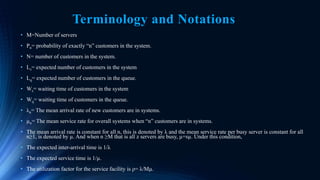
• M=Number of servers
• Pn= probability of exactly “n” customers in the system.
• N= number of customers in the system.
• Ls= expected number of customers in the system
• Lq= expected number of customers in the queue.
• Ws= waiting time of customers in the system
• Wq= waiting time of customers in the queue.
• λn= The mean arrival rate of new customers are in systems.
• µn= The mean service rate for overall systems when “n” customers are in systems.
• The mean arrival rate is constant for all n, this is denoted by λ and the mean service rate per busy server is constant for all
n≥1, is denoted by µ. And when n ≥M that is all z servers are busy, µ=sµ. Under this condition,
• The expected inter-arrival time is 1/λ
• The expected service time is 1/µ.
• The utilization factor for the service facility is ρ= λ/Mµ.
Formula 1 [Adding another server to the system during
busy days (Increase server)]
PROPOSED MODEL: (M/M/C): (GD/∞/∞) model:
• The probability of no customer in the bank,
P0=
1
𝑛=0
𝑠−1
𝜆
𝜇
𝑛
𝑛!
+
𝜆
𝜇
𝑠
𝑠!
∗
1
1−
𝜆
𝑠𝜇
• The probability of n customers in the bank,
𝝀
𝝁
𝒏!
𝒑0 if 0≤ 𝒏 ≤ 𝒔
Pn=
𝝀
𝝁
𝒔!𝒔 𝒏−𝒔 𝒑0 if n≥ 𝒔
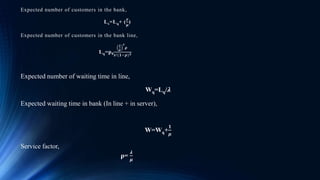
Expected number of customers in the bank,
Ls=Lq+ (
𝜸
𝝁
)
Expected number of customers in the bank line,
Lq=p0
𝝀
𝝁
𝒔
𝝆
𝒔!(𝟏−𝝆) 𝟐
Expected number of waiting time in line,
Wq=Lq/𝝀
Expected waiting time in bank (In line + in server),
W=Wq+
𝟏
𝝁
Service factor,
ρ=
𝝀
𝝁
Case study of a local bank
[Service time per day is 10:00 to 1:00 and 3:00-4:00.total 240
minutes.]
Bank data of customer count for one
month
Week No. Monday Tuesday Wednesday Thursday Friday
Week 1 140 114 132 146 156
Week 2 120 123 199 145 150
Week 3 199 171 159 120 130
Week 4 150 180 149 107 110
Total 609 588 639 518 546
Average 152.25 147 159.75 129.5 136.5
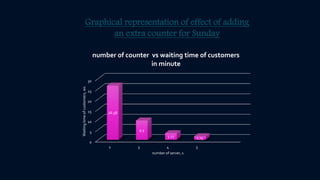
0
5
10
15
20
25
30
2 3 4 5
26.58
9.5
3.27 1.75
Waitingtimeofcustomers,ws
number of server, s
number of counter vs waiting time of customers
in minute
Graphical representation of effect of adding
an extra counter for Sunday
Problem Formulation
• It has been seen in the research that If waiting time increases then
frustration level increases with this. In the scenario utilization factor
is as high as 0.39 to 0.48 during busy days of the bank. It is clear that
high utilization rate is not helping to reduce customer’s waiting time in
queue. On high utilization factor customers have to wait more time in
system as like as 26.58, 15.123, 96.664, 4.992, 7.074 minutes
respectively from Monday to Friday. It seems that there is a problem
in the operations which if not noticed could reduce business of bank.
Result and discussion of formula 1
• The comparative analysis of adding an extra counter to the system and
improving the service rate have shown in the above figures.
• when one more counter is added (s=3) the waiting time in system
reduces significantly to 9.5, 5.624, 33.923, 2.387, 3.025 minutes
respectively from Monday to Thursday. However, it can be seen that
adding one more counter (s=3) does significantly change the waiting
time of the system except for Tuesday. Using four counter for Tuesday
significantly changes waiting time from 33.923 (when s=3) to 9.217.
• The second way of reducing the waiting time in line is by improving the
service rate. The above figure indicates the ultimate effect of improving
the service rate. From the comparative analysis, it can be seen that on
Tuesday, if the service rate is improved from .70 to .76 then waiting
time reduces to 96.664 to 14.12 (82.554minutes) without adding an
extra counter thus adding no extra cost.
Result and discussion of formula 2
Psychological View [Frustration]
Conclusion
The efficiency of commercial banks is improved by the following three
measures:
• The queuing number
• The service stations number and
• The optimal service rate
which are investigated by means of queuing theory. By the example, the
results are effective and practical. The time of customer queuing is
reduced. The customer satisfaction is increased. It was proved that this
optimal model of the queuing is feasible.
Bibliography
• http://people.brunel.ac.uk/~mastjjb/jeb/or/queue.html
• http://www.supositorio.com/rcalc/rcalclite.htm
• http://www.shmula.com/queueing-theory-part-3/170/
• http://www.ams.sunysb.edu/~jsbm/courses/342/examples-queueing

Queueing model of bank

  • 1.
    QUEUEING MODEL OF AXISBANK SUBMITTED BY:- PRAVIN KUMAR
  • 2.
    What is theQueuing Theory? • Queue - a line of people or vehicles waiting for something. • Queuing Theory- Mathematical study of waiting lines, using models to show results, and show opportunities within arrival, service, and departure processes. • In this paper, queue theory is applied to enhance the service of a bank in lines. For this, firstly a queue model (M/M/C): (GD/∞/∞) is selected to find out efficiency of the servers.
  • 3.
    Objectives of theproject • Finding out the efficiency of the servers. • Signifying the number of service facilities. • The amount of time customers has to spend to get the desired service. • The length of the queue (Waiting line). • How much time the customers have to wait before the service starts. • the optimal number of counter is calculated to improve the operational efficiency.
  • 4.
    Significance of Queuingmodels • Queuing Models Calculate the best number of servers to minimize costs. • Queue lengths and waiting times can be predicted. • Improve Customer Service, continuously. • When a system gets congested, the service delay in the system increases. • A good understanding of the relationship between congestion and delay is essential for designing effective congestion control for queuing system. • Queuing Theory provides all the tools needed for this analysis.
  • 5.
    Literature Review Salzarulo Peter,June 2016: He suggested when scheduling appointments, health care facilities must estimate patient examination durations. It is apparent that as these estimates become more accurate, more precise schedules can be developed and this may result in improvements to service provider idle time, patient wait time, and facility overtime. http://onlinelibrary.wiley.com/doi/10.1111/poms.12528/epdf?r3_referer=wol&tracking_action=preview_click& show_checkout=1&purchase_referrer=onlinelibrary.wiley.com&purchase_site_license=LICENSE_DENIED Schultz Kenneth ,November-December 2011: He suggested patient service measures are affected by system variability, as are health car e costs due to variability’s effect on the availability of key resources such as equipment and personnel. http://onlinelibrary.wiley.com/doi/10.1111/j.1937- 5956.2010.01210.x/epdf?r3_referer=wol&tracking_action=preview_click&show_checkout=1&purchase_referr er=onlinelibrary.wiley.com&purchase_site_license=LICENSE_DENIED
  • 6.
    Terminology and Notations •M=Number of servers • Pn= probability of exactly “n” customers in the system. • N= number of customers in the system. • Ls= expected number of customers in the system • Lq= expected number of customers in the queue. • Ws= waiting time of customers in the system • Wq= waiting time of customers in the queue. • λn= The mean arrival rate of new customers are in systems. • µn= The mean service rate for overall systems when “n” customers are in systems. • The mean arrival rate is constant for all n, this is denoted by λ and the mean service rate per busy server is constant for all n≥1, is denoted by µ. And when n ≥M that is all z servers are busy, µ=sµ. Under this condition, • The expected inter-arrival time is 1/λ • The expected service time is 1/µ. • The utilization factor for the service facility is ρ= λ/Mµ.
  • 7.
    Formula 1 [Addinganother server to the system during busy days (Increase server)] PROPOSED MODEL: (M/M/C): (GD/∞/∞) model: • The probability of no customer in the bank, P0= 1 𝑛=0 𝑠−1 𝜆 𝜇 𝑛 𝑛! + 𝜆 𝜇 𝑠 𝑠! ∗ 1 1− 𝜆 𝑠𝜇 • The probability of n customers in the bank, 𝝀 𝝁 𝒏! 𝒑0 if 0≤ 𝒏 ≤ 𝒔 Pn= 𝝀 𝝁 𝒔!𝒔 𝒏−𝒔 𝒑0 if n≥ 𝒔
  • 8.
    Expected number ofcustomers in the bank, Ls=Lq+ ( 𝜸 𝝁 ) Expected number of customers in the bank line, Lq=p0 𝝀 𝝁 𝒔 𝝆 𝒔!(𝟏−𝝆) 𝟐 Expected number of waiting time in line, Wq=Lq/𝝀 Expected waiting time in bank (In line + in server), W=Wq+ 𝟏 𝝁 Service factor, ρ= 𝝀 𝝁
  • 9.
    Case study ofa local bank [Service time per day is 10:00 to 1:00 and 3:00-4:00.total 240 minutes.] Bank data of customer count for one month Week No. Monday Tuesday Wednesday Thursday Friday Week 1 140 114 132 146 156 Week 2 120 123 199 145 150 Week 3 199 171 159 120 130 Week 4 150 180 149 107 110 Total 609 588 639 518 546 Average 152.25 147 159.75 129.5 136.5
  • 10.
    0 5 10 15 20 25 30 2 3 45 26.58 9.5 3.27 1.75 Waitingtimeofcustomers,ws number of server, s number of counter vs waiting time of customers in minute Graphical representation of effect of adding an extra counter for Sunday
  • 11.
    Problem Formulation • Ithas been seen in the research that If waiting time increases then frustration level increases with this. In the scenario utilization factor is as high as 0.39 to 0.48 during busy days of the bank. It is clear that high utilization rate is not helping to reduce customer’s waiting time in queue. On high utilization factor customers have to wait more time in system as like as 26.58, 15.123, 96.664, 4.992, 7.074 minutes respectively from Monday to Friday. It seems that there is a problem in the operations which if not noticed could reduce business of bank.
  • 12.
    Result and discussionof formula 1 • The comparative analysis of adding an extra counter to the system and improving the service rate have shown in the above figures. • when one more counter is added (s=3) the waiting time in system reduces significantly to 9.5, 5.624, 33.923, 2.387, 3.025 minutes respectively from Monday to Thursday. However, it can be seen that adding one more counter (s=3) does significantly change the waiting time of the system except for Tuesday. Using four counter for Tuesday significantly changes waiting time from 33.923 (when s=3) to 9.217.
  • 13.
    • The secondway of reducing the waiting time in line is by improving the service rate. The above figure indicates the ultimate effect of improving the service rate. From the comparative analysis, it can be seen that on Tuesday, if the service rate is improved from .70 to .76 then waiting time reduces to 96.664 to 14.12 (82.554minutes) without adding an extra counter thus adding no extra cost. Result and discussion of formula 2
  • 14.
  • 15.
    Conclusion The efficiency ofcommercial banks is improved by the following three measures: • The queuing number • The service stations number and • The optimal service rate which are investigated by means of queuing theory. By the example, the results are effective and practical. The time of customer queuing is reduced. The customer satisfaction is increased. It was proved that this optimal model of the queuing is feasible.
  • 16.
    Bibliography • http://people.brunel.ac.uk/~mastjjb/jeb/or/queue.html • http://www.supositorio.com/rcalc/rcalclite.htm •http://www.shmula.com/queueing-theory-part-3/170/ • http://www.ams.sunysb.edu/~jsbm/courses/342/examples-queueing