
Management
Process
Underperforming Team –
Case Study
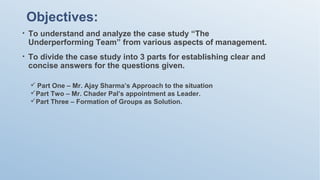
Objectives:
• To understand and analyze the case study “The
Underperforming Team” from various aspects of management.
• To divide the case study into 3 parts for establishing clear and
concise answers for the questions given.
 Part One – Mr. Ajay Sharma’s Approach to the situation
Part Two – Mr. Chader Pal’s appointment as Leader.
Part Three – Formation of Groups as Solution.
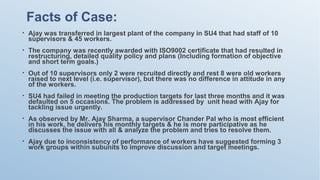
Facts of Case:
• Ajay was transferred in largest plant of the company in SU4 that had staff of 10
supervisors & 45 workers.
• The company was recently awarded with ISO9002 certificate that had resulted in
restructuring, detailed quality policy and plans (Including formation of objective
and short term goals.)
• Out of 10 supervisors only 2 were recruited directly and rest 8 were old workers
raised to next level (i.e. supervisor), but there was no difference in attitude in any
of the workers.
• SU4 had failed in meeting the production targets for last three months and it was
defaulted on 5 occasions. The problem is addressed by unit head with Ajay for
tackling issue urgently.
• As observed by Mr. Ajay Sharma, a supervisor Chander Pal who is most efficient
in his work, he delivers his monthly targets & he is more participative as he
discusses the issue with all & analyze the problem and tries to resolve them.
• Ajay due to inconsistency of performance of workers have suggested forming 3
work groups within subunits to improve discussion and target meetings.
Part – I (Mr. Ajay Sharma’s approach to the situation)
Planning & strategic thinking has already been done at Senior Management Levels. Mr. Sharma was given
the task of execution these plans using best strategy.
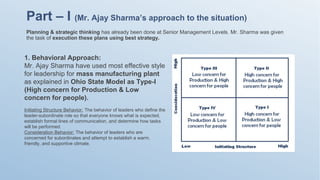
1. Behavioral Approach:
Mr. Ajay Sharma have used most effective style
for leadership for mass manufacturing plant
as explained in Ohio State Model as Type-I
(High concern for Production & Low
concern for people).
Initiating Structure Behavior: The behavior of leaders who define the
leader-subordinate role so that everyone knows what is expected,
establish formal lines of communication, and determine how tasks
will be performed.
Consideration Behavior: The behavior of leaders who are
concerned for subordinates and attempt to establish a warm,
friendly, and supportive climate.
2. Reviewing of Employees:
After joining plant Mr. Ajay invested 2 weeks in understanding workers, observed the
functioning of the workers and made notes on how they work, their interaction with
each other and their competence.
3. Manpower Allocation:
Mr. Ajay Sharma did analyze his current manpower inventory of 10 supervisors out
which he picked one supervisor Chander Pal who had been delivering production
targets and diagnosing & resolving issues effectively.
4. Organizing:
Mr. Ajay Sharma identified the activities that are to be performed example making
work groups and assigning, creating awareness of production targets and quality,
checking these production targets, and monitor individual performance and recognizing
workers who do great work.
Part – I (Continued..)
5. Total Quality Management:
ISO Quality Management Standards is one of the models of TQM and since company
was now ISO certified its main emphasis had become to manufacture high quality
products and to reduce waste and inventory. Hence quality work groups were
proposed by Mr. Ajay to create awareness of TQM methodologies.
6. Recognition/Awards:
Mr. Ajay Sharma cleared mentioned that he is unable to do much on monetary ground
for workers but based on individual performance the SU4 best performer will be
selected weekly. This is a motivation used by Mr. Ajay which will promote healthy
competition within the sub-unit.
Part – I (Continued..)
Mr. Chander Pal as leader of work group. Mr. Pal has most vocal and knowledgeable person and gives accurate diagnosis of
problems at sub-unit. He is seen discussing all and sundry issues with everybody in free time and is generally doing his work very
efficiently. The six workers under him are giving production as per their targets without fail.
Part – II (Chader Pal’s appointment as Leader.)
Roles a Leader Can Play:
As a Planner - As supervisor Mr. Pal has to plan the daily work schedules in the
factory.
As a Manager - He is, in fact, an operative manager of the work groups.
As a Guide and Leader - Leading the workers by guiding them the way of perform
their daily tasks. In fact, he plays a role of an motivator by telling them.
Part – II (Continued…)
As a Mediator – He is called a linking pin between management and workers. He is
the spokesperson of management as well as worker.
As an Inspector - An important role of supervisor is to enforce discipline in the factory.
Checking line progress, time schedule, work performance, rules & regulations followed.
As a Counselor - A supervisor plays the role of a counselor to the worker’s problem.
Listening to the grievances but also handling the grievances and satisfying the workers
Mr. Ajay has already deployed Mr. Pal as in-charge of work groups he has rightly taken the decision to meet the management’s
goals of production target and quality. Further more Mr. Pal is the first-line managers who is in direct communication with workers
to achieve the objectives set by Mr. Ajay Sharma he have to take considerable amount of steps and execute the plans effectively
as below.
Part – III (Formation of Groups as Solution)
 Ensuring everyone knows their daily/weekly set production targets.
 Researching on exact causes of failure of production on 5 occasions.
 To analyze if these causes are due to worker capability issue or due to poor personal
attitude towards work.
 Finding solutions to the problems of employees by advising training programs for
capability issues and disciplinary action for attitude issues.
Part – III (continued..)
Doing worker job reviews of all in the work group. (What workers are doing, what are
they not doing, any particular factor that hindering worker performance).
 Taking feedback/listening to workers for areas for areas of improvement, identify any
training or additional support which might be required. Also informal talk with workers
might get more information that will help improve production quality.
 He should do daily monitoring of production targets and prepare reports for
management to study.
As we understand from case study that SU4 is currently not meeting complete targets of
production, Mr. Pal will have to use his own strategy which has already proven
successful as well as new policy of production with quality. Hence he has to also adopt
quality methodology like Six Sigma, & Kaizen etc. The whole process will take minimum
1-2 weeks to come to a progressive level.
Team Members

Underperforming Team Case Study

  • 1.
  • 2.
    Objectives: • To understandand analyze the case study “The Underperforming Team” from various aspects of management. • To divide the case study into 3 parts for establishing clear and concise answers for the questions given.  Part One – Mr. Ajay Sharma’s Approach to the situation Part Two – Mr. Chader Pal’s appointment as Leader. Part Three – Formation of Groups as Solution.
  • 3.
    Facts of Case: •Ajay was transferred in largest plant of the company in SU4 that had staff of 10 supervisors & 45 workers. • The company was recently awarded with ISO9002 certificate that had resulted in restructuring, detailed quality policy and plans (Including formation of objective and short term goals.) • Out of 10 supervisors only 2 were recruited directly and rest 8 were old workers raised to next level (i.e. supervisor), but there was no difference in attitude in any of the workers. • SU4 had failed in meeting the production targets for last three months and it was defaulted on 5 occasions. The problem is addressed by unit head with Ajay for tackling issue urgently. • As observed by Mr. Ajay Sharma, a supervisor Chander Pal who is most efficient in his work, he delivers his monthly targets & he is more participative as he discusses the issue with all & analyze the problem and tries to resolve them. • Ajay due to inconsistency of performance of workers have suggested forming 3 work groups within subunits to improve discussion and target meetings.
  • 4.
    Part – I(Mr. Ajay Sharma’s approach to the situation) Planning & strategic thinking has already been done at Senior Management Levels. Mr. Sharma was given the task of execution these plans using best strategy. 1. Behavioral Approach: Mr. Ajay Sharma have used most effective style for leadership for mass manufacturing plant as explained in Ohio State Model as Type-I (High concern for Production & Low concern for people). Initiating Structure Behavior: The behavior of leaders who define the leader-subordinate role so that everyone knows what is expected, establish formal lines of communication, and determine how tasks will be performed. Consideration Behavior: The behavior of leaders who are concerned for subordinates and attempt to establish a warm, friendly, and supportive climate.
  • 5.
    2. Reviewing ofEmployees: After joining plant Mr. Ajay invested 2 weeks in understanding workers, observed the functioning of the workers and made notes on how they work, their interaction with each other and their competence. 3. Manpower Allocation: Mr. Ajay Sharma did analyze his current manpower inventory of 10 supervisors out which he picked one supervisor Chander Pal who had been delivering production targets and diagnosing & resolving issues effectively. 4. Organizing: Mr. Ajay Sharma identified the activities that are to be performed example making work groups and assigning, creating awareness of production targets and quality, checking these production targets, and monitor individual performance and recognizing workers who do great work. Part – I (Continued..)
  • 6.
    5. Total QualityManagement: ISO Quality Management Standards is one of the models of TQM and since company was now ISO certified its main emphasis had become to manufacture high quality products and to reduce waste and inventory. Hence quality work groups were proposed by Mr. Ajay to create awareness of TQM methodologies. 6. Recognition/Awards: Mr. Ajay Sharma cleared mentioned that he is unable to do much on monetary ground for workers but based on individual performance the SU4 best performer will be selected weekly. This is a motivation used by Mr. Ajay which will promote healthy competition within the sub-unit. Part – I (Continued..)
  • 7.
    Mr. Chander Palas leader of work group. Mr. Pal has most vocal and knowledgeable person and gives accurate diagnosis of problems at sub-unit. He is seen discussing all and sundry issues with everybody in free time and is generally doing his work very efficiently. The six workers under him are giving production as per their targets without fail. Part – II (Chader Pal’s appointment as Leader.) Roles a Leader Can Play: As a Planner - As supervisor Mr. Pal has to plan the daily work schedules in the factory. As a Manager - He is, in fact, an operative manager of the work groups. As a Guide and Leader - Leading the workers by guiding them the way of perform their daily tasks. In fact, he plays a role of an motivator by telling them.
  • 8.
    Part – II(Continued…) As a Mediator – He is called a linking pin between management and workers. He is the spokesperson of management as well as worker. As an Inspector - An important role of supervisor is to enforce discipline in the factory. Checking line progress, time schedule, work performance, rules & regulations followed. As a Counselor - A supervisor plays the role of a counselor to the worker’s problem. Listening to the grievances but also handling the grievances and satisfying the workers
  • 9.
    Mr. Ajay hasalready deployed Mr. Pal as in-charge of work groups he has rightly taken the decision to meet the management’s goals of production target and quality. Further more Mr. Pal is the first-line managers who is in direct communication with workers to achieve the objectives set by Mr. Ajay Sharma he have to take considerable amount of steps and execute the plans effectively as below. Part – III (Formation of Groups as Solution)  Ensuring everyone knows their daily/weekly set production targets.  Researching on exact causes of failure of production on 5 occasions.  To analyze if these causes are due to worker capability issue or due to poor personal attitude towards work.  Finding solutions to the problems of employees by advising training programs for capability issues and disciplinary action for attitude issues.
  • 10.
    Part – III(continued..) Doing worker job reviews of all in the work group. (What workers are doing, what are they not doing, any particular factor that hindering worker performance).  Taking feedback/listening to workers for areas for areas of improvement, identify any training or additional support which might be required. Also informal talk with workers might get more information that will help improve production quality.  He should do daily monitoring of production targets and prepare reports for management to study. As we understand from case study that SU4 is currently not meeting complete targets of production, Mr. Pal will have to use his own strategy which has already proven successful as well as new policy of production with quality. Hence he has to also adopt quality methodology like Six Sigma, & Kaizen etc. The whole process will take minimum 1-2 weeks to come to a progressive level.
  • 11.