QUESTIONNAIRE ANALYSIS Ellie Francis
QUESTION 1: DO YOU USE SOCIAL
MEDIA? IF SO WHICH TYPES EG
TWITTER ETC
94%
6%
YES
NO
11
12
11
4.5
0
2
4
6
8
10
12
14
TWITTER FACEBOOK INSTAGRAM SNAPCHAT
This question here
shows the high
percent of our target
audience who use
social media. A huge
but not shocking 94%
of people do use
social media and
Twitter, Facebook,
Instagram and
snapchat seem to be
the main uses. Due to
the percent to being
so high, this allowed
us to create
questions which are
likely to be relatable
QUESTION 2: ARE YOU MALE OR
FEMALE?
40%
60%
Male Female
This questions allows us to see the variation of the
genders which we will be asking. Its important that we
ae both male and females as our target audience cannot
be based on one gender as we want to be able to make
generalizations for our target audience which is age 16-
19 year olds.
From the pie chart, you can see that within our
questionnaire more females than males were asked. This
could mean that our results could be hindered, however,
this can still help us to gather information on the use of
social media for both male and females. We can here
make comparisons and use this to create interviews/vox
pops with our audience.
QUESTION 3: WHAT IS YOUR
ETHNICITY?
0
2
4
6
8
10
12
14
White
British
Black Asian Other
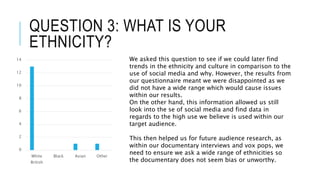
We asked this question to see if we could later find
trends in the ethnicity and culture in comparison to the
use of social media and why. However, the results from
our questionnaire meant we were disappointed as we
did not have a wide range which would cause issues
within our results.
On the other hand, this information allowed us still
look into the se of social media and find data in
regards to the high use we believe is used within our
target audience.
This then helped us for future audience research, as
within our documentary interviews and vox pops, we
need to ensure we ask a wide range of ethnicities so
the documentary does not seem bias or unworthy.
QUESTION 4: IF YOU ARE A SOCIAL
MEDIA USER HOW MUCH TIME WHO
YOU SAY YOU SPEND ON SITES PER
DAY?
0 2 4 6 8 10 12
None
Below 1 hour
1-4 hours
More than 4 hours
This questions shows us how long
people roughly spend on social media
each day. This is a question we then
want to go on and ask within our
interviews as we feel this can show
how addictive social media really is.
This questions shows that on average
the audience we asked believe they
spend 1-4 hours on social media.
We can then compare this to our vox
pops and use statistical information
within our documentary from our own
findings.
QUESTION 5: IF YOU DO NOT USE
SOCIAL MEDIA WHAT ARE YOUR
REASONS BEHIND THIS? OR IF YOU
ARE WHY DO YOU THINK PEOPLE OPT
OF USING THEM?
0
1
2
3
4
5
6
From previous questions we
know that only 6% of those
who answered our
questionnaire did not use
social media. This question
here finds the reasoning as to
why people do not use it.
’keeping life private’ was the
most popular answer. This
can be used within our
documentary as we can
compare and look at reasons
as to why some people do not
find social media addictive.
The question itself, does not
directly relate to what we are
focusing on within our
QUESTION 6: TO WHAT EXTENT DO
YOU BELIEVE SOCIAL MEDIA CAN
BE ‘ADDICTIVE’?
0
0.5
1
1.5
2
2.5
3
3.5
4
4.5
Its easy to
use
Like
another
world
Access to
know whats
going on
Crave
Attention
Addicting
to posting
pictures
Don’t think
it is
From the results it can be said
that social media is clearly
addictive in various ways. Our
audience research prove that
most people within this age
range believe social media is
addictive and have come up with
various reasons why. These
reasons are likely to be why they
are addicted or use social media.
These results are something we
can then go on to use within our
documentary as statistical
information or general
information usage.
QUESTION 7: DO YOU UNDERSTAND
THE DANGERS THAT SOCIAL MEDIA
CAN CAUSE? IF SO STATE EXAMPLES.
0
1
2
3
4
5
6
7
This question shows that our
target audience do understand
the most popular causes to bad
use of social media. The four
responses that can be seen in
our data analysis are most
probably the worst outcomes of
dangerous use of social media.
Again these are examples which
can be used to give our
audience better understanding
as well as maybe asking this
question within vox pops and
interviews to gain more
information.
QUESTION 8: IN WHICH SITUATIONS
DO YOU USE SOCIAL MEDIA?
0
2
4
6
8
10
12
At homeOut in public BothOther(if so state what)N/A
Questionning our target audience on where
they use social media, shows that it is not just
one place that social media is used but in
most instances everywhere. Being both at
home as well as out in public. We could hae
improved this question by asking if our
audience feel they need to use it in a
work/educational environment.
This would of here shown the higher impact
which social media has on our audience and
would back up the focus our documentary is
on- the addictive of social media and life
online.
QUESTION 9: IF YOU ARE A SOCIAL
MEDIA USER WHICH OF THE
FOLLOWING DO YOU FEEL YOU USE
MOST FREQUENTLY?
0 2 4 6 8
Facebook
Twitter
Instagram
Snapchat
Myspace
Bebo
Twitter is known to be used most
frequently used by our target
audience. However, the other 3 social
medias which we have found to be
popular within our target audience
are Instagram, snapchat and
Facebook. These are the four main
social medias we will be focusing on
within our documentary.
Due to being the most popular within
our age range we feel sticking to
what they use most will have the
most encouragement to watch as well
as shocked by the statistics we give.
QUESTION 10: NAME THREE
DIFFERENT SOCIAL MEDIA SITES AND
EXPLAIN WHY/HOW YOU USE THEM?
26%
21%29%
24%
Faceb
ook
Insta
Snapc
hat
Twitte
r
0
1
2
3
4
5
6
7
8
9
10
Chat to
others
Take
pictures
Post/Look
at posts
News Watch
things
Social media across the
world is used for most likely
the same thing in the age
range we are looking into.
This is data we can use
within the documentary so
differentiation or similarity
in the way in which social
media is used in a range of
ages.
QUESTION 11: DO YOU BELIEVE THERE
IS A CHANGE IN SOCIETY DUE TO
SOCIAL MEDIA? EXPLAIN YOUR
ANSWER?This is a question which
allowed our audience to
expand on their thoughts and
opinions which is just what we
wanted. The question showed
variation in the way in which
our audience thought but also
helped us decide on what kind
of questions where needed in
our vox pops in order to have
a fun but knowledge driven
documentary. From the results
it is clear that everyone
believes there has been a
change in the way in which
social media has been used.
The results are shocking as
our audience is so young! This
is something we can then go
on and talk about within our
documentary.
0
2
4
6
8
10
12
Lack basic people
skills
Body concious No one talks
anymore
No childhood
QUETSION 12: WHEN WATCHING
DOCUMENTARYS DO YOU PREFER
ONES WITH AN ON SCREEN
PRESENTER?
0
1
2
3
4
5
6
7
8
9
Yes No Don’t
Mind
Chart Title
Column1 Column2 Series 3
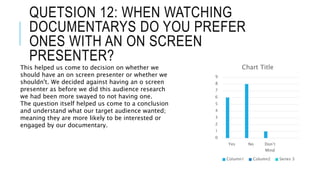
This helped us come to decision on whether we
should have an on screen presenter or whether we
shouldn't. We decided against having an o screen
presenter as before we did this audience research
we had been more swayed to not having one.
The question itself helped us come to a conclusion
and understand what our target audience wanted;
meaning they are more likely to be interested or
engaged by our documentary.

Questionnaire analysis

  • 1.
  • 2.
    QUESTION 1: DOYOU USE SOCIAL MEDIA? IF SO WHICH TYPES EG TWITTER ETC 94% 6% YES NO 11 12 11 4.5 0 2 4 6 8 10 12 14 TWITTER FACEBOOK INSTAGRAM SNAPCHAT This question here shows the high percent of our target audience who use social media. A huge but not shocking 94% of people do use social media and Twitter, Facebook, Instagram and snapchat seem to be the main uses. Due to the percent to being so high, this allowed us to create questions which are likely to be relatable
  • 3.
    QUESTION 2: AREYOU MALE OR FEMALE? 40% 60% Male Female This questions allows us to see the variation of the genders which we will be asking. Its important that we ae both male and females as our target audience cannot be based on one gender as we want to be able to make generalizations for our target audience which is age 16- 19 year olds. From the pie chart, you can see that within our questionnaire more females than males were asked. This could mean that our results could be hindered, however, this can still help us to gather information on the use of social media for both male and females. We can here make comparisons and use this to create interviews/vox pops with our audience.
  • 4.
    QUESTION 3: WHATIS YOUR ETHNICITY? 0 2 4 6 8 10 12 14 White British Black Asian Other We asked this question to see if we could later find trends in the ethnicity and culture in comparison to the use of social media and why. However, the results from our questionnaire meant we were disappointed as we did not have a wide range which would cause issues within our results. On the other hand, this information allowed us still look into the se of social media and find data in regards to the high use we believe is used within our target audience. This then helped us for future audience research, as within our documentary interviews and vox pops, we need to ensure we ask a wide range of ethnicities so the documentary does not seem bias or unworthy.
  • 5.
    QUESTION 4: IFYOU ARE A SOCIAL MEDIA USER HOW MUCH TIME WHO YOU SAY YOU SPEND ON SITES PER DAY? 0 2 4 6 8 10 12 None Below 1 hour 1-4 hours More than 4 hours This questions shows us how long people roughly spend on social media each day. This is a question we then want to go on and ask within our interviews as we feel this can show how addictive social media really is. This questions shows that on average the audience we asked believe they spend 1-4 hours on social media. We can then compare this to our vox pops and use statistical information within our documentary from our own findings.
  • 6.
    QUESTION 5: IFYOU DO NOT USE SOCIAL MEDIA WHAT ARE YOUR REASONS BEHIND THIS? OR IF YOU ARE WHY DO YOU THINK PEOPLE OPT OF USING THEM? 0 1 2 3 4 5 6 From previous questions we know that only 6% of those who answered our questionnaire did not use social media. This question here finds the reasoning as to why people do not use it. ’keeping life private’ was the most popular answer. This can be used within our documentary as we can compare and look at reasons as to why some people do not find social media addictive. The question itself, does not directly relate to what we are focusing on within our
  • 7.
    QUESTION 6: TOWHAT EXTENT DO YOU BELIEVE SOCIAL MEDIA CAN BE ‘ADDICTIVE’? 0 0.5 1 1.5 2 2.5 3 3.5 4 4.5 Its easy to use Like another world Access to know whats going on Crave Attention Addicting to posting pictures Don’t think it is From the results it can be said that social media is clearly addictive in various ways. Our audience research prove that most people within this age range believe social media is addictive and have come up with various reasons why. These reasons are likely to be why they are addicted or use social media. These results are something we can then go on to use within our documentary as statistical information or general information usage.
  • 8.
    QUESTION 7: DOYOU UNDERSTAND THE DANGERS THAT SOCIAL MEDIA CAN CAUSE? IF SO STATE EXAMPLES. 0 1 2 3 4 5 6 7 This question shows that our target audience do understand the most popular causes to bad use of social media. The four responses that can be seen in our data analysis are most probably the worst outcomes of dangerous use of social media. Again these are examples which can be used to give our audience better understanding as well as maybe asking this question within vox pops and interviews to gain more information.
  • 9.
    QUESTION 8: INWHICH SITUATIONS DO YOU USE SOCIAL MEDIA? 0 2 4 6 8 10 12 At homeOut in public BothOther(if so state what)N/A Questionning our target audience on where they use social media, shows that it is not just one place that social media is used but in most instances everywhere. Being both at home as well as out in public. We could hae improved this question by asking if our audience feel they need to use it in a work/educational environment. This would of here shown the higher impact which social media has on our audience and would back up the focus our documentary is on- the addictive of social media and life online.
  • 10.
    QUESTION 9: IFYOU ARE A SOCIAL MEDIA USER WHICH OF THE FOLLOWING DO YOU FEEL YOU USE MOST FREQUENTLY? 0 2 4 6 8 Facebook Twitter Instagram Snapchat Myspace Bebo Twitter is known to be used most frequently used by our target audience. However, the other 3 social medias which we have found to be popular within our target audience are Instagram, snapchat and Facebook. These are the four main social medias we will be focusing on within our documentary. Due to being the most popular within our age range we feel sticking to what they use most will have the most encouragement to watch as well as shocked by the statistics we give.
  • 11.
    QUESTION 10: NAMETHREE DIFFERENT SOCIAL MEDIA SITES AND EXPLAIN WHY/HOW YOU USE THEM? 26% 21%29% 24% Faceb ook Insta Snapc hat Twitte r 0 1 2 3 4 5 6 7 8 9 10 Chat to others Take pictures Post/Look at posts News Watch things Social media across the world is used for most likely the same thing in the age range we are looking into. This is data we can use within the documentary so differentiation or similarity in the way in which social media is used in a range of ages.
  • 12.
    QUESTION 11: DOYOU BELIEVE THERE IS A CHANGE IN SOCIETY DUE TO SOCIAL MEDIA? EXPLAIN YOUR ANSWER?This is a question which allowed our audience to expand on their thoughts and opinions which is just what we wanted. The question showed variation in the way in which our audience thought but also helped us decide on what kind of questions where needed in our vox pops in order to have a fun but knowledge driven documentary. From the results it is clear that everyone believes there has been a change in the way in which social media has been used. The results are shocking as our audience is so young! This is something we can then go on and talk about within our documentary. 0 2 4 6 8 10 12 Lack basic people skills Body concious No one talks anymore No childhood
  • 13.
    QUETSION 12: WHENWATCHING DOCUMENTARYS DO YOU PREFER ONES WITH AN ON SCREEN PRESENTER? 0 1 2 3 4 5 6 7 8 9 Yes No Don’t Mind Chart Title Column1 Column2 Series 3 This helped us come to decision on whether we should have an on screen presenter or whether we shouldn't. We decided against having an o screen presenter as before we did this audience research we had been more swayed to not having one. The question itself helped us come to a conclusion and understand what our target audience wanted; meaning they are more likely to be interested or engaged by our documentary.