Jennifer Evans
Assistant Director ELA
St. Clair County RESA
Evans.jennifer@sccresa.org
http://www.protopage.com/evans.jennifer#Untitled/Home
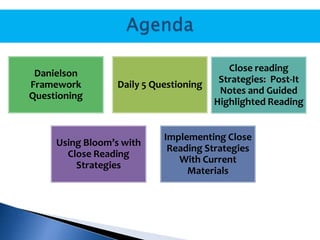
Danielson
Framework
Questioning

Daily 5 Questioning

Using Bloom’s with
Close Reading
Strategies

Close reading
Strategies: Post-It
Notes and Guided
Highlighted Reading

Implementing Close
Reading Strategies
With Current
Materials


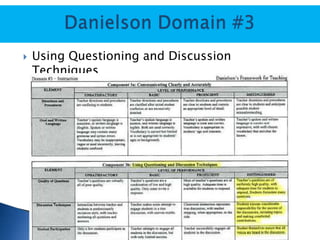
Using Questioning and Discussion
Techniques
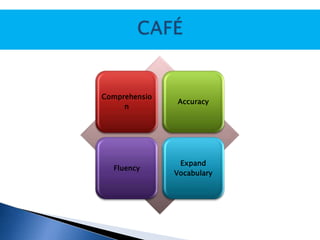
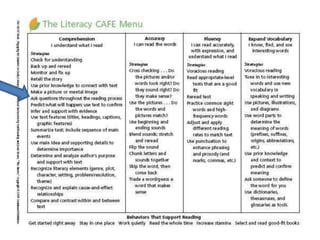
Comprehensio
n

Accuracy

Fluency

Expand
Vocabulary


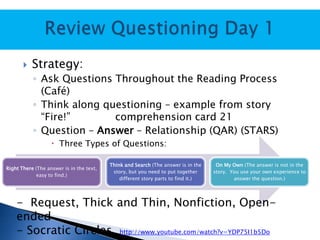
Strategy:
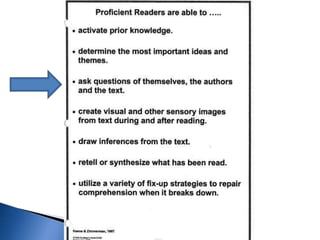
◦ Ask Questions Throughout the Reading Process
(Café)
◦ Think along questioning – example from story
“Fire!”
comprehension card 21
◦ Question – Answer – Relationship (QAR) (STARS)
 Three Types of Questions:

Right There (The answer is in the text,
easy to find.)

Think and Search (The answer is in the
story, but you need to put together
different story parts to find it.)

On My Own (The answer is not in the
story. You use your own experience to
answer the question.)

- Request, Thick and Thin, Nonfiction, Openended
- Socratic Circles http://www.youtube.com/watch?v=YDP75I1b5Do
The use of questioning routines, such as
QAR, questioning the author, or
Bloom’s, is effective for developing textdependent questions.
Regardless of the system used, the
questions should be developed in advance
of the lesson to ensure that the discussion
regularly guides students back to the text.
( p 119 Text Complexity by Douglas
Fisher)
1. Post-it
Notes

2. Guided
Highlighted
Reading
Independent reading of the text is
supported through a series of
instructional moves including:
setting the purpose, teacher
modeling, guided instruction, group
work, and independent tasks.


Set Purpose: To engage 4th grade students
in a close reading of an excerpt from an
informational book on the history of the
development of “Post-it Notes.”

◦ Purpose is to discover how a familiar office product
was initially thought to be a failure and to trace its
development as a useful item.



Strategy Handout
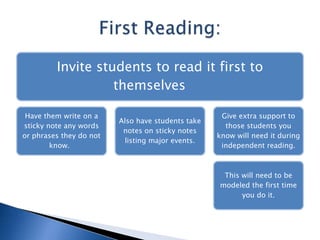
Invite students to read it first to
themselves
Have them write on a
sticky note any words
or phrases they do not
know.

Also have students take
notes on sticky notes
listing major events.

Give extra support to
those students you
know will need it during
independent reading.

This will need to be
modeled the first time
you do it.
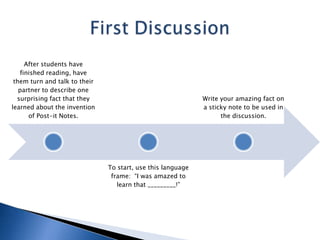
After students have
finished reading, have
them turn and talk to their
partner to describe one
surprising fact that they
learned about the invention
of Post-it Notes.

Write your amazing fact on
a sticky note to be used in
the discussion.

To start, use this language
frame: “I was amazed to
learn that _________!”
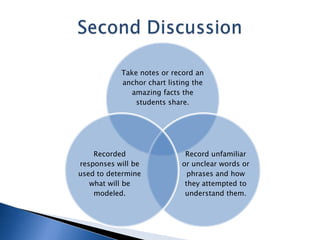
Take notes or record an
anchor chart listing the
amazing facts the
students share.

Recorded
responses will be
used to determine
what will be
modeled.

Record unfamiliar
or unclear words or
phrases and how
they attempted to
understand them.
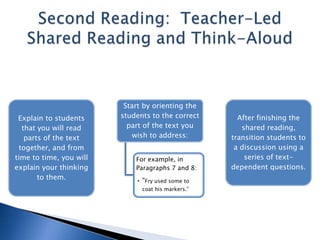
Explain to students
that you will read
parts of the text
together, and from
time to time, you will
explain your thinking
to them.

Start by orienting the
students to the correct
part of the text you
wish to address:
For example, in
Paragraphs 7 and 8:

• “Fry used some to
coat his markers.”

After finishing the
shared reading,
transition students to
a discussion using a
series of textdependent questions.
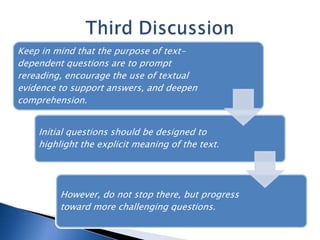
Keep in mind that the purpose of textdependent questions are to prompt
rereading, encourage the use of textual
evidence to support answers, and deepen
comprehension.
Initial questions should be designed to
highlight the explicit meaning of the text.

However, do not stop there, but progress
toward more challenging questions.
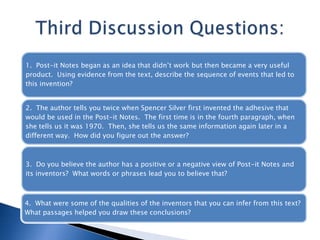
1. Post-it Notes began as an idea that didn’t work but then became a very useful
product. Using evidence from the text, describe the sequence of events that led to
this invention?
2. The author tells you twice when Spencer Silver first invented the adhesive that
would be used in the Post-it Notes. The first time is in the fourth paragraph, when
she tells us it was 1970. Then, she tells us the same information again later in a
different way. How did you figure out the answer?

3. Do you believe the author has a positive or a negative view of Post-it Notes and
its inventors? What words or phrases lead you to believe that?

4. What were some of the qualities of the inventors that you can infer from this text?
What passages helped you draw these conclusions?







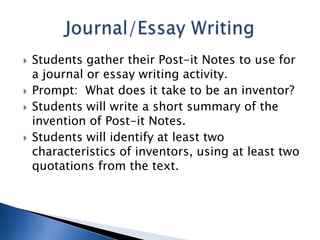
Students gather their Post-it Notes to use for
a journal or essay writing activity.
Prompt: What does it take to be an inventor?
Students will write a short summary of the
invention of Post-it Notes.
Students will identify at least two
characteristics of inventors, using at least two
quotations from the text.











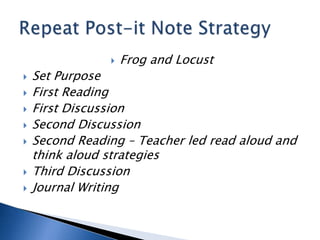
Frog and Locust

Set Purpose
First Reading
First Discussion
Second Discussion
Second Reading – Teacher led read aloud and
think aloud strategies
Third Discussion
Journal Writing




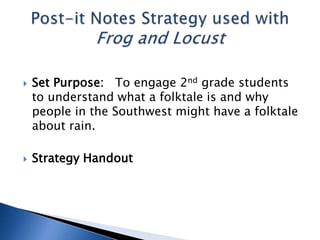
Set Purpose: To engage 2nd grade students
to understand what a folktale is and why
people in the Southwest might have a folktale
about rain.
Strategy Handout
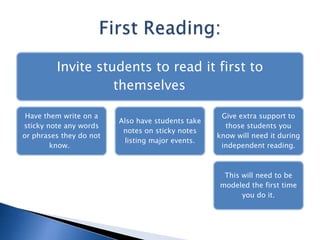
Invite students to read it first to
themselves
Have them write on a
sticky note any words
or phrases they do not
know.

Also have students take
notes on sticky notes
listing major events.

Give extra support to
those students you
know will need it during
independent reading.

This will need to be
modeled the first time
you do it.
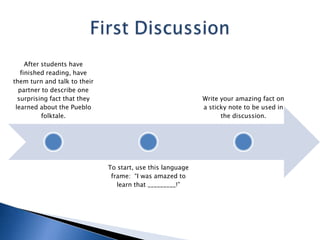
After students have
finished reading, have
them turn and talk to their
partner to describe one
surprising fact that they
learned about the Pueblo
folktale.

Write your amazing fact on
a sticky note to be used in
the discussion.

To start, use this language
frame: “I was amazed to
learn that _________!”
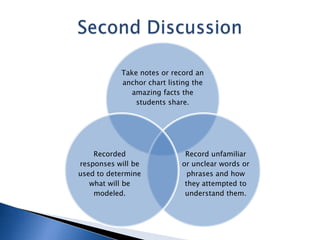
Take notes or record an
anchor chart listing the
amazing facts the
students share.

Recorded
responses will be
used to determine
what will be
modeled.

Record unfamiliar
or unclear words or
phrases and how
they attempted to
understand them.
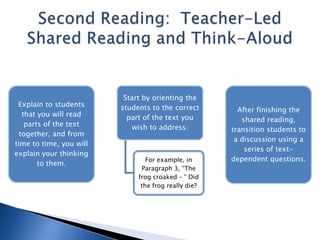
Explain to students
that you will read
parts of the text
together, and from
time to time, you will
explain your thinking
to them.

Start by orienting the
students to the correct
part of the text you
wish to address:

For example, in
Paragraph 3, “The
frog croaked – “ Did
the frog really die?

After finishing the
shared reading,
transition students to
a discussion using a
series of textdependent questions.
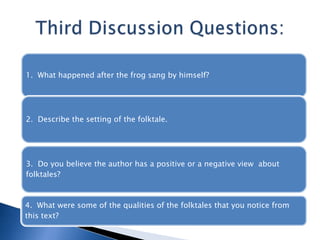
1. What happened after the frog sang by himself?

2. Describe the setting of the folktale.

3. Do you believe the author has a positive or a negative view about
folktales?

4. What were some of the qualities of the folktales that you notice from
this text?








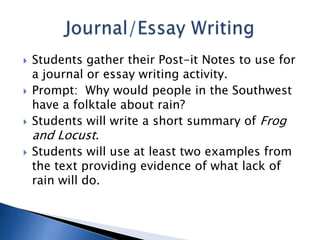
Students gather their Post-it Notes to use for
a journal or essay writing activity.
Prompt: Why would people in the Southwest
have a folktale about rain?
Students will write a short summary of Frog
and Locust.
Students will use at least two examples from
the text providing evidence of what lack of
rain will do.




https://www.teachingchannel.org/videos/enh
ance-student-note-taking (5th grade Brewer)
https://www.teachingchannel.org/videos/stu
dent-annotated-reading-strategy (9th grade)
 Chips

In Activity:

◦ How would you use this strategy in
preparation for a performance-task?
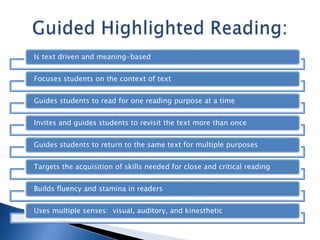
Is text driven and meaning-based
Focuses students on the context of text
Guides students to read for one reading purpose at a time

Invites and guides students to revisit the text more than once
Guides students to return to the same text for multiple purposes
Targets the acquisition of skills needed for close and critical reading
Builds fluency and stamina in readers
Uses multiple senses: visual, auditory, and kinesthetic
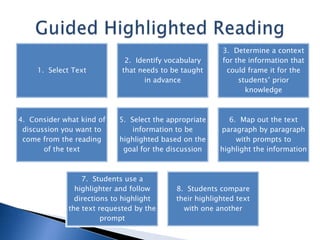
1. Select Text

2. Identify vocabulary
that needs to be taught
in advance

3. Determine a context
for the information that
could frame it for the
students’ prior
knowledge

4. Consider what kind of
discussion you want to
come from the reading
of the text

5. Select the appropriate
information to be
highlighted based on the
goal for the discussion

6. Map out the text
paragraph by paragraph
with prompts to
highlight the information

7. Students use a
highlighter and follow
directions to highlight
the text requested by the
prompt

8. Students compare
their highlighted text
with one another
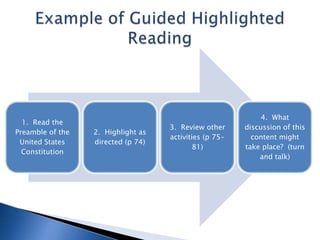
1. Read the
Preamble of the
United States
Constitution

2. Highlight as
directed (p 74)

3. Review other
activities (p 7581)

4. What
discussion of this
content might
take place? (turn
and talk)
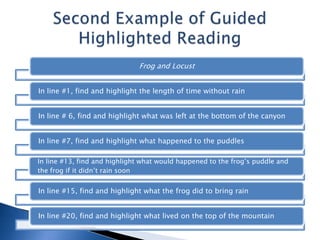
Frog and Locust
In line #1, find and highlight the length of time without rain
In line # 6, find and highlight what was left at the bottom of the canyon
In line #7, find and highlight what happened to the puddles
In line #13, find and highlight what would happened to the frog’s puddle and
the frog if it didn’t rain soon

In line #15, find and highlight what the frog did to bring rain
In line #20, find and highlight what lived on the top of the mountain
 How

would you use this strategy
in preparation for a performancetask?
(Turn and Talk)
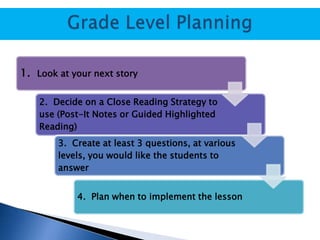
1. Look at your next story
2. Decide on a Close Reading Strategy to
use (Post-It Notes or Guided Highlighted
Reading)
3. Create at least 3 questions, at various
levels, you would like the students to
answer
4. Plan when to implement the lesson
Questioning – part 2

Questioning – part 2

  • 1.
    Jennifer Evans Assistant DirectorELA St. Clair County RESA Evans.jennifer@sccresa.org http://www.protopage.com/evans.jennifer#Untitled/Home
  • 2.
    Danielson Framework Questioning Daily 5 Questioning UsingBloom’s with Close Reading Strategies Close reading Strategies: Post-It Notes and Guided Highlighted Reading Implementing Close Reading Strategies With Current Materials
  • 4.
     Using Questioning andDiscussion Techniques
  • 5.
  • 7.
     Strategy: ◦ Ask QuestionsThroughout the Reading Process (Café) ◦ Think along questioning – example from story “Fire!” comprehension card 21 ◦ Question – Answer – Relationship (QAR) (STARS)  Three Types of Questions: Right There (The answer is in the text, easy to find.) Think and Search (The answer is in the story, but you need to put together different story parts to find it.) On My Own (The answer is not in the story. You use your own experience to answer the question.) - Request, Thick and Thin, Nonfiction, Openended - Socratic Circles http://www.youtube.com/watch?v=YDP75I1b5Do
  • 8.
    The use ofquestioning routines, such as QAR, questioning the author, or Bloom’s, is effective for developing textdependent questions. Regardless of the system used, the questions should be developed in advance of the lesson to ensure that the discussion regularly guides students back to the text. ( p 119 Text Complexity by Douglas Fisher)
  • 9.
  • 10.
    Independent reading ofthe text is supported through a series of instructional moves including: setting the purpose, teacher modeling, guided instruction, group work, and independent tasks.
  • 11.
     Set Purpose: Toengage 4th grade students in a close reading of an excerpt from an informational book on the history of the development of “Post-it Notes.” ◦ Purpose is to discover how a familiar office product was initially thought to be a failure and to trace its development as a useful item.  Strategy Handout
  • 12.
    Invite students toread it first to themselves Have them write on a sticky note any words or phrases they do not know. Also have students take notes on sticky notes listing major events. Give extra support to those students you know will need it during independent reading. This will need to be modeled the first time you do it.
  • 13.
    After students have finishedreading, have them turn and talk to their partner to describe one surprising fact that they learned about the invention of Post-it Notes. Write your amazing fact on a sticky note to be used in the discussion. To start, use this language frame: “I was amazed to learn that _________!”
  • 14.
    Take notes orrecord an anchor chart listing the amazing facts the students share. Recorded responses will be used to determine what will be modeled. Record unfamiliar or unclear words or phrases and how they attempted to understand them.
  • 15.
    Explain to students thatyou will read parts of the text together, and from time to time, you will explain your thinking to them. Start by orienting the students to the correct part of the text you wish to address: For example, in Paragraphs 7 and 8: • “Fry used some to coat his markers.” After finishing the shared reading, transition students to a discussion using a series of textdependent questions.
  • 16.
    Keep in mindthat the purpose of textdependent questions are to prompt rereading, encourage the use of textual evidence to support answers, and deepen comprehension. Initial questions should be designed to highlight the explicit meaning of the text. However, do not stop there, but progress toward more challenging questions.
  • 17.
    1. Post-it Notesbegan as an idea that didn’t work but then became a very useful product. Using evidence from the text, describe the sequence of events that led to this invention? 2. The author tells you twice when Spencer Silver first invented the adhesive that would be used in the Post-it Notes. The first time is in the fourth paragraph, when she tells us it was 1970. Then, she tells us the same information again later in a different way. How did you figure out the answer? 3. Do you believe the author has a positive or a negative view of Post-it Notes and its inventors? What words or phrases lead you to believe that? 4. What were some of the qualities of the inventors that you can infer from this text? What passages helped you draw these conclusions?
  • 18.
        Students gather theirPost-it Notes to use for a journal or essay writing activity. Prompt: What does it take to be an inventor? Students will write a short summary of the invention of Post-it Notes. Students will identify at least two characteristics of inventors, using at least two quotations from the text.
  • 19.
            Frog and Locust SetPurpose First Reading First Discussion Second Discussion Second Reading – Teacher led read aloud and think aloud strategies Third Discussion Journal Writing
  • 20.
      Set Purpose: Toengage 2nd grade students to understand what a folktale is and why people in the Southwest might have a folktale about rain. Strategy Handout
  • 21.
    Invite students toread it first to themselves Have them write on a sticky note any words or phrases they do not know. Also have students take notes on sticky notes listing major events. Give extra support to those students you know will need it during independent reading. This will need to be modeled the first time you do it.
  • 22.
    After students have finishedreading, have them turn and talk to their partner to describe one surprising fact that they learned about the Pueblo folktale. Write your amazing fact on a sticky note to be used in the discussion. To start, use this language frame: “I was amazed to learn that _________!”
  • 23.
    Take notes orrecord an anchor chart listing the amazing facts the students share. Recorded responses will be used to determine what will be modeled. Record unfamiliar or unclear words or phrases and how they attempted to understand them.
  • 24.
    Explain to students thatyou will read parts of the text together, and from time to time, you will explain your thinking to them. Start by orienting the students to the correct part of the text you wish to address: For example, in Paragraph 3, “The frog croaked – “ Did the frog really die? After finishing the shared reading, transition students to a discussion using a series of textdependent questions.
  • 25.
    1. What happenedafter the frog sang by himself? 2. Describe the setting of the folktale. 3. Do you believe the author has a positive or a negative view about folktales? 4. What were some of the qualities of the folktales that you notice from this text?
  • 26.
        Students gather theirPost-it Notes to use for a journal or essay writing activity. Prompt: Why would people in the Southwest have a folktale about rain? Students will write a short summary of Frog and Locust. Students will use at least two examples from the text providing evidence of what lack of rain will do.
  • 27.
      https://www.teachingchannel.org/videos/enh ance-student-note-taking (5th gradeBrewer) https://www.teachingchannel.org/videos/stu dent-annotated-reading-strategy (9th grade)
  • 28.
     Chips In Activity: ◦How would you use this strategy in preparation for a performance-task?
  • 29.
    Is text drivenand meaning-based Focuses students on the context of text Guides students to read for one reading purpose at a time Invites and guides students to revisit the text more than once Guides students to return to the same text for multiple purposes Targets the acquisition of skills needed for close and critical reading Builds fluency and stamina in readers Uses multiple senses: visual, auditory, and kinesthetic
  • 30.
    1. Select Text 2.Identify vocabulary that needs to be taught in advance 3. Determine a context for the information that could frame it for the students’ prior knowledge 4. Consider what kind of discussion you want to come from the reading of the text 5. Select the appropriate information to be highlighted based on the goal for the discussion 6. Map out the text paragraph by paragraph with prompts to highlight the information 7. Students use a highlighter and follow directions to highlight the text requested by the prompt 8. Students compare their highlighted text with one another
  • 31.
    1. Read the Preambleof the United States Constitution 2. Highlight as directed (p 74) 3. Review other activities (p 7581) 4. What discussion of this content might take place? (turn and talk)
  • 32.
    Frog and Locust Inline #1, find and highlight the length of time without rain In line # 6, find and highlight what was left at the bottom of the canyon In line #7, find and highlight what happened to the puddles In line #13, find and highlight what would happened to the frog’s puddle and the frog if it didn’t rain soon In line #15, find and highlight what the frog did to bring rain In line #20, find and highlight what lived on the top of the mountain
  • 33.
     How would youuse this strategy in preparation for a performancetask? (Turn and Talk)
  • 34.
    1. Look atyour next story 2. Decide on a Close Reading Strategy to use (Post-It Notes or Guided Highlighted Reading) 3. Create at least 3 questions, at various levels, you would like the students to answer 4. Plan when to implement the lesson

Editor's Notes

  • #3 Focus on Writing StandardsGive them the Standards bookmarks for their grade level
  • #16 Read think aloud portion on p 125
  • #17 P 125
  • #25 Read think aloud portion on p 125