a skill-building activity designed to
supplement classroom lesson plans
Improving
Listening Skills
Teacher’s Guide
NOTES:
Communication
• Photocopy the activity for your students.
• pen or pencil
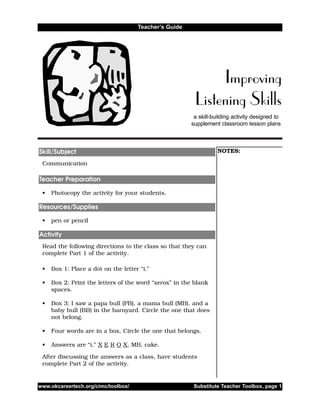
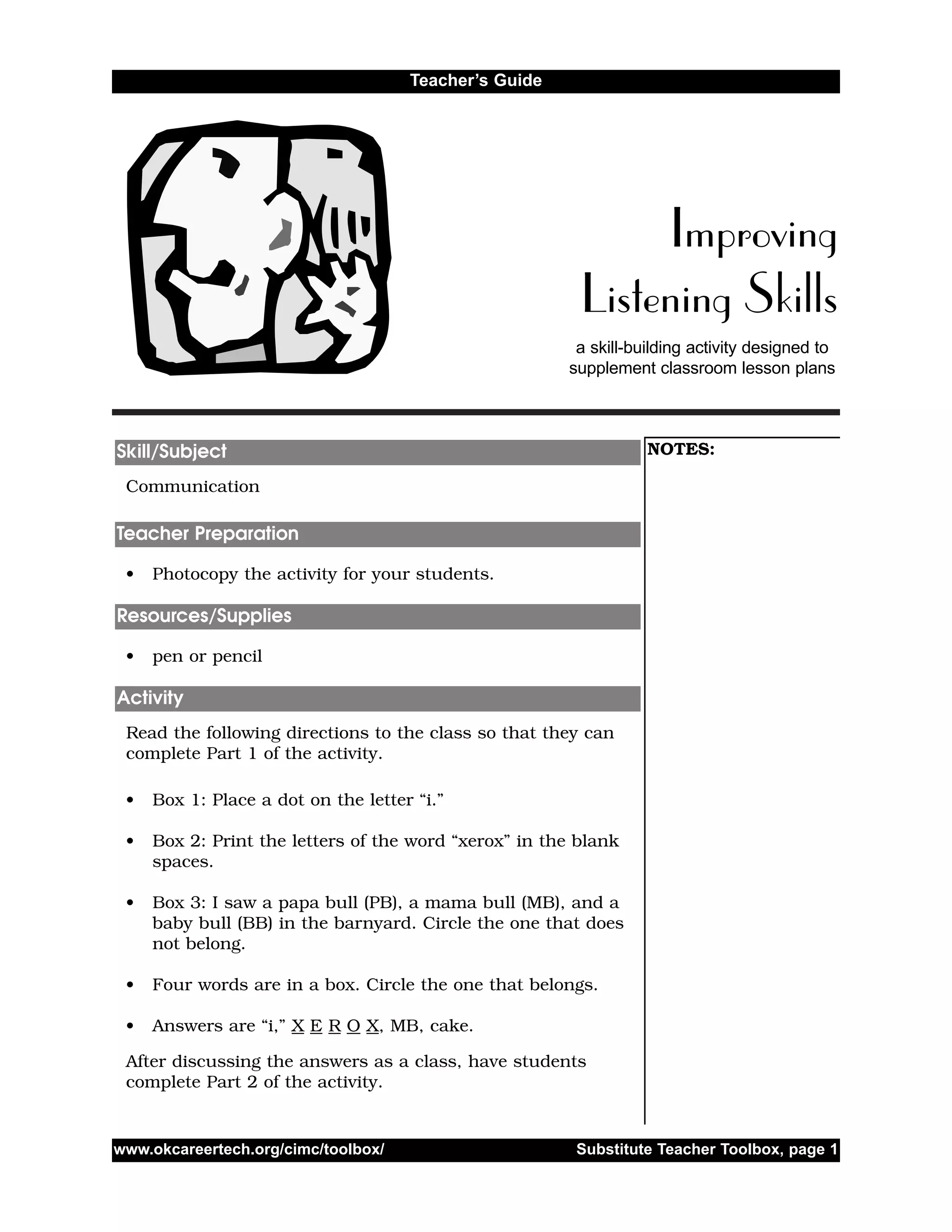
Read the following directions to the class so that they can
complete Part 1 of the activity.
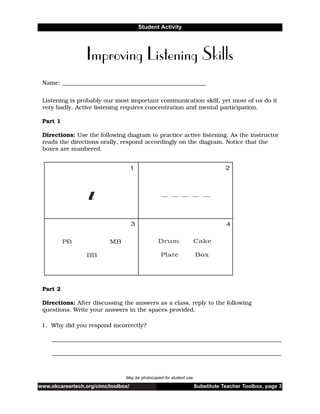
• Box 1: Place a dot on the letter “i.”
• Box 2: Print the letters of the word “xerox” in the blank
spaces.
• Box 3: I saw a papa bull (PB), a mama bull (MB), and a
baby bull (BB) in the barnyard. Circle the one that does
not belong.
• Four words are in a box. Circle the one that belongs.
• Answers are “i,” X E R O X, MB, cake.
After discussing the answers as a class, have students
complete Part 2 of the activity.
Activity
Resources/Supplies
Teacher Preparation
Skill/Subject
www.okcareertech.org/cimc/toolbox/ Substitute Teacher Toolbox, page 1
NOTES:To complete Part 3:
• Divide the students into two groups.
• Have one small group form an inner circle with the
second group becoming an outer circle.
• Ask the students in the inner circle to discuss examples
from their experiences of when “actions spoke louder
than words.”
• While the inner group is discussing, have the outer group
observe the listening skills of inner-circle members.
• Using the rating scale in Part 3 of the activity, have
outer-circle members rate at least three inner-circle
members. (This rating can be done by name or
anonymously, depending on your evaluation of the
group's maturity.)
Students should be assessed on their answers to Part One.
Part Two is for discussion purposes only. There are no right
or wrong answers. Part Three is also for discussion
purposes. Assess students on their involvement in the
discussion.
Assessment
www.okcareertech.org/cimc/toolbox/ Substitute Teacher Toolbox, page 2
www.okcareertech.org/cimc/toolbox/ Substitute Teacher Toolbox, page 3
Student Activity
Improving Listening Skills
May be photocopied for student use.
Name: __________________________________________________
Listening is probably our most important communication skill, yet most of us do it
very badly. Active listening requires concentration and mental participation.
Part 1
Directions: Use the following diagram to practice active listening. As the instructor
reads the directions orally, respond accordingly on the diagram. Notice that the
boxes are numbered.
Part 2
Directions: After discussing the answers as a class, reply to the following
questions. Write your answers in the spaces provided.
1. Why did you respond incorrectly?
________________________________________________________________________________
________________________________________________________________________________
www.okcareertech.org/cimc/toolbox/ Substitute Teacher Toolbox, page 4
May be photocopied for student use.
2. What lesson does your response teach you about becoming a better
communicator?
________________________________________________________________________________
________________________________________________________________________________
3. Does your response prove that directions may be ambiguous and need greater
clarity? How?
________________________________________________________________________________
________________________________________________________________________________
4. How would you have done better if you had asked for clarification of any unclear
portion of the message?
________________________________________________________________________________
________________________________________________________________________________
Part 3
Directions: Follow your instructor's directions, and use this scale to rate the
listening skills of inner-circle members. Use the back of this sheet to record your
ratings.
Rating
1 — Does not listen to the speaker; is absorbed in own thoughts
2 — Contributes to the discussion but gives no indication of having heard others'
comments
3 — Sends nonverbal messages, such as eye contact or a head nod, to show that
what was being said was being heard
4 — Accurately refers to other speaker's comments in making his or her own
statements
5 — Shows by comments that he or she understands the feelings behind others'
comments; responds without judging the others
a skill-building activity designed to
supplement classroom lesson plans
Stranded: Coming to
Consensus
Teacher’s Guide
NOTES:
Communication
• Photocopy the activity for your students.
• You may want to write the list of supplies on the board.
• pen or pencil
Have students read the scenario below and rank the items
they think are most important to carry. After the class has
finished making their choices, divide them into groups of
three for Part 3. After the groups have had time to come to a
consensus, break up the groups for Part 4. Facilitate a large
group discussion about how each of the smaller groups
functioned.
This activity is for student awareness only, and there are no
right or wrong answers. However, you may want to collect
papers to ensure participation.
Assessment
Activity
Resources/Supplies
Teacher Preparation
Skill/Subject
www.okcareertech.org/cimc/toolbox/ Substitute Teacher Toolbox, page 1
NOTES:
www.okcareertech.org/cimc/toolbox/ Substitute Teacher Toolbox, page 2
www.okcareertech.org/cimc/toolbox/ Substitute Teacher Toolbox, page 3
Student Activity
Stranded: Coming to Consensus
May be photocopied for student use.
Name: __________________________________________________
Directions: Read the scenario below and rank the items you think are most
important to carry with you.
Part 1
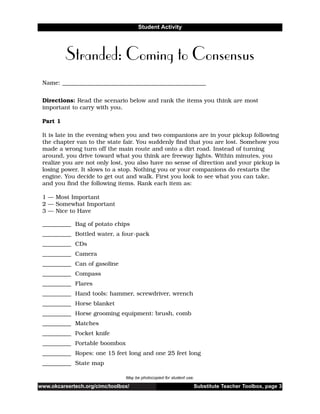
It is late in the evening when you and two companions are in your pickup following
the chapter van to the state fair. You suddenly find that you are lost. Somehow you
made a wrong turn off the main route and onto a dirt road. Instead of turning
around, you drive toward what you think are freeway lights. Within minutes, you
realize you are not only lost, you also have no sense of direction and your pickup is
losing power. It slows to a stop. Nothing you or your companions do restarts the
engine. You decide to get out and walk. First you look to see what you can take,
and you find the following items. Rank each item as:
1 — Most Important
2 — Somewhat Important
3 — Nice to Have
__________ Bag of potato chips
__________ Bottled water, a four-pack
__________ CDs
__________ Camera
__________ Can of gasoline
__________ Compass
__________ Flares
__________ Hand tools: hammer, screwdriver, wrench
__________ Horse blanket
__________ Horse grooming equipment: brush, comb
__________ Matches
__________ Pocket knife
__________ Portable boombox
__________ Ropes: one 15 feet long and one 25 feet long
__________ State map
www.okcareertech.org/cimc/toolbox/ Substitute Teacher Toolbox, page 4
May be photocopied for student use.
Part 2
You can carry only one item. Which items would you most like to take? List your
top three, with A being most important.
A. ________________________________________________________________________________
B. ________________________________________________________________________________
C. ________________________________________________________________________________
Part 3
Working in groups of three, determine as a group the three items your group will
carry. You are committed to the three you chose. But, remember that each person
can take only one item and all three members must agree on the three items. Your
group choices are:
• ________________________________________________________________________________
• ________________________________________________________________________________
• ________________________________________________________________________________
Part 4
Write your personal observations of what occurred in your group.
a skill-building activity designed to
supplement classroom lesson plans
How Well Can You
Follow Directions?
Teacher’s Guide
NOTES:
Communication
• No preparation is necessary for this activity.
• pen or pencil
• paper
Make sure that each student has plenty of paper to use to
manipulate the letters. Read each direction slowly, pausing
between each step. Some students may have difficulty
following along, but do not give them hints as you go. The
lessons learned come from careful listening.
Collect papers at the end of the exercise to ensure that all
students participated.
Holland
Answers
Assessment
Activity
Resources/Supplies
Teacher Preparation
Skill/Subject
www.okcareertech.org/cimc/toolbox/ Substitute Teacher Toolbox, page 1
NOTES:
www.okcareertech.org/cimc/toolbox/ Substitute Teacher Toolbox, page 2
www.okcareertech.org/cimc/toolbox/ Substitute Teacher Toolbox, page 3
Student Activity
How Well Can You Follow Directions?
May be photocopied for student use.
Name: __________________________________________________
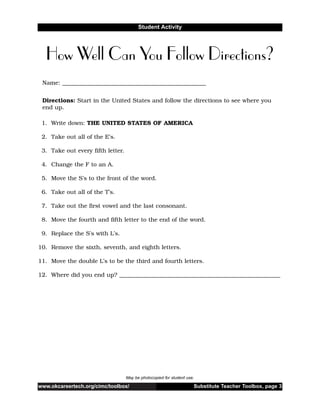
Directions: Start in the United States and follow the directions to see where you
end up.
1. Write down: THE UNITED STATES OF AMERICA
2. Take out all of the E’s.
3. Take out every fifth letter.
4. Change the F to an A.
5. Move the S’s to the front of the word.
6. Take out all of the T’s.
7. Take out the first vowel and the last consonant.
8. Move the fourth and fifth letter to the end of the word.
9. Replace the S’s with L’s.
10. Remove the sixth, seventh, and eighth letters.
11. Move the double L’s to be the third and fourth letters.
12. Where did you end up? ________________________________________________________
www.okcareertech.org/cimc/toolbox/ Substitute Teacher Toolbox, page 4
May be photocopied for student use.

Lesson plan - Listening

  • 1.
    a skill-building activitydesigned to supplement classroom lesson plans Improving Listening Skills Teacher’s Guide NOTES: Communication • Photocopy the activity for your students. • pen or pencil Read the following directions to the class so that they can complete Part 1 of the activity. • Box 1: Place a dot on the letter “i.” • Box 2: Print the letters of the word “xerox” in the blank spaces. • Box 3: I saw a papa bull (PB), a mama bull (MB), and a baby bull (BB) in the barnyard. Circle the one that does not belong. • Four words are in a box. Circle the one that belongs. • Answers are “i,” X E R O X, MB, cake. After discussing the answers as a class, have students complete Part 2 of the activity. Activity Resources/Supplies Teacher Preparation Skill/Subject www.okcareertech.org/cimc/toolbox/ Substitute Teacher Toolbox, page 1
  • 2.
    NOTES:To complete Part3: • Divide the students into two groups. • Have one small group form an inner circle with the second group becoming an outer circle. • Ask the students in the inner circle to discuss examples from their experiences of when “actions spoke louder than words.” • While the inner group is discussing, have the outer group observe the listening skills of inner-circle members. • Using the rating scale in Part 3 of the activity, have outer-circle members rate at least three inner-circle members. (This rating can be done by name or anonymously, depending on your evaluation of the group's maturity.) Students should be assessed on their answers to Part One. Part Two is for discussion purposes only. There are no right or wrong answers. Part Three is also for discussion purposes. Assess students on their involvement in the discussion. Assessment www.okcareertech.org/cimc/toolbox/ Substitute Teacher Toolbox, page 2
  • 3.
    www.okcareertech.org/cimc/toolbox/ Substitute TeacherToolbox, page 3 Student Activity Improving Listening Skills May be photocopied for student use. Name: __________________________________________________ Listening is probably our most important communication skill, yet most of us do it very badly. Active listening requires concentration and mental participation. Part 1 Directions: Use the following diagram to practice active listening. As the instructor reads the directions orally, respond accordingly on the diagram. Notice that the boxes are numbered. Part 2 Directions: After discussing the answers as a class, reply to the following questions. Write your answers in the spaces provided. 1. Why did you respond incorrectly? ________________________________________________________________________________ ________________________________________________________________________________
  • 4.
    www.okcareertech.org/cimc/toolbox/ Substitute TeacherToolbox, page 4 May be photocopied for student use. 2. What lesson does your response teach you about becoming a better communicator? ________________________________________________________________________________ ________________________________________________________________________________ 3. Does your response prove that directions may be ambiguous and need greater clarity? How? ________________________________________________________________________________ ________________________________________________________________________________ 4. How would you have done better if you had asked for clarification of any unclear portion of the message? ________________________________________________________________________________ ________________________________________________________________________________ Part 3 Directions: Follow your instructor's directions, and use this scale to rate the listening skills of inner-circle members. Use the back of this sheet to record your ratings. Rating 1 — Does not listen to the speaker; is absorbed in own thoughts 2 — Contributes to the discussion but gives no indication of having heard others' comments 3 — Sends nonverbal messages, such as eye contact or a head nod, to show that what was being said was being heard 4 — Accurately refers to other speaker's comments in making his or her own statements 5 — Shows by comments that he or she understands the feelings behind others' comments; responds without judging the others
  • 5.
    a skill-building activitydesigned to supplement classroom lesson plans Stranded: Coming to Consensus Teacher’s Guide NOTES: Communication • Photocopy the activity for your students. • You may want to write the list of supplies on the board. • pen or pencil Have students read the scenario below and rank the items they think are most important to carry. After the class has finished making their choices, divide them into groups of three for Part 3. After the groups have had time to come to a consensus, break up the groups for Part 4. Facilitate a large group discussion about how each of the smaller groups functioned. This activity is for student awareness only, and there are no right or wrong answers. However, you may want to collect papers to ensure participation. Assessment Activity Resources/Supplies Teacher Preparation Skill/Subject www.okcareertech.org/cimc/toolbox/ Substitute Teacher Toolbox, page 1
  • 6.
  • 7.
    www.okcareertech.org/cimc/toolbox/ Substitute TeacherToolbox, page 3 Student Activity Stranded: Coming to Consensus May be photocopied for student use. Name: __________________________________________________ Directions: Read the scenario below and rank the items you think are most important to carry with you. Part 1 It is late in the evening when you and two companions are in your pickup following the chapter van to the state fair. You suddenly find that you are lost. Somehow you made a wrong turn off the main route and onto a dirt road. Instead of turning around, you drive toward what you think are freeway lights. Within minutes, you realize you are not only lost, you also have no sense of direction and your pickup is losing power. It slows to a stop. Nothing you or your companions do restarts the engine. You decide to get out and walk. First you look to see what you can take, and you find the following items. Rank each item as: 1 — Most Important 2 — Somewhat Important 3 — Nice to Have __________ Bag of potato chips __________ Bottled water, a four-pack __________ CDs __________ Camera __________ Can of gasoline __________ Compass __________ Flares __________ Hand tools: hammer, screwdriver, wrench __________ Horse blanket __________ Horse grooming equipment: brush, comb __________ Matches __________ Pocket knife __________ Portable boombox __________ Ropes: one 15 feet long and one 25 feet long __________ State map
  • 8.
    www.okcareertech.org/cimc/toolbox/ Substitute TeacherToolbox, page 4 May be photocopied for student use. Part 2 You can carry only one item. Which items would you most like to take? List your top three, with A being most important. A. ________________________________________________________________________________ B. ________________________________________________________________________________ C. ________________________________________________________________________________ Part 3 Working in groups of three, determine as a group the three items your group will carry. You are committed to the three you chose. But, remember that each person can take only one item and all three members must agree on the three items. Your group choices are: • ________________________________________________________________________________ • ________________________________________________________________________________ • ________________________________________________________________________________ Part 4 Write your personal observations of what occurred in your group.
  • 9.
    a skill-building activitydesigned to supplement classroom lesson plans How Well Can You Follow Directions? Teacher’s Guide NOTES: Communication • No preparation is necessary for this activity. • pen or pencil • paper Make sure that each student has plenty of paper to use to manipulate the letters. Read each direction slowly, pausing between each step. Some students may have difficulty following along, but do not give them hints as you go. The lessons learned come from careful listening. Collect papers at the end of the exercise to ensure that all students participated. Holland Answers Assessment Activity Resources/Supplies Teacher Preparation Skill/Subject www.okcareertech.org/cimc/toolbox/ Substitute Teacher Toolbox, page 1
  • 10.
  • 11.
    www.okcareertech.org/cimc/toolbox/ Substitute TeacherToolbox, page 3 Student Activity How Well Can You Follow Directions? May be photocopied for student use. Name: __________________________________________________ Directions: Start in the United States and follow the directions to see where you end up. 1. Write down: THE UNITED STATES OF AMERICA 2. Take out all of the E’s. 3. Take out every fifth letter. 4. Change the F to an A. 5. Move the S’s to the front of the word. 6. Take out all of the T’s. 7. Take out the first vowel and the last consonant. 8. Move the fourth and fifth letter to the end of the word. 9. Replace the S’s with L’s. 10. Remove the sixth, seventh, and eighth letters. 11. Move the double L’s to be the third and fourth letters. 12. Where did you end up? ________________________________________________________
  • 12.
    www.okcareertech.org/cimc/toolbox/ Substitute TeacherToolbox, page 4 May be photocopied for student use.